
Choose an industrial labeling machine by defining the finished package, required accepted output, and operating conditions before comparing equipment. A useful quotation should explain how the proposed system handles your actual bottles and labels, what production rate it can demonstrate, and which options are included. Start with a sample-based specification so that price comparisons refer to the same job.
For a beverage or food manufacturer, labeling affects more than shelf appearance. An unstable application process can interrupt packing, create manual sorting work, and consume labels without producing additional saleable units. The purchasing decision should therefore connect package quality with daily production planning.
What Information Should You Prepare First?
Prepare a product matrix covering the packages you will run at launch and the formats you realistically expect to add. Separate confirmed requirements from possible future projects; otherwise, every speculative bottle can become an expensive design constraint. Identify the format that represents most of your production and the format most likely to cause handling problems.
Record the following for each SKU:
- Container material, dimensions, filled weight, and useful labeling area.
- Round, oval, rectangular, tapered, or otherwise shaped body.
- Label dimensions, material, adhesive, backing liner, and roll direction.
- Intended label position and visual acceptance criteria.
- Expected batch quantity, shift schedule, and changeover frequency.
- Container temperature and surface condition at the labeler entrance.
Photographs are useful for screening, but production samples reveal details that drawings can miss. A molded seam, flexible wall, recessed panel, or slight taper can change the application result. Provide filled or representative weighted containers when stability depends on the product inside.
Which Labeling Technology Fits the Package?
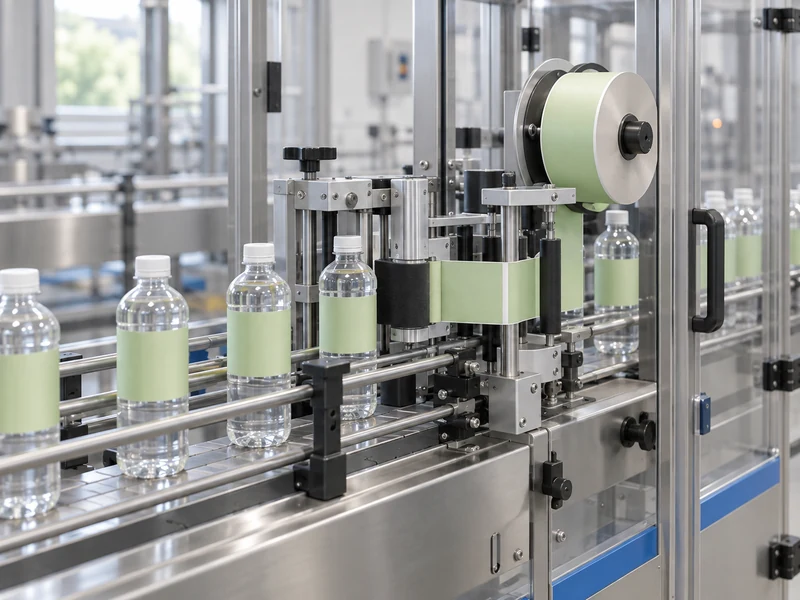
Choose the technology from the decoration requirement and material system. BRENU’s industrial labeling machine range covers self-adhesive, sleeve, and glue-based applications. Treat that range as a starting point for application review rather than evidence that one machine performs every process.
| Application Route | Reason to Consider It | Question to Resolve |
| Pressure-sensitive labels | Separate labels or wraps with frequent artwork changes | Will the adhesive and liner run reliably on the actual package? |
| Shrink sleeves | Decoration extending around a shaped container | Can the sleeve and heat process preserve package and artwork quality? |
| Glue-applied labels | A package designed around a compatible label and adhesive process | What handling, adhesive preparation, and cleaning are required? |
A round body does not automatically require a full wrap, and an oval bottle does not automatically require a sleeve. Decide whether the design needs one panel, separate front and back labels, or coverage around the container. That decision narrows the machinery discussion considerably.
If marketing has not finalized the artwork, agree on a practical decoration envelope first. Keep critical information away from package features that may interfere with application or inspection. A small artwork change can be less costly than a complex mechanical solution.

How Should You Specify Production Capacity?
Specify the quantity of acceptable labeled containers needed over a defined production window. A maximum mechanical speed says little about output when rolls must be replaced, products changed, or containers reworked. Ask suppliers to state the package and label conditions behind every speed commitment.
As a planning example, a shift requiring 36,000 accepted bottles during 360 available production minutes needs an average of 100 accepted bottles per minute. That calculation does not mean a nominal 100-bottle-per-minute machine is sufficient. You still need an agreed allowance for operating losses that are not already excluded from those minutes.
Avoid applying the same loss twice. If the available production window already excludes changeovers, do not subtract those changeovers again in the efficiency assumption. A transparent calculation is more useful than a large but unexplained capacity margin.
For a complete project, map this requirement onto the water bottling process from treatment to packing. The labeler must fit the actual production sequence and discharge conditions. Purchasing extra labeling capacity will not correct a slower downstream packer.
What Does Labeling Accuracy Actually Mean?
Accuracy should be defined against a physical reference and a measurable acceptance rule. Specify vertical location, angular skew, seam relationship, or alignment to a molded feature as separate requirements when relevant. A single tolerance number can conceal very different inspection methods.
Ask where measurements will be taken and how many samples will be assessed. A label may look centered from the front while its trailing edge rises noticeably around the back. Establish whether the acceptance criteria cover the entire label or only its starting position.
Barcode quality also deserves its own check. GS1’s barcode verification guidance distinguishes a structured quality assessment from simply confirming that a scanner reads a sample. Decide with your packaging team what verification evidence is appropriate for the finished pack.
Do not ask a labeler to compensate for unlimited variation in bottles or printed rolls. Define incoming material limits and retain approved reference samples. When both parties know the permitted variation, failures are easier to investigate without guesswork.
Which Integration Details Can Change the Quotation?
Conveyor height, travel direction, available floor space, and upstream discharge behavior should be included from the beginning. Also identify who supplies product spacing, accumulation, inspection, and rejected-product handling. Items left between supplier scopes often become commissioning problems.
If filling and capping are part of the purchase, discuss the interface with the monoblock filling machine at the same time. A compact machine layout is only useful if operators can access reels, adjustment points, and service areas. Include those access zones in the drawing.
The downstream package format matters as well. BRENU’s discussion of shrink wrapping versus carton packing provides context for that decision. Confirm how labeled containers are accumulated and transferred before committing to a line arrangement.
What Should a Supplier Demonstration Prove?
A useful demonstration should include your demanding formats, normal operating speed, and routine interruptions. Request a written test sequence before sending samples. Otherwise, a short video may show a polished run without answering the questions that determine daily output.
Ask the supplier to demonstrate:
- Feeding and stabilizing the smallest and least stable agreed containers.
- Running production labels at the specified rate.
- Stopping and restarting without losing acceptable positioning.
- Changing between two representative formats.
- Detecting agreed faults and managing affected containers.
- Recording accepted output, rejects, and intervention time.
Use a test duration and sample quantity that reflect the purchasing risk. There is no universal demonstration length that proves every machine. A highly varied product range requires more evidence than one stable container used continuously.
Make the result reviewable by saving the setup, material identifiers, and acceptance record. If a supplier substitutes an easier label stock or container, record that limitation explicitly. A successful test on a substitute is useful information, but it is not the same as qualification of your production materials.
Which Quotation Details Make Offers Comparable?
Put the proposed equipment, included services, and operating conditions in a side-by-side scope sheet so that each price refers to a clearly defined labeling job. List tooling, inspection, installation, operator training, recommended spares, and acceptance testing as separate items. Clarify any exclusions involving freight, utilities, taxes, or site preparation.
For investment planning, the broader logic in calculating bottling-line ROI helps connect capital expenditure to useful output. Apply your own labor rates, material costs, and demand assumptions to the labeling station. Do not convert a supplier’s theoretical speed into guaranteed sales.
Ask about the handover package as carefully as the machine hardware. You need operating instructions, a parts list, setup records, and a clear route for technical questions. Support promises are easier to assess when response channels and included services are written down.
How Much Flexibility Is Worth Buying Now?
Buy flexibility for a defined set of likely formats rather than an unlimited promise of future compatibility. Ask which new sizes can be accommodated through normal adjustment and which require tooling, a different applicator, or engineering work. This distinction makes an upgrade statement commercially useful.
An illustrative manufacturer may launch with two round bottles and consider an oval bottle for a later product. The current round-bottle requirement can be tested immediately, while the oval project remains conditional until its dimensions and artwork are settled. Request a separately identified future option instead of assuming the launch configuration already covers it.
Consider who will perform later format qualification and how the setup information will be delivered. An inexpensive change part has limited value if its introduction requires an unplanned installation visit. Include expected lead time, training needs, and the evidence required before a new format enters routine production.
What Should You Send With Your Inquiry?
Send your product matrix, container and label samples, line layout, output requirement, and draft acceptance criteria. Include photographs of the current installation if the new labeler will join an existing line. Explain the problem you most need the investment to solve, whether that is labor, placement quality, capacity, or changeover time.
Ask BRENU to identify the proposed configuration, package-specific performance conditions, and any tests still required. Keep unresolved items visible in the quotation review instead of turning assumptions into purchase requirements by accident. The strongest choice is the machine whose agreed operating conditions match your production reality and whose performance can be demonstrated before final acceptance.