
Packing plays a key role before bottled water leaves the production line. It affects product appearance, transportation safety, labor cost, storage efficiency, and even how consumers perceive the brand.
For bottled water, two common secondary packaging methods are shrink wrapping and carton packing. Shrink wrapping uses plastic film to hold bottles together, while carton packing places bottles inside corrugated boxes. Both options are common, but each fits different production needs.
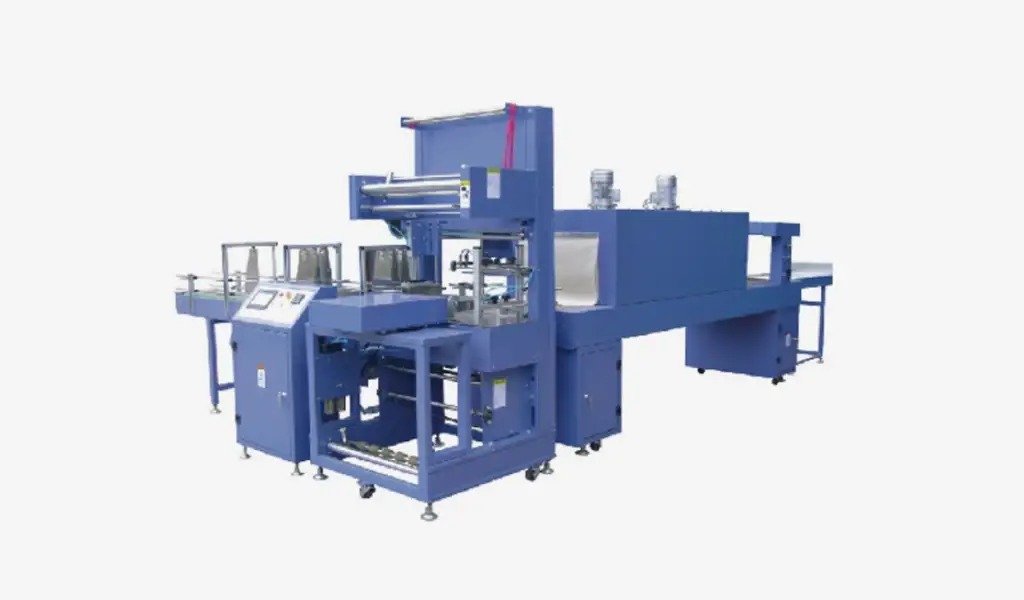
What Is Shrink Wrapping for Bottled Water?
Shrink wrapping is a packaging method that groups bottled water with heat-shrink film. The bottles are arranged into a fixed format, wrapped with film, and then passed through a heat shrink tunnel. The film tightens around the bottles and forms a compact bundle.
Common shrink pack formats include:
- 6 bottles per pack
- 12 bottles per pack
- 24 bottles per pack
- 4 × 6 arrangement for 500ml water
- 3 × 4 arrangement for larger bottles
Shrink wrapping is often used for supermarket bottled water, wholesale packs, convenience store bundles, and local distribution. It is suitable for high-speed bottled water lines because the packing process can be automated.
The biggest advantage is material efficiency. Compared with cartons, shrink film uses less packaging material and occupies less warehouse space before use. It suits factories seeking simple, fast, cost-efficient packing.
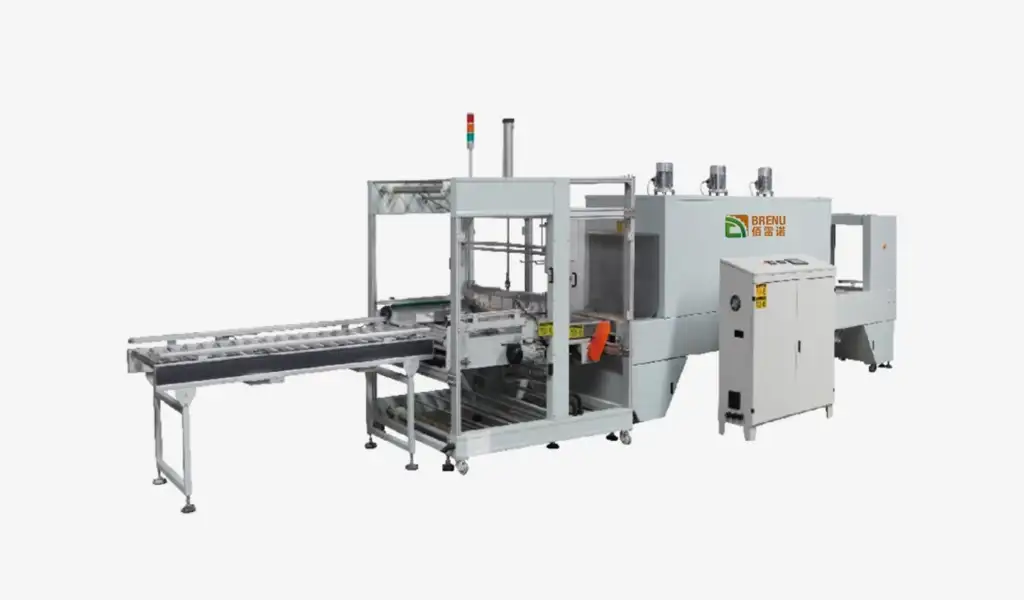
What Is Carton Packing for Bottled Water?
Carton packing uses corrugated cardboard boxes to hold bottled water. Bottles are loaded into cartons manually or automatically, then the box is sealed with tape, glue, or hot melt adhesive.
Carton packing is commonly used for:
- Premium bottled water
- Export bottled water
- Long-distance transportation
- E-commerce delivery
- Large bottles or glass bottled water
- Private label water brands
Cartons provide better protection against impact, compression, dust, and sunlight. Cartons provide ample space for branding, barcodes, handling marks, and product details.
Compared with shrink wrapping, carton packing usually costs more. However, it can reduce bottle deformation, label scratching, and product damage during complex logistics.
Shrink Wrapping vs Carton Packing: Quick Comparison
| Packing Method | Main Material | Best For | Protection Level | Cost Level | Branding Space |
| Shrink Wrapping | PE shrink film | Local retail, wholesale bundles, high-speed lines | Medium | Low | Limited |
| Carton Packing | Corrugated carton | Export, e-commerce, premium water, long-distance shipping | High | Medium to high | Large |
| Shrink Tray + Film | Cardboard tray + shrink film | Better stacking and display | Medium to high | Medium | Moderate |
| Carton with Dividers | Carton + internal partition | Glass bottles or premium water | Very high | High | Large |
Shrink wrapping is usually better when the goal is speed and lower cost. Carton packing is more suitable when the product needs stronger protection and a more complete brand presentation.
Shrink Wrapping vs Carton Packing Cost
Packaging cost is one of the main reasons factories compare these two methods. In general, shrink film is cheaper than corrugated cartons, especially for standard PET bottled water.
The following data shows typical estimated packaging material consumption for 24 bottles of 500ml water. Actual costs vary by material thickness, local prices, carton grade, printing, labor, and line speed.
| Item | Shrink Wrapping | Carton Packing |
| Typical material per 24-bottle pack | 35–55g PE film | 180–300g corrugated board |
| Estimated material cost per pack | Lower | 2–4 times higher |
| Storage space for empty materials | Small | Larger |
| Labor demand | Low with automation | Medium, unless fully automated |
| Printing cost | Lower, limited print area | Higher, more printable area |
| Best cost scenario | High-volume local sales | Premium or export sales |
Shrink wrapping can help reduce packaging material cost, especially when the product is sold in bulk. However, carton packing may save money in another way by reducing damage during transport.
For example, if bottled water is transported across a short distance, shrink packs may be enough. But for cross-border shipping, stacked pallets, or mixed-container loading, cartons may prevent greater losses.
Protection During Transportation
Transportation conditions have a major influence on packaging choice. Bottled water may experience vibration, compression, loading pressure, humidity, and rough handling before reaching the customer.
Shrink wrapping holds bottles together tightly, but the sides and top remain exposed. PET bottles may be squeezed if the pallet is stacked too high or handled roughly. Labels can also rub against other packs during transport.
Cartons provide a protective outer layer. The corrugated board absorbs part of the impact and helps keep the bottles clean. This is especially useful when water is shipped through long logistics chains.
For glass bottled water, carton packing is usually the safer choice. Internal dividers or molded pulp inserts can be added to prevent bottle-to-bottle collision.
Packing Speed and Automation
Shrink wrapping is often chosen for high-speed bottled water production lines. A shrink wrapping machine can connect directly with the filling, capping, labeling, and conveying system. Bottles enter the packing section continuously, and finished packs come out ready for palletizing.
Carton packing can also be automated, but the system is usually more complex. It may require carton forming, bottle loading, flap folding, sealing, coding, and inspection. The investment cost is higher than a basic shrink wrapping system.
Typical line speed comparison:
| Packing System | Typical Speed Range | Automation Level | Suitable Production Scale |
| Semi-automatic shrink wrapping | 6–12 packs/min | Medium | Small to medium plants |
| Automatic shrink wrapping | 15–35 packs/min | High | Medium to large lines |
| Semi-automatic carton packing | 4–10 cartons/min | Medium | Small batch or premium products |
| Automatic carton packing | 10–25 cartons/min | High | Large plants, export production |
For a standard bottled water line, shrink wrapping is often easier to integrate. It requires fewer packing materials, fewer forming steps, and a simpler machine layout.
Carton packing is more suitable when product protection and presentation are more important than maximum packing speed.
Shelf Display and Consumer Experience
Shrink packs are easy for customers to recognize. Consumers can see the bottles directly, which is useful for retail display. Clear film also helps show bottle shape, water clarity, label design, and cap color.
For everyday bottled water, this direct visibility can be an advantage. Shoppers can quickly identify the product and pack size.
Cartons create a different impression. They make the product look more organized and protected, especially for premium bottled water or gift-style packaging. Printed cartons can carry brand stories, water source information, sustainability messages, QR codes, and handling instructions.
In retail channels, cartons are also easier to stack neatly. However, consumers cannot see the bottles unless the carton has a window or open-top display structure.
Environmental Considerations
Both shrink wrapping and carton packing have environmental advantages and challenges.
Shrink wrapping uses less material by weight, but it is usually made from plastic film. Recycling depends on local collection systems and film quality. Contaminated or mixed thin film is harder to collect and recycle.
Carton packing uses paper-based material, which is widely recyclable in many markets. However, cartons require more material by weight and may increase transport volume before use. If the carton has heavy ink coverage, coating, lamination, or plastic windows, recyclability may be affected.
A balanced solution is shrink tray packing. This method uses a cardboard tray with shrink film. It improves stacking strength while using less board than a full carton.
For brands that care about sustainability, the best choice is not always one material over another. The real focus should be total material use, recycling availability, product damage rate, and logistics efficiency.
Space Efficiency in Storage and Shipping
Shrink film rolls take up less storage space than flat cartons. This helps factories reduce warehouse pressure, especially when production volume is high.
Shrink-packed bottled water also has a compact appearance. The film fits closely around the bottles, reducing unnecessary packaging volume.
Cartons need more storage space before use and create a larger packed unit. However, they are more stable during pallet stacking. This can improve container loading safety and reduce collapse risk during transport.
For local distribution, shrink wrapping is often space-efficient enough. For export shipments, cartons may provide better pallet stability and lower damage risk.
Branding and Printing Options
Shrink film can be printed, but the print area is limited and may distort after shrinking. Many bottled water brands use transparent film to keep costs low and show the product directly.
Cartons offer much stronger branding possibilities. The outer box can be printed with logos, product details, water source claims, color blocks, retail codes, and promotional messages.
This matters for private label bottled water, hotel water supply, premium mineral water, and export brands. A well-designed carton can improve shelf presence and make the product easier to identify in warehouses.
If the brand sells mainly through supermarkets and wholesalers, shrink wrapping may be enough. If the product needs stronger brand communication, carton packing has more advantages.
Machine Investment and Maintenance
A shrink wrapping machine is generally simpler than a full carton packing system. It includes film feeding, sealing, cutting, heat shrinking, and cooling. Maintenance mainly focuses on sealing blades, film rollers, tunnel temperature, conveyor belts, and electrical components.
Carton packing equipment may include carton erectors, loading units, flap folders, sealing machines, and coding systems. More machine sections mean more maintenance points.
For small and medium bottled water plants, shrink wrapping is easier to operate and maintain. For large plants with stable orders, carton packing automation can still be worthwhile because it supports professional logistics and premium market positioning.
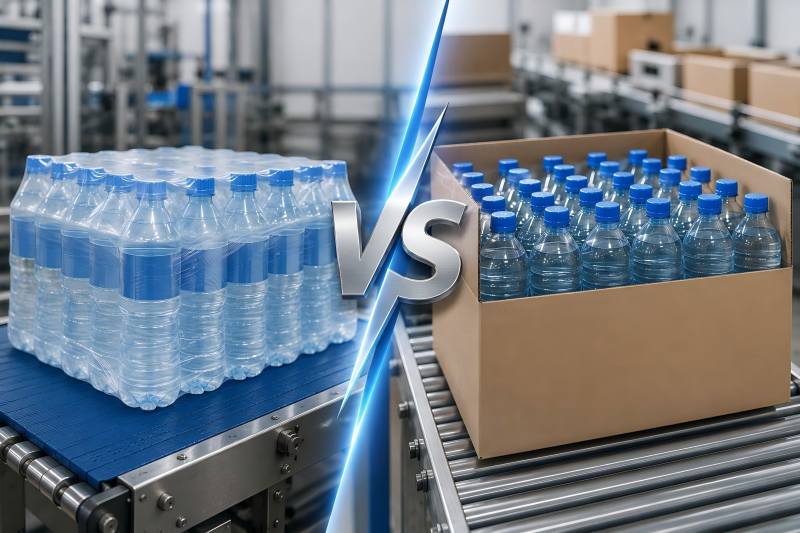
When Should You Choose Shrink Wrapping?
Shrink wrapping is a good choice when the product is sold in high volume and transported over short or medium distances.
It is especially suitable for:
- Standard PET bottled water
- Local retail and wholesale channels
- Cost-sensitive products
- High-speed production lines
- Clear product display
- Simple palletizing needs
- Supermarket bundle packs
Shrink wrapping helps reduce packaging cost and supports efficient production. For many bottled water factories, it is the most practical option for daily output.
When Should You Choose Carton Packing?
Carton packing is better when bottled water needs stronger protection or a more premium image.
It is suitable for:
- Export bottled water
- Glass bottled water
- E-commerce delivery
- Long-distance logistics
- Premium mineral water
- Private label water
- Branded retail packaging
- Mixed bottle sizes or special bottle shapes
Cartons reduce exposure to dust, sunlight, and external impact. They also make the product easier to manage during shipping, storage, and brand promotion.
Can Both Methods Be Used Together?
Yes. Some bottled water lines use a combination of shrink wrapping and carton packing.
For example, bottles can first be shrink-wrapped into small bundles, then placed into cartons for export. Another common method is tray shrink packing, where bottles sit in a cardboard tray and are wrapped with film.
This combined solution improves stability while controlling material cost. It is useful when the brand needs both visibility and stronger transport protection.