
A complete water bottling line is not only a filling machine. It is a connected production system that starts with raw water control and ends with packed bottles ready for storage, shipment, and retail display.
For bottled water factories, the key goals are stable water quality, hygienic production, accurate filling, clean packaging, and traceable batches. A well-designed water bottling line should match the water source, bottle size, production capacity, local regulations, and target market.
Overall Water Bottling Line Process
A standard water bottling process includes water intake, pretreatment, fine purification, disinfection, bottle preparation, rinsing, filling, capping, labeling, coding, packing, and palletizing.
Different factories may use spring water, well water, municipal water, or purified water as the source. The process design depends on the original water quality and the required finished product standard.
| Process Stage | Main Equipment | Purpose | Common Control Point |
| Raw water intake | Raw water tank, feed pump | Store and feed source water | Source water quality, flow stability |
| Pretreatment | Sand filter, carbon filter, softener | Remove particles, odor, chlorine, hardness | Turbidity, odor, pressure drop |
| Fine treatment | Cartridge filter, UF, RO, mineral dosing | Improve purity and adjust water taste | TDS, conductivity, membrane pressure |
| Disinfection | UV sterilizer, ozone system | Control microorganisms | Ozone level, UV intensity |
| Product water storage | Sanitary water tank | Hold treated water before filling | Tank hygiene, vent filter |
| Bottle preparation | Bottle blower or bottle unscrambler | Supply clean empty bottles | Bottle shape, bottle cleanliness |
| Rinsing-filling-capping | Monoblock filling machine | Rinse, fill, and seal bottles | Fill level, cap torque, leakage |
| Labeling and coding | Labeling machine, date coder | Add brand label and traceability code | Label position, code clarity |
| Packing | Shrink wrapper, carton packer, palletizer | Prepare for transport and storage | Pack strength, carton count |
Regulatory systems also treat bottled water as a food product. Codex defines bottled or packaged drinking water as water filled into sealed containers and suitable for direct consumption without further treatment.
Raw Water Intake and Source Control
The first step is source water control. A bottling plant should not design the treatment system before testing the source water. Testing helps confirm whether the line needs simple filtration, reverse osmosis, softening, activated carbon, UV, ozone, or mineral adjustment.
Common source water options include:
- Municipal water
- Deep well water
- Spring water
- Surface water
- Treated bulk water
Source water should be protected from pollution risks such as wastewater, chemicals, septic tanks, industrial ponds, pesticides, hydrocarbons, and other possible contaminants. Codex recommends using hydrogeological data to understand the watershed and protection area around the water source.
For ground water, regular testing should confirm biological, chemical, physical, and where necessary radiological stability. Codex also states that production should stop when contamination is detected until the water returns to established parameters.
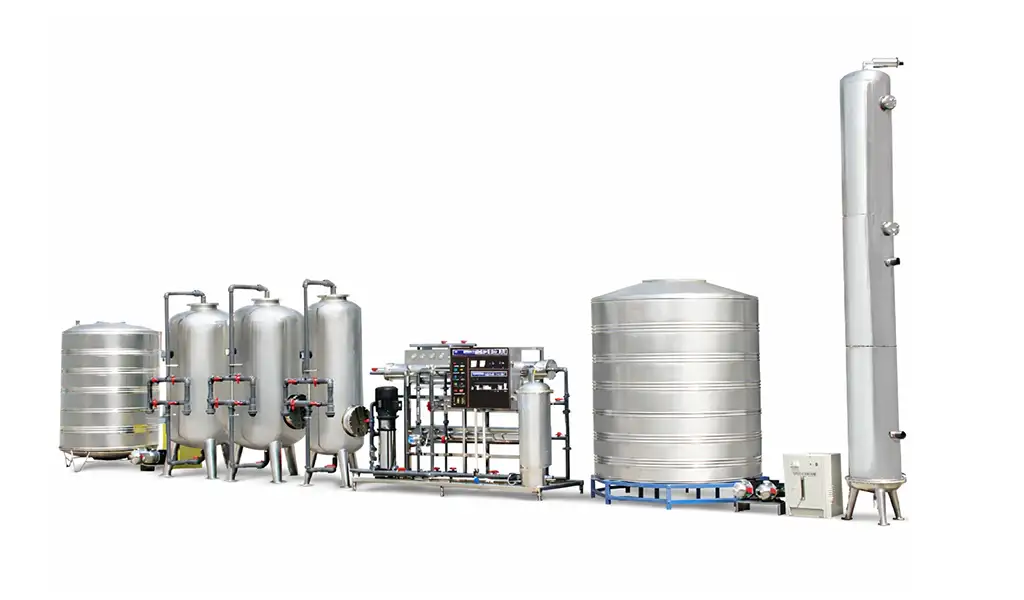
Pretreatment Before Purification
Pretreatment protects the downstream equipment and improves water stability. Without good pretreatment, RO membranes, UV lamps, ozone contact systems, and filling valves may face scaling, fouling, or microbial risk.
1. Multimedia Sand Filter
The sand filter removes visible particles, suspended solids, and part of the turbidity. It is often the first filtration step after the raw water tank.
Install pressure gauges at both the filter inlet and outlet. When the pressure difference increases, the filter should be backwashed to restore flow.
2. Activated Carbon Filter
Activated carbon filtration reduces odors, color, organic compounds, and residual chlorine. It is especially useful when municipal water is used as the source.
Residual chlorine can damage RO membranes, so carbon filtration is important before reverse osmosis. The carbon bed also needs regular backwashing and replacement planning.
3. Softener or Antiscalant System
When source water has high hardness, a softener or antiscalant dosing system helps reduce scaling. This protects RO membranes, heaters, pipelines, and filling equipment.
For high-hardness water, pretreatment design should be based on calcium, magnesium, alkalinity, silica, and total dissolved solids.
Fine Purification: UF, RO, and Mineral Adjustment
The fine treatment section decides the final water type. A purified water line usually uses reverse osmosis, while a mineral water line may keep natural minerals and use lighter filtration.
| Treatment Option | Main Function | Suitable Water Type | Typical Use in Bottling Line |
| Cartridge filtration | Fine particle removal | Most water sources | Final protection before UF, RO, or filling |
| Ultrafiltration | Removes fine suspended matter and microorganisms | Spring water, well water, pretreatment water | Improves clarity and microbial control |
| Reverse osmosis | Reduces dissolved salts and impurities | Purified bottled water | Produces low-TDS water |
| Mineral dosing | Adjusts taste and mineral profile | Purified water | Adds controlled minerals after RO |
| UV sterilization | Microbial control without chemical residue | Most bottled water lines | Before tank or before filling |
| Ozone treatment | Disinfection and residual protection | Purified water, drinking water | Product water tank and filling loop |
Reverse osmosis is commonly used when the buyer wants purified water with low TDS. The system usually includes a high-pressure pump, RO membrane housing, conductivity meter, reject water outlet, and automatic flushing.
For mineral water, the goal is different. The line should preserve the stable mineral profile while still controlling particles and microorganisms. In this case, the treatment process may use filtration, UV, ozone, and sanitary storage instead of heavy desalination.
Disinfection and Product Water Storage
After purification, the water enters the disinfection and storage stage. This section is critical because treated water can be re-contaminated if tanks, pipes, valves, vents, or filling equipment are not sanitary.
Common disinfection methods include UV and ozone. UV is often used for instant microbial control, while ozone can provide stronger disinfection in the product water tank and circulation loop.
The product water tank should usually be made from food-grade stainless steel. It should have a sanitary manhole, spray ball, sterile air vent, level sensor, smooth welding, and drainable bottom design.
Dead corners should be avoided. Water should not remain stagnant in pipes, hoses, or valve pockets, because stagnant water can increase microbial risk.
Bottle Supply: Blow Molding or Bottle Unscrambling
The next stage is bottle supply. For PET bottled water, factories can choose either pre-made bottles or in-house bottle blowing.
Small lines often use pre-made bottles and a bottle unscrambler. Medium and high-speed lines often use PET preforms and an automatic blow molding machine.
| Bottle Supply Method | Advantages | Best For | Buyer Focus |
| Pre-made bottles | Simple start, lower equipment cost | Small and medium lines | Bottle storage, transport cost, bottle cleanliness |
| Automatic bottle blowing | Saves bottle transport space, supports custom bottle shape | Medium and large lines | Air compressor, mold quality, preform heating |
| Integrated blowing-filling-capping | Compact layout, less bottle handling | High-speed water plants | Higher investment, stronger technical support |
Bottle quality affects the whole filling process. Poor bottle roundness, unstable neck size, weak base design, or thin bottle walls can cause rinsing problems, filling instability, cap leakage, and poor labeling results.
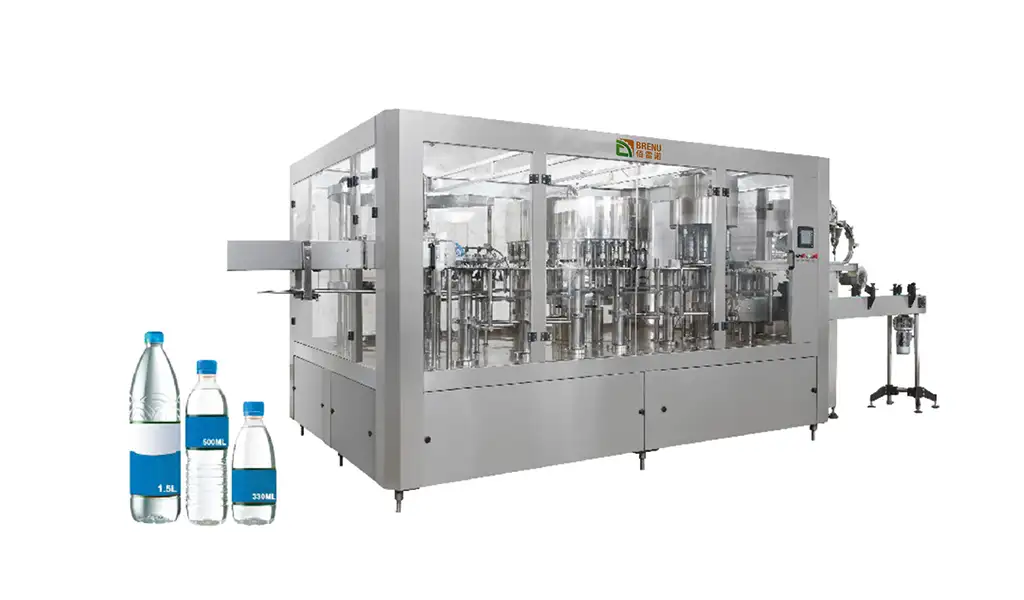
Bottle Rinsing Before Filling
Before filling, empty bottles should be rinsed to remove dust, particles, or possible contamination from storage and handling.
In a typical water filling monoblock, bottles enter the rinser, are clamped by the neck, inverted, rinsed with clean water or disinfected water, drained, and then transferred to the filling section.
The rinsing process should be matched with bottle size. A 330 ml bottle and a 1.5 L bottle may need different rinsing time, nozzle angle, and drainage design.
For hygienic production, the rinsing water quality should be controlled. The final rinse should not introduce new contamination into the bottle.
Filling and Capping
The rinsing-filling-capping machine is the core of the water bottling line. It is usually designed as a monoblock system to reduce bottle transfer distance and improve hygiene.
For still water, gravity filling or normal-pressure filling is commonly used. For sparkling water, the filling system needs pressure control to protect carbonation.
During filling, the machine must maintain stable fill level, smooth bottle movement, and clean water contact surfaces. Filling valves should be easy to clean and made from suitable food-contact materials.
Capping comes immediately after filling. The cap sorter sends caps into the capping head, and the system applies controlled torque to seal the bottle.
Important filling and capping checks include:
- Fill level accuracy
- Cap torque
- Bottle leakage
- Neck finish condition
- Bottle deformation
- Foreign matter inspection
- Production code clarity
FDA rules state that filling, capping, and sealing performance should be monitored, and filled containers should be visually or electronically inspected to confirm they are sound, properly sealed, coded, and labeled. Unsatisfactory containers should be rejected or reprocessed.
Labeling, Coding, and Visual Inspection
After capping, bottles pass through inspection and labeling. The line may use self-adhesive labels, shrink sleeve labels, hot melt BOPP labels, or wrap-around labels.
The right labeling method depends on bottle shape, bottle material, label material, production speed, and brand design. Round bottles are easier to label, while square, flat, or irregular bottles require more careful positioning.
Coding is also important for traceability. A standard code may include production date, batch number, line number, and expiration date.
Each bottle pack should show a batch code and production date, while the plant keeps records of product type, output volume, lot number, and distribution details.
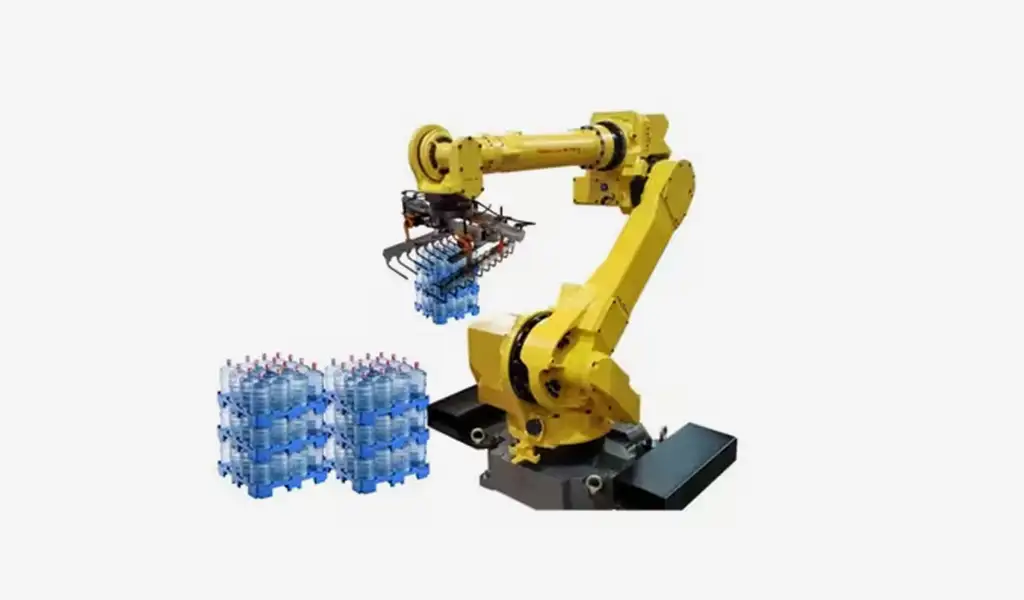
Packing and Palletizing
Packing protects bottled water during storage and transport. The most common packing methods are shrink film packing, carton packing, tray shrink packing, and pallet wrapping.
Small bottles are often packed as 12, 15, 20, or 24 bottles per pack. Large bottles may use fewer bottles per carton or shrink bundle.
| Bottle Size | Common Pack Format | Typical Line Capacity Range | Packing Focus |
| 330 ml | 24 bottles/shrink pack | 3,000–24,000 BPH | Fast counting, stable shrink tunnel |
| 500 ml | 12 or 24 bottles/pack | 3,000–36,000 BPH | Pack tightness, label protection |
| 1 L | 12 bottles/pack | 2,000–18,000 BPH | Bottle stability, film strength |
| 1.5 L | 6 or 12 bottles/pack | 2,000–12,000 BPH | Strong bottom support |
| 5 L | Carton or handle pack | 600–3,000 BPH | Weight handling, carton strength |
| 5 gallon | Single bottle handling | 100–2,000 BPH | Washing, cap sealing, reuse control |
These capacity ranges are common planning references. Final output depends on bottle size, filling valve number, machine configuration, operator skill, packing format, and factory layout.
Palletizing options include manual, semi-automatic, and automatic systems. For large output, automatic palletizing reduces labor pressure and improves pallet consistency.
Hygiene Clauses for a Water Bottling Line
Hygiene should be written into the equipment specification, factory layout, operation procedure, and purchase contract. Hygiene requirements should be clearly specified.
FDA CGMP requires bottling areas to be isolated from storage and other operations with sealed walls, ceilings, and self-closing doors. They also require ventilation to reduce condensation and require container washing and sanitizing to be arranged in a way that reduces post-sanitizing contamination.
| Hygiene Clause | Practical Requirement | Data or Reference Point |
| Approved water source | Product water and operations water should come from approved, protected, sanitary sources | FDA requires approved source water and sanitary quality control |
| Bottling room separation | Filling area should be separated from storage and other plant operations | Tight walls, ceilings, self-closing doors |
| Sanitary contact surfaces | Tanks, pipes, fillers, and caps in contact with water should be cleanable and non-toxic | Product water-contact surfaces must be clean and sanitized |
| Container and cap control | Bottles and caps should be stored in clean, dry, sanitary conditions | Containers and closures should be inspected before use |
| Cleaning records | CIP, sanitation, inspection, and test records should be kept | FDA requires records for inspections, sanitation, testing, and production |
| Heat sanitizing | Hot water or steam can be used for enclosed systems | At least 170°F for 15 min or 200°F for 5 min under FDA minimums |
| Chemical sanitizing | Chemical sanitizers should reach equivalent bactericidal action | Equivalent to 50 ppm available chlorine for 2 min at 57°F for immersion/circulation |
| Ozone sanitizing | Ozone water can be used in enclosed systems | 0.1 ppm ozone water solution for at least 5 min under FDA minimums |
| Final product testing | Finished bottled water should be tested regularly | FDA calls for at least weekly total coliform testing and annual chemical, physical, and radiological testing |
The FDA also requires source water testing from each source at minimum frequencies for chemical contaminants, radiological contaminants, and total coliform when the source is not a public water system.
Quality Control During Production
Quality control should cover both water quality and package quality. Many problems do not appear as machine failures at first. They appear as unstable taste, microbial risk, leaking bottles, poor label position, damaged packs, or unclear batch codes.
A practical QC plan should include:
- Raw water testing
- Treated water conductivity or TDS
- Turbidity
- Ozone concentration
- UV lamp status
- Microbiological testing
- Bottle and cap inspection
- Fill level checking
- Cap torque testing
- Leak testing
- Label position checking
- Date code checking
- Finished pack drop and compression review
EPA drinking water rules for filtration include turbidity limits for public systems using conventional or direct filtration, with turbidity not higher than 1 NTU and no more than 0.3 NTU in at least 95% of monthly samples. While bottled water plants must follow their applicable local bottled-water rules, turbidity remains a useful process-control indicator for water treatment design.
Factory Layout and Material Flow
A good layout reduces contamination risk and improves production efficiency. The best layout keeps raw materials, empty bottles, caps, finished bottles, and cartons moving in a clear direction.
The filling room should be cleaner than the surrounding packing area. Bottle blowing, filling, capping, and product water storage need stronger hygiene control than carton packing or palletizing.
Recommended layout principles include:
- Separate raw water treatment from packing areas
- Keep bottle and cap storage clean and dry
- Place the product water tank near the filler
- Reduce long exposed bottle transfer sections
- Avoid crossing flows between empty bottles and finished products
- Reserve maintenance space around filters, RO skids, and filling machines
- Use floor drainage where washing and sanitation are required
The bottling line requires stable utility support. These include compressed air, treated water, electricity, drainage, ventilation, steam or hot water if required, and enough space for packaging material storage.
How to Choose the Right Water Bottling Line
The right bottling line depends on the buyer’s product plan. A small local water brand may need a simple 3,000 BPH line. A regional distributor may need a 12,000–18,000 BPH line. A high-volume factory may choose 24,000 BPH or higher with automatic blowing, filling, labeling, packing, and palletizing.
Before confirming the project, buyers should prepare:
- Source water test report
- Target bottle size and bottle drawing
- Required capacity per hour
- Water type: purified, mineral, spring, still, or sparkling
- Label type and packing format
- Factory layout drawing
- Local hygiene and food safety requirements
- Budget for automation level
- Required spare parts and after-sales support
A reliable supplier should not only quote a filling machine. The supplier should help match the water treatment system, bottle handling, filling technology, labeling method, packing system, utilities, and sanitation plan.