
Select an industrial labeling machine technology by matching the decoration, container, and production routine. Pressure-sensitive labels suit many panel and wrap applications, sleeves offer extensive coverage around suitable containers, and glue-applied systems require a compatible label-and-adhesive process. Compare the complete application method before deciding which option is economical for your factory.
The same bottle can sometimes use more than one labeling route. That does not make the routes interchangeable: they can require different artwork, consumables, utilities, inspections, and cleaning routines. A meaningful comparison starts with the finished package you need to sell.
How Does a Pressure-Sensitive Labeling System Work?
A pressure-sensitive process dispenses a label from its backing and presses it onto the package. Successful application depends on controlled container movement and a label construction that releases and adheres as intended. The machine, printed roll, adhesive, and container form one operating system.
This route is worth evaluating when products use separate front and back panels, a partial wrap, or a wrap around a suitable cylindrical body. It can also make artwork changes relatively straightforward when the physical label format stays the same. A new artwork file, however, does not eliminate the need to verify product identity and roll direction.
Roll specifications should include label dimensions, gap, liner width, core size, maximum outside diameter, and unwind orientation. Identify clear films, metallic finishes, or unusual liners early because detection and dispensing may need additional evaluation. Do not assume that matching label width alone establishes compatibility.
Ask your converter to recommend an adhesive for both the application condition and the later storage condition. A bottle labeled warm and stored cold is a different application from a bottle that is already wet and chilled at the labeling station. Test the sequence that production will actually use.
When Is Shrink Sleeve Labeling Worth Considering?
Consider sleeves when the design benefits from coverage around much of the package or follows a shape that is difficult for a conventional flat label. The sleeve is positioned before a controlled heat process shrinks it to the container. Assess the applicator and heat treatment together rather than treating the tunnel as a minor accessory.
BRENU’s automatic shrink sleeve machine page describes body and cap-area sleeve applications. Ask which arrangement is proposed for your package and whether separate equipment or tooling is needed. A decorative body sleeve should not be presented as a tamper feature unless its design actually provides that function.
Sleeve artwork requires attention to distortion after shrinking. Approve the appearance on the finished container rather than on a flat proof alone. Text, geometric graphics, and barcodes can reveal distortion that is less obvious in a background color.
For beverage projects, the complete carbonated drink filling process is useful context for locating the labeling stage. The condition of the bottle arriving from previous operations matters. Confirm the interaction between the package, product temperature, and chosen tunnel process during trials.
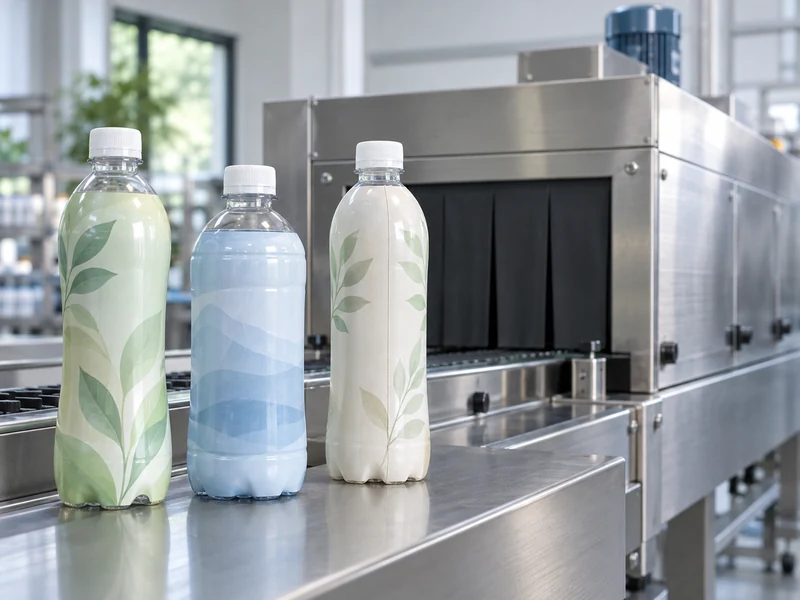
What Must You Clarify About Glue-Applied Labels?
Clarify the exact adhesive and label-feed method before comparing a glue-applied quotation with other technologies. Cold-glue, hot-melt, cut-label, and roll-fed descriptions do not identify one universal machine configuration. Ask which materials and package shapes the proposed arrangement has been designed to process.
The practical questions include adhesive storage, preparation, application control, cleaning, and restart behavior after stops. Consumable economy should be considered alongside the labor and downtime needed to maintain consistent results. A lower label price can lose its advantage if it creates additional waste or intervention.
Request a demonstration using the proposed label material and production adhesive. An alternative adhesive may behave differently when the package is stored, handled, or exposed to moisture. Keep the material specification attached to the equipment acceptance record.
How Do the Three Routes Compare in Daily Operation?
Compare routine work as well as the finished appearance. Operators must replenish materials, make adjustments, clear approved faults, and verify the correct package after each change. These tasks are part of the process you are buying.
| Decision Area | Pressure-Sensitive | Shrink Sleeve | Glue-Applied |
| Material System | Label, adhesive, and release liner | Printed tubular film and heat process | Label stock and separately applied adhesive |
| Trial Priority | Release, placement, and adhesion | Placement, shrink result, and distortion | Feed consistency, glue control, and bond |
| Changeover Review | Rolls, guides, and application settings | Film format, tooling, and tunnel recipe | Label feed, handling parts, and adhesive setup |
| Cost Items to Check | Converted rolls and liner handling | Film, utilities, and thermal equipment | Labels, adhesive, and cleaning resources |
None of these rows establishes a universal winner. A factory with one stable bottle and long production runs will weight the criteria differently from a co-packer changing artwork several times a shift. Use your real product mix to rank the alternatives.
Can One Machine Handle Every Labeling Requirement?
Usually, the first question should be whether one platform can handle your defined application range. Supporting multiple bottle sizes within one technology is different from switching between three fundamentally different technologies. Ask suppliers to identify the boundaries of the proposed configuration.
The BRENU labeling range can help structure the discussion by technology and placement. Prepare a format matrix showing the required result for every container. Mark whether each format is covered by standard adjustments, optional change parts, or a separate machine.
Also separate current production from future aspirations. Paying for an unconfirmed application may add complexity without providing useful flexibility. Ask for an upgrade route and its conditions when the future package is not yet defined.
How Should You Evaluate Barcode and Artwork Quality?
Inspect the package after the full application process and expected handling. A well-printed flat label can behave differently after wrapping, shrinking, or bonding to a glossy surface. Your approval sample should represent the finished unit that a customer or warehouse will scan.
GS1’s retail 2D barcode implementation guidance discusses how curvature, moisture, and surface reflections can influence scanning. Use that guidance when coordinating artwork with the packaging team. The machine trial should preserve the required code area and presentation conditions.
Treat visual quality and encoded data as different checks. A neatly applied label can still identify the wrong product, while a correct code can be located on an unacceptable package. Your release procedure needs to address both outcomes.

Which Cost Comparison Is Most Useful?
Calculate the expected cost per accepted package over a representative production period. Include materials, operating labor, utilities, planned cleaning, changeovers, and rejects. Keep the machine purchase and installation costs visible as a separate investment calculation.
For illustration, compare two options using exactly the same annual accepted volume and SKU schedule. If one option needs longer changeovers, account for the time using your actual production constraint rather than an arbitrary penalty. Where unused capacity has no economic effect, do not treat every saved minute as extra revenue.
BRENU’s water bottling investment discussion provides wider financial context. For the labeling comparison, replace broad line assumptions with material quotations and measured trial results. Small differences in consumables can matter over large volumes, while frequent changeovers can dominate short-run work.
How Does Batch Size Change the Technology Decision?
Batch size changes the importance of replenishment, cleaning, setup, and material inventory. A long production run can spread a preparation task across many accepted units, while repeated short runs bring that task back into the daily schedule. Compare a representative production week rather than only one continuous demonstration.
For example, a co-packer with several artworks on one bottle may prioritize reliable roll identification and rapid restart. A dedicated line producing one package may place greater weight on sustained material consumption and replenishment. These examples describe different decision priorities, not guaranteed advantages of any one technology.
Include minimum material order quantities and unused printed stock in the commercial review. A packaging change can leave inventory that is no longer usable even when the equipment remains suitable. Ask the converter and machine supplier to review the same batch plan so that material purchasing assumptions match the proposed operating method.
Do not select solely from a technology label such as “automatic” or “high speed.” Request evidence for the specific package and routine your plant will use.
What Trial Will Resolve the Decision?
Run competing technologies against a common package brief and acceptance standard. Use the same container condition, the same intended appearance, and realistic downstream handling. Record which design compromises each route requires.
Include at least one difficult format, a restart, and a representative material replenishment. Examine packages immediately after application and after an agreed conditioning period. The goal is to reveal differences that affect your production decision, not to generate the most attractive demonstration video.
Finally, consider how the decoration will be protected through secondary packing. Abrasion and contact during packing may expose weaknesses that are invisible at the applicator exit. Choose the technology that produces an acceptable package across the complete workflow and at a cost supported by your own production evidence.