
A complete carbonated drink filling line includes water treatment, syrup preparation, beverage mixing, carbonation, rinsing, isobaric filling, capping, labeling, coding, packing, and inspection. Each machine plays an important role in keeping beverage quality stable and production efficient.
What Is a Carbonated Drink Filling Line?
A carbonated drink filling line usually includes beverage preparation equipment, carbonation equipment, filling and sealing machines, labeling machines, packaging machines, conveyors, and inspection systems.
The core function of the line is to keep CO₂ dissolved in the beverage during filling. This is why carbonated drink filling machines often use isobaric filling, also called pressure filling. The bottle or can is pressurized before filling, so the beverage can enter smoothly without excessive foam or CO₂ loss.
A complete line can be designed for small, medium, or large production capacity. The layout depends on bottle type, drink formula, output demand, workshop space, automation level, and packaging style.
Typical Production Capacity of Carbonated Drink Filling Lines
Different beverage plants need different output levels. A small soda water factory may only need several thousand bottles per hour, while a large soft drink plant may require high-speed rotary filling equipment.
| Production Scale | Typical Capacity | Suitable Bottle Size | Common Application |
| Small line | 2,000–6,000 bottles/hour | 250ml–1.5L | Startup brands, local soda plants |
| Medium line | 8,000–18,000 bottles/hour | 330ml–2L | Regional beverage factories |
| Large line | 20,000–36,000 bottles/hour | 330ml–1.5L | Mass production soft drink plants |
| High-speed line | 40,000+ bottles/hour | 330ml–500ml | Large-scale carbonated drink brands |
Actual capacity depends on bottle volume, filling valve quantity, capping speed, label type, packaging format, and conveyor design. Larger bottles usually reduce the final output because filling time is longer.
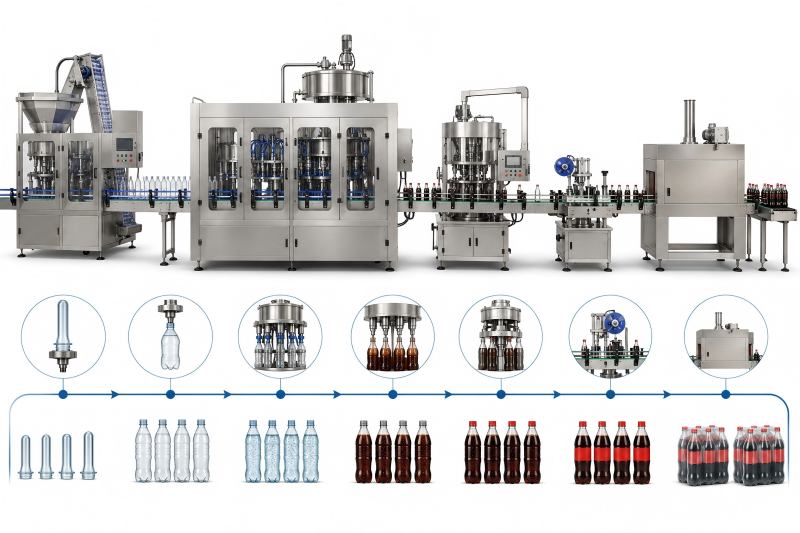
Main Machines in a Complete Carbonated Drink Filling Line
A complete carbonated beverage line is not just one filling machine. It is a coordinated system where each machine supports the next step.
Water Treatment System
Water is the base of most carbonated beverages, so water quality directly affects taste, safety, and product stability. A standard water treatment system may include raw water tank, quartz sand filter, activated carbon filter, water softener, precision filter, reverse osmosis system, UV sterilizer, ozone sterilizer, and purified water tank.
For carbonated drinks, clean and stable water helps prevent flavor changes, sediment, odor, and microbial risk. The treated water should meet the production standard before entering the mixing system.
Sugar Melting and Syrup Preparation System
Many carbonated soft drinks use syrup, sweeteners, flavors, colors, acids, and other ingredients. The sugar melting system heats and dissolves sugar into syrup, then filters it to remove impurities.
The syrup preparation tank is usually equipped with an agitator, temperature control, liquid level control, and sanitary pipeline. For flavored sparkling drinks, this section is important because formula consistency affects every batch.
Beverage Mixing System
The beverage mixing system blends treated water, syrup, flavor, and other ingredients according to the formula. For higher accuracy, many factories use automatic proportioning systems instead of manual mixing.
A good mixing system helps maintain stable Brix, acidity, flavor concentration, and final taste. It helps minimize errors and maintain consistent batches.
Carbonation System
The carbonation system injects CO₂ into the beverage under controlled pressure and temperature. Lower beverage temperature usually helps CO₂ dissolve better, so a cooling unit or plate heat exchanger is often used before carbonation.
CO₂ content is one of the most important quality indicators for carbonated drinks. If carbonation is too low, the drink may taste flat. If it is too high, filling may create foam, leakage, or bottle deformation.
| Beverage Type | Typical CO₂ Volume | Filling Temperature | Key Control Point |
| Sparkling water | 3.0–4.5 vol | 2–6°C | Strong gas retention |
| Carbonated soft drink | 3.0–4.0 vol | 4–8°C | Foam and flavor balance |
| Light sparkling juice drink | 2.0–3.0 vol | 4–8°C | Gentle carbonation |
| Energy soda drink | 2.5–3.5 vol | 4–8°C | Stable taste and pressure |
These values are typical references. The final setting should be adjusted according to formula, package type, target taste, and local production standards.
Bottle Unscrambler or Bottle Feeding System
For PET bottle lines, empty bottles are usually supplied by a bottle unscrambler or air conveyor system. The bottle unscrambler arranges messy bottles into the correct direction and sends them forward automatically.
For glass bottle lines, depalletizers or bottle loading tables may be used. Stable bottle feeding is important because unstable bottle supply can reduce the whole line speed.
Bottle Rinsing Machine
Before filling, bottles need to be cleaned. The rinsing machine turns bottles upside down and uses sterile water, filtered water, or air to remove dust and particles inside the bottle.
In many carbonated drink lines, rinsing, filling, and capping are combined into one 3-in-1 monoblock machine. This compact design reduces bottle transfer distance, improves hygiene, and saves workshop space.
Isobaric Filling Machine
Isobaric filling drives the carbonated drink filling process. It fills beverages under pressure to reduce foam and keep CO₂ inside the liquid.
The basic process includes bottle positioning, bottle sealing, pressure equalization, filling, gas return, pressure release, and bottle discharge. The filling valve design, sealing gasket, pressure control, and liquid tank structure all affect filling quality.
Compared with gravity filling, isobaric filling is more suitable for soda, sparkling water, cola, and other carbonated beverages. It provides better control over foam, gas loss, and filling accuracy.
Capping or Seaming Machine
After filling, the container must be sealed quickly. PET bottles usually use plastic screw caps, glass bottles may use crown caps or aluminum caps, and cans use a seaming machine.
Good sealing prevents CO₂ leakage, product oxidation, microbial contamination, and transportation problems. For carbonated drinks, cap torque and sealing pressure must be controlled carefully.
Bottle Warmer or Cooling Tunnel
After cold filling, condensation may appear on the bottle surface. A bottle warmer can raise the bottle temperature gradually to reduce water droplets before labeling and packing.
In humid conditions, surface drying improves label adhesion and overall package appearance.
Labeling Machine
The labeling machine applies labels to bottles or cans. Common options include self-adhesive labeling, shrink sleeve labeling, hot melt OPP labeling, and wrap-around labeling.
For carbonated beverages, shrink sleeve labels are often used for full-body design, while OPP labels are common for high-speed PET bottle production. The best option depends on brand design, bottle shape, budget, and production speed.
Date Coding Machine
The date coding machine prints production date, expiry date, batch number, QR code, or traceability information. It can be installed after labeling or before packing.
Common coding methods include inkjet coding, laser coding, and thermal transfer coding. For beverage production, clear and durable coding helps meet market and logistics requirements.
Shrink Wrapping or Carton Packing Machine
Final packaging protects the bottles during storage and transport. Carbonated drink lines often use film shrink wrapping, tray shrink packing, carton packing, or case packing.
Shrink wrapping is common for bottled soda and sparkling water because it is efficient and cost-effective. Carton packing provides stronger protection and is suitable for premium retail channels or long-distance shipping.
From Mixing to Final Packaging
A complete carbonated drink filling process usually follows a clear sequence. Each step must be connected smoothly to maintain stable production.
| Step | Process Stage | Main Equipment | Purpose |
| 1 | Water purification | Water treatment system | Produce clean process water |
| 2 | Syrup preparation | Sugar melting tank, mixing tank | Prepare beverage base |
| 3 | Formula blending | Beverage mixing system | Control taste, Brix, and acidity |
| 4 | Cooling and carbonation | Chiller, carbonation mixer | Dissolve CO₂ into beverage |
| 5 | Bottle feeding | Bottle unscrambler, air conveyor | Supply empty containers |
| 6 | Rinsing | Bottle rinsing machine | Clean bottle interior |
| 7 | Filling | Isobaric filling machine | Fill carbonated beverage under pressure |
| 8 | Sealing | Capping or seaming machine | Prevent leakage and CO₂ loss |
| 9 | Warming or drying | Bottle warmer, air dryer | Prepare surface for labeling |
| 10 | Labeling and coding | Labeling machine, coder | Add brand and traceability information |
| 11 | Packing | Shrink wrapper, carton packer | Prepare products for delivery |
| 12 | Inspection | Level, cap, label, and leakage inspection | Improve final quality control |
This process can be adjusted according to bottle material, beverage formula, factory layout, and automation level. For example, a canned carbonated drink line uses depalletizing, rinsing, filling, seaming, tunnel pasteurizing if needed, coding, and carton packing.
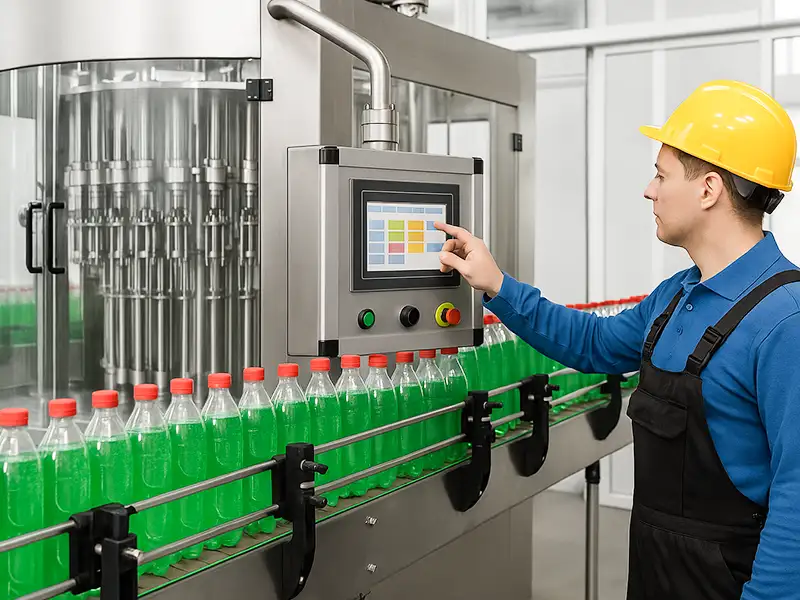
Key Technical Data for Line Selection
When choosing a carbonated drink filling line, buyers should not only look at machine capacity. Filling accuracy, pressure control, automation level, power consumption, and packaging compatibility are also important.
| Item | Typical Reference Range | Buyer Focus |
| Filling accuracy | ±1–2% | Reduces product waste |
| Filling temperature | 2–8°C | Helps control foam |
| CO₂ pressure | 0.3–0.6 MPa | Supports stable carbonation |
| Bottle size range | 200ml–2L | Depends on market products |
| Cap type | Screw cap, crown cap, can lid | Must match container |
| Machine material | SUS304 / SUS316 | Hygiene and corrosion resistance |
| Automation level | Semi-auto to full-auto | Affects labor and output |
| Power supply | Customized by country | Must match factory conditions |
These figures are general industrial references. The final setup should match the beverage formula, packaging, utilities, and required output.
PET Bottle, Glass Bottle, and Can Filling Differences
Different containers require different machine structures. PET bottles are lightweight and widely used, glass bottles feel premium, and cans are common for soft drinks and energy drinks.
PET bottle lines usually include bottle blowing or bottle unscrambling, air conveying, rinsing, filling, capping, labeling, and shrink wrapping. They are flexible and suitable for many drink sizes.
Glass bottle lines need stronger bottle handling, washing, filling, crown capping, inspection, and sometimes returnable bottle systems. Can lines use empty can depalletizers, can rinsers, filling-seaming monoblocks, and carton packaging systems.
| Container Type | Main Advantage | Main Challenge | Common Products |
| PET bottle | Light, low cost, flexible size | CO₂ retention and deformation control | Soda, sparkling water |
| Glass bottle | Premium feel, strong gas barrier | Heavy, fragile, higher transport cost | Craft soda, premium drinks |
| Aluminum can | Fast cooling, strong market appeal | Requires precise seaming | Cola, energy drinks, sparkling drinks |
The right container depends on brand positioning, distribution channel, product shelf life, and packaging cost.
Quality Control Points in Carbonated Drink Filling
Carbonated drinks are sensitive to temperature, pressure, hygiene, and sealing. Small problems in the process may cause foam overflow, low fill level, gas loss, leakage, or unstable taste.
Important quality checks include CO₂ content testing, Brix testing, filling level inspection, cap torque testing, leakage testing, label position checking, and package appearance inspection.
Factories should also monitor the cleaning process. CIP cleaning is often used for syrup tanks, beverage pipelines, carbonators, and filling machines. Clean equipment helps reduce contamination risk and supports stable production.
How to Improve Production Efficiency
A carbonated drink filling line should be designed as a balanced system. A slow machine can become the bottleneck of the entire production line.
Good conveyor layout can reduce bottle jams and improve continuous operation. Buffer sections can be added between key machines to reduce downtime caused by short stops.
Automation can also improve efficiency. Automatic bottle feeding, cap feeding, liquid level control, pressure control, label detection, and packing systems reduce manual labor and improve production stability.
Key Points When Choosing a Filling Line Supplier
A reliable supplier should understand both beverage processing and packaging machinery. Carbonated drink production is not only about filling speed; it also requires control of carbonation, foam, hygiene, pressure, and final package quality.
Before ordering a line, buyers should confirm drink type, container size, cap type, label type, output requirement, workshop layout, power supply, water source, and packaging format. These details help the supplier design a practical and stable solution.
A good supplier can provide machine layout, process design, equipment selection, installation guidance, operator training, and after-sales support. For new beverage factories, this support can reduce project risk and shorten startup time.