
Choose cavity count from the accepted bottle output required by your production schedule, using a demonstrated per-cavity rate for the actual bottle. Then check the available machine configurations, utilities, mold investment, changeover time, and downstream capacity. More cavities are useful only when the plant can operate them effectively and sell the additional production.
What Does a Cavity Count Tell You?
A cavity is a forming position that produces a bottle during the relevant machine cycle. In a linear machine, several cavities may operate together in a repeated cycle; in a rotary machine, forming stations move around a wheel. Their production calculations must reflect the machine architecture rather than assuming that all cavity counts are directly comparable.
The cavity number alone says little about usable output. Bottle geometry, preform heating, stretching, pressure sequence, cooling, and mechanical movement all influence the achievable rate. A supplier’s headline output for a small water bottle may not apply to your larger or more demanding container.
What Bottle Output Must the New Blower Deliver?
Begin with accepted bottles required per production day or batch. Determine the time available for blowing after planned activities such as format changes and routine setup. Keep a separate allowance for unplanned stops and quality losses if these have not already been included in the time estimate.
For example, a plant requiring 30,000 accepted bottles in six scheduled hours needs an average of 5,000 accepted bottles per scheduled hour. That average includes the effects of ordinary production losses within those six hours. It is different from the instantaneous rate shown on a machine screen during uninterrupted running.
Check the filling schedule alongside blowing demand. A plant may blow into a managed buffer for later filling or feed the filler continuously. These operating arrangements produce different requirements for peak rate, storage, and recovery after a stoppage.
How Can You Estimate the Number of Cavities?
For a machine quoted in bottles per cavity per hour, divide the required accepted hourly output by the demonstrated nominal per-cavity rate multiplied by the agreed operating factor. Round up to an available machine configuration. Verify that the operating factor includes the intended losses without counting them twice.
As a hypothetical example, suppose the required accepted output is 5,000 bottles per hour and a trial establishes 1,200 nominal bottles per cavity per hour. With an 85% operating factor, the calculation is 5,000 divided by 1,020, or approximately 4.90 cavities. If the supplier offers four- and six-cavity versions, the six-cavity option deserves evaluation while the four-cavity option would not meet that assumed requirement.
This arithmetic screens options; it does not establish a performance guarantee. Request a written output commitment tied to the bottle, preform, and utilities. The PET bottle blowing machine range is a starting point for identifying configurations, but the final selection should use application-specific evidence.
What If the Supplier Quotes Cycle Time Instead?
For a linear machine producing one bottle from each active cavity per cycle, theoretical hourly output is active cavities multiplied by 3,600 and divided by cycle time in seconds. Apply the relevant production-loss allowance afterward. Confirm whether the quoted cycle time covers the complete repeated sequence.
A four-cavity machine with a hypothetical three-second complete cycle has a theoretical rate of 4,800 bottles per hour. That figure excludes losses unless the supplier explicitly states otherwise. Using a blowing-stage duration instead of the full cycle would overstate output.
Why Can Bottle Design Change the Answer?
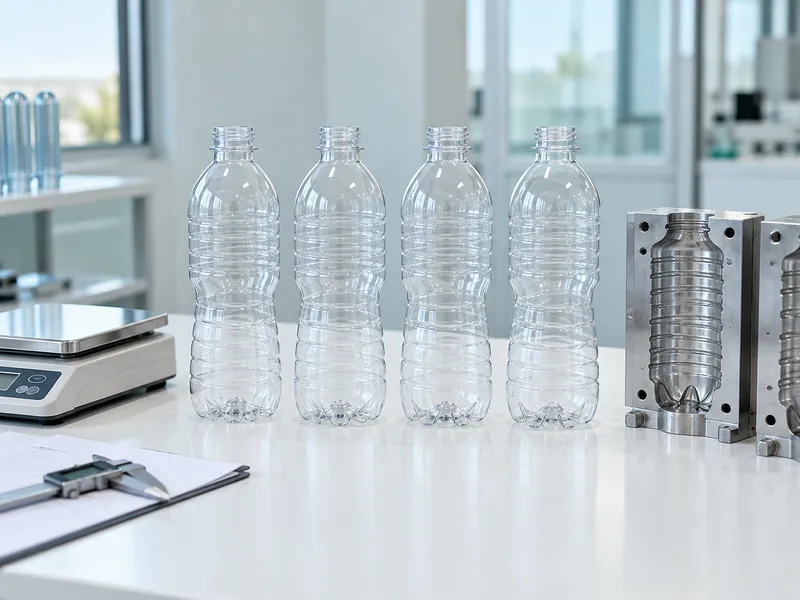
A cavity cannot be evaluated independently of the package it forms. Larger containers may need different machine spacing or stretching travel, while complex shapes can require different heating and forming conditions. Thermal requirements can also affect the cycle or available output.
Prepare a format matrix listing bottle dimensions, neck finish, preform, material, target rate, and application. Ask the supplier to identify the limiting format and explain its restriction. The bottle with the largest sales volume is not always the bottle with the most demanding process.
| Format Variable | Possible Effect | Evidence to Request |
| Large Bottle Envelope | Limits mold spacing and machine compatibility | Approved dimensions and tooling layout |
| Complex Shoulder or Grip | Requires more controlled material distribution | Production samples and stable process settings |
| Hot-Fill Requirement | May need a different thermal process | Qualified heat-resistant package and demonstrated rate |
| Preform Variation | Changes heating behavior and available process margin | Trials using the intended supply |
| Frequent Format Changes | Reduces time available for saleable production | Measured complete changeover duration |
How Do More Cavities Affect Utilities?
Higher output normally raises total demand for preforms, compressed air, cooling, and material handling. Confirm the utility requirement for the proposed operating point rather than scaling a small machine’s figures without review. Air-recovery arrangements and machine design can change the relationship.
Check whether existing utilities can support the new machine while other equipment is running. A compressor may appear adequate during an isolated trial but become limiting during simultaneous production. Verify pressure at the blower under the combined demand.
Consider energy per accepted bottle as well as total connected power. A larger installation operated far below its intended utilization may carry significant standby and auxiliary loads. The best cavity count should fit the plant’s actual schedule rather than only its most optimistic forecast.
How Should Mold Cost and Changeover Be Compared?
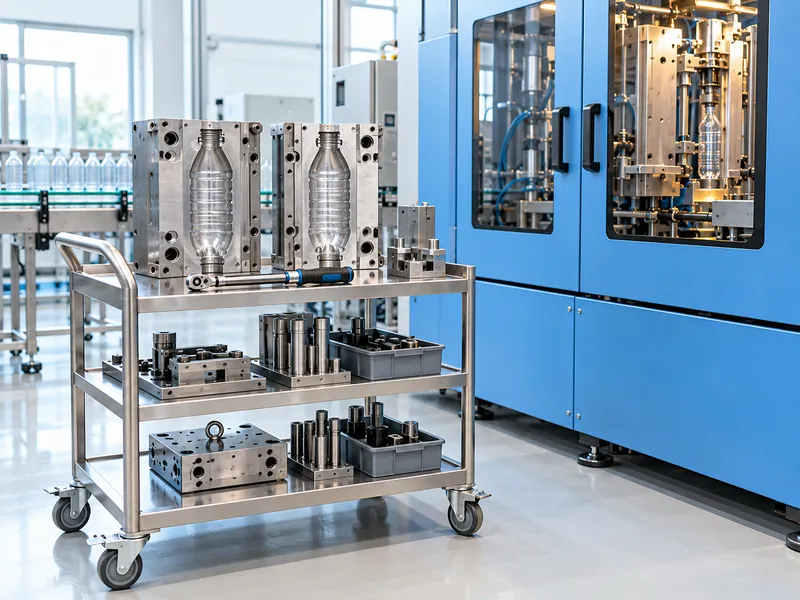
Each additional forming position usually adds tooling and maintenance exposure. Where many bottle formats are required, the number of mold sets can materially affect the project budget. Ask for a tooling schedule that distinguishes mold bodies, base inserts, carriers, and format-specific handling parts.
Compare complete changeovers, not just the time needed to remove a mold. Include isolation, cooling connections, part replacement, recipe selection, checks, trial bottles, and approval. A fast mechanical swap may still be followed by a lengthy qualification period.
If short batches dominate production, assess the annual hours lost to repeated changes. A machine with fewer cavities and a well-managed format schedule may sometimes compete with a larger machine that changes frequently. Use your actual order mix to test that possibility.
Should You Buy Extra Cavities for Future Growth?
Additional capacity can be justified when growth is credible and the rest of the line can support it. Separate confirmed orders, reasonable forecasts, and speculative expansion. Assign operating hours to each scenario before deciding how much spare capacity to purchase.
Compare a larger machine now with a smaller installation plus a defined expansion path. The second option may require extra floor area or duplicated utilities, while the first may create underutilized capital. Include both consequences in the bottling line investment model.
What Should You Verify During Acceptance?
Verify both total output and the performance of individual cavities. A strong average can conceal one cavity producing thin bases, dimensional variation, or excessive rejects. Keep samples identified by forming position so that problems can be traced.
- Run the agreed bottle and preform combination at the contracted rate.
- Count accepted bottles over an agreed duration and record all interruptions.
- Sample every cavity at startup and during stable production.
- Test the specified dimensions and application-relevant bottle properties.
- Measure utility conditions at the machine during the run.
- Demonstrate a normal restart and a representative format change.
Ask how the machine handles an unavailable cavity and what restrictions apply. Do not assume that every design can continue operating with a cavity disabled or that output simply falls in direct proportion. Obtain the manufacturer’s approved procedure and revised performance expectations.
What Should the Final Cavity Specification Contain?
The final specification should identify the required accepted output for each bottle, the available production hours, and the conditions under which output will be verified. Attach the tooling list, utility schedule, format-change assumptions, and quality criteria. State how much spare production time the chosen configuration leaves after the forecast workload and scheduled interruptions have been accounted for.
Choose the cavity count that satisfies this documented requirement without creating an unsupported burden on utilities, maintenance, or demand. A six-cavity machine is not inherently better than a four-cavity machine, and a lower count is not inherently more economical. The useful comparison is dependable production delivered by the complete installation.