
For many bottled water manufacturers, production does not begin with a fully automatic plant. A new factory often starts with a relatively small budget, using semi-automatic bottle blowing, filling, capping, labeling, and packing equipment to test the local market and build a stable customer base.
When sales increase, the production problem changes. The question is no longer simply how to produce bottled water, but whether the factory should upgrade the existing bottled water line or install a completely new automatic water bottling line.
Both options can increase capacity, but the right choice depends on the condition of the current equipment, required output, factory space, labor cost, bottle specifications, and long-term expansion plan.
Why Many Bottled Water Plants Start With Semi-Automatic Equipment
For a new bottled water business, controlling the initial investment is usually more important than maximizing production speed. Semi-automatic equipment allows manufacturers to enter the market with lower equipment and infrastructure costs.
A small plant may initially use separate machines for bottle blowing, rinsing, filling, capping, labeling, and shrink wrapping. Operators manually transfer bottles between some processes, while other stages use short conveyors.
This arrangement works well when production demand is still limited. However, once daily orders increase, manual handling and separate machines can gradually become production bottlenecks.
What Changes When a Bottled Water Factory Starts Expanding?
Expansion normally begins when the existing line can no longer comfortably meet daily production requirements.
For example, a plant designed around 1,000–2,000 bottles per hour may still technically operate at full speed, but operators may need overtime to complete orders. Production interruptions, bottle accumulation, inconsistent filling, and labor costs may also increase.
At this stage, manufacturers usually have two choices:
- Upgrade the existing semi-automatic bottled water line.
- Build a new fully automatic bottled water line.
The better solution depends on how much of the original production system can still support future capacity.
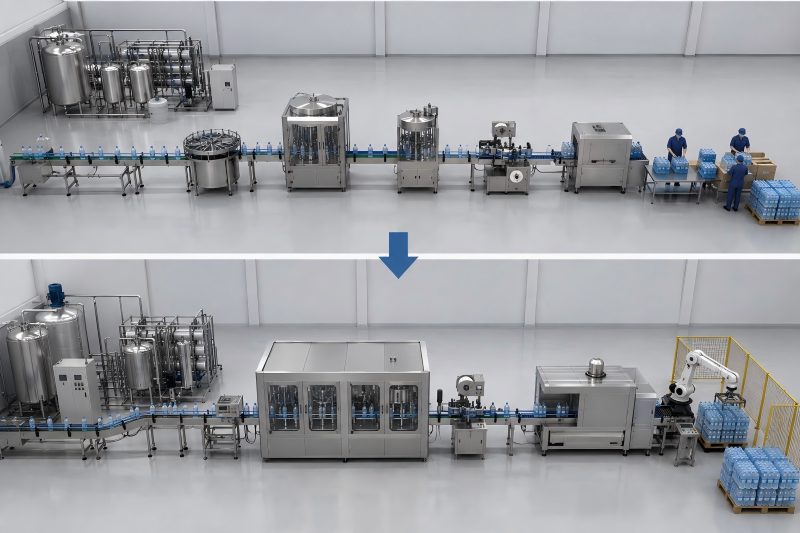
Option 1: Upgrading the Existing Bottled Water Line
Upgrading does not necessarily mean replacing every machine. In many projects, several existing machines can continue operating while the main bottleneck equipment is replaced or automated.
For example, a factory may keep its water treatment system and bottle blowing machine while replacing separate rinsing, filling, and capping machines with an automatic 3-in-1 rinsing filling capping machine.
Conveyors, automatic labeling machines, date printers, shrink wrappers, and palletizing equipment can then be added gradually.
When Upgrading Makes Sense
Upgrading is usually suitable when the existing equipment is still in good condition and the required production increase is moderate.
A plant running at 2,000 bottles per hour may only need to increase production to 4,000 or 6,000 bottles per hour. If the water treatment capacity, bottle blowing system, compressed air supply, and factory space are sufficient, replacing several key machines may be more economical than rebuilding the complete line.
This approach allows the manufacturer to use part of the original investment instead of abandoning equipment that still has production value.
Advantages of Upgrading an Existing Line
The biggest advantage is lower capital investment.
Instead of purchasing a complete bottling line at once, the factory can focus its budget on the processes that limit production capacity. This is especially useful for growing bottled water companies that want higher automation but still need to control cash flow.
Upgrading can also reduce changes to the existing factory layout. If the original water treatment system, bottle storage area, and utility connections remain usable, installation can be simpler.
Limitations of Upgrading
The main difficulty is equipment compatibility.
A new filling machine may run at 6,000 bottles per hour, but the existing bottle blower may only provide 3,500 bottles per hour. In this situation, replacing the filler alone will not allow the complete line to reach 6,000 bottles per hour.
The same problem can occur with labeling, packing, conveyors, air compressors, and water treatment equipment.
For this reason, an upgrade project should be evaluated as a complete production system rather than as a single-machine replacement.
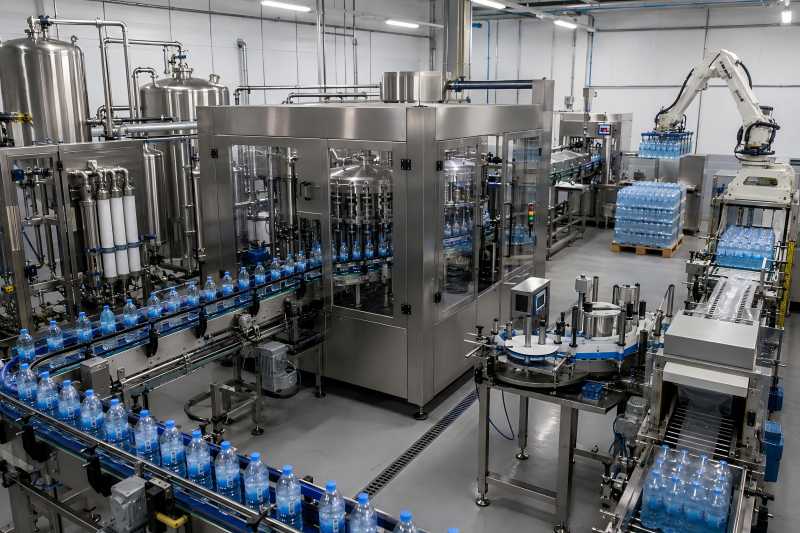
Option 2: Setting Up a New Automatic Filling Line
A new filling line is usually selected when the required production increase is much larger or when the existing equipment is no longer suitable for automation.
Instead of modifying individual machines, the manufacturer installs a coordinated production line designed around a specific target capacity.
A typical automatic bottled water line may include:
- Water treatment system
- PET bottle blowing machine
- Air conveyor
- 3-in-1 rinsing, filling, and capping machine
- Bottle conveyor
- Labeling machine
- Coding system
- Shrink wrapping or carton packing machine
- Automatic palletizing system
Because these machines are designed to operate together, production speed and bottle transfer are easier to balance.
When to Install a New Filling Line
A new line becomes more practical when production demand is expected to increase significantly.
For example, upgrading a 2,000 BPH semi-automatic plant to 3,000 or 4,000 BPH may be straightforward. But trying to convert the same plant directly to 12,000 or 18,000 BPH can require replacing almost every major machine.
At that point, upgrading the old system piece by piece may create more engineering work without providing meaningful savings.
A completely new line is also more suitable when the existing machines have different operating speeds, outdated control systems, or limited automation interfaces.
New Filling Line vs Existing Line Upgrade
| Factor | Upgrade Existing Line | Install New Filling Line |
| Initial Investment | Lower | Higher |
| Suitable Expansion | Small to medium | Medium to large |
| Existing Equipment Reuse | High | Limited |
| Automation Level | Gradual improvement | Fully integrated |
| Installation Changes | Usually smaller | More extensive |
| Production Balance | Depends on old equipment | Easier to optimize |
| Future Expansion | May be limited | Easier to plan |
| Labor Reduction | Moderate to significant | Significant |
| Factory Layout Changes | Usually fewer | Often required |
| Long-Term Capacity | Depends on existing system | Designed around target output |
Do Not Evaluate the Filling Machine Alone
One of the most common mistakes in bottled water plant expansion is selecting equipment only according to filling speed.
If a manufacturer purchases a 12,000 BPH filling machine, this does not automatically mean the plant can produce 12,000 bottles every hour.
The complete production chain must support approximately the same output.
Bottle Blowing Capacity
The bottle blowing machine must continuously supply enough empty PET bottles.
If the filler requires 8,000 bottles per hour but the blower only produces 5,000 bottles per hour, the filling machine will frequently wait for bottles.
Water Treatment Capacity
Higher filling output also requires more purified water.
When increasing production, the RO system, storage tanks, pumps, UV sterilization, and ozone system should all be checked to confirm they can support the new demand.
Labeling and Packing Capacity
The downstream equipment is equally important.
A high-speed filler followed by a slow labeling or shrink wrapping machine simply moves the bottleneck from one process to another.
Example: Upgrading a Small Bottled Water Factory
Consider a factory using a semi-automatic line producing approximately 2,000 bottles per hour.
The plant already has a suitable RO water treatment system and a reliable bottle blowing machine. However, rinsing, filling, capping, and bottle transfer require several operators.
Instead of replacing the entire factory, the manufacturer could install a 3-in-1 automatic filling machine, connect the bottle blower through an air conveyor, and add automatic labeling and shrink wrapping equipment.
The production process changes from several independent operations into a continuous line.
This type of upgrade can significantly reduce manual bottle handling while allowing the factory to continue using useful existing equipment.
Example: When Building a New Line Makes More Sense
Now consider another factory producing 2,000 BPH that wants to reach 12,000 BPH.
Its original blower, water treatment system, filler, labeler, and packing machine are all designed for low output. The workshop layout also does not provide enough conveyor space for high-speed production.
In this situation, upgrading each machine individually would eventually mean replacing almost the complete line.
Building a new 12,000 BPH production line from the beginning usually creates a cleaner layout and makes it easier to match each machine to the same production target.
The original small line can still be kept for smaller bottle sizes, backup production, seasonal products, or secondary markets.
How Labor Requirements Change After Automation
Labor reduction is one of the main reasons established bottled water plants move from semi-automatic equipment to automatic production.
Semi-automatic plants often need workers to load bottles, transfer containers, place caps, move finished bottles, and assist with packing.
Automatic conveyors and integrated machines reduce these manual transfer points.
Operators are still required for production and monitoring. Instead, labor gradually shifts from repetitive bottle handling toward machine monitoring, quality inspection, material replenishment, maintenance, and production management.
Factory Space Should Be Checked Before Expansion
Higher-speed equipment often requires more space than manufacturers initially expect.
The filling machine itself may fit inside the workshop, but additional space is needed for air conveyors, bottle conveyors, labeling machines, shrink wrappers, inspection points, buffer sections, and maintenance access.
Bottle blowing is another important consideration because PET preform storage, bottle transfer, compressors, chillers, and high-pressure air equipment all require space.
A good expansion plan should therefore evaluate the complete production flow before the new machines are purchased.
Should You Upgrade Gradually or Automate Everything at Once?
For many small and medium bottled water companies, gradual automation is practical.
The factory may first replace the filling section, then upgrade labeling and packing equipment as sales continue increasing. This spreads investment across several stages.
However, gradual expansion works best when the final production target is considered from the beginning.
For example, if the plant eventually expects to reach 12,000 BPH, choosing conveyors, electrical systems, utilities, and workshop layouts only for the current 4,000 BPH requirement may create additional reconstruction later.