
Match a PET preform to the complete package requirement: bottle geometry, neck finish, resin specification, material distribution, filling conditions, and distribution loads. Weight alone is not a sufficient selection rule. Approve the combination through blowing and filling trials using the intended machine, mold, closure, and product conditions.
Which Requirements Should Be Fixed First?
Begin with the bottle’s job rather than a catalog preform. Define the nominal fill volume, overflow capacity, closure, filling temperature, internal pressure, expected shelf life, and handling conditions. Include secondary packaging and transport because a bottle that survives filling may still distort in storage.
Keep the approved bottle drawing and preform drawing under revision control. Changes to a shoulder, base, grip, or neck finish can affect tooling and material distribution even when the stated bottle volume remains unchanged. Ask the bottle designer, preform supplier, and machine supplier to review the same revisions.
- Identify the beverage and whether filling is ambient, cold, hot, or pressure-based.
- Record the filled package dimensions and closure specification.
- Define relevant mechanical, thermal, appearance, and shelf-life requirements.
- List the blower’s heating, stretching, mold, and handling constraints.
- Specify resin, color, additives, and recycled-content requirements.
Why Is Preform Weight Only a Starting Point?
A preform’s mass indicates how much material is available, but it does not show where that material will end up. Two preforms with similar weight may have different body lengths, wall profiles, gate regions, and neck masses. Those differences can change how the body heats and stretches.
The neck normally retains its injection-molded geometry during reheating and blowing. Material allocated to the neck therefore cannot simply be counted as material available for the bottle sidewall. Evaluate the stretchable portion separately when comparing alternative designs.
A heavier preform may reduce some mechanical risks but can increase heating demand and material cost without solving an unsuitable geometry. A lighter preform can work well when the bottle design and process distribute material effectively. Neither conclusion should be assumed before testing the actual combination.
How Do Bottle Shape and Stretching Affect Compatibility?
The preform must stretch into the bottle without forcing critical regions outside the workable process window. Long narrow bottles, broad shoulders, deep grips, and complex bases impose different demands. A nominal volume match does not establish compatibility with those features.
Discuss axial and circumferential stretch with the supplier using its defined calculation method. Axial estimates compare relevant stretchable lengths, while circumferential estimates compare relevant diameters; the exact reference dimensions matter. Do not apply a universal numerical ratio to every resin, preform, and bottle family.
What Should You Ask About Difficult Shapes?
Ask whether the design requires special heating control, preferential heating, or other process features beyond a standard configuration. An oval bottle, for example, may require controlled circumferential heating to distribute material appropriately. A deep grip can also challenge the movement of material into the mold.
Review the proposed PET blowing equipment together with the preform and mold design. Confirm that the selected machine can provide the necessary heating control, stretching motion, and bottle envelope. A compatible mold mounting does not prove that the machine can reliably form the package.
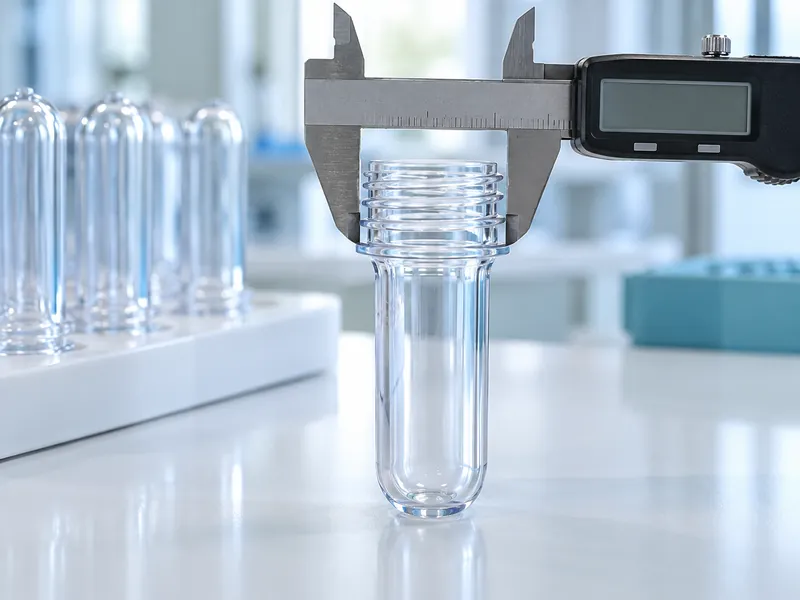
How Should the Neck Finish Be Matched?
Match the complete neck specification, including threads, sealing surfaces, bore, support ring, and dimensional tolerances. A matching nominal diameter does not guarantee closure compatibility. The cap supplier’s drawing and the preform supplier’s neck drawing should identify the same finish.
Check handling interfaces as well as sealing. Neck guides, grippers, blowing nozzles, and filling equipment may reference different features around the finish. Small dimensional differences can affect transfer stability or introduce marks even when the cap can be screwed on by hand.
Use appropriate gauges and closure testing rather than relying on visual similarity. Include application torque, removal behavior, leakage, and any required tamper-evident function in package qualification. Record the actual cap specification and production lot used during approval.
How Do Filling Conditions Change the Selection?
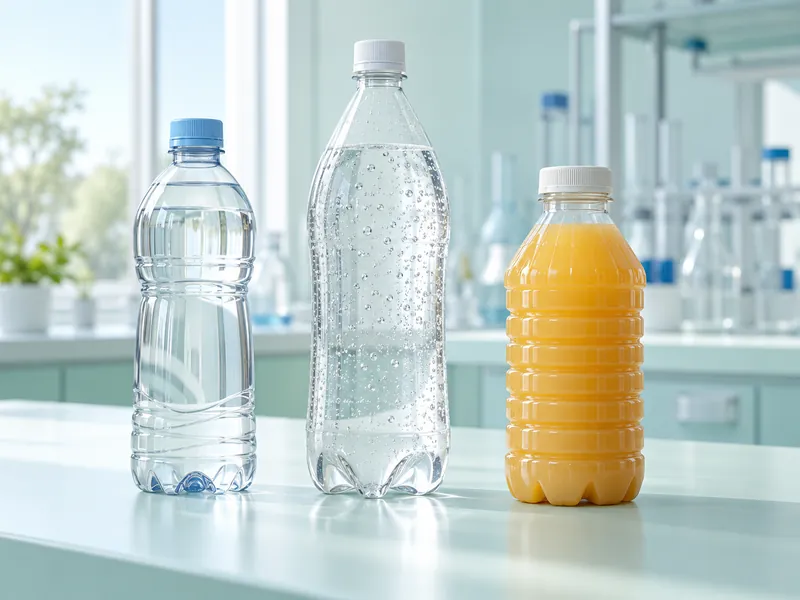
Filling conditions determine which stresses the bottle must resist and therefore influence the preform, bottle design, and blowing process. Still water, carbonated beverages, and hot-filled juice should not share an acceptance plan merely because the bottles have similar capacities. Their critical failure mechanisms differ.
| Application | Main Package Challenge | Qualification Focus |
| Still Water | Handling and compression of lightweight containers | Top load, transfer stability, closure sealing, and filled-pack performance |
| Carbonated Drinks | Internal pressure and time-dependent dimensional change | Pressure resistance, creep, base stability, and carbonation retention |
| Hot-Fill Juice | Heating followed by cooling and internal vacuum | Thermal stability, vacuum accommodation, closure integrity, and final dimensions |
What Is Different About Hot Filling?
Hot filling requires a package and process designed for the specified temperature history. Heat-resistant PET production may involve heat-setting and controlled mold temperatures, depending on the technology. An ordinary cold-fill bottle should not be treated as suitable simply by increasing its weight.
Qualify the complete heating, filling, holding, capping, and cooling sequence. Inspect the bottle after cooling and after the specified storage period, since immediate appearance can miss delayed distortion. The process owner should define the actual product treatment and package acceptance limits.
What Is Different About Carbonation?
A carbonated package must retain its shape and closure integrity under the pressure associated with its beverage and temperature conditions. Bottle-base geometry, material distribution, and time-dependent deformation become important. Test the intended package rather than borrowing a pressure claim from another bottle design.
Include conditions representing the expected distribution environment. Warm storage can change package behavior and gas retention, so room-temperature inspection alone may be inadequate. The agreed test plan should define temperature, duration, conditioning, and failure criteria.
What Resin and Recycled-Content Information Matters?
Request a controlled material specification and the supplier’s relevant quality documentation. Resin characteristics, color, additives, and recycled content can influence reheating behavior and package appearance. A successful recipe for one preform supply should not automatically be transferred to another.
Identify whether an alternative preform changes material formulation as well as geometry. If several variables change at once, diagnosing an unsuccessful trial becomes harder. Keep traceable samples from the original and proposed supplies for comparison.
Incoming checks should cover contamination, visible inclusions, haze, gate quality, damage, and dimensional consistency according to an agreed sampling plan. Food-contact suitability must be supported by appropriate supplier documentation for the intended use. A clean-looking preform is not a substitute for that documentation.
How Should a Preform Trial Be Organized?
Run a controlled comparison that isolates the candidate preform’s effect. Use the approved bottle drawing and inspect samples from all cavities after the process has stabilized. For each trial, retain the oven settings, stretching sequence, air-pressure readings, and cooling-water conditions with the sample identification so that a later production team can connect an approved bottle to its recorded setup instead of reconstructing that setup from memory.
- Verify the delivered preforms against their drawing and lot documentation.
- Check feeding, neck handling, and fit before beginning production.
- Develop a stable heating and blowing recipe within supplier limits.
- Measure bottle dimensions and wall distribution at specified locations.
- Complete mechanical, sealing, thermal, or pressure tests relevant to the application.
- Run the bottles through the intended filler and downstream packaging process.
- Repeat critical checks after conditioning and representative storage.
For thin containers, extend the trial beyond the blower discharge. The guide to lightweight PET bottle handling on filling machines explains why transfers and accumulation deserve attention. A bottle can meet a laboratory weight target while remaining difficult to handle at production speed.
When Should You Requalify an Approved Combination?
Requalification is appropriate when a change could alter forming behavior or package performance. Examples include a new preform supplier, a revised neck, a resin formulation change, a new recycled-content level, or a materially different filling condition. Define the required scope according to the significance of the change.
Keep an approval record linking the preform drawing, bottle drawing, mold, machine recipe, closure, and test results. Document acceptable operating ranges and the conditions that require production to stop for investigation. This record makes future substitutions more controlled than choosing the nearest available preform by weight.