
Lightweight PET does not require a slow filling line. It requires better control of bottle handling.
For a high-speed 3-in-1 filling machine, the most important improvements usually come from stable neck handling, synchronized transfers, controlled filling and pressure transitions, appropriate capping force, balanced air conveying and intelligent downstream accumulation control.
The key is to stop treating the bottle as a passive package. On a high-speed line, the bottle is part of the mechanical system.
Why Lightweight PET Bottles Behave Differently
Traditional PET bottles usually have enough structural margin to tolerate small imperfections in line adjustment. A slightly aggressive guide rail, an imperfect starwheel position or excessive conveyor pressure may not immediately cause visible problems.
Lightweight bottles provide much less margin.
Reducing resin normally means thinner bottle walls or more carefully distributed material. Depending on bottle geometry, certain areas can become particularly sensitive, including the shoulder, sidewall, base and transition zones between reinforced and flexible sections.
At high speed, this can create several production symptoms:
| Production Area | Possible Lightweight-Bottle Problem | Typical Result |
| Infeed | Bottle squeezing or instability | Poor feeding, jams |
| Transfer | Excessive side contact | Scratches, deformation |
| Rinsing | Weak bottle control | Swinging or dropped bottles |
| Filling | Pressure or flow disturbance | Bottle distortion, foaming |
| Capping | Excessive downward force or torque | Neck/base deformation |
| Discharge | Poor transfer alignment | Falling bottles |
| Conveyor | Excessive back pressure | Sidewall collapse |
The important point is that lightweight PET problems rarely come from only one machine station. A bottle may leave the filler correctly and deform later because downstream accumulation creates too much compression.
The entire bottle path therefore needs to be considered.
Start with the Bottle Before Adjusting the Machine
When a new lightweight bottle is introduced, operators often begin by changing filler settings immediately. That can hide the real cause.
First inspect the bottle itself.
Bottle weight alone does not tell you whether it will run successfully. Two bottles with identical volume and gram weight can behave very differently because their resin distribution and geometry are different.
Before high-speed trials, evaluate:
- Bottle volume and total weight
- Neck finish and neck-ring dimensions
- Bottle height and maximum diameter
- Wall thickness distribution
- Shoulder geometry
- Base geometry and standing stability
- Panel resistance
- Filled-bottle center of gravity
- Bottle temperature during filling
- Cap specification and required torque
Pay particular attention to where the bottle receives mechanical support.
A lightweight bottle designed around neck handling may perform very well on a rotary filling machine because the neck finish remains comparatively rigid even though the body has been significantly lightweighted.
This is one reason neck-handling architecture is so useful for high-speed PET applications.
Use the Neck as the Main Handling Reference
For lightweight PET bottles, controlling the container by its strongest repeatable feature is generally better than relying heavily on the body.
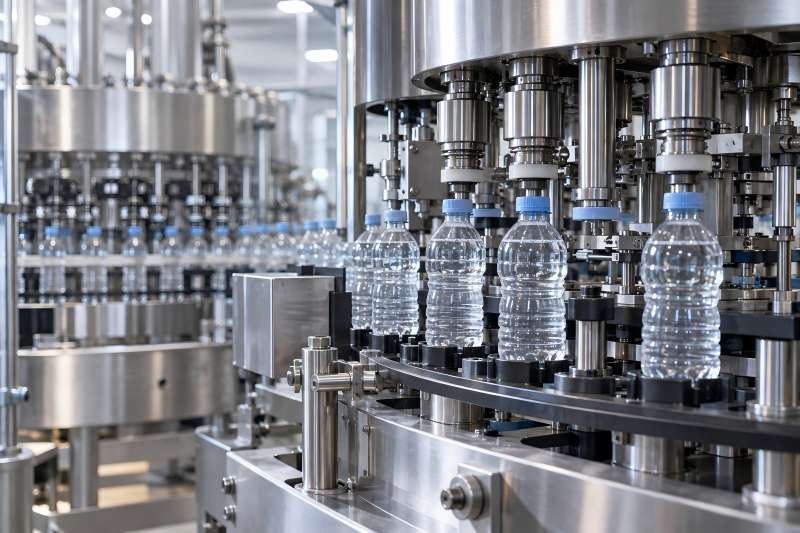
On a properly configured 3-in-1 machine, bottles can be transferred through the rinser, filler and capper primarily by the neck.
The bottle body is then allowed to remain relatively free.
This has several advantages.
First, bottle diameter variations have less influence on positioning. Second, the machine does not need to squeeze the flexible sidewall to maintain control. Third, changeover between PET bottle formats can become easier when several bottles share the same neck finish.
But neck handling does not eliminate every problem.
Transfer height, gripper geometry, starwheel timing and neck-guide alignment still need to be accurate. At high speed, even a small mismatch between two rotating components can produce repeated impact.
With a rigid bottle, this may only create noise. With a very lightweight bottle, it can produce vibration, neck damage or unstable transfer.
Smooth Transfer Matters More Than Maximum Speed
A high-speed filling line should not be thought of as a collection of machines rotating quickly. Treat the entire line as a coordinated bottle-handling system.
A bottle should move from one control point to another without being suddenly accelerated, released or redirected.
The critical transitions usually include:
- Air conveyor to rinser infeed.
- Infeed starwheel to rinsing carousel.
- Rinser to filling carousel.
- Filler to capping carousel.
- Capper to discharge starwheel.
- Discharge conveyor to downstream packaging equipment.
If lightweight bottles repeatedly fail at one location, reducing the complete line speed may temporarily solve the symptom but does not necessarily solve the mechanical problem.
Instead, observe the exact transfer.
Look for a bottle being pushed before the next handling component has fully accepted it, excessive clearance allowing the bottle to swing, incorrect guide positioning, worn transfer parts or a mismatch in rotational synchronization.
Filling Method Has a Direct Effect on Bottle Stability
The liquid entering the bottle carries momentum. At low speed this is easy to ignore; at high output it becomes part of bottle handling.
A narrow, aggressive liquid stream can create turbulence and foam while also disturbing a flexible container. The appropriate filling behavior depends on the product.
For still water and similar low-viscosity products, the filling valve should provide fast flow without unnecessarily violent liquid entry. For carbonated beverages, pressure management becomes even more important because the bottle must withstand internal pressure changes during filling and pressure release.
| Product | Main Filling Concern | Lightweight PET Priority |
| Still water | High flow rate | Smooth liquid entry |
| Juice | Foam/product characteristics | Controlled filling profile |
| Carbonated drinks | Pressure and CO₂ | Stable pressure transitions |
| Flavored beverages | Foam and sanitation | Repeatable valve behavior |
| Functional drinks | Product variation | Recipe-based control |
The fastest valve setting is not automatically the highest-production setting.
If aggressive filling creates foam, unstable levels or bottle deformation, the machine will lose output through rejects and stops. A slightly more controlled filling profile can therefore produce higher effective production.
Pressure Changes Need Special Attention for Carbonated Products
Lightweight PET bottles used for carbonated beverages face a different mechanical environment from bottles used for still water.
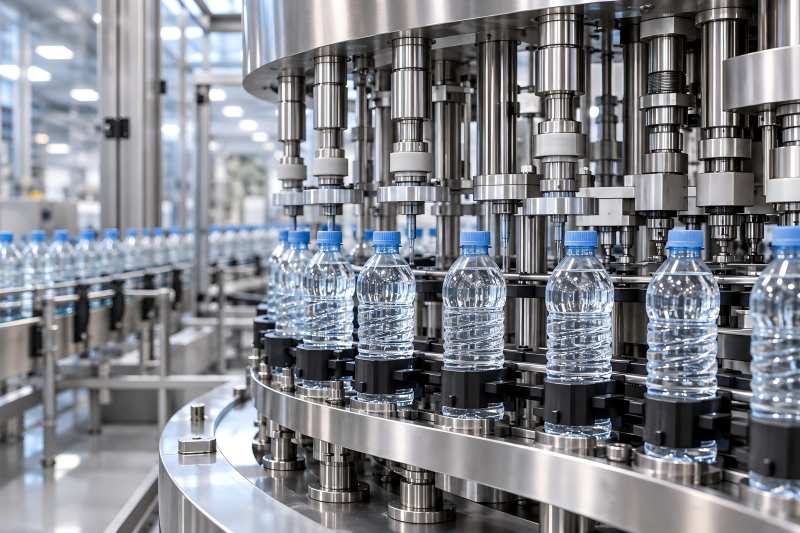
During counter-pressure filling, the bottle experiences internal pressure. The challenge is not only reaching the required filling pressure but managing the transition between pressurization, liquid filling and pressure release.
Sudden pressure changes can affect both the beverage and the bottle.
If pressure is released too aggressively, foaming may increase and the bottle can experience rapid dimensional changes. If pressure balancing is unstable between valves, fill-level consistency can also suffer.
For lightweight carbonated bottles, focus on:
- Stable bowl/tank pressure
- Consistent pre-pressurization
- Controlled product flow
- Repeatable valve timing
- Smooth decompression
- Appropriate beverage temperature
- Stable CO₂ conditions
A high-speed carbonated filling machine should therefore be tuned around the complete pressure curve rather than only the final filling volume.
Do Not Ignore Product Temperature
PET stiffness changes with temperature.
This means a bottle validated with cold water may behave differently when the actual product enters the line at a higher temperature.
For conventional cold filling, this may be relatively easy to manage. For warm-fill or hot-fill applications, however, bottle design becomes much more important. A bottle lightweighted for cold still water cannot automatically be assumed suitable for a higher-temperature beverage.
When evaluating a bottle, use production conditions that reflect the actual product.
A trial using room-temperature water can confirm basic machine transfer, but it cannot fully validate bottle performance if commercial production uses different temperature, pressure or carbonation conditions.
Capping Can Deform a Bottle That Filled Perfectly
The bottle can travel successfully through rinsing and filling and still fail during capping.
This happens because capping introduces both vertical and rotational forces.
If the capper applies unnecessary downward load, a flexible bottle may compress. If torque is too high, the bottle can twist or lose stability. If the bottle is poorly controlled while the closure is applied, the cap may become crooked or inconsistently tightened.
The goal should be sufficient force to apply the closure correctly, not maximum force.
Check capper performance through actual closure results:
- Application torque
- Removal torque
- Cap height
- Tamper-band condition
- Seal integrity
- Bottle deformation
- Neck damage
Mechanical adjustment should then be made around those results.
When moving from a heavier bottle to a lightweight design, simply keeping all previous capping settings unchanged is risky.
Air Conveyor Settings Can Make or Break Lightweight-Bottle Handling
Empty lightweight PET bottles are especially unstable because they have almost no mass.
Before filling, air conveying is therefore one of the most sensitive parts of the line.
Too little airflow can cause poor movement and gaps in bottle supply. Too much airflow can make bottles oscillate, collide or arrive at the filler in an uncontrolled condition.
Air distribution matters as much as total airflow.
The goal is to maintain a stable bottle stream without creating unnecessary turbulence around the bottle body.
During commissioning, observe whether bottles lean, rotate, bounce or accumulate unevenly. These movements often reveal conveyor settings that need improvement before the bottles even enter the 3-in-1 machine.
Control Downstream Back Pressure
Once filled, PET bottles become heavier and easier to convey, but another problem appears: accumulation pressure.
When downstream equipment slows, bottles begin pushing against one another.
Rigid containers tolerate this reasonably well. Lightweight PET bottles may not.
Long accumulation sections, narrow guide rails and excessive conveyor speed differences can create enough side pressure to deform bottles.
This is particularly important between the filler and labeling, packaging or case-packing equipment.
Instead of allowing the filler to continuously push bottles into a blocked downstream section, use coordinated line control. Conveyor speeds, accumulation sensors and machine status signals should work together so the upstream equipment responds before bottle compression becomes excessive.
This is where line automation contributes directly to packaging quality.
A Practical Commissioning Sequence
Trying to reach rated speed immediately makes troubleshooting difficult. A better approach is to increase production systematically.
A useful commissioning sequence is:
- Run empty bottles through the machine slowly.Check neck handling, starwheels, guides and transfers.
- Inspect every transfer point.Look for swinging, impact, scratching and unstable bottle release.
- Begin filling at reduced speed.Confirm bottle stability, fill level and valve behavior.
- Check the capper independently.Verify bottle deformation, closure position and torque.
- Increase speed in stages.For example, move from roughly 50% to 70%, 85% and finally target output.
- Observe accumulation conditions.Deliberately test normal downstream slowdowns.
- Run continuously.Short trials may hide heating, wear, pressure fluctuation or accumulation problems.
- Record the successful settings.Store them as a production recipe for that bottle and product combination.
The final step is often underestimated.
If operators need to rediscover the correct settings after every changeover, the line has not really been commissioned.
Don’t Rely on Slower Speeds to Fix Problems
Speed reduction is a useful diagnostic tool, but it should not become the permanent solution to every lightweight-bottle problem.
Suppose a 3-in-1 machine is designed for 12,000 BPH, but a lightweight bottle runs reliably only at 8,000 BPH.
The useful question is what changes between those two operating points.
Perhaps a transfer impact becomes stronger. Perhaps air-conveyor supply becomes unstable. Perhaps filling-valve timing is no longer ideal. Perhaps downstream accumulation increases. Perhaps cap application becomes inconsistent.
Finding that threshold helps locate the actual bottleneck.
This is much more useful than simply concluding that the bottle is “too thin.”
Build a Bottle-Specific Production Recipe
Modern filling lines should treat different bottle formats as different production conditions.
A useful recipe can include:
| Parameter Group | Settings to Record |
| Filling | Valve timing, level, flow profile |
| Carbonated Filling | Pressure, pre-pressurization, decompression |
| Conveyor | Speed ratios, accumulation settings |
| Air Conveyor | Blower settings |
| Capping | Head settings, torque-related parameters |
| Inspection | Fill-level and closure limits |
| Machine Speed | Validated production range |
Mechanical change parts should also be clearly identified for each bottle.
This becomes especially important for beverage factories producing several bottle sizes on the same 3-in-1 filling machine.
Lightweighting Should Be Evaluated by Total Production Cost
Reducing PET weight saves resin, but bottle cost should not be evaluated separately from filling-line performance.
A lighter bottle that saves packaging material but creates frequent jams, rejects, speed losses and customer complaints may increase total production cost.
The better optimization target is the lightest bottle that can still run reliably under real factory conditions.
That requires cooperation between bottle designers, preform suppliers, beverage producers and filling-machine engineers.
At BRENU Filling, this is also why bottle samples and product information are valuable before a high-speed 3-in-1 filling line is finalized. Rated output alone does not define the right machine configuration. Bottle geometry, neck finish, product characteristics, filling temperature, carbonation, cap type and downstream handling all influence how the line should be designed and adjusted.