
Expanding a bottled water plant does not always mean constructing another production hall. For many manufacturers, the more practical solution is to increase output within the existing building by replacing low-efficiency equipment, reducing manual handling, and redesigning the production flow.
The key is to identify which equipment actually limits capacity. In most projects, the filling section should receive the highest priority, followed by water treatment, labeling, packing, conveying, and palletizing.
Start With the Current Production Bottleneck
Before adding equipment, calculate the actual capacity of every major section of the plant.
A typical bottled water production process includes:
Water Treatment → Bottle Blowing → Rinsing → Filling → Capping → Labeling → Packing → Palletizing
If these sections operate at very different capacities, simply installing a faster machine at one point may not increase the final output.
For example:
| Production Section | Existing Capacity | Expansion Target |
| Water Treatment | 4,000 L/h | 8,000 L/h |
| Bottle Blowing | 4,500 BPH | 8,000 BPH |
| Filling | 3,000 BPH | 8,000 BPH |
| Labeling | 5,000 BPH | 8,000 BPH |
| Packing | 3,500 BPH | 8,000 BPH |
In this example, the existing filling machine is the most obvious bottleneck. Upgrading water treatment alone would provide more purified water but would not significantly increase the number of finished bottles leaving the factory.
For plants with limited floor space, expansion should therefore focus on capacity per square meter rather than simply adding more machines.
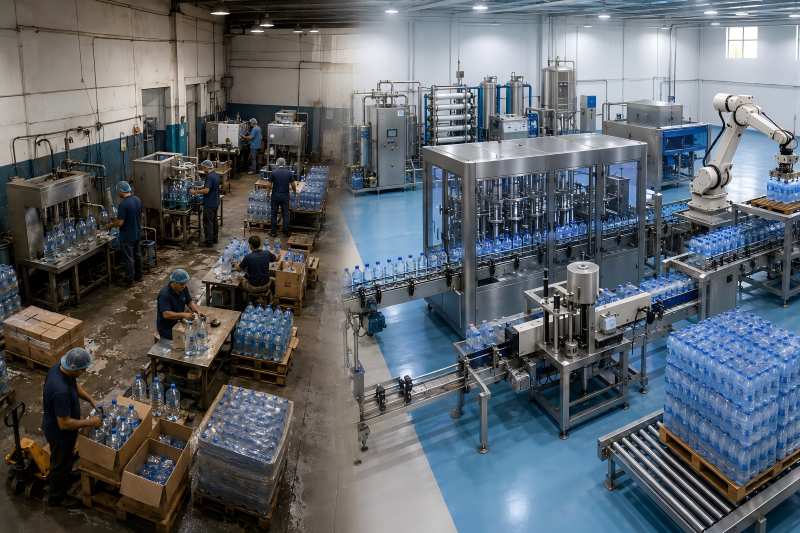
1. Upgrade Equipment in the Right Order
When budget or factory space does not allow the complete line to be replaced at once, expansion can be completed in stages.
A practical priority is:
Priority 1 — Rinsing, Filling and Capping Machine
This is normally the core capacity upgrade.
Replace separate or semi-automatic processes with a higher-speed integrated filling system.
Priority 2 — Water Treatment System
Increase purified water output so it can continuously support the new filler.
Priority 3 — Bottle Blowing System
Increase bottle supply if PET bottles are produced inside the factory.
Priority 4 — Labeling Machine
Upgrade labeling capacity to match the new filling speed.
Priority 5 — Packing Machine
Replace manual packing with automatic shrink wrapping or carton packing.
Priority 6 — Robot Palletizing
Automate end-of-line handling once the line reaches a production level where manual palletizing becomes inefficient.
This sequence focuses investment first on the equipment that directly determines production capacity.
2. Upgrade the Filling Machine First
For many small and medium bottled water factories, filling is the most important equipment to upgrade.
Older plants often rely on separate or semi-automatic rinsing, filling, and capping equipment. These systems require more manual bottle transfer, additional conveyors, and larger operating areas.
A more efficient approach is replacing them with an integrated rinsing, filling and capping machine.
From Semi-Automatic Filling to a 3-in-1 Filling Machine
A compact 3-in-1 water filling machine combines three essential processes:
- Bottle rinsing
- Water filling
- Bottle capping
Instead of moving bottles between several independent machines, bottles are transferred continuously through the same rotary system.
This change can provide several advantages when factory space is limited:
- Higher filling speed within a smaller footprint
- Less manual bottle handling
- Shorter conveyor distances
- Fewer bottle transfer points
- More stable production
- Easier centralized control
- Reduced labor requirements
For example, a plant producing around 2,000–3,000 bottles per hour with semi-automatic equipment may upgrade to a 6,000–12,000 BPH rinsing, filling and capping machine without increasing the filling area proportionally.
The exact capacity should still match bottle volume, bottle shape, water supply, and downstream equipment.
3. Increase Water Treatment Capacity to Match Filling Output
After determining the new filling capacity, the water treatment system must be checked.
Installing an 8,000 BPH filling machine is ineffective if the purification system can only provide enough treated water for 4,000 bottles per hour.
The required treatment capacity depends heavily on bottle size.
For example, an 8,000 BPH line filling 500 ml bottles requires approximately 4,000 liters of finished water per hour for the product alone. Additional capacity should normally be considered for rinsing, cleaning, process losses, and production fluctuations.
Rather than replacing the entire treatment system immediately, evaluate individual sections such as:
- Raw water pumps
- Sand filters
- Activated carbon filters
- Water softeners
- RO membranes
- High-pressure pumps
- UV sterilization
- Ozone systems
- Finished water tanks
In some plants, increasing RO membrane capacity or installing a larger storage tank may be sufficient. In others, the complete water treatment system needs to be expanded.
Use Storage Tanks to Reduce Space Pressure
Limited factory space makes buffer storage especially useful.
A properly sized purified water tank allows the water treatment system and filling machine to operate more independently. Temporary fluctuations in treatment output therefore do not immediately stop the filling line.
Instead of oversizing every upstream component, a balanced system can sometimes achieve better space utilization through controlled buffer storage.
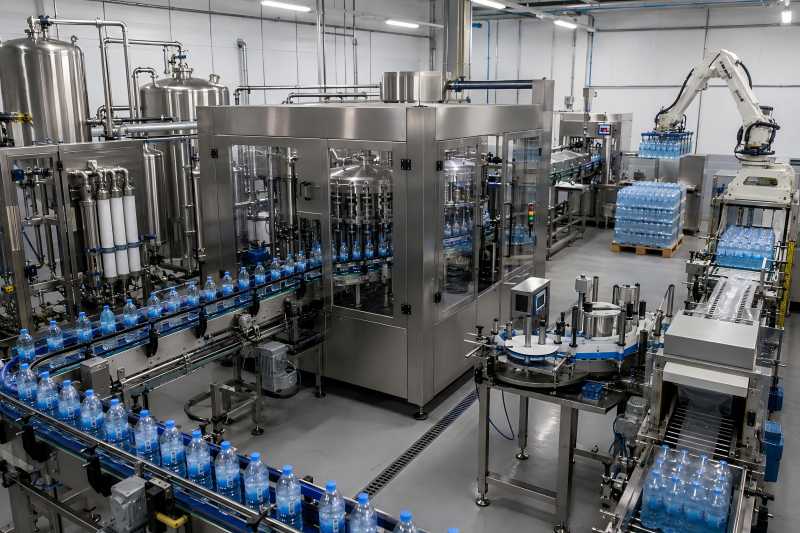
4. Match Bottle Blowing Capacity With the New Filling Machine
For PET bottled water production, bottle preparation is another common bottleneck.
If the plant blows its own bottles, the blow molding machine should be able to continuously supply the upgraded filling line.
Suppose the new filling machine reaches 8,000 BPH, while the existing bottle blower produces only 4,000 BPH. The filling machine would frequently wait for empty bottles, reducing the benefit of the upgrade.
When floor space is restricted, consider:
- Higher-speed automatic blow molding machines
- Compact preform feeding systems
- Shorter air conveyors
- Direct connection between blowing and filling
- Reduced empty-bottle storage
A direct blow-fill configuration can be particularly useful because large quantities of empty PET bottles no longer need to be stored around the production area.
Empty bottles occupy considerable volume despite their low weight. Eliminating unnecessary intermediate storage can release valuable factory space.
5. Upgrade the Labeling Machine for Continuous Production
Once filling speed increases, labeling equipment must process bottles at the same rate.
An older semi-automatic labeling machine may quickly become the next production bottleneck.
Depending on the bottle and packaging design, the plant may use:
- Sleeve labeling machines
- OPP hot-melt labeling machines
- Self-adhesive labeling machines
For a compact high-speed line, the labeling machine should normally have slightly more rated capacity than the filling machine.
For example, an 8,000 BPH filling line may be paired with a labeling machine rated above 8,000 BPH. This provides operating margin for acceleration, bottle spacing changes, and short production interruptions.
The layout should also keep the distance between the filler and labeler as short as practical while maintaining enough conveyor accumulation to prevent one short stop from shutting down the complete line.
6. Replace Manual Packing With Automatic Packing Equipment
Packing often becomes a hidden bottleneck after the filling machine has been upgraded.
Workers may be able to manually pack 2,000 or 3,000 bottles per hour, but maintaining the same method at 8,000 or 12,000 BPH requires significantly more labor and working space.
Automatic packaging equipment solves both problems.
Common options include:
Shrink Wrapping Machine
Groups bottles into packs and applies shrink film automatically.
It is commonly used for bottled water because it provides relatively compact packaging with limited material handling.
Carton Packing Machine
Places bottles into cartons where stronger secondary packaging or more protection is required.
Film Wrapping With Tray
Combines a tray with shrink film to improve pack stability during transport.
Automatic packing reduces the amount of space required for workers to manually collect, arrange, and wrap bottles around the conveyor.
7. Use a Palletizing Robot Instead of Manual Palletizing
Palletizing is usually one of the final areas to consider during expansion, but it can create serious congestion at higher production speeds.
Manual palletizing requires operators to collect finished packs, arrange them on pallets, and move completed pallets away from the line. At higher outputs, the packing area can quickly become crowded.
A robot palletizer can automate this process.
The robot continuously picks finished packs and stacks them according to a programmed pallet pattern. One system can often handle different bottle pack formats by changing the operating program and gripper configuration.
For plants with limited space, robotic palletizing offers several advantages:
- Smaller working area than multiple manual stations
- Reduced accumulation of finished packs
- More consistent pallet formation
- Lower manual handling requirements
- Easier integration with pallet conveyors
- Higher capacity for future expansion
The robot can be added later as production demand increases. However, the future palletizing area should be considered when redesigning the production layout.
8. Shorten the Production Flow Instead of Adding More Conveyors
Long conveyors can consume surprising amounts of factory space.
When upgrading a bottled water plant, manufacturers sometimes continue using the original machine positions and simply connect new equipment with additional conveyors. The result is higher capacity but a much more complicated factory layout.
A better approach is to streamline the entire production process. Instead of:
Rinser → Conveyor → Filler → Conveyor → Capper → Conveyor → Labeler
A compact upgraded line can become:
3-in-1 Rinser/Filler/Capper → Labeler → Packer → Robot Palletizer
This removes several transfer points and creates a much shorter production route.
Conveyors should still provide sufficient buffering, but every conveyor should have a clear purpose rather than simply filling the distance between machines.
9. Use Vertical Space Where Possible
Factory expansion is usually discussed in terms of floor area, but vertical space can also be used.
Certain auxiliary systems can be positioned above or beside the primary production line, including:
- Cap elevators
- Preform feeding systems
- Air pipes
- Water pipelines
- Cable trays
- Certain utility components
This leaves more floor space available for the main production equipment and operator access.
However, heavy equipment and tanks should only be elevated when the building structure, maintenance access, and safety requirements allow it.
10. Reduce Intermediate Storage
Traditional small plants often rely heavily on intermediate storage.
Empty bottles may be stored before filling, finished bottles may wait before labeling, and packed products may accumulate before palletizing.
As line speed increases, this approach requires more and more space.
A properly balanced automatic production line should move bottles continuously from one process to the next.
The goal should be:
less storage between processes and more controlled conveyor buffering.
For PET bottled water plants, direct integration between bottle blowing, filling, labeling, packing, and palletizing can significantly reduce the amount of work-in-process inventory inside the factory.
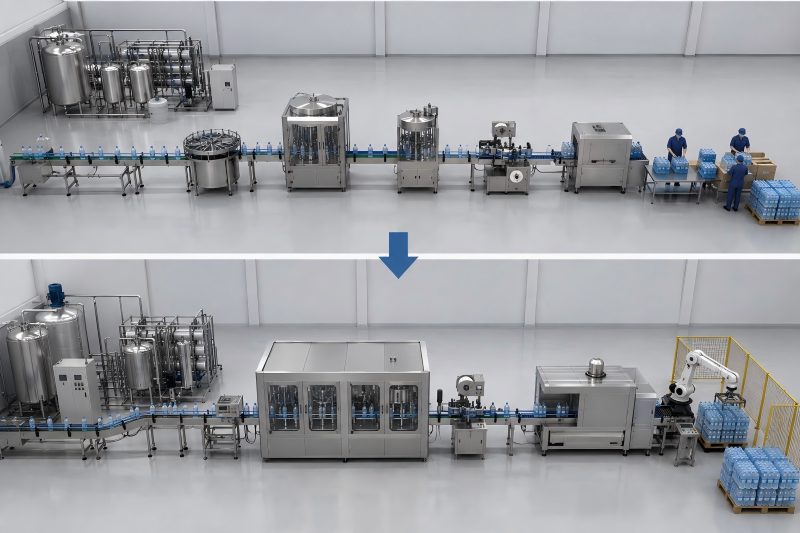
A Typical Limited-Space Expansion Example
Consider a bottled water factory using separate semi-automatic rinsing, filling, and capping equipment.
Its original production capacity is approximately 3,000 BPH, and the manufacturer wants to reach around 8,000 BPH without constructing another production building.
The original line might include:
- 4,000 L/h water treatment system
- Semi-automatic bottle handling
- Separate rinsing equipment
- Semi-automatic filler
- Separate capper
- Small labeling machine
- Manual shrink packing
- Manual palletizing
Instead of installing another complete 3,000 BPH line beside it, the manufacturer could reorganize the existing area around one higher-capacity line.
The upgraded configuration could include:
Expanded Water Treatment → Automatic Bottle Supply → 8,000 BPH 3-in-1 Rinsing/Filling/Capping Machine → Automatic Labeler → Shrink Packer → Robot Palletizer
The result is not simply more equipment. It is a shorter and more automated production chain capable of producing significantly more bottled water from roughly the same manufacturing area.
Do Not Oversize One Machine
A common mistake during expansion is purchasing the highest-capacity filling machine possible.
If the filler operates at 12,000 BPH but the labeler, packer, water treatment system, or bottle blower can only support 6,000 BPH, actual factory capacity remains close to 6,000 BPH.
Equipment should be selected based on overall production line capacity. For an 8,000 BPH target, manufacturers should evaluate:
- Required purified water volume
- Bottle blowing output
- Filling speed
- Labeling capacity
- Packing capacity
- Palletizing capacity
- Conveyor accumulation
- Compressor capacity
- Electrical load
- Available floor area
A balanced 8,000 BPH line is usually more productive than an unbalanced line containing one 15,000 BPH machine.
Plan the Expansion Around the Filling Line
When floor space is limited, the filling machine should become the center of the new layout.
Its bottle inlet, filled-bottle outlet, operator side, maintenance side, water connections, electrical cabinets, cap feeding system, and downstream conveyor direction should be determined first.
The labeling machine, packing machine, and palletizing robot can then be positioned around this production direction.
Water treatment equipment can often remain in a separate utility area and supply purified water through sanitary pipelines, allowing valuable production-floor space to remain available for packaging equipment.
Leave Space for the Next Expansion
A successful factory expansion should solve today’s capacity problem without creating tomorrow’s layout problem.
Even when the current target is only 6,000 or 8,000 BPH, consider whether future production may reach 12,000 or 18,000 BPH.
This does not mean buying oversized equipment immediately. It means planning machine orientation, conveyors, electrical capacity, water treatment connections, compressed air, and end-of-line space so future upgrades do not require rebuilding the entire factory.