
Choose a semi-automatic PET bottle blowing machine when demand is modest, production is intermittent, and trained operators can reliably handle the manual steps. Choose a fully automatic system when repeated production runs, labor availability, and integration with filling justify the larger investment. The deciding measure is the cost and reliability of accepted bottles delivered to the filler, rather than the machine’s advertised maximum speed.
What Does the Automation Level Actually Change?
Automation mainly changes how preforms and bottles move through the process and how consistently the sequence repeats. Both types still depend on suitable preforms, controlled heating, stretching, compressed air, and compatible molds. A machine that automates handling does not remove the need to establish a sound blowing recipe.
On a typical semi-automatic arrangement, operators load preforms, transfer heated material, or remove finished bottles, depending on the design. A fully automatic machine coordinates these movements through feeding, heating, blowing, and discharge equipment. Ask the supplier to identify every manual task in the proposed configuration because the labels do not describe all machines identically.
Start with the available PET bottle blowing machine configurations and send the supplier your bottle drawings before it prepares the offer. Confirm which feeding, conveying, inspection, and utility components are included. An apparently complete machine quotation can still exclude equipment needed for continuous production.
How Should You Compare Effective Output?
Compare the number of accepted bottles produced during a realistic operating period. Include warm-up, breaks, preform replenishment, mold changes, minor stops, and restart rejects. A brief high-speed run leaves unanswered how many usable containers the equipment will deliver after several hours of ordinary work.
For a planning estimate, multiply the demonstrated running rate by the available production hours and a clearly defined allowance for operating losses. If the running rate already includes rejected bottles, do not subtract the same quality loss again. Define the losses covered by each percentage before using that percentage to rank quotations.
What Does a Practical Capacity Example Look Like?
Suppose a plant needs 12,000 accepted bottles during six hours available for blowing. Its average requirement is 2,000 accepted bottles per available hour. If a trial suggests that stops and rejects reduce usable output to 80% of the nominal rate, the preliminary nominal requirement becomes 2,500 bottles per hour.
The calculation above uses invented planning inputs; it does not describe a tested blower. The next step is to test the proposed equipment with the intended preform, bottle weight, mold, and utility supply. A larger bottle or more demanding shape may change the result substantially.
When Is Semi-Automatic Blowing a Sensible Choice?
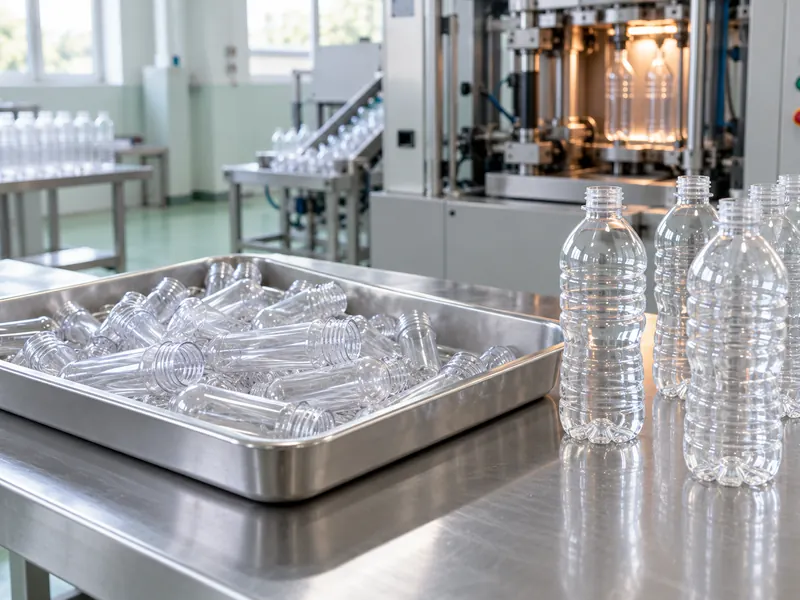
For a factory making occasional batches, a manually assisted blower may cover demand without committing capital to a heavily underused automatic installation. It may also suit a separate development or short-run activity where a dedicated automated line would spend much of its time idle. The advantage depends on the full operating arrangement, not simply a lower purchase price.
- Orders are small enough that demonstrated shift output comfortably covers demand.
- Operators are available for each manual station, including breaks and absences.
- The factory has room for orderly movement between heating, blowing, inspection, and bottle storage.
- Temporary bottle inventory can separate blowing from filling without creating unacceptable handling or hygiene problems.
Watch an operator complete an extended run instead of observing only a few cycles. Repeated lifting, awkward reaches, and inconsistent transfer timing can reduce output or create variability as the shift progresses. Any improvement to handling must preserve the machine’s guards and operating procedures.
When Does Full Automation Become More Valuable?
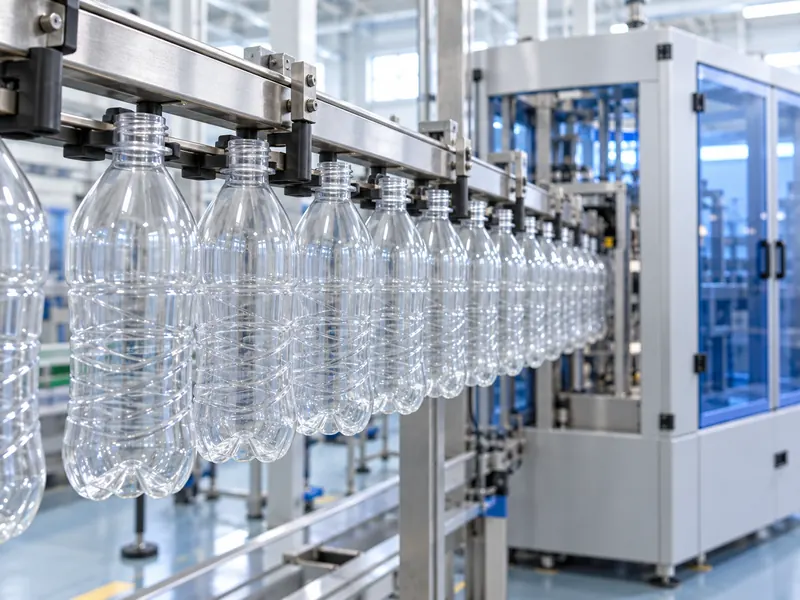
Full automation becomes more valuable when the same bottling operation runs repeatedly and manual handling limits the dependable supply of bottles. It can reduce variation in transfer timing and support coordinated production with the filler. It also introduces feeding, sensors, drives, and controls that require suitable maintenance skills.
Evaluate whether the plant can keep the automatic machine supplied with preforms and whether downstream equipment can accept its output. Frequent filler stops can leave the blower cycling between production and standby. Under those conditions, additional nominal speed may provide less benefit than better line balancing.
For light containers, review the requirements for handling lightweight PET bottles through the filling line. Stable blowing is only part of the job: the finished bottle must also tolerate the actual transfers, filling sequence, capping loads, and accumulation conditions. Include these downstream interfaces in the acceptance plan.
Which Costs Belong in the Comparison?
Build a comparison around installed cost and annual operating cost at the volume you can reasonably sell. Include the blower, molds, preform feeding, air treatment, compressor capacity, cooling, conveyors, installation, training, and initial spare parts. Separate items shared by both alternatives from items required only by one configuration.
| Decision Area | Semi-Automatic Option | Fully Automatic Option |
| Manual Work | Measure staffing and handling time across the shift | Measure replenishment, supervision, and fault recovery |
| Production Pattern | Check economics for intermittent batches | Check utilization during repeated longer runs |
| Line Connection | Account for bottle storage and transfer labor | Confirm conveyor interfaces and stop coordination |
| Maintenance | Confirm routine skills and local service | Confirm controls support and critical spare availability |
| Quality | Verify consistency between operators and restarts | Verify consistency across cavities and operating speeds |
Measure labor in paid hours, including relief coverage, material movement, inspection, and cleanup. Measure energy over the agreed system boundary, including the relevant compressor and cooling loads. Comparing only blower motor power can misrepresent the cost of producing the bottles.
How Should You Evaluate the Additional Investment?
Estimate the extra annual cash benefit of automation from labor savings, reduced rejects, avoided handling, and additional profitable output. Subtract any additional maintenance, service, utility, and financing costs relevant to the comparison. If there is no credible positive annual benefit, a simple payback calculation does not justify the larger investment.
Use a low-volume scenario as well as the expected case, because a machine still carries ownership costs when orders are weak. Brenu’s guide to water bottling line investment returns provides a broader framework for linking equipment decisions to sales and operating assumptions. Use current quotations and your own plant data for the actual decision.
Does Automation Guarantee Better Bottle Quality?
Both designs need a validated combination of heating, stretching, pressure, and cooling before their bottles can be approved. Automation can improve repeatability, but unsuitable preforms, poor heating profiles, air-pressure instability, or incorrect mold cooling can still cause defects. The relevant evidence is consistent test performance from production samples.
Agree which bottle properties matter before the trial. These may include neck dimensions, wall distribution, usable volume, standing stability, top load, leakage, and application-specific pressure or thermal performance. Do not approve a bottle merely because it looks clear and holds its shape immediately after blowing.
What Should the Supplier Demonstrate Before You Decide?
Request a trial that represents routine production and at least one realistic interruption. Use the intended preforms and document bottle drawings, resin or recycled-content assumptions, mold identity, and utility conditions. Record the staffing level and all manual tasks alongside output and rejects.
- Run each important bottle format long enough to observe stable operation.
- Collect samples from every cavity at agreed intervals.
- Record accepted output, rejected bottles, and the reasons for stoppages.
- Demonstrate preform replenishment and controlled restart after a normal stop.
- Time a format change from the last accepted bottle of one format to the first approved production of the next.
- Verify connection to the proposed filling and conveying arrangement.
Specify who owns commissioning, operator training, recipe documentation, and fault diagnosis. Confirm that the maintenance team can obtain the necessary drawings, manuals, and spare parts. A production system is only dependable if the factory can restore it after a routine fault.
How Can You Make the Final Choice?
Choose the least complex configuration that meets your verified output, quality, staffing, and growth requirements with a practical operating margin. Semi-automatic equipment is reasonable when its manual steps remain manageable at the required volume. Fully automatic equipment is reasonable when sustained utilization and reliable line integration pay for the additional equipment and support.
Prepare one requirement sheet containing bottle drawings, preform samples, annual volume by format, shift pattern, available utilities, and future capacity assumptions. Give each bidder identical input documents and evaluate the trials against one agreed set of measurable requirements. This produces a decision based on your plant’s work rather than on a general preference for more automation.