
A CIP system is one of the most important supporting systems in a modern juice filling line. It improves hygiene control, maintains product consistency, reduces cleaning labor, protects equipment performance, and helps manufacturers achieve more efficient production.
For small beverage producers, CIP helps establish reliable quality control. For large factories, it becomes a key factor in maintaining continuous production and reducing operational costs.
What Is a CIP System in a Juice Filling Line?
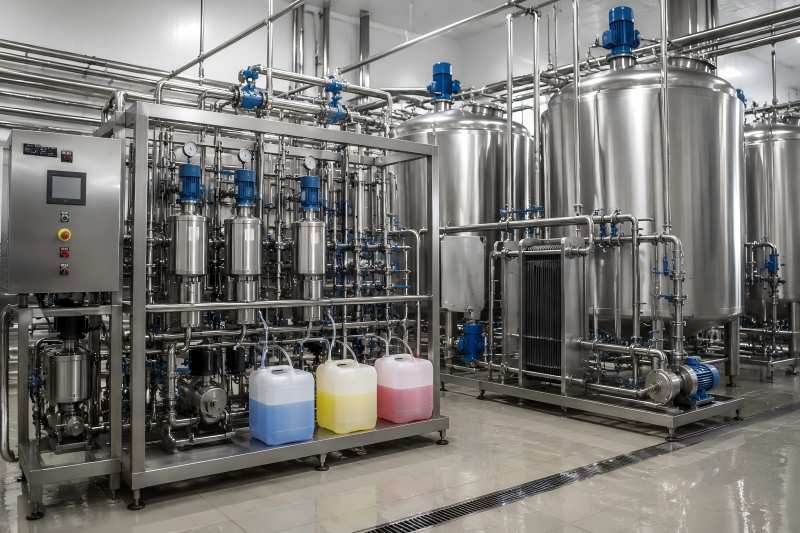
A CIP system is an automated cleaning process that circulates cleaning solutions through the internal surfaces of beverage production equipment. Instead of removing pipes or opening machines for manual cleaning, the system uses controlled chemical, temperature, flow, and time parameters to remove residues and microorganisms.
In a juice filling line, the CIP system usually connects with:
- Juice preparation tanks
- Mixing tanks
- Storage tanks
- Product pipelines
- Pumps
- Heat exchangers
- Filling valves
- Homogenizers and pasteurization equipment
The cleaning process typically includes several stages:
| CIP Stage | Main Purpose | Typical Operation |
| Pre-rinsing | Remove remaining juice residues | Water circulation |
| Alkaline cleaning | Remove sugar, pulp, and organic deposits | Alkaline solution circulation |
| Intermediate rinsing | Remove chemical residues | Clean water flushing |
| Acid cleaning | Remove mineral deposits | Acid solution circulation |
| Final rinsing | Prepare equipment for production | Purified water circulation |
| Sanitization | Reduce microbial contamination | Hot water or sanitizer treatment |
A complete CIP cycle allows the juice filling line to return to a hygienic production condition with minimal operator involvement.
Why Is CIP Important for Juice Filling Lines?
1. Maintains Product Safety and Hygiene
Juice contains natural sugars, nutrients, and organic compounds that can support microbial growth if residues remain inside the equipment.
During continuous production, small amounts of juice may remain in pipelines, valves, or filling heads. Over time, these residues can become a source of contamination, affecting the taste, color, and safety of the final product.
A CIP system eliminates hidden residues in hard-to-reach equipment areas. For example:
- Filling valves may contain small internal passages where product residue accumulates.
- Long pipelines may have dead zones where liquid remains after production.
- Tank outlets may collect pulp or sediment.
By circulating cleaning solutions through the entire system, CIP improves hygiene consistency and reduces contamination risks.
2. Improves Juice Quality Consistency
For beverage manufacturers, maintaining the same flavor and appearance in every batch is essential.
Without effective cleaning, leftover product from a previous batch may mix with the next production cycle. This can cause:
- Flavor contamination
- Color changes
- Unstable product characteristics
- Shortened shelf life
A CIP system helps ensure that every production batch starts with a clean processing environment.
The impact can be especially significant when manufacturers produce multiple juice flavors on the same filling line.
For example:
| Production Change | Cleaning Requirement |
| Orange juice → Apple juice | Remove previous flavor residues |
| Fruit juice → Vitamin drink | Prevent ingredient cross-contamination |
| High pulp juice → Clear juice | Remove pulp deposits completely |
A reliable CIP process gives manufacturers more flexibility when scheduling different products.
3. Reduces Manual Cleaning Time
Traditional manual cleaning requires operators to open equipment, remove components, and clean individual parts. This process takes significant labor and production time.
A CIP system automates most cleaning operations, allowing workers to focus on production monitoring and quality control.
A comparison:
| Cleaning Method | Cleaning Time | Labor Requirement | Consistency |
| Manual Cleaning | 4–8 hours | High | Depends on operator skill |
| Semi-Automatic CIP | 2–4 hours | Medium | More stable |
| Automatic CIP | 1–3 hours | Low | Highly consistent |
Actual cleaning time depends on the filling line size, product type, and cleaning requirements, but automation generally improves production availability.
For large beverage plants operating multiple shifts, reducing cleaning downtime can significantly increase annual production capacity.
4. Protects Filling Equipment Performance
A juice filling machine depends on precise operation of pumps, valves, and pipelines. Product buildup can gradually affect equipment performance.
Common problems caused by insufficient cleaning include:
- Blocked filling nozzles
- Reduced filling accuracy
- Increased pump pressure
- Pipeline restrictions
- More frequent maintenance
For example, fruit pulp particles may accumulate around filling valves. This can influence filling speed and create inconsistent filling levels between bottles.
A CIP system helps maintain smooth internal surfaces and keeps equipment operating under designed conditions.
5. Extends Equipment Service Life
Cleaning is not only related to hygiene. It also affects equipment durability.
Organic residues and mineral deposits may cause:
- Corrosion of metal surfaces
- Seal damage
- Valve wear
- Reduced heat transfer efficiency
Regular CIP cleaning helps prevent these issues by controlling deposits before they become serious problems.
A properly maintained juice filling line can achieve:
| Equipment Component | Potential Benefit from CIP |
| Product Pipeline | Reduced blockage and buildup |
| Filling Valve | More stable operation |
| Heat Exchanger | Better heat transfer performance |
| Pump System | Lower wear caused by deposits |
| Storage Tank | Improved hygiene condition |
For manufacturers investing in automatic filling equipment, CIP is an important factor in protecting the original investment.
6. Supports Higher Production Efficiency
Modern beverage factories usually require continuous operation with limited downtime.
A CIP system improves efficiency by combining cleaning automation with production scheduling.
For example, a beverage factory producing several juice products may organize production as:
- Produce one juice flavor
- Complete CIP cleaning cycle
- Switch to another product
- Restart production quickly
This reduces the time between product changes and improves overall equipment utilization.
A well-designed CIP system can also store cleaning programs for different products, allowing operators to select the correct cleaning process more easily.
Key Parameters Affecting CIP Cleaning Performance
A CIP system does not work only through chemical cleaning. Its effectiveness depends on several operating factors.
The four main parameters include:
| Parameter | Influence on Cleaning |
| Temperature | Higher temperature improves removal of organic residues |
| Chemical Concentration | Determines cleaning strength |
| Flow Velocity | Creates mechanical cleaning force |
| Cleaning Time | Ensures sufficient contact duration |
These parameters need to be balanced according to the juice type.
For example:
- Clear juices may require shorter cleaning cycles.
- High pulp juices usually require stronger cleaning processes.
- Sugar-rich beverages may need stronger alkaline cleaning.
A good CIP design should match the actual production conditions instead of using a fixed cleaning program for every application.
What Should Be Considered When Selecting a CIP System for Juice Filling Lines?
Production Capacity
The CIP system should match the size of the juice filling line.
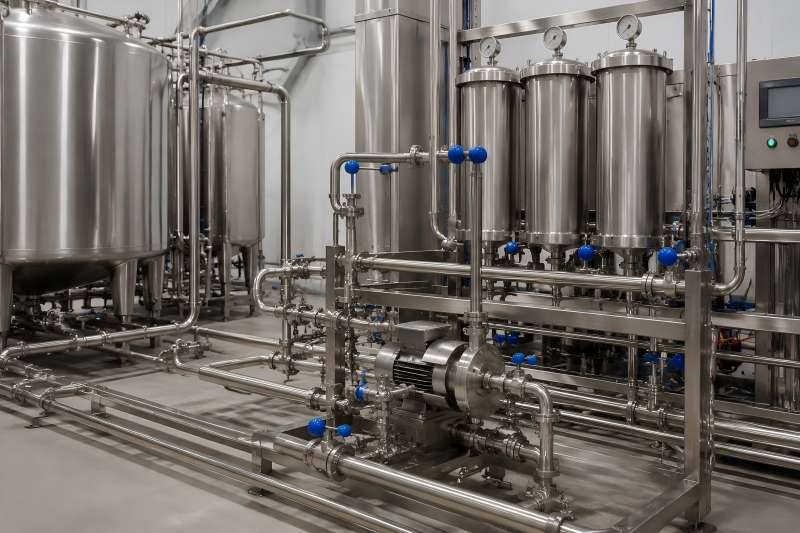
Small beverage factories may require compact CIP units, while large production plants usually need multi-tank automatic CIP systems.
| Production Scale | Recommended CIP Configuration |
| Small production | Single-tank or compact CIP |
| Medium production | Semi-automatic multi-tank CIP |
| Large production | Fully automatic multi-circuit CIP |
Juice Characteristics
Different juice products create different cleaning challenges.
Important factors include:
- Sugar content
- Pulp concentration
- Acidity
- Viscosity
- Production frequency
High-viscosity juices with fruit particles usually require stronger cleaning capability compared with clear beverages.
Automation Level
A modern CIP system can integrate with the control system of the juice filling line.
Automation functions may include:
- Automatic chemical dosing
- Temperature monitoring
- Flow control
- Cleaning recipe management
- Cleaning record tracking
Higher automation reduces operator errors and improves repeatability.
CIP System and Overall Juice Filling Line Design
A CIP system should not be considered as an independent cleaning device. It needs to work together with the entire juice filling line.
During equipment design, manufacturers should consider:
- Smooth pipeline layout
- Reduced dead corners
- Proper valve selection
- Drainage capability
- Compatible materials
For example, stainless steel pipelines with optimized internal surfaces allow cleaning solutions to flow more effectively.
A filling line designed for easy CIP cleaning will usually have better hygiene performance and lower maintenance requirements.