
The best filling nozzle for thick sauces is not simply the nozzle with the largest opening.
A good nozzle must provide enough flow for the required production speed while maintaining clean cutoff, accurate filling, and reliable particle passage.
For most high-viscosity sauces, large-port positive shut-off nozzles provide the strongest overall balance. Suck-back control helps reduce dripping and stringing, while straight product passages are important for sauces containing seeds or vegetable pieces.
When filling conditions become more demanding, diving nozzles can further improve package cleanliness and reduce air entrapment.
Ultimately, nozzle selection should be based on the complete filling process. Sauce viscosity, particle size, temperature, bottle opening, filling method, and production capacity must be considered together. When these factors are correctly matched, the nozzle becomes more than a simple outlet—it becomes one of the key components controlling the stability of the entire sauce filling machine.
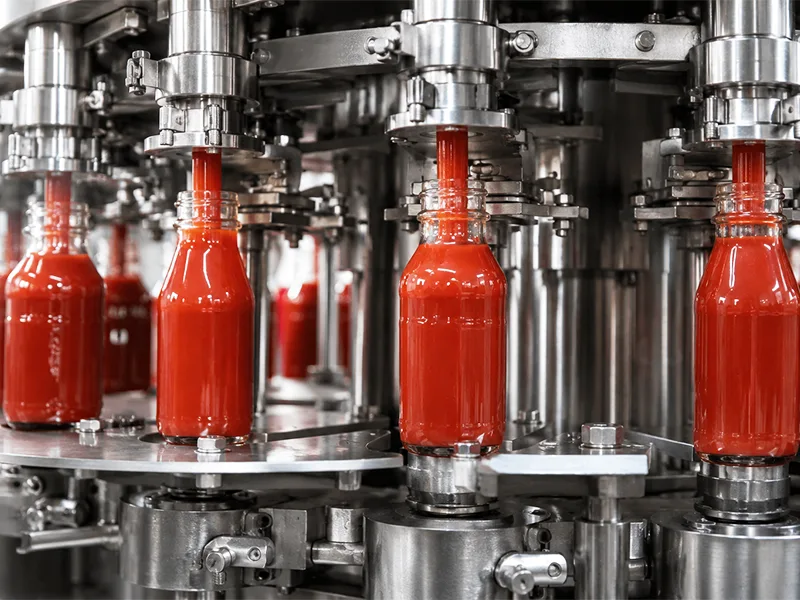
Why Thick Sauces Need Special Filling Nozzles
Water and other low-viscosity liquids flow easily through relatively narrow passages. Thick sauces create much more resistance.
As viscosity increases, several problems can appear:
- Filling speed decreases.
- Pressure inside the product path increases.
- Sauce may remain attached to the nozzle after filling.
- Seeds or vegetable particles may block narrow passages.
- Sudden product discharge can cause splashing.
- Inconsistent flow can reduce filling accuracy.
This means that nozzle design directly affects both production efficiency and package cleanliness.
For a filling machine running several thousand bottles per hour, even a small amount of sauce remaining on the nozzle after every cycle can become a significant sanitation and maintenance problem.
Large-Diameter Nozzles Are Usually the Starting Point
For thick sauces, increasing the internal diameter of the nozzle is one of the most effective ways to improve filling performance.
A larger flow passage reduces resistance and allows viscous products to move through the nozzle with less pressure.
Consider two filling nozzles handling the same sauce.
| Nozzle Configuration | Typical Effect with Thick Sauce |
| Narrow opening | Higher resistance, slower flow |
| Medium opening | Suitable for moderately viscous sauces |
| Large opening | Faster transfer of thick sauces |
| Large straight passage | Better for sauces containing particles |
The exact nozzle diameter cannot be selected only from the viscosity value. Bottle neck diameter and particle size also matter.
For example, if a sauce contains pepper seeds measuring approximately 3–4 mm, using a nozzle passage only slightly larger than the particles creates unnecessary blockage risk. The entire product path should provide enough clearance for particles to pass without accumulating.
In practice, nozzle diameter should therefore be matched with the largest ingredient particles, not merely the liquid portion of the sauce.
Positive Shut-Off Nozzles for Clean Filling
One of the biggest challenges in sauce packaging is dripping.
When a piston or pump finishes pushing sauce into the bottle, some product may remain inside the nozzle. Because thick sauces do not separate cleanly like water, they can continue hanging from the nozzle tip.
A positive shut-off nozzle solves this problem by mechanically closing the product passage at the end of each filling cycle.
Instead of relying only on gravity to stop the product, an internal valve cuts off the sauce flow.
This is particularly useful for:
- ketchup
- mayonnaise
- mustard
- chili sauce
- barbecue sauce
- concentrated dressings
- fruit sauces
The main advantage is cleaner bottle mouths. This is especially important when the bottle immediately enters a capping machine.
If sauce remains around the neck, it may interfere with cap sealing or create an unattractive finished package.
Suck-Back Nozzles Help Control Stringing
Some sauces do not drip in individual drops. This often happens with products containing gums, starches, sugars, or emulsified ingredients.
A suck-back nozzle introduces a small reverse movement after filling. When the filling cycle ends, a small volume of product is drawn backward into the nozzle.
This creates a cleaner break at the nozzle tip.
The amount of suck-back must be controlled carefully.
Too little reverse movement may not stop stringing. Too much can introduce air into the nozzle or affect the next filling cycle.
For servo piston filling machines, suck-back can often be coordinated with piston movement and nozzle closing. This allows the filling process to finish with a controlled product cutoff instead of an abrupt stop.
Diving Nozzles for Splashing and Air Control
Large nozzle diameter alone does not solve every problem.
Some thick sauces may still splash when discharged from a height, especially when filling wide bottles or containers.
During filling, the nozzle can remain near the rising product level and gradually move upward.
This design offers several practical advantages. It shortens the sauce’s drop distance. It can also reduce air entrainment, product splashing, and contamination of the bottle neck.
Diving filling is particularly useful for products where appearance matters.
For example, mayonnaise or creamy dressings can develop visible air pockets if they fall too far into the bottle. Controlled bottom-up filling can create a more uniform finished package.
However, diving mechanisms increase machine complexity and cycle time. They are therefore not necessary for every thick sauce.
If a bottle has a large opening and the product flows smoothly, fixed nozzles may provide higher efficiency.
Straight-Through Nozzles for Sauces with Particles
Chunky sauces require a different approach.
A sauce containing garlic pieces, chili seeds, onion fragments, herbs, or small vegetable particles can become difficult to fill when the nozzle contains narrow internal bends.
Even when the nozzle outlet is large, the internal valve design may create a smaller restriction.
For particle-containing sauces, the full product path should be examined.
The important dimensions include:
- filling valve opening
- hose diameter
- manifold passage
- nozzle internal diameter
- valve seat clearance
The smallest point in the entire system determines whether particles can pass reliably.
For these products, a large-port straight-through nozzle is usually preferable.
Reducing sharp turns and narrow chambers minimizes the chance that solids will accumulate inside the nozzle.
This also makes cleaning easier because sauce residues have fewer places to collect.
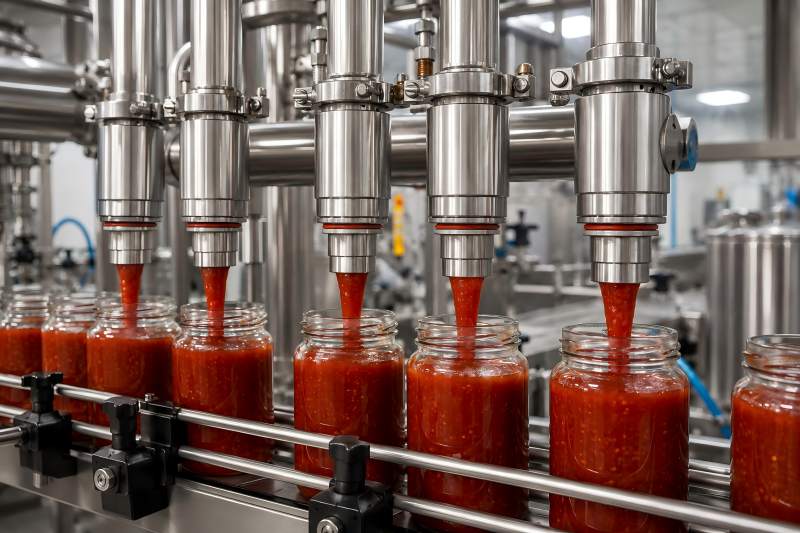
Nozzle Selection Depends on Filling Method
The filling nozzle cannot be selected independently from the filling system.
Servo Piston Filling
Servo piston systems are commonly used for thick sauces because they provide controlled volumetric displacement.
The piston pushes a defined amount of sauce toward the nozzle. Because the product is positively displaced, the filling machine can handle much higher viscosity than a simple gravity system.
For this configuration, large-port shut-off nozzles are often the most practical choice.
The nozzle opening needs to be large enough to allow the piston to discharge product without excessive pressure.
Pump Filling
Pump fillers can also handle sauces, particularly when continuous product transfer is needed.
The correct nozzle depends on the pump type.
A positive displacement pump can generate considerable pressure. If the nozzle is too narrow, pressure may increase unnecessarily, creating unstable flow or damaging delicate particles.
For this reason, pump capacity, hose diameter, and nozzle diameter should be designed as one system.
Gravity Filling
Gravity filling is less suitable for extremely thick sauces because the product depends mainly on its own weight to move.
For moderately viscous sauces, larger nozzles can help increase flow rate.
However, if the sauce becomes too thick, increasing nozzle size eventually provides limited improvement. At that point, a piston or pump system becomes more appropriate.
Filling Temperature Changes Nozzle Performance
Sauce viscosity is not always constant.
Many products become significantly thinner when heated.
A tomato sauce filled at 80°C may move through a nozzle much more easily than the same product at 25°C.
This means nozzle testing should be performed at the actual production temperature.
A nozzle selected based on room-temperature samples may be unnecessarily large for hot filling. Conversely, a nozzle tested with warm sauce may become too restrictive if the real production process fills at a lower temperature.
Temperature also affects dripping.
A sauce that separates cleanly when cold may become much more fluid when hot, increasing the need for positive shut-off control.
Bottle Neck Size Places a Practical Limit on Nozzle Diameter
Manufacturers often want the largest possible nozzle because it increases product flow.
But the bottle opening sets a physical limit.
The nozzle must enter or align with the bottle neck without causing contact problems.
For stable production, there should also be enough clearance between the nozzle and bottle opening to compensate for small bottle position variations.
If the nozzle diameter is too close to the neck diameter, bottles may collide with the filling head during high-speed operation.
Therefore, packaging should be considered early in machine configuration.
Changing from a 28 mm opening to a 45 mm opening can significantly expand nozzle design possibilities for thick sauces.
For this reason, bottle selection and filling equipment selection should ideally be coordinated rather than treated as separate purchasing decisions.
Larger Is Not Always Better
It is easy to assume that the largest nozzle is always best for viscous products.
That is not necessarily true.
A very large nozzle can discharge product too quickly. This may cause splashing, inconsistent cutoff, or poor control at small filling volumes.
Suppose a machine fills 100 mL sauce bottles. A very large nozzle may complete the main discharge quickly, but controlling the final few milliliters can become difficult.
For larger 1 L or 2 L containers, the same nozzle may be much more appropriate.
Nozzle selection therefore requires a balance between flow rate and filling control.
The ideal nozzle should allow enough flow to meet the target production speed without making the end of the filling cycle difficult to control.
A Practical Nozzle Selection Approach
Instead of selecting the nozzle only from a standard equipment catalog, sauce producers should evaluate several product characteristics together.
The first is viscosity. A moderately thick sauce may only need an enlarged shut-off nozzle, while an extremely thick paste may require a much larger product path.
The second is particle content. The maximum particle size often matters more than average viscosity because a single oversized ingredient can create blockage.
The third is filling temperature. Product behavior during production should be evaluated rather than relying on laboratory measurements alone.
The fourth is bottle geometry. Neck diameter, bottle height, and filling volume affect whether fixed or diving nozzles are appropriate.
Finally, the required capacity must be considered. A nozzle configuration suitable for 1,000 bottles per hour may become a bottleneck when the production target increases to 5,000 bottles per hour.
What Is the Best Nozzle for Most Thick Sauces?
For many industrial sauce applications, a practical starting configuration is:
a large-diameter sanitary nozzle with a positive shut-off valve and adjustable suck-back control.
If the sauce contains particles, the internal product passage should also be designed with large clearances and minimal restrictions.
For sauces that trap air or splash easily, a diving mechanism can be added.
This modular approach is usually more effective than trying to use one universal nozzle for every sauce.
A manufacturer filling smooth ketchup, chunky chili sauce, and mayonnaise on the same machine may even need interchangeable nozzle components or adjustable filling parameters for each product.