
Conventional layer palletizers suit stable, high-volume production. Robotic systems provide greater flexibility for multiple formats. Gantry and high-level systems offer additional layout and speed options.
The final decision should be based on packs per minute, pack stability, pallet pattern, product variety, floor space, and future capacity. When these factors are evaluated together, the palletizing system can support higher production efficiency, safer operation, and more reliable mineral water distribution.
Why Palletizing Becomes Critical at High Capacity
A mineral water line may produce bottles continuously for many hours. Even a small delay at the end of the line can cause packs to accumulate and eventually force upstream machines to slow down.
Consider a line producing 24,000 bottles per hour. If each shrink pack contains 24 bottles, the packaging section outputs about 1,000 packs per hour, or nearly 17 packs per minute. If one pallet holds 60 packs, the plant completes approximately 16 to 17 pallets every hour.
| Production Item | Illustrative Value |
| Filling line capacity | 24,000 bottles/hour |
| Bottles per shrink pack | 24 |
| Packs produced | 1,000 packs/hour |
| Packs per pallet | 60 |
| Finished pallets | 16–17 pallets/hour |
| Pallets in a 10-hour shift | 160–170 pallets |
These figures are planning examples. Actual output depends on bottle size, pack configuration, pallet dimensions, and line efficiency.
Manual workers must repeatedly lift, rotate, align, and stack packs while keeping the pallet pattern consistent. As production continues, fatigue may reduce placement accuracy, increase package damage, and create workplace safety risks.
An automatic palletizing system provides a more stable operating rhythm. It also allows the filling, labeling, and packaging machines to continue running closer to their designed capacities.
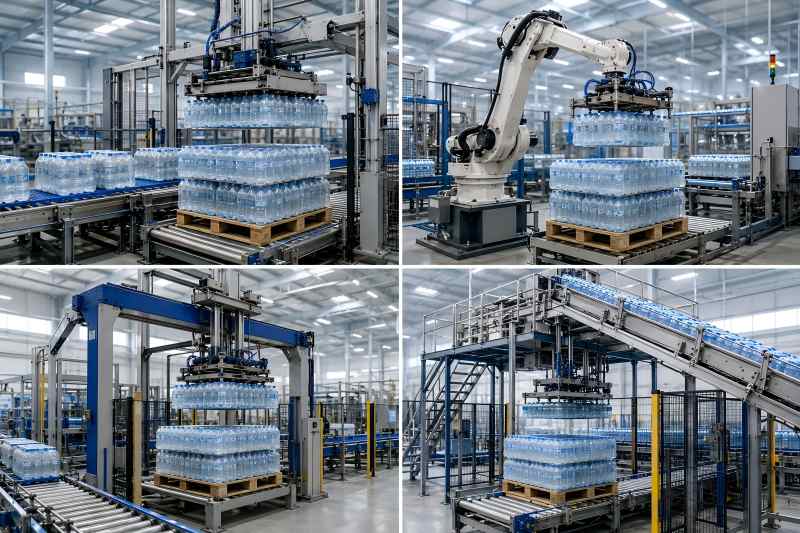
Main Palletizing System Options
High-capacity mineral water plants commonly use four palletizing approaches. Each has a different balance of speed, flexibility, space requirement, and investment.
1. Conventional Layer Palletizer
A conventional palletizer arranges packs into complete rows or layers before transferring each layer onto the pallet. It is suitable for plants producing large quantities of the same bottle and pack format.
Its main advantage is stable high-speed operation. Because an entire layer is placed at one time, it can handle large pack volumes efficiently.
Conventional systems are particularly suitable for standardized shrink-wrapped mineral water packs. However, format changes may need extra space and mechanical adjustments.
2. Robotic Palletizer
A robotic palletizer uses a programmable arm and gripper to handle packs. It offers greater flexibility when the plant handles different bottle sizes, pack patterns, or pallet formats.
Pattern changes can often be completed through recipe selection. A robot may also serve two packaging lines when the layout and cycle time permit.
For extremely high output, however, a single robot may not provide enough capacity. Multi-pack gripping, row gripping, dual robots, or separate palletizing cells may be required.
3. Gantry Palletizer
A gantry palletizer moves along horizontal and vertical axes above the palletizing area. It provides controlled pack placement and can suit plants where floor space is limited but overhead space is available.
This structure can serve several pallet positions while keeping much of the operating area clear. It is less flexible than a six-axis robot, but it performs well with repeatable patterns and moderate-to-high production rates.
4. High-Level Palletizer
A high-level palletizer receives packs from an elevated conveyor and forms rows or complete layers before placing them onto the pallet. It is often selected for very fast lines because continuous pack flow supports rapid layer formation.
This system requires more building height and structural planning. However, it can provide excellent speed for standardized mineral water packs produced continuously.
| System Type | Best Application | Relative Speed | Flexibility | Space Requirement |
| Conventional layer palletizer | Stable, high-volume production | High | Medium-Low | High |
| Robotic palletizer | Multiple formats and patterns | Medium-High | High | Medium |
| Gantry palletizer | Repeatable patterns in compact layouts | Medium-High | Medium | Medium-Low |
| High-level palletizer | Very fast, continuous pack flow | Very High | Medium | High |
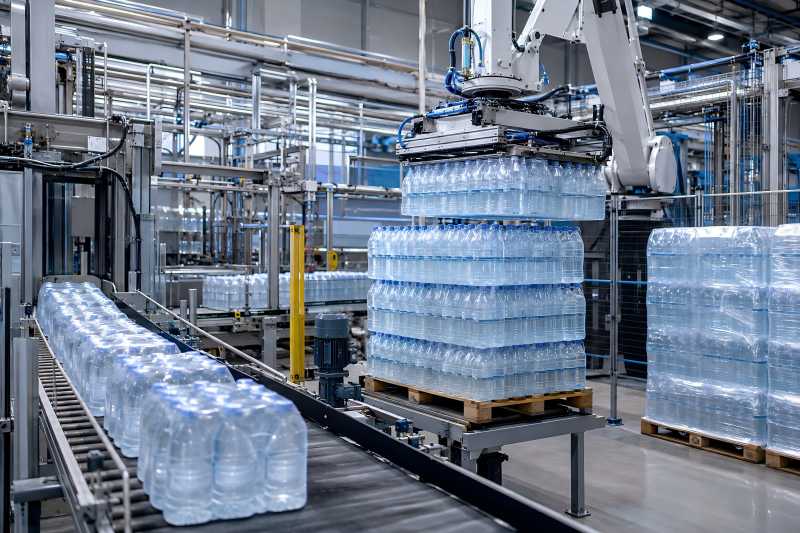
Key Factors in Palletizing System Selection
1. Pack Type and Stability
Mineral water is commonly packed in shrink film, cartons, trays, or film-wrapped trays. Each format behaves differently during lifting and stacking.
Shrink packs may deform if the gripper applies uneven pressure. Cartons are more rigid, but they may crush under excessive compression. Trays provide bottom support but may shift if the upper film is loose.
The palletizer should therefore be tested with actual production packs rather than only drawings or dimensions. Film tension, bottle arrangement, moisture, surface friction, and pack consistency can all influence gripping performance.
2. Required Throughput
Palletizer capacity should be calculated from packs per minute rather than bottles per hour.
Pack output = Bottle output ÷ Bottles per pack
A 36,000-bottle-per-hour line using 12-bottle packs produces 3,000 packs per hour, or 50 packs per minute. The same bottle output using 24-bottle packs produces only 25 packs per minute.
Therefore, two filling lines with the same bottle capacity may require very different palletizing equipment.
The selected system should also include a reasonable capacity margin. Designing exactly at average output leaves little room for production peaks, pallet changes, conveyor recovery, or short interruptions.
A planning margin of approximately 10% to 20% above normal pack output can improve operating stability, provided the rest of the packaging line supports the additional speed.
3. Pallet Pattern and Load Stability
The goal is not simply to place the maximum number of packs on a pallet. The completed load must remain stable during forklift handling, warehouse movement, and truck transportation.
Important pattern decisions include:
- Packs per layer
- Number of layers
- Alternating layer direction
- Pallet height
- Edge alignment
- Central gaps
- Use of layer pads
- Total pallet weight
Interlocking patterns generally provide better stability but may reduce packing density. Column stacking uses pallet space efficiently, but the load may require stronger stretch wrapping or additional layer pads.
Tall pallets can increase warehouse and truck space utilization. However, they also raise the center of gravity and may increase pressure on the lowest pack layers.
4. Available Floor Space
The required area includes more than the palletizer itself. A complete layout may also contain accumulation conveyors, an empty pallet dispenser, safety fencing, layer-pad storage, a stretch wrapper, full-pallet conveyors, and forklift lanes.
Maintenance access must also be considered. A compact robotic cell may fit a smaller building, but placing support equipment too close together can make cleaning, inspection, and part replacement difficult.
Plants should evaluate both floor area and building height. A high-level palletizer may reduce congestion at ground level, but it requires elevated conveyors and stronger supporting structures.
5. Product Change Frequency
A plant producing only one 500 mL bottle may prioritize maximum speed. A plant filling 330 mL, 500 mL, 1.5 L, and 5 L bottles needs faster changeovers and greater recipe flexibility.
Changeover evaluation should include:
- Gripper adjustment
- Conveyor guide adjustment
- Pallet pattern selection
- Layer-pad settings
- Pallet size changes
- Stretch-wrapper settings
Software recipes are valuable only when the required mechanical adjustments are also simple. A machine with flexible programming may still create long downtime if guides, grippers, and conveyors require complicated manual changes.
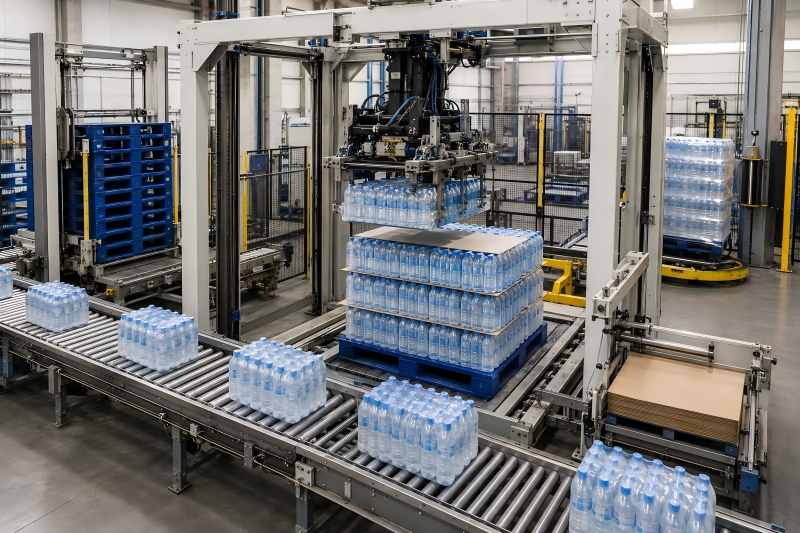
Integration with the Packaging Line
A palletizer cannot perform well if the pack conveyor delivers unstable, crowded, or misaligned products. Good integration begins before packs enter the palletizing cell.
Pack Accumulation
Accumulation conveyors provide a temporary buffer between the shrink wrapper or cartoner and the palletizer. This allows the packaging machine to continue running during short pallet changes or minor interruptions.
Too little accumulation can cause frequent upstream stops. Excessive conveyor pressure can deform shrink-wrapped packs.
Controlled conveyor zones and low-pressure accumulation help maintain pack spacing and shape. Sensors should also provide the palletizer with accurate information about pack position and flow.
Empty Pallet Handling
An automatic pallet dispenser stores and releases empty pallets one at a time. It reduces manual handling and allows the palletizing cycle to continue with fewer interruptions.
Pallet quality must be controlled because broken boards, uneven height, or incorrect dimensions can interrupt automatic operation.
Wooden pallets should be inspected before entering the system. Plastic pallets provide more consistent dimensions and cleaner handling, but they generally require a higher initial investment.
Layer Pads and Slip Sheets
Layer pads improve load stability and distribute pressure between pack layers. They are especially useful for tall pallets, smooth shrink film, or products transported over long distances.
An automatic sheet dispenser can place cardboard or plastic sheets between selected layers. However, this adds another consumable and another machine movement to the palletizing cycle.
The plant should determine whether the improvement in stability justifies the extra material and operating cost.
Stretch Wrapping and Labeling
After stacking, the full pallet normally moves to a stretch wrapper. The wrapping program should match the pallet height, pack strength, and transport conditions.
Excessive film tension can deform or crush mineral water packs. Low tension can cause the pallet load to shift during handling.
A pallet label can then identify the product, production batch, quantity, warehouse location, and shipment destination. This helps connect the palletizing system with inventory and traceability management.
Example Capacity Planning
The following table shows how pack format changes palletizer demand even when bottle output remains the same.
| Bottle Output | Bottles per Pack | Pack Output | Approximate Demand |
| 24,000 bottles/hour | 24 | 16.7 packs/minute | Moderate |
| 24,000 bottles/hour | 12 | 33.3 packs/minute | High |
| 36,000 bottles/hour | 24 | 25 packs/minute | High |
| 36,000 bottles/hour | 12 | 50 packs/minute | Very high |
A very-high-demand application may require a high-level layer palletizer, two robotic arms, row gripping, or separate palletizing cells.
Plants should also calculate complete pallets per hour. This determines the required speed of empty pallet supply, full-pallet discharge, stretch wrapping, and forklift collection.
Common Palletizing Problems
1. Unstable Pallets
Unstable loads often result from an unsuitable pattern, inconsistent pack dimensions, weak shrink film, missing layer pads, or poor stretch wrapping.
The solution should address the complete package rather than only changing the palletizer program. Pack quality and pallet quality are equally important.
2. Pack Damage
Damage may occur when conveyors apply too much pressure, grippers squeeze the pack, or layers are placed too quickly.
Controlled acceleration, adjustable gripping force, and softer contact surfaces can reduce pack deformation. The machine should handle the product securely without applying unnecessary pressure.
3. End-of-Line Bottlenecks
A palletizer may have sufficient theoretical speed but still restrict production because pallet replacement, sheet placement, wrapping, or full-pallet discharge takes too long.
Capacity analysis should therefore include the complete cycle. Evaluating only robot pick-and-place speed can produce an unrealistic result.
4. Frequent Sensor Alarms
Mineral water plants may have wet floors, reflective film, and transparent packaging. These conditions can affect product detection.
Suitable sensors, correct installation angles, and protected cable connections help reduce false alarms and unexpected stops.
5. Difficult Changeovers
Complex recipes and too many manual settings can extend downtime. Clearly marked guides, stored patterns, standard adjustment points, and changeover checklists improve repeatability.
Labor and Operating Impact
Automatic palletizing does not remove the need for employees, but it changes their role. Instead of repeatedly lifting packs, operators manage pallets, consumables, alarms, product changes, and quality checks.
| Item | Manual Palletizing | Automatic Palletizing |
| Direct palletizing operators | 4–8 | 1–2 |
| Load consistency | Operator-dependent | Repeatable |
| Changeover method | Manual instructions | Recipes plus adjustments |
| Fatigue risk | High | Low |
| Production data | Limited | Available through controls |
These values are illustrative. Actual labor requirements depend on plant layout, shift pattern, local working methods, pallet transportation, and the automation level of surrounding equipment.
Automatic palletizing can also improve workforce allocation. Employees previously assigned to repetitive lifting may be moved to quality inspection, material preparation, maintenance support, or warehouse management.
Evaluating Return on Investment
The cheapest equipment does not always deliver the lowest operating costs. A stable and easy-to-maintain system may provide better long-term value than a faster machine that is difficult to operate or support.
Plants should evaluate:
- Annual production hours
- Labor replacement or reassignment
- Product damage reduction
- Pallet and stretch-film consumption
- Maintenance requirements
- Spare-part availability
- Changeover time
- Future expansion capacity
The return on investment is usually strongest when the palletizer removes an existing bottleneck and allows the filling line to operate closer to its designed output.
For example, increasing effective line operation from 80% to 88% may create more value than reducing palletizing labor alone. Therefore, the investment should be evaluated as part of the complete production line rather than as an isolated machine.