
A juice plant does not always need to be rebuilt from the ground up when production demand increases. In many cases, the better approach is to upgrade the existing factory step by step, keeping useful equipment while improving the parts of the production line that have become bottlenecks.
For many small and medium juice manufacturers, the original plant may have started with relatively simple equipment, manual bottle handling, separate rinsing, filling and capping machines, and limited automation. This configuration works well during the early stage of production, but it can become increasingly difficult to manage as sales grow.
An effective juice plant upgrade should therefore focus on more than simply buying a faster machine. Factory layout, juice processing capacity, bottle handling, filling technology, sanitation, automation and downstream packaging all need to develop together.
1. Start by Finding the Real Bottleneck
Before replacing equipment, first determine which part of the juice production process is limiting the factory.
A plant may have enough juice preparation capacity but an undersized filling machine. Another factory may install a faster filler while its bottle feeding or pasteurization system remains too slow.
Typical bottlenecks include:
- Insufficient juice preparation capacity
- Slow bottle rinsing and filling
- Excessive manual bottle transfer
- Frequent product changeover
- Unstable capping
- Limited conveyor capacity
- Manual labeling and packing
- Long cleaning cycles
- Poor coordination between machines
For example, suppose an existing plant produces around 3,000 bottles per hour. The juice preparation system may already be capable of supplying enough product for 6,000 bottles per hour, while the old filling section only handles 3,000 bottles per hour.
In this situation, replacing the entire processing system would create unnecessary investment. Upgrading the filling and packaging sections first would provide a much better return.
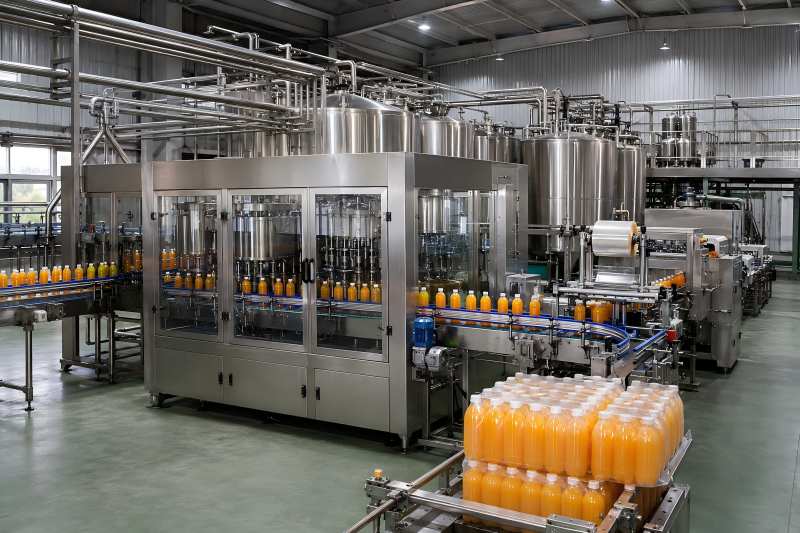
2. Reconsider the Factory Layout Before Adding Machines
Factory space is often one of the biggest limitations when upgrading an operating juice plant.
Older factories are usually arranged according to the original production volume. As more machines are added over time, conveyors become longer, operators walk between different sections, and material movement becomes increasingly complicated.
Before installing new equipment, divide the factory into clear process areas.
A practical layout may include:
- Raw material and ingredient preparation
- Juice mixing and processing
- Bottle preparation
- Rinsing, filling and capping
- Pasteurization or cooling where required
- Labeling and coding
- Secondary packaging
- Finished product storage
Empty bottles should enter from one side of the filling area, while finished cartons or shrink-wrapped packages leave from the opposite side whenever factory conditions allow. Avoid unnecessary crossings between raw materials, empty bottles, operators and finished products.
A better layout can sometimes improve actual plant output even before production equipment is replaced.
3. Upgrade the Filling Section to a 3-in-1 Filling Machine
For many bottled juice plants, the filling section is the most important part of an upgrade.
Older production lines often use three independent machines:
- Bottle rinsing machine
- Juice filling machine
- Bottle capping machine
Bottles are transferred between these machines through conveyors. This configuration is simple, but it requires more factory space and creates more bottle transfer points.
When production capacity increases, these transfer points can become a source of bottle jams, instability and additional labor.
A 3-in-1 juice filling machine combines rinsing, filling, and capping in one integrated unit. The bottle enters the machine, is rinsed, transferred directly to the filling station and then capped before leaving the machine.
Why Upgrade to a 3-in-1 System?
Its benefits go beyond higher filling speed.
Integration reduces the number of independent bottle transfers. This makes the filling process more compact and helps maintain more consistent bottle movement.
A typical comparison looks like this:
| Item | Separate Machines | 3-in-1 Filling Machine |
| Rinsing | Independent machine | Integrated |
| Filling | Independent machine | Integrated |
| Capping | Independent machine | Integrated |
| Bottle transfer | Multiple conveyors | Internal transfer |
| Floor space | Larger | More compact |
| Operator requirement | Higher | Lower |
| Line synchronization | More difficult | Easier |
| Automation potential | Moderate | High |
For factories moving from semi-automatic production toward fully automatic production, the 3-in-1 machine often becomes the central equipment of the upgraded filling line.
4. Select the Filling Technology According to the Juice
One mistake during an upgrade is choosing a filling machine only according to bottles per hour.
Juice characteristics also determine filling system design.
Clear fruit drinks with relatively low viscosity behave differently from juice containing pulp, fibers or suspended particles. Hot-filled juice also requires different machine configuration from a product filled at normal temperature.
Important factors include:
- Juice viscosity
- Pulp or particle content
- Filling temperature
- Bottle material
- Bottle neck design
- Required filling accuracy
- Product foaming characteristics
- Production capacity
For relatively free-flowing juice, gravity or controlled flow filling may provide efficient operation.
For thicker juice or products containing more pulp, the filling valve and product passage need to be designed with sufficient diameter to reduce restrictions.
If the juice requires hot filling, the product tank, filling valves, pipelines and circulation system should also be designed for continuous operation at the required temperature.
The correct upgrade is therefore not simply replacing a small filler with a larger one. The filling system should match both the juice and the production target.
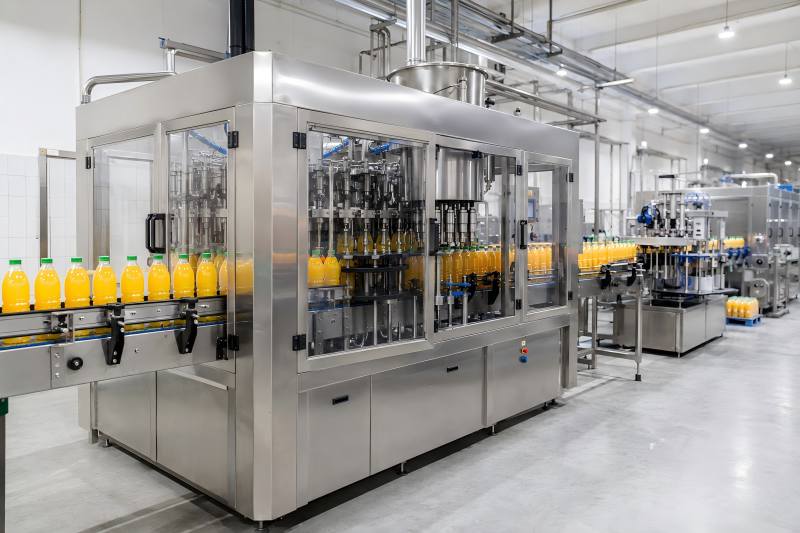
5. Upgrade Bottle Handling at the Same Time
A new 3-in-1 filling machine cannot achieve its rated capacity if operators still place bottles manually onto the conveyor.
Bottle feeding should therefore be evaluated together with the filler.
A smaller plant may originally use manually arranged bottles. When output increases, an automatic bottle unscrambler or bottle feeding system can provide a continuous supply of containers.
The transition may look like this:
Before upgrading
Manual bottle loading → bottle rinsing → filling → manual capping → labeling → manual packing
After upgrading
Automatic bottle feeding → 3-in-1 rinsing, filling and capping → labeling → coding → automatic packaging
This change reduces repetitive manual handling while creating a more predictable production rhythm.
It also allows fewer operators to supervise larger sections of the line.
6. Check Whether Juice Processing Capacity Can Support the New Filler
Increasing filling capacity creates additional demand upstream.
If the original line produced 3,000 bottles per hour and the upgraded filling machine produces 8,000 bottles per hour, juice preparation must supply enough product continuously.
Suppose the bottle size is 500 ml.
At 3,000 bottles per hour, theoretical product demand is approximately:
3,000 × 0.5 L = 1,500 L/hour
At 8,000 bottles per hour:
8,000 × 0.5 L = 4,000 L/hour
Actual process design should include appropriate production margin, but this simple calculation shows why upgrading only the filler can create a new bottleneck upstream.
Check the capacity of:
- Mixing tanks
- Syrup preparation tanks
- Filters
- Homogenizers
- Pasteurizers
- Buffer tanks
- Product pumps
- Sanitary pipelines
If some existing equipment still has enough capacity, it can remain in operation.
Upgrade only the sections that cannot support the new production target.
7. Improve Sanitary Design During the Upgrade
Higher production capacity means more product passes through the same factory every day. Cleaning efficiency therefore becomes increasingly important.
Older systems may contain long connecting hoses, manually cleaned tanks or pipelines with unnecessary bends.
During an upgrade, the plant should simplify product transfer wherever possible.
Sanitary stainless steel pipelines can connect processing tanks directly to the filling machine. Pumps, valves and product contact parts should also be selected according to the juice and cleaning requirements.
Larger juice plants can use CIP systems to improve cleaning efficiency and consistency.
Instead of dismantling every product-contact component after production, controlled cleaning solutions can circulate through tanks, pipelines and selected processing equipment.
This becomes especially valuable when the factory produces several juice flavors and requires frequent product changes.
8. Upgrade Labeling and Packaging According to the New Speed
Downstream equipment is often overlooked during filling machine upgrades.
If a new 3-in-1 machine doubles production capacity but the old labeling machine remains unchanged, bottles will quickly accumulate after filling.
The same problem can occur at the packaging section.
Before increasing filling speed, check:
- Labeling machine speed
- Date coding capacity
- Conveyor width and speed
- Shrink wrapping or carton packing capacity
- Case conveyor capacity
- Palletizing requirements
Not every plant needs a robotic palletizer immediately.
For medium-capacity factories, automatic labeling and shrink wrapping may provide enough improvement while palletizing remains manual. When production volume grows further, automatic case packing or robotic palletizing can be added later.
This phased approach keeps the investment aligned with actual production demand.
9. Design the Upgrade for Future Expansion
A factory should not be upgraded only for today’s order volume.
If current demand is 4,000 bottles per hour and sales are growing steadily, installing equipment with a maximum practical capacity of exactly 4,000 bottles per hour leaves little room for expansion.
It may be more practical to design the line around 6,000 or 8,000 bottles per hour while initially operating below maximum speed.
Not every machine needs excess capacity. Instead, important infrastructure should leave enough flexibility for future development, including:
- Main product pipelines
- Electrical capacity
- Compressed air supply
- Conveyor layout
- Factory floor space
- Utility connections
- Control cabinet capacity
Planning these details during the first upgrade is usually easier than modifying them again after several years.
10. Move from Individual Machines to Line-Level Control
Another important difference between a small juice plant and an upgraded automatic plant is how equipment communicates.
In a simple line, operators may start and stop each machine separately.
As production speeds increase, machines should operate as a coordinated system.
For example, if the labeling machine stops, conveyors can temporarily accumulate bottles while the filling section receives a control signal. If downstream accumulation reaches its limit, the filler can slow down or stop automatically.
Sensors can detect:
- Missing bottles
- Bottle accumulation
- Low cap levels
- Missing caps
- Conveyor jams
- Product tank level
- Machine faults
This type of coordination helps protect production stability and reduces the need for operators to constantly adjust individual machines.
11. A Practical Juice Plant Upgrade Example
Consider a juice manufacturer that originally started with a semi-automatic line.
The existing configuration includes:
- Manual bottle feeding
- Separate bottle rinser
- 3,000 BPH filling machine
- Independent capping machine
- Basic labeling machine
- Manual shrink packing
As market demand grows, the company wants to reach approximately 8,000 bottles per hour.
Instead of constructing an entirely new factory, the production line could be reorganized around the following equipment:
Automatic bottle feeding → 8,000 BPH 3-in-1 rinsing, filling and capping machine → automatic labeling → date coding → shrink wrapping → finished product conveyor
The existing juice preparation tanks can remain if their capacity is sufficient. Product pumps or pasteurization equipment can be upgraded separately where required.
The result is not simply a faster filler.
Bottle transfer becomes shorter, the filling area becomes more compact, manual handling decreases and future packaging automation becomes easier to integrate.
Upgrade the Process, Not Just the Machine
The most effective juice plant upgrade is rarely based on replacing one machine in isolation.
Production capacity depends on how juice preparation, bottle feeding, rinsing, filling, capping, labeling and packaging work together.
For many growing factories, upgrading from separate or semi-automatic filling equipment to a 3-in-1 rinsing, filling and capping machine is an important step toward full automation. However, the factory layout, upstream juice supply, bottle handling and downstream packaging should be evaluated at the same time.
A well-planned upgrade allows manufacturers to reuse suitable existing equipment while investing in the areas that create the greatest production improvement.
Instead of rebuilding the entire juice plant, manufacturers can expand in stages, moving from manual or semi-automatic production toward a more compact, hygienic and automated juice filling line as market demand grows.