
Choosing a filling nozzle should start with the liquid rather than a standard nozzle catalogue. Viscosity determines how easily the product flows, but foam behavior, particles, surface tension, temperature, hygiene requirements and chemical compatibility determine how that flow must be controlled.
Bottle geometry and production speed then define the practical nozzle diameter, movement and filling profile.
For straightforward water-like products, nozzle selection can be relatively simple. For foaming detergents, viscous cosmetics, sauces with particles or aggressive chemicals, it becomes part of the core filling-system design.
Why the Filling Nozzle Matters
During filling, the nozzle is the final point where controlled liquid flow becomes actual product inside the container. Any instability here directly affects the finished package.
A poorly matched nozzle can cause several practical problems:
- Liquid dripping onto bottle necks or conveyors
- Excessive foam and inaccurate final levels
- Splashing at high filling speeds
- Product stringing after nozzle shutoff
- Clogging when filling liquids containing particles
- Slow filling of viscous products
- Bottle contamination during nozzle withdrawal
- Difficult cleaning and sanitation
This is why two liquids with similar filling volumes may require completely different nozzle structures.
Water and shampoo, for example, may both be filled into 500 mL bottles, but their flow behavior is very different. Designing both around the same nozzle diameter and shutoff mechanism can unnecessarily limit machine performance.
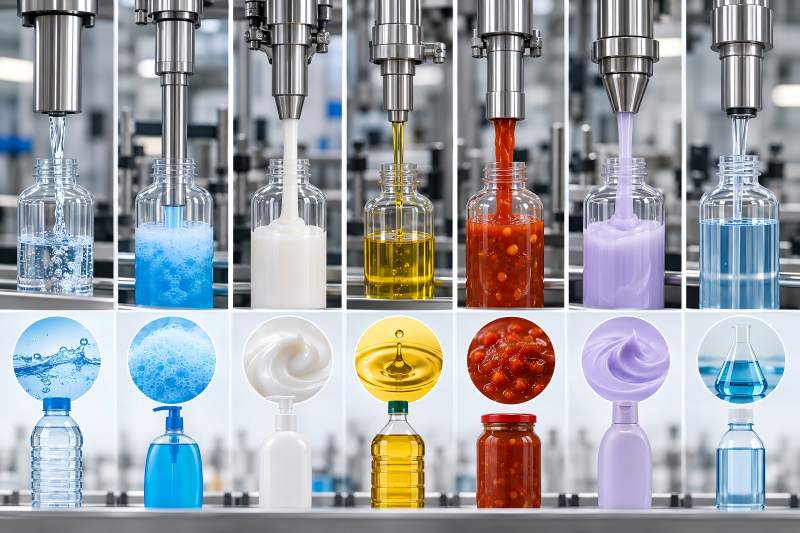
Start With the Liquid, Not the Nozzle
Before selecting a nozzle, define how the product actually behaves during filling.
| Product Characteristic | Why It Matters for Nozzle Selection |
| Low viscosity | Higher risk of dripping and splashing |
| High viscosity | Requires larger flow passages and better shutoff |
| Foaming tendency | Consider bottom-up filling to minimize foaming |
| Sticky/stringy product | Benefits from positive shutoff |
| Particles/pulp | Requires sufficient internal passage |
| Hot product | Nozzle materials and seals must tolerate temperature |
| Corrosive liquid | Wetted materials need chemical compatibility |
| Hygienic product | Nozzle must support sanitary cleaning |
| Volatile liquid | Flow control and filling method become more important |
Viscosity matters, but other product characteristics are equally important for nozzle selection. Foaming, surface tension, particles, temperature and product cleanliness can be equally important.
Free-Flow Nozzles for Water-Like Liquids
Low-viscosity products such as water, some beverages, light detergents, solvents and thin cleaning liquids move easily through relatively small passages.
The challenge is usually not getting the product through the nozzle. The challenge is stopping it cleanly.
Thin liquids can continue dripping after the filling valve closes. At higher flow rates, they may also splash against the bottle bottom or walls.
For these products, a relatively narrow, well-controlled nozzle with a fast shutoff mechanism is often preferable.
Typical applications include:
- Water
- Juice without pulp
- Thin liquid cleaners
- Light oils
- Some chemicals
- Alcohol-based products
For high-speed production, nozzle geometry should also minimize turbulence. Increasing nozzle diameter can reduce liquid velocity, but making the nozzle unnecessarily large may create poor control at the end of the filling cycle.
The best design balances flow rate and cutoff accuracy rather than maximizing either one independently.
Diving Nozzles for Foaming Products
Foam is one of the most common reasons a filling machine fails to reach its expected speed.
Products such as detergents, shampoos, liquid soaps and certain beverages can trap air when the liquid stream falls from the nozzle into the container.
A diving nozzle addresses this by entering the bottle before filling begins. The nozzle fills from the bottom and rises with the liquid level.
This reduces the distance the product falls and can significantly control foam formation.
A typical sequence is:
Nozzle enters bottle → filling starts near bottom → nozzle rises with liquid level → flow slows near target volume → nozzle closes → nozzle exits
The nozzle movement should be coordinated with the filling profile. Simply placing a long nozzle inside the bottle does not automatically eliminate foam.
In many applications, a two-stage filling speed works better. High flow is used during the main fill, followed by slower flow near the final volume.
Positive Shutoff Nozzles for Viscous Products
Thick products create a different problem.
Honey, syrup, cream, shampoo, sauce, lotion and similar materials may continue stretching from the nozzle after the filling cycle ends. Instead of a clean break, the product forms a string between the nozzle and container.
A positive shutoff nozzle closes the product path directly at or near the nozzle tip.
This can improve:
- Cutoff consistency
- Bottleneck cleanliness
- Filling accuracy
- Conveyor cleanliness
- Product recovery
The nozzle passage also needs to be large enough for the required flow.
Using a small nozzle for a thick product increases pressure drop and forces the pump or piston system to work harder. The machine may technically achieve the correct volume but require an unnecessarily long filling time.
For viscous products, therefore, nozzle selection should consider internal diameter, flow resistance and shutoff behavior together.
Nozzles for Sauces and Products Containing Particles
Particle-containing liquids require special attention.
Examples include sauces with small vegetable pieces, fruit preparations, pulp-containing beverages and certain food products.
The most important consideration is usually the minimum internal passage.
A nozzle opening that is only slightly larger than the largest expected particle may still clog because several particles can enter the restriction simultaneously.
As a practical engineering approach, the product’s largest normal particle should be identified first, followed by abnormal agglomerates that may occasionally reach the filler.
| Product | Nozzle Priority |
| Smooth sauce | Large passage + clean cutoff |
| Sauce with particles | Unrestricted product path |
| Juice with pulp | Passage size + gentle flow |
| Thick fruit preparation | Large bore + positive shutoff |
| Suspension | Flow consistency + anti-settling considerations |
The filling valve, piping, pump and nozzle should all be checked. Installing a large-bore nozzle provides little benefit if an upstream valve contains a smaller restriction.
Anti-Drip Nozzles for Oils and Thin Chemicals
Edible oils, lubricants and certain chemical liquids may not foam significantly but can create persistent dripping.
Even a few drops per bottle become a serious issue on a high-output line. Oil on the bottle surface can interfere with labeling, while chemical products may create safety and cleanliness problems.
An anti-drip nozzle uses mechanical shutoff, valve design, suction-back, or a combination of these methods to reduce residual liquid after filling.
The important distinction is that anti-drip performance should be tested with the actual product.
A nozzle that works perfectly with water may behave differently with cooking oil because viscosity and surface tension affect how liquid separates from the nozzle tip.
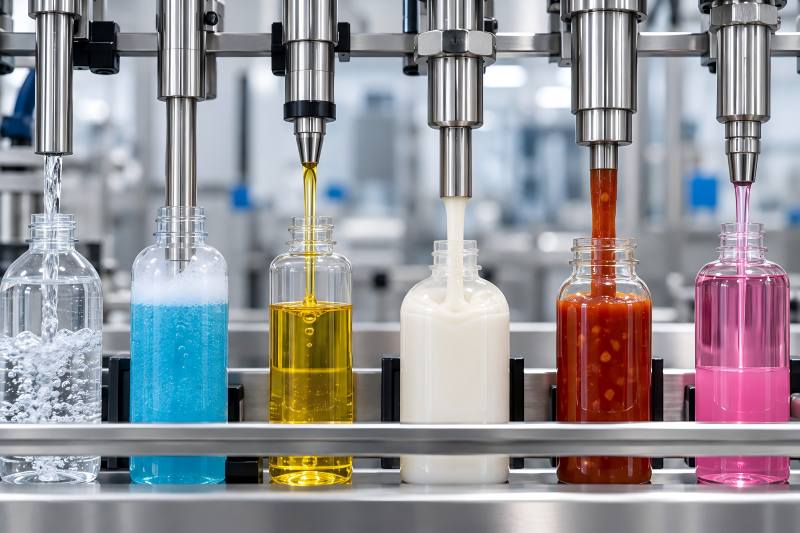
Filling Nozzles for Cosmetics and Personal Care
Cosmetics are particularly demanding because packaging appearance matters almost as much as filling accuracy.
Products such as lotion, serum, shampoo, conditioner and liquid cream can vary from almost water-like to extremely viscous.
For these products, the nozzle often needs:
- Clean positive cutoff
- Accurate low-volume control
- Smooth internal surfaces
- Easy sanitation
- Minimal product retention
- Appropriate diving capability
Container geometry is also important. Cosmetic bottles frequently have narrow necks or decorative packaging that leaves little clearance.
A nozzle should therefore be selected around the usable bottle opening, not merely the nominal neck diameter.
Food and Beverage Filling Nozzle Selection
Food applications introduce sanitation requirements that may be less important in general chemical filling.
The nozzle should avoid unnecessary dead spaces where product can accumulate. Wetted surfaces should be smooth and accessible to the required cleaning procedure.
Depending on the application, sanitary stainless steel construction and food-compatible seals may be required.
For dairy products, sauces, beverages and other hygiene-sensitive products, nozzle selection should be evaluated as part of the complete sanitary filling system rather than as an isolated component.
A beautifully polished nozzle does not make a machine hygienic if the valve behind it contains difficult-to-clean cavities.
Nozzles for Corrosive or Aggressive Chemicals
Chemical compatibility changes the selection process considerably.
Acids, alkaline cleaners, disinfectants and aggressive chemicals can attack nozzle bodies, seals, O-rings and valve components.
Wetted materials should match the liquid’s chemical properties and filling temperature to ensure safe, reliable operation.
Common engineering options may include different stainless-steel grades and specialized polymers or elastomers depending on the application.
Check material compatibility with both the product and cleaning chemicals. A seal that tolerates the filled liquid may still deteriorate when exposed repeatedly to the cleaning solution.
Nozzle Diameter Is a Production Decision
One of the easiest mistakes is treating nozzle diameter as a simple bottle-opening question.
Diameter directly influences flow velocity, filling time and pressure drop.
A larger nozzle generally allows higher flow at lower velocity, which can be useful for viscous or foaming products. But bottle neck clearance places a physical limit on nozzle size.
A useful design relationship is:
Required production speed → available filling time → required flow rate → suitable nozzle passage
Consider a 1 L bottle.
If the available actual filling time is 4 seconds, the average liquid delivery rate during filling must be approximately 15 L/min per active nozzle. If filling time is reduced to 2 seconds, that requirement roughly doubles.
This does not mean the nozzle alone determines capacity. Pumps, pistons, flowmeters, valves and piping must also support the required rate.
It does show why nozzle selection should be connected to production capacity calculations.
Match the Nozzle to the Filling Technology
Different filling principles also influence nozzle requirements.
| Filling Technology | Typical Nozzle Consideration |
| Gravity filling | Flow control and clean shutoff |
| Piston filling | Large passage for viscous products |
| Pump filling | Match nozzle restriction to pump characteristics |
| Flowmeter filling | Stable flow profile and cutoff |
| Net-weight filling | Accurate flow control near target weight |
| Overflow filling | Nozzle design is integral to level control |
For example, a piston filler designed for thick sauce benefits little from a large cylinder and powerful actuator if the product is forced through a restrictive nozzle.
Similarly, a high-accuracy flowmeter filler needs predictable cutoff behavior because uncontrolled dripping after valve closure creates an error that the meter cannot correct.
Bottle Geometry Cannot Be Ignored
The nozzle must physically interact with the container hundreds or thousands of times per hour.
Important dimensions include bottle opening diameter, neck height, container height and the distance between adjacent bottles.
For diving filling, the internal bottle geometry matters as well.
A nozzle that enters a cylindrical bottle easily may interfere with a shoulder or internal neck transition on another container.
Enough clearance should also remain to accommodate normal bottle dimensional variation and positioning tolerances.
Designing with almost zero clearance may work during a factory demonstration but become unreliable during continuous production.
Different SKUs May Require Different Nozzles
More factories need one filling machine to handle various products and container sizes efficiently.
This is possible, but expecting a single nozzle configuration to be optimal for every SKU can create compromises.
Imagine one line filling:
| SKU | Product Behavior | Preferred Approach |
| 250 mL thin cleaner | Low viscosity | Small anti-drip nozzle |
| 500 mL foaming detergent | High foam | Diving nozzle |
| 1 L shampoo | Viscous/foaming | Larger diving shutoff nozzle |
| 2 L thick detergent | Higher flow requirement | Larger bore nozzle |
Instead of forcing every product through one fixed configuration, interchangeable nozzle sets can sometimes be a better investment.
Changeover takes additional time, but the machine performs much closer to its optimum condition for each product.
What Information Should You Give the Filling Machine Manufacturer?
Good nozzle selection begins with good application data. When discussing a filling project with a machine manufacturer such as BRENU, provide more than bottle volume and expected production speed.
A useful specification should include the product name and viscosity or representative sample, whether the liquid foams or contains particles, particle size where applicable, filling temperature, required volume range, bottle dimensions and neck diameter, target bottles per hour, cleaning method, required hygiene standard, and any special chemical compatibility requirements.
Actual product samples are particularly valuable when dealing with unusual viscosity, foam, stringing, suspended solids or aggressive chemicals.
A Practical Selection Guide
For preliminary machine planning, the following logic works well:
| Liquid Type | Typical Nozzle Direction | Main Risk |
| Water-like liquids | Free-flow / controlled shutoff | Dripping, splashing |
| Foaming detergents | Diving nozzle | Foam |
| Shampoo | Diving + positive shutoff | Foam, stringing |
| Lotion/cream | Large-bore shutoff | Slow flow, dripping |
| Edible oil | Anti-drip nozzle | Residual drops |
| Honey/syrup | Large-bore positive shutoff | Stringing |
| Sauce with particles | Large unrestricted passage | Clogging |
| Juice with pulp | Larger sanitary passage | Particle blockage |
| Corrosive chemicals | Chemically compatible nozzle | Material degradation |
| Hygienic beverages | Sanitary nozzle design | Product retention |
Use this table as an initial guide, not a fixed specification. Products belonging to the same category can behave very differently.
Do Not Optimize the Nozzle Alone
A filling nozzle cannot compensate for an incorrectly designed filling system.
If the pump is oversized, the product may enter the bottle too aggressively. If the piping is undersized, a larger nozzle may not increase output. If valve response is inconsistent, an expensive precision nozzle cannot fully stabilize the fill.
Consider the entire filling path for better overall performance:
Tank → pump or dosing system → piping → filling valve → nozzle → bottle
Every restriction and transition affects the next one.
This becomes especially important when increasing machine speed. At low production rates, an imperfect nozzle design may appear acceptable. Once the machine is pushed toward higher output, foam, pressure variation, dripping and cutoff errors become much more visible.