
Sauce viscosity affects much more than filling speed. It determines how easily the product moves through the machine and influences the filling principle, pump, piston, valve, nozzle, piping, pressure, cleaning design, and achievable production capacity.
Thin sauces mainly require accurate flow control. As consistency increases, active product movement becomes more important. Thick ketchup, mayonnaise, chili sauce, and particulate sauces often benefit from servo piston filling, larger product passages, anti-drip nozzles, and suitable positive-displacement feeding systems.
The most reliable machine selection therefore starts with the sauce itself.
Instead of asking only “How many bottles per hour do we need?”, manufacturers should first ask “How does this sauce actually flow under real production conditions?”
Once viscosity, temperature, particle content, and consistency are understood, the filling machine can be designed around the product rather than forcing the product to adapt to the machine.
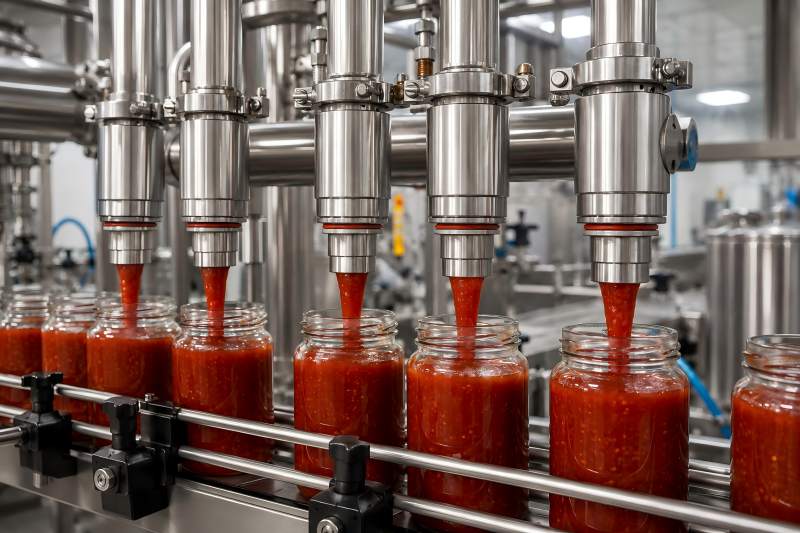
What Does Sauce Viscosity Tell Us?
A low-viscosity liquid moves easily, while a high-viscosity product flows slowly and usually requires more force to transfer.
Viscosity is commonly expressed in centipoise, or cP.
At room temperature, water is about 1 cP, while sauce viscosity can range from dozens to tens of thousands of cP depending on formulation and temperature.
The following ranges are useful as general engineering references rather than strict classification limits.
| Product Type | Approximate Viscosity Range | Typical Filling Behavior |
| Thin soy-style sauce | 5–100 cP | Flows freely |
| Light dressing | 100–1,000 cP | Moderate flow |
| Syrup / thin tomato sauce | 1,000–5,000 cP | Slower flow |
| Ketchup | 5,000–20,000 cP | Thick, requires controlled pressure |
| Mayonnaise | 10,000–50,000+ cP | Very thick, limited gravity flow |
| Chili paste | 20,000–100,000+ cP | Extremely thick, often contains particles |
Actual viscosity varies considerably by recipe.
This is why simply telling a filling machine supplier that the product is “chili sauce” is usually insufficient. Two chili sauces can behave completely differently. One may pour easily, while another may remain almost stationary unless pressure is applied.
Consistency Is More Important Than a Single Viscosity Number
Viscosity is useful, but sauce consistency should also be considered.
A sauce may be thick due to its high dissolved solids content. Another sauce may have similar apparent thickness but contain suspended chili pieces, seeds, garlic, onion, herbs, or fruit pulp.
These products require different machine configurations.
For example:
- Smooth ketchup mainly creates a flow-resistance problem.
- Chili sauce containing seeds creates both viscosity and particle-passage problems.
- Mayonnaise requires gentle product handling because excessive shear may affect its structure.
- Fruit sauce containing pulp needs sufficiently large valves and nozzles to reduce blockage.
Therefore, machine selection should consider at least four characteristics:
viscosity, particle size, particle concentration, and product structure.
This distinction becomes increasingly important as sauce consistency increases.
Low-Viscosity Sauces Require Less Filling Force
Thin sauces are generally easier to transfer through pipelines.
Thin sauces such as soy sauce, vinegar-based sauces, and light marinades can use gravity, flow-meter, or pump-assisted filling systems.
Because these liquids flow easily, the machine does not need to generate large pressure.
The engineering challenge is often different: preventing splashing, foaming, or inaccurate cut-off.
If the filling nozzle closes too slowly, a low-viscosity sauce may continue dripping after the bottle leaves the filling position. If filling pressure is unnecessarily high, liquid may splash against the bottle wall or neck.
Consequently, a more powerful filling system is not automatically better.
For low-viscosity sauces, precise valve control and stable flow are usually more important than strong product pressure.
Medium-Viscosity Sauces Need More Controlled Dosing
As viscosity increases, gravity becomes less reliable.
Consider a sauce around 2,000–5,000 cP. It can still move through pipes, but flow rate changes become more noticeable when temperature, tank level, or pressure changes.
This creates a potential filling accuracy problem.
If a machine relies mainly on uncontrolled gravity flow, two bottles may receive slightly different quantities because the sauce does not flow at exactly the same rate throughout the production cycle.
For these products, manufacturers often move toward:
- volumetric filling,
- controlled pump filling,
- servo-controlled piston filling.
These technologies provide more active control over product movement.
A piston filler, for example, draws a predetermined volume of sauce into a cylinder and then pushes that quantity into the bottle. The filling amount is therefore less dependent on natural gravity flow.
This makes volumetric filling particularly useful when product consistency becomes thicker.
High-Viscosity Sauces Favor Piston Filling
For ketchup, thick chili sauce, barbecue sauce, curry paste, concentrated dressings, and similar products, servo piston filling is often one of the most practical solutions.
The reason is straightforward.
Instead of waiting for the sauce to flow naturally, the piston actively pushes the product through the filling path.
Suppose a factory fills 500 mL bottles.
If a machine has 8 filling heads and each filling cycle takes approximately 4 seconds, the theoretical filling rate could be:
8 bottles × 15 cycles/minute = 120 bottles/minute
or approximately:
7,200 bottles/hour
Actual production output will normally be lower because bottle feeding, positioning, filling response, capping, and line synchronization consume additional time.
A very thick sauce might increase the filling cycle from 4 seconds to 6 seconds.
The same eight-head configuration would then theoretically produce:
8 × 10 cycles/minute = 80 bottles/minute
or around:
4,800 bottles/hour.
This simple example illustrates an important point: viscosity directly influences achievable line speed.
Adding more filling heads may sometimes be more effective than trying to force a thick sauce through smaller nozzles at excessive pressure.
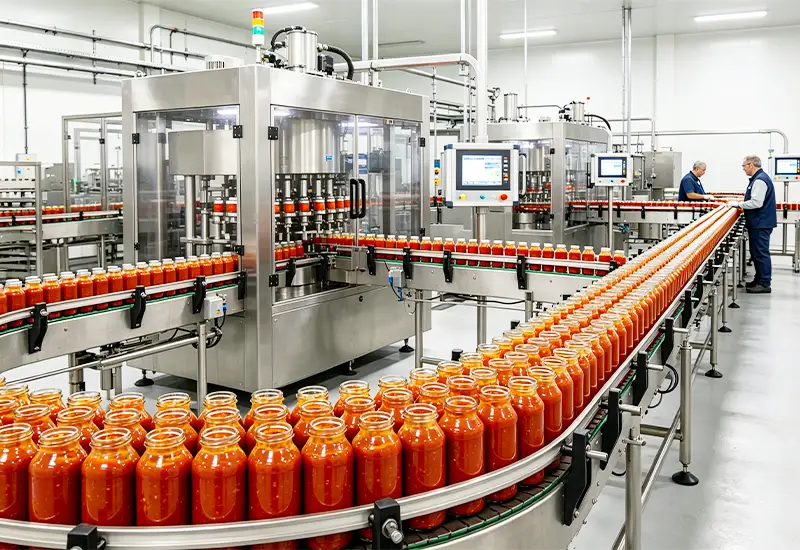
Nozzle Diameter Must Increase with Sauce Thickness
One of the easiest mistakes in sauce filling machine design is focusing heavily on the filling cylinder while underestimating the nozzle.
Thick sauces experience significantly greater resistance inside small passages.
A narrow nozzle requires higher pressure to maintain the same filling speed. This can create several problems:
- unstable product flow,
- excessive mechanical load,
- sauce stringing,
- particle blockage,
- splashing after pressure release.
Larger filling nozzles generally allow thick sauces to move at lower velocity and lower resistance.
For example, moving from a narrow 8 mm product passage to a 16 mm passage does much more than simply double the diameter. The cross-sectional flow area increases considerably.
An 8 mm opening has an area of approximately 50 mm², while a 16 mm opening provides about 201 mm².
That is roughly four times the passage area.
In practice, valve geometry, sauce behavior, pressure, and particles also affect flow, but the example demonstrates why product-path dimensions matter so much for thick sauces.
Sauce with Particles Requires Large-Port Valves
Viscosity becomes even more important when solids are present.
Imagine two sauces:
Sauce A has a viscosity of 10,000 cP and is completely smooth.
Sauce B has a viscosity of only 6,000 cP but contains 5 mm chili pieces.
Sauce B may actually be more difficult to fill.
The particles can accumulate around narrow valve openings, elbows, seals, or filling nozzles. Therefore, the maximum particle size should be considered together with viscosity.
If the sauce contains 3–5 mm particles, the product passage should not be designed close to that same dimension. A much larger clear passage provides better operating reliability.
This is why thick particulate sauces commonly require:
large-port product valves, wider sanitary piping, fewer sharp bends, and larger filling nozzles.
The goal is not only faster filling. It is maintaining the original consistency of the product without repeatedly blocking the filling system.
Pump Selection Changes with Viscosity
The pump feeding sauce from the storage or mixing tank to the filling machine must also match product consistency.
A standard centrifugal pump works well for many low-viscosity liquids, but performance can decline considerably as viscosity increases.
Thicker products often benefit from positive-displacement pumps.
Depending on the sauce, options can include:
- rotary lobe pumps,
- screw pumps,
- progressive cavity pumps,
- other sanitary positive-displacement designs.
The important design principle is stable product delivery.
The pump should maintain sufficient filling-machine supply pressure without unnecessarily shearing, heating, or damaging the sauce.
Selecting an oversized pump and reducing flow afterward is not always a good solution. Excessive pressure can stress seals, increase product temperature, and make filling control more difficult.
Temperature Can Completely Change Filling Performance
Sauce viscosity is not constant.
Temperature can change it dramatically.
A sauce that moves slowly at 20°C may become significantly easier to pump at 50°C.
Consider a hypothetical tomato sauce:
| Product Temperature | Example Viscosity |
| 20°C | 18,000 cP |
| 30°C | 12,000 cP |
| 40°C | 8,000 cP |
| 50°C | 5,500 cP |
These values are examples, but the overall viscosity trend is typical. This means filling tests should be performed near the actual production temperature.
A machine tested using room-temperature water cannot reliably demonstrate how it will fill hot ketchup or thick chili paste.
Similarly, a sauce factory should tell the equipment supplier whether the product is filled at 25°C, 60°C, 85°C, or another temperature.
Temperature may influence not only filling speed but also seal materials, tank insulation, piping design, and machine cleaning.
Filling Speed Should Not Be Maximized Blindly
High-viscosity sauce filling often creates a conflict between production capacity and filling quality.
Increasing piston speed reduces filling time, but forcing thick sauce into a bottle too quickly may create pressure spikes.
The sauce may hit the bottle bottom, rise rapidly, trap air, or splash around the neck.
For some products, a two-stage filling profile works better.
The machine may start quickly while the bottle is relatively empty, then reduce speed near the end of the filling cycle.
Servo-controlled piston systems are particularly useful here because piston speed and stroke can be adjusted electronically.
Rather than treating filling as a simple open-and-close action, the machine can control how quickly the sauce enters the package at different stages.
This is especially valuable when filling wide viscosity ranges.
Anti-Drip Design Becomes More Important as Consistency Increases
Thick sauce creates another problem: it often does not separate cleanly from the nozzle.
After filling ketchup or mayonnaise, a strand of product may remain between the nozzle and bottle.
This is commonly called stringing.
It contaminates bottle necks, makes capping less reliable, increases cleaning work, and can make finished products look unattractive.
A well-designed sauce filling machine therefore needs anti-drip or suck-back control.
At the end of the filling cycle, a slight reverse movement or controlled shut-off can pull remaining sauce back toward the nozzle.
For very thick products, mechanical shut-off nozzles may also be necessary.
Again, viscosity determines machine configuration.
Viscosity Also Influences Cleaning Design
A machine that can fill thick sauce successfully must also be capable of removing it during cleaning.
High-viscosity residues cling to:
- cylinder walls,
- valve chambers,
- pipe elbows,
- seals,
Dead spaces therefore become particularly undesirable.
A filling system intended for multiple sauce recipes should use sanitary product paths that can be disassembled or cleaned effectively.
For factories switching between ketchup, chili sauce, dressing, and other products, cleaning time can become a major production factor.
Saving five minutes per filling cycle matters little if product changeover requires several hours.
Therefore, filling-machine efficiency should be evaluated using total production availability, not only bottles per hour.
A Practical Selection Guide
A simplified selection approach can look like this:
| Sauce Condition | Suitable Filling Direction |
| Thin, free-flowing | Gravity / flow-meter filling |
| Medium viscosity, smooth | Pump or volumetric filling |
| Thick, smooth | Servo piston filling |
| Thick with small particles | Large-port servo piston filling |
| Very thick paste | Heavy-duty piston / positive-displacement system |
| Temperature-sensitive sauce | Controlled pump and temperature-aware configuration |
This table should not replace product testing, but it provides a useful starting point.
Do Not Select a Sauce Filling Machine by Viscosity Alone
Viscosity is one of the strongest indicators of filling-machine design, but it should never be treated as the only specification.
A supplier should ideally understand:
- viscosity or consistency,
- filling temperature,
- bottle volume,
- bottle-neck diameter,
- particle type and maximum particle size,
- required bottles per hour,
- filling accuracy,
- cleaning requirements.
A 20,000 cP smooth sauce in a 1-liter wide-mouth bottle may be easier to fill than a 5,000 cP particulate sauce through a narrow bottle neck.
The entire product-packaging combination needs to be considered.