
Verify actual output by counting accepted containers at an agreed final point, not by relying on filler nameplate speed. Whole-line capacity also depends on supply, quality, rejects, and interruptions.
Agree on test conditions, counting rules, and time basis before testing. A protocol makes factory and site results comparable and prevents a short peak-speed reading from being mistaken for sustained production.
Establish the Final Counting Point for Actual Output
A complete bottling system can encompass water treatment, bottle blowing, rinsing, filling, capping, labeling, inspection, and secondary packing.
Not every project includes every stage, so the test boundary must match the equipment supplied and the output the buyer needs.
Choose a final counting point that represents the agreed deliverable. Depending on the project, this might be accepted filled bottles after inspection, labeled bottles, or completed saleable cases after packing.
State the point explicitly rather than using the vague phrase “line output.”
Define which quality requirements a unit must meet to count as good output. A bottle that fails agreed fill-level, cap, label, coding, or packaging checks should not count as a saleable unit.
If reporting cases, record bottle-level and case-level counts separately where useful. Do not combine them into one rate, and account for incomplete cases remaining at the end of the test.
Separate Nameplate Speed from Good Output
Nameplate speed is a reference value, not proof of what a complete line will deliver in normal operation.
It may describe one machine under specified conditions, while saleable output depends on connected stages and their interactions.
Gross output counts units processed or completed at the chosen boundary before quality deductions. Good output counts only units meeting the agreed product and packaging criteria. The two figures are both useful, but each serves a distinct purpose.
| Metric | Definition | Practical value |
| Nameplate speed | Rated speed under specified conditions | Equipment reference |
| Gross output | Units counted before quality deductions | Total throughput |
| Good output | Units accepted against agreed criteria | Saleable production |
| Good-output rate | Accepted units divided by stated time | Production comparison |
Always state the unit and period beside a reported rate, such as good bottles per hour or accepted cases per shift. A figure without a counting boundary and time denominator is difficult to verify.
Do not assume filler speed equals complete-line capacity. Conveyors, cap feeding, labeling, inspection, accumulation space, and packing can limit final output even when the filler itself runs quickly.
Agree on FAT and SAT Conditions
A Factory Acceptance Test (FAT) checks equipment at the factory against a protocol agreed in advance.
A Site Acceptance Test (SAT) checks the installed system under site conditions, which may differ in utilities, layout, materials, and upstream supply.
For both tests, document the bottle format and material, cap, label, pack configuration, water quality, and relevant utility conditions.
Specify which optional systems are included, such as pretreatment or RO, UF, or NF treatment, and whether blowing and packing are in scope.
Define the acceptance boundary, counting method, quality criteria, planned exclusions, and treatment of startup before the test. Agree how interruptions, material shortages, and deviations will be recorded so results are not adjusted informally afterward.
The protocol should distinguish a functional check from rate verification or sustained-operation testing. A brief observation can show that equipment operates, but cannot by itself establish representative output over a longer production window.
Use the same definitions for factory and site reporting wherever possible. If site conditions differ—for example, because of a different container format or utility supply—record the difference before comparing results.
Check the Whole Line for Bottlenecks
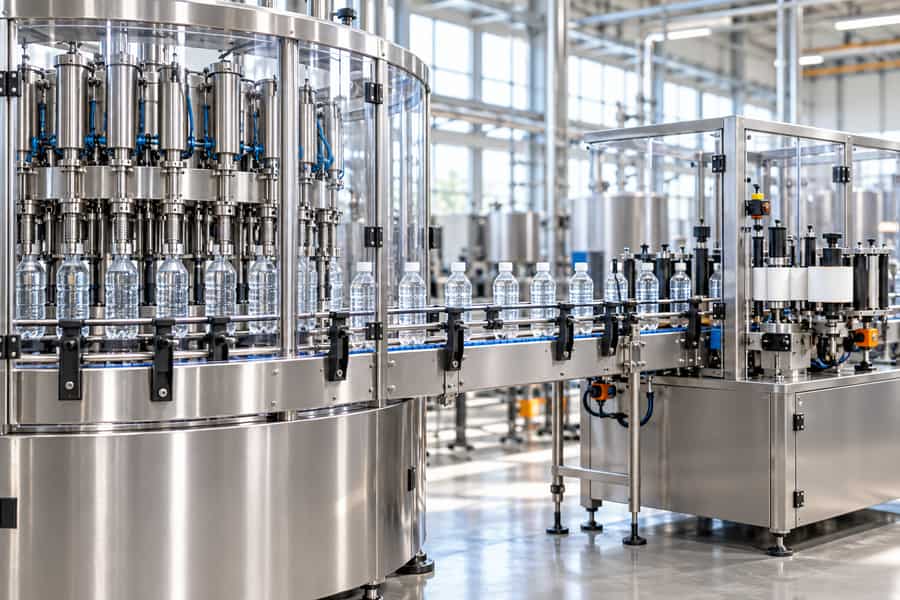
Actual output is governed by the connected process, not simply by the machine with the highest rated speed. One constrained stage can limit throughput, while short stops across several stages can compound losses.
Where water treatment and storage are included, confirm treated water is available at the required quality and flow. Record interruptions caused by inadequate supply, treatment operation, or storage limitations.
Where bottle blowing is included, check whether containers arrive steadily enough to support filling.
Jams, container rejects, format changes, or a mismatch between blowing and filling rates can leave the filler waiting or create excess accumulation.
At rinsing, filling, and capping, observe sustained operation as well as peak speed. Record stops caused by bottle handling, cap supply, filling control, rejects, and transfers between machines.
Downstream equipment deserves equal attention.
Labelers, inspection systems, cartoners, case packers, and palletizing equipment can limit finished output even when upstream machines keep running.
Check whether accumulation conveyors provide enough buffer and whether downstream stops eventually halt filling.
Brenu supplies customizable water bottling lines that can include pretreatment, RO/UF/NF options, purified-water storage, rinsing, filling, capping, and downstream packaging.
Since not every option is standard, evaluate only stages included in the project and agreed test scope.
Reconcile Counts, Work in Progress, and Rejects
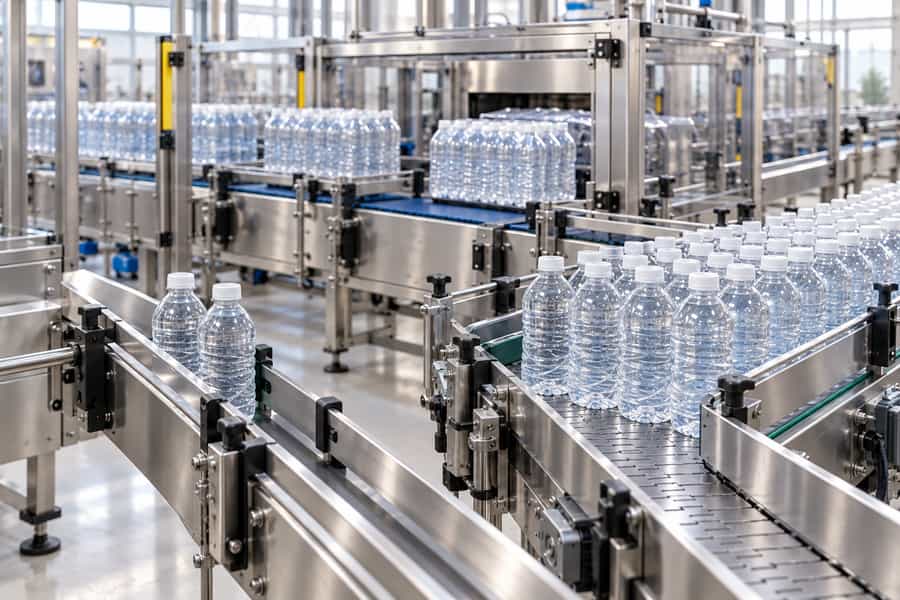
A reliable output figure should be supported by counts that reconcile across the line.
Record opening and closing work in progress (WIP) at relevant accumulation points, especially when units may remain between machines at test end.
Capture units entering and leaving key stages, alongside accepted units, rejects, samples, and rework. If a unit passes through a stage more than once, make sure it is not counted as multiple finished products.
Separate product-quality rejects, handling damage, and packaging defects when recording losses. These categories help locate problems, but each unit should be deducted only once from the final good-output count.
At the final boundary, reconcile counted units with accepted output, rejects, samples, rework, and unresolved WIP under the agreed protocol. Investigate unexplained differences between machine counters and final counts before approving the result.
Do not count unfinished bottles or incomplete cases as saleable output simply because they entered the line.
Record their status and apply the agreed end-of-test rule, especially if product remains on conveyors or inside packing equipment.
Define the Time Denominator Before Calculating a Rate
The same quantity of good product can produce different hourly rates depending on the time basis. Every report should name its denominator so readers can distinguish full-window output from output while the line is running.
Elapsed test time is the full interval between agreed start and end timestamps. It includes interruptions occurring within that window and is useful for assessing output across the entire test period.
Planned production time is the scheduled production window after only exclusions explicitly permitted by the protocol. Do not automatically remove breaks, changeovers, cleaning, or other scheduled activities; state which are included or excluded.
Run time is the portion of the defined production window when the line is operating. It helps assess output while running, but a run-time rate alone hides stoppage effects unless downtime is also reported.
Record start and finish times, agreed exclusions, run-time intervals, and downtime events. Apply the same rules to each result being compared, and do not switch denominators midway through a report.
Divide accepted units by the stated time basis and label the result clearly. Reporting both a full-window rate and a run-time rate can be useful if their different meanings are explicit.
Conduct a Sustained, Representative Production Run
A representative run should reflect the operating conditions the line is expected to handle, rather than a temporary maximum-speed demonstration.
Agree on the product format, water quality, container specifications, packaging configuration, and operating settings before testing begins.
The test protocol should define how startup, stabilization, format changes, and interruptions are treated.
These events can materially affect output, so their inclusion or exclusion must follow documented rules rather than decisions made after results are known.
Choose a test window that provides meaningful evidence of sustained operation under the agreed conditions.
There is no universal mandatory test duration; the appropriate period depends on the acceptance objectives, production pattern, equipment configuration, and practical operating constraints.
During the run, collect timestamped production counts and operating data at the agreed counting boundary. Record any changes to machine settings, temporary interventions, material substitutions, or operating conditions that could influence the result.
For a configurable Brenu water bottling line, the test scope should identify which treatment, storage, rinsing, filling, capping, and packaging stages are included. This prevents a result from being attributed to equipment or functions outside the agreed supply scope.
Record Downtime and Identify Its Causes
Downtime records explain why measured output falls below the expected rate. A total downtime figure is useful, but cause-based records help engineers distinguish equipment faults from supply constraints, quality problems, and planned production activities.
For each event, record the start time, end time, duration, affected machine, observed cause, and corrective action. If the cause remains uncertain, mark it as unconfirmed instead of assigning an unsupported explanation.
Use a consistent classification system throughout the test. Categories may include planned stops, unplanned equipment failures, minor stoppages, upstream supply interruptions, downstream blockages, quality-related holds, and format changes.
Where several machines stop together, identify the initiating event when evidence supports it.
For example, a packing-machine fault may eventually stop the filler, but recording every affected machine as an independent initiating failure would distort the analysis.
Review downtime alongside production counts and WIP records. This makes it easier to determine whether a stoppage reduced final output, created temporary accumulation, or shifted unfinished product beyond the test boundary.
Evaluate OEE Alongside Good Output
Overall Equipment Effectiveness (OEE) provides a combined measure of availability, operating performance, and product quality. It is useful for understanding production losses, but it should supplement—not replace—the directly measured good-output rate.
Availability is determined by dividing run time by planned production time.
Calculate performance using total units produced divided by the agreed ideal output for the actual run time, and quality using accepted units divided by total units produced.
The ideal rate must be agreed for the specific container format and operating configuration. A rate established for one bottle size or packaging arrangement should not automatically be applied to another format without justification.
Use one agreed counting boundary for gross and accepted units, and reconcile opening and closing WIP before calculating these factors. Mixing counters from different stages can distort the result.
Consider the following illustrative example. All figures are assumed solely to demonstrate the calculation and are not Brenu specifications, verified equipment performance, or guarantees.
| Metric | Illustrative calculation | Result |
| Planned production time | Assumed test window | 4 hours |
| Run time | Assumed operating time | 3.5 hours |
| Ideal rate | Agreed illustrative format rate | 7,000 bottles/hour |
| Gross output | Total bottles produced | 22,400 |
| Good output | Accepted bottles | 21,000 |
| Availability | 3.5 ÷ 4 × 100% | 87.5% |
| Performance | 22,400 ÷ (7,000 × 3.5) × 100% | 91.4286% |
| Quality | 21,000 ÷ 22,400 × 100% | 93.75% |
| OEE | 87.5% × 91.4286% × 93.75% | 75% |
| Good output per planned hour | 21,000 ÷ 4 | 5,250 bottles/hour |
| Good output per run hour | 21,000 ÷ 3.5 | 6,000 bottles/hour |
The example shows why OEE and good-output rate should be reported together.
OEE summarizes three categories of loss, while good output per planned hour directly indicates how many accepted bottles the line delivered during the scheduled production window.
Performance uses gross output because quality losses are accounted for separately in the quality factor.
Deducting rejected bottles from gross output before calculating performance, then applying the quality factor again, would count the same quality loss twice.
Similarly, do not subtract downtime twice when calculating availability. Run time already excludes the non-running portions of planned production time, so the availability calculation should use the measured time values consistently.
Assemble the Acceptance Evidence
An acceptance decision should rely on traceable records rather than a single displayed counter or a handwritten production total.
The evidence should allow both parties to reproduce the calculations and understand any differences from expected output.
Start with the agreed test protocol, including the equipment boundary, product format, operating conditions, ideal rate, quality criteria, time definitions, and rules for exclusions. Preserve the approved version so that later changes can be identified.
Include timestamped machine-counter readings, final accepted counts, reject records, opening and closing WIP, and downtime logs. Where counters disagree, document the discrepancy and explain how the final count was reconciled.
Record the calculations for gross output, good output, good-output rate, availability, performance, quality, and OEE where applicable. Show the units and time denominators explicitly, and retain the underlying values rather than submitting percentages alone.
The evidence package should also identify test deviations, unresolved faults, corrective actions, and any conditions that prevented a representative assessment. Photographs, operator logs, and control-system records can support the findings when relevant and available.
Agree on Acceptance Criteria and Retesting
Acceptance criteria should be established before the test, not created afterward to fit the observed result.
They may address good-output rate, product quality, packaging quality, required operating conditions, and the equipment included in the agreed scope.
Define how interruptions outside the equipment supplier’s control will be handled. Water-supply problems, unavailable packaging materials, or unstable utilities may affect a test, but their treatment should follow the agreed protocol and supporting evidence.
If a test fails a criterion, identify the specific shortfall before deciding on corrective action.
A low good-output rate caused by repeated cap-feeding interruptions requires a different response from one caused by excessive rejects or insufficient treated-water supply.
Agree whether the issue requires adjustment, maintenance, additional observation, or a repeat test. The retest scope should identify the affected criterion, relevant operating conditions, measurement method, and evidence required to demonstrate the outcome.
Where practical, retain the original test results alongside retest results. Replacing an unsuccessful result with a later successful one without explanation weakens traceability and can conceal recurring problems.
The final acceptance record should state which criteria were met, which remain unresolved, and whether further action is required.
Any conditional acceptance or deviation should be documented and approved by the responsible parties under the agreed contractual process.