
Finished-bottle traceability connects filling windows to the treatment events, storage tanks, and transfers that may have supplied their water. A batch code identifies a product group but does not prove safety.
Reliable links depend on consistent identifiers and synchronized records, with uncertainty preserved whenever sources overlap or changeover boundaries are unclear.
Define the Traceability Chain
The objective is to reconstruct water’s path from treatment through storage to the filling line and connect that production period to finished bottles.
The chain includes treatment events, tank inventory, transfers, the supply route, filling windows, finished-product batch codes, and packaging records.
Each link shows what happened, where water moved, when it could have reached the filler, and which products may contain it.
Keep process identity separate from product identity.
A treatment-event ID identifies a defined run or period.
A tank ID identifies a physical vessel; a transfer ID identifies a movement; a filling-window ID identifies a production interval; and a finished-bottle batch code identifies a product group under the site’s batch rules.
These identifiers should connect, not substitute for one another. Starting from a bottle code, staff should trace backward through its filling window and water-source history.
Starting from a treatment deviation, they should trace forward to potentially affected production.
Assign Unique IDs to Treatment Events and Equipment
Create a unique ID for each treatment event using a consistent rule. It may represent a production run or another defined operating period. Never reuse an ID after a restart or for a new run.
Record event start and end times, equipment, relevant process measurements, alarms, deviations, and operator actions. Include an approved process reference where applicable; retain actual data, not just a completion statement.
Use consistent IDs for equipment and stages. Tank IDs should match labels in procedures and logs; transfer IDs distinguish movements, including repeated movements between the same tanks.
Filling-window IDs identify the line, product or SKU, and production interval. Brenu supplies customizable water bottling lines that may include pretreatment, RO/UF/NF options, purified-water storage, rinsing, filling, capping, and downstream packaging.
Since not every option is standard, map the equipment and stages actually installed rather than assuming a fixed configuration.
| Record | Key fields | Traceability purpose |
| Treatment event | Event ID, time range, equipment, results, alarms | Identifies treatment history |
| Tank inventory | Tank ID, timestamp, status, quantity where measured | Shows retained water |
| Transfer | Transfer ID, source, destination, time, quantity where measured | Connects source and destination |
| Filling window | Window ID, line, product, start/end time | Defines production period |
| Finished batch | Batch code, product, pack time range, quantity | Identifies potentially affected bottles |
This is a starting structure, not a universal specification. Add fields required by the actual process and quality system, and ensure every ID has one clear meaning.
Track Tank Transfers, Retained Water, and Mixing
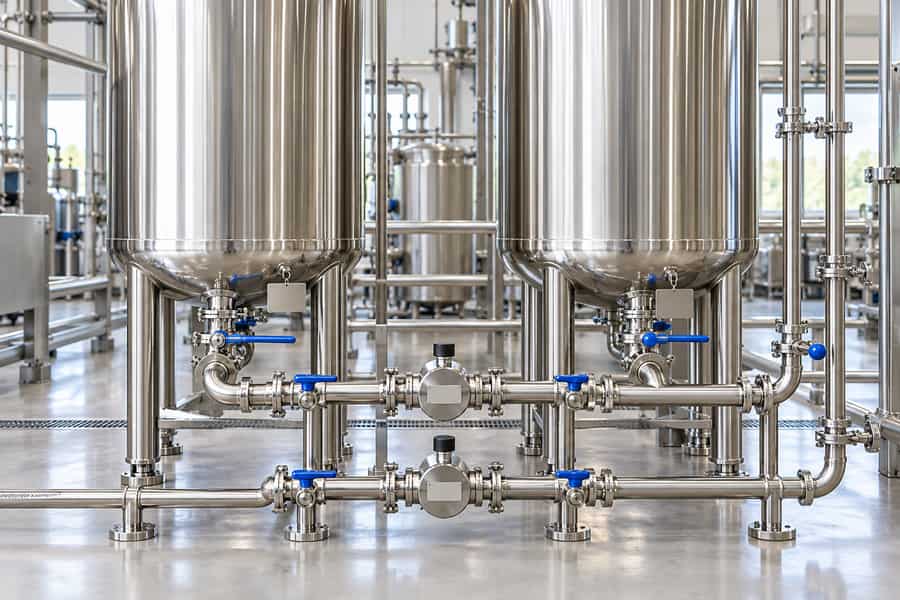
A storage tank does not necessarily correspond to one treatment event. It may retain water from an earlier run, receive water from a later run, or supply several filling windows before emptying.
Traceability needs an inventory history, not just the tank’s latest status.
For each transfer, record source and destination, time, quantity where measured, and the operator or automated record confirming movement. Capture recirculation, returns, drain-downs, and other movements when they change the tank’s contents or source relationships.
Track residual as well as incoming water. If a tank is partly emptied before another transfer arrives, its contents may combine contributions from different treatment events.
Similar overlap may occur in pipework or other parts of the supply route. Do not assume a new event starts with an empty system.
In an explicitly illustrative case, Tank A receives event T-101, then T-102 before the first volume is fully used.
If it supplies windows F-21 and F-22, both may need links to both events.
Quantities and timing narrow the contribution only when reliable measurements support the calculation. If quantities are missing or inventory cannot be reconciled, do not assign the whole filling window to the latest event.
Retain plausible source links and flag uncertainty. Additional evidence may narrow the affected scope, but records should not imply more precision than the data supports.
Synchronize Clocks Across the Production System
Treatment controls, tank instruments, filling equipment, laboratory systems, and manual logs may record events independently. Clock differences can make a transfer appear to precede treatment or disconnect a filling window from its actual source.
Define one plant time standard and document how each system follows it.
Specify the time zone, timestamp format, and precision used in electronic and paper records. Where automatic synchronization is available, check clock drift and document how discrepancies are corrected.
Record event start and end times when boundaries matter, rather than relying on a shift date or one daily timestamp.
A treatment event may span several filling windows, and a tank transfer may occur near a changeover.
Coarse records can hide overlaps that determine which batches need investigation. Operators should enter manual records as events occur or follow a late-entry procedure that distinguishes event time from entry time.
Corrections should preserve the original entry, reason for change, and person making it, under the plant’s record-control process.
Review clock alignment periodically and after relevant maintenance or control-system changes. If timing accuracy is unknown for a period, document the limitation and use a conservative traceability window rather than treating timestamps as exact.
Link Treatment Histories to Filling Windows
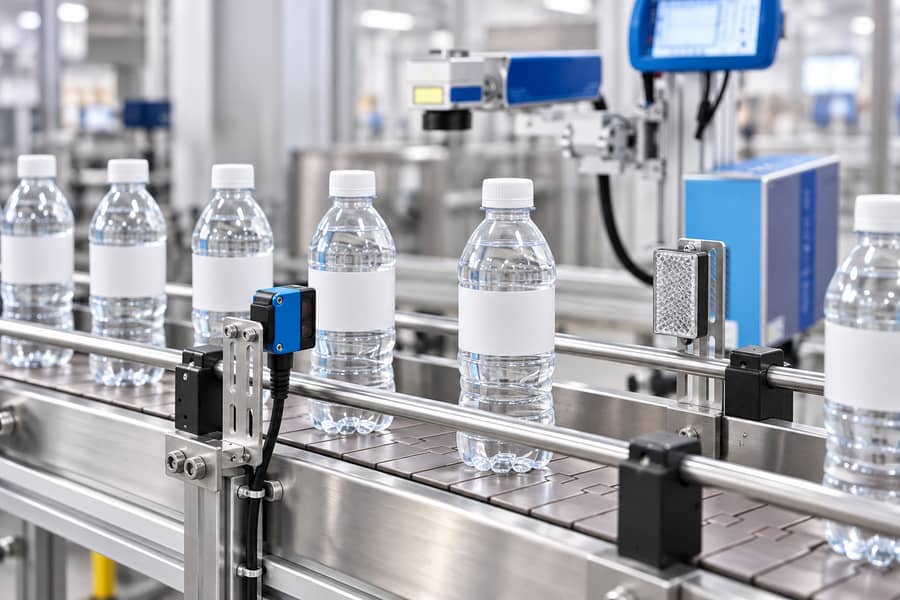
A filling window is the interval when a line produced a specified product under a documented water-supply configuration. Set its boundaries using actual production events, including relevant stops, changeovers, and route changes—not automatically by shift.
For each window, record the line, product or SKU, start and end times, finished-batch code or codes, and water-source path.
Link it to the supplying tank or tanks, then connect those tanks to transfer and treatment-event records. Packaging timestamps and quantities can help confirm which units belong to the window.
The relationship is often many-to-many, not one-to-one. One treatment event can contribute water to several tanks or filling windows, connecting it to multiple finished-bottle batches.
Conversely, a batch may be produced while its supply tank contains water from multiple treatment events, so it can link back to several source events.
In an explicitly illustrative scenario, event T-201 supplies Tank B, which feeds window F-31 and batch B-501.
Later, T-202 enters the same tank before F-32 and batch B-502 are produced. If some T-201 water remains, both batches may link to T-201, while B-502 may also link to T-202.
Actual links depend on transfer timing, inventory, and supply route. Represent connections as individual records or a traceability matrix, rather than storing only one treatment ID in a batch field.
The matrix should allow one window to reference several contributing events and one event to reference multiple windows.
If a defensible volume contribution cannot be calculated, record the source relationship without assigning a precise percentage.
Distinguish confirmed links from possible exposure links. A confirmed transfer may have a recorded route and measured movement; a possible link may result from uncertain timing, retained water, or an incomplete changeover record.
Keeping these categories separate supports investigation without claiming certainty the records cannot establish.
Handle Uncertain Changeover and Flushing Boundaries
A changeover does not automatically create a clean traceability boundary.
Water may remain in storage tanks, pipework, or other equipment after a supply route changes, allowing material from an earlier treatment event to reach subsequent filling windows.
Record when the previous supply stops, when the new route becomes active, and when the required flushing or transition procedure is completed. Where available, retain valve-position records, flushing quantities, relevant observations, and operator confirmation.
Do not assume that starting a flush proves all residual water has been displaced. The effective boundary depends on the installed system, retained volumes, flow paths, and the validated operating procedure.
If timestamps conflict or flushing records are incomplete, extend the investigation to include potentially affected filling windows. Document the reason for the expanded scope and distinguish confirmed connections from plausible exposure.
For customized systems, the traceability map should reflect the actual installed treatment and transfer arrangement. Brenu’s water bottling line solutions can be configured around different treatment, storage, filling, and packaging requirements, so record structures should match the equipment actually supplied.
Place Potentially Affected Product on Hold
A treatment deviation, unexplained tank balance, missing transfer record, or uncertain changeover may require a temporary hold.
The scope should include finished-product batches that could have received affected water, not simply the batch running when the problem was discovered.
Use the traceability relationships to identify packed inventory, product awaiting packaging, retained samples where applicable, and relevant tank contents. Record each affected identifier, quantity where known, current location, and hold status.
A hold should remain traceable throughout the investigation. If product moves between the production area, warehouse, and distribution staging, preserve the associated inventory and location records so potentially affected units are not overlooked.
Release requires an authorized review of the deviation, relevant treatment records, applicable test results, corrective actions, and the established quality procedure.
The reviewer should document the evidence considered, the decision, its timing, and the responsible person.
A batch code identifies the product under investigation; it does not establish that the product is safe. Likewise, conductivity alone cannot prove microbiological safety.
Release decisions must consider the relevant process requirements and quality evidence rather than relying on one measurement.
Build an Illustrative Many-to-Many Trace Matrix
Consider an explicitly illustrative scenario in which treatment event T-201 supplies Tank B. Filling window F-31 produces batch B-501 before treatment event T-202 contributes additional water to the same tank.
During F-32, Tank B supplies the filling line for batch B-502. Some water associated with T-201 remains in the tank when T-202 arrives, so the later batch may have contributions from both treatment events.
The matrix below illustrates the relationships that an investigation should preserve. It does not assert measured quantities or establish the exact proportion contributed by either event.
| Treatment event | Tank | Filling window | Finished batch | Traceability interpretation |
| T-201 | Tank B | F-31 | B-501 | Earlier source linked to the first batch |
| T-201 | Tank B | F-32 | B-502 | Earlier source may persist through retained water |
| T-202 | Tank B | F-32 | B-502 | Additional source associated with the later batch |
These rows represent individual source-to-product relationships, not three independent production runs. Each batch can have several upstream links, and one treatment event can connect to multiple batches.
The relationship between T-201 and B-502 should remain qualified if the retained-water contribution cannot be established conclusively.
Likewise, a recorded transfer from T-202 does not, by itself, quantify how much of that event reached the filler.
Where reliable measurements support a calculation, inventory balances can help refine the investigation. Where measurements are missing or uncertainty remains, retain the plausible links and avoid inventing precise source percentages.
This structure supports both directions of investigation: identifying every batch potentially connected to a treatment event and reconstructing all potential source events for a finished-bottle batch.
Verify Forward and Backward Traceability with Mock Tests
Mock trace tests determine whether the record system works under realistic conditions. They should test both the ability to identify affected product and the ability to reconstruct its source history.
Forward trace: Start with T-201 and identify every tank receiving its water, every relevant transfer, and every filling window that may have used it.
Include B-501 and investigate B-502 if retained water creates a plausible connection.
Backward trace: Start with B-502 and retrieve F-32, Tank B’s inventory history, its incoming transfers, and the contributing treatment events. The result should identify both T-201 and T-202 where the illustrative mixing scenario applies.
Boundary test: Introduce an illustrative uncertainty around the changeover between F-31 and F-32. Check whether the system flags potentially affected production instead of automatically assigning a precise boundary.
Reconciliation test: Compare transfer records, available tank measurements, production quantities, and documented losses. Investigate unexplained differences rather than forcing the numbers to balance through unsupported assumptions.
Document each test’s starting point, records retrieved, affected scope, unresolved gaps, corrective actions, and retest outcome.
Set the review criteria according to the plant’s own procedures and operational needs; do not assume a universal acceptable retrieval time or reconciliation tolerance.
Maintain Practical Record Controls
Assign responsibility for creating, reviewing, and correcting treatment, transfer, filling, and batch records. Operators should understand which identifiers to enter and when records must be completed.
Maintain controlled equipment registers, identifier definitions, product-code rules, and the mapping between electronic systems.
If an identifier or process configuration changes, preserve historical mappings so older batches remain traceable under the arrangements that applied when they were produced.
When a record is amended, keep the previous entry, the updated details, the justification for the revision, and the identity of the person making the change. Missing data should be flagged explicitly rather than replaced with estimated values presented as actual measurements.
Establish record-retention, access-control, backup, and retrieval procedures appropriate to the plant’s quality system and applicable requirements. Ensure authorized personnel can retrieve related records together without relying on one operator’s memory or a single spreadsheet.
Finally, review recurring gaps such as incomplete transfer quantities, inconsistent clocks, missing flushing records, and unresolved inventory differences. Assign corrective actions and verify their effectiveness through subsequent trace tests.
A useful traceability system does more than attach a batch code to a treatment report.
It preserves the relationships between events, tanks, transfers, filling windows, and finished products, while making uncertainty visible whenever the available evidence cannot establish an exact boundary.