
The best sauce production line is not necessarily the line with the fastest filler or the largest mixing tank. It is the line where sauce consistency, temperature, particle size, transfer pressure, filling method, packaging speed, and cleaning requirements have been designed to work together.
For low-viscosity sauces, relatively simple transfer and filling systems may be sufficient. As viscosity increases—or when the recipe contains seeds, herbs, or solid pieces—the importance of larger product passages, positive-displacement pumping, servo-controlled filling, and anti-drip design increases significantly.
In practical production, stable sauce consistency often matters as much as machine capacity. When every batch reaches the filler at a predictable viscosity and temperature, the line becomes easier to control, filling accuracy improves, and unnecessary product loss decreases.
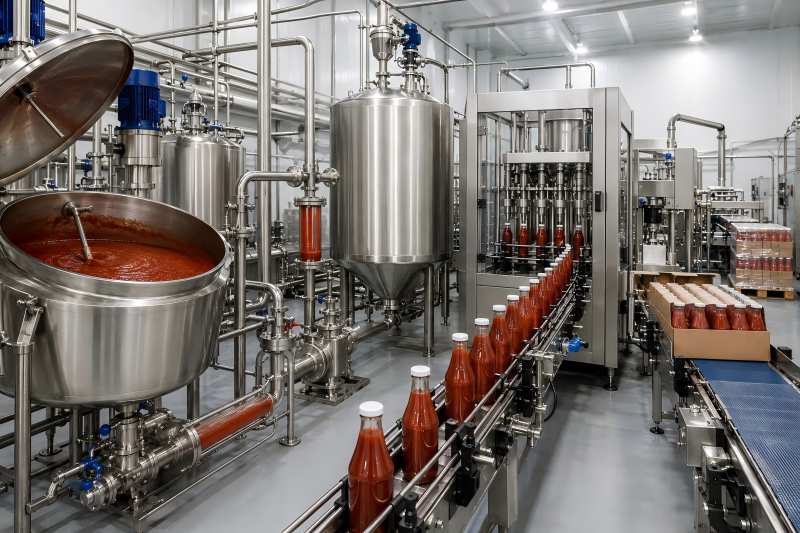
Understanding Sauce Characteristics Before Designing the Line
Before selecting equipment, the first question should not be production capacity. It should be:
What kind of sauce will actually move through the system?
Sauces differ in viscosity, particle size, temperature sensitivity, oil content, acidity, and tendency to foam.
Approximate viscosity ranges can illustrate these differences:
| Sauce Type | Approximate Viscosity | Typical Processing Challenge |
| Thin seasoning sauce | 10–300 mPa·s | Splashing and foaming |
| Salad dressing | 500–3,000 mPa·s | Oil-water stability |
| Tomato sauce | 2,000–10,000 mPa·s | Uneven flow |
| Ketchup | 10,000–50,000 mPa·s | High transfer resistance |
| Mayonnaise | 20,000–100,000+ mPa·s | Shear sensitivity |
| Chili sauce with particles | Highly variable | Particle passage and blockage |
These values are illustrative because viscosity changes with formulation and temperature.
This is an important engineering point. A sauce measured at 25°C may behave very differently after heating to 75°C. Higher temperature often reduces viscosity, allowing easier pumping and filling.
Equipment selection should reflect actual processing temperature and sauce consistency, not just lab viscosity.
1. Raw Material Preparation
The production process usually begins with ingredient preparation.
Depending on the recipe, ingredients may include:
- Water
- Vegetable oil
- Tomato paste
- Sugar
- Salt
- Vinegar
- Starch
- Spices
- Chili
- Stabilizers
- Preservatives
Powders must be introduced carefully because starches, gums, and stabilizers can form lumps when added too quickly.
For example, adding a thickening agent directly into a low-speed mixing tank may create concentrated clumps. These clumps can survive later processing and eventually affect filling valves or product appearance.
A better process controls powder feeding rate and agitation intensity.
Liquid ingredients may also be pre-measured in separate tanks before entering the main mixing vessel. This helps improve recipe repeatability between batches.
2. Mixing Builds the Basic Sauce Structure
The mixing tank is where individual ingredients become a consistent product.
For simple liquid sauces, moderate-speed agitation may be enough. Thick sauces often require stronger mixing systems.
Typical options include:
- Anchor agitators
- Paddle mixers
- High-shear mixers
- Scraper agitators
An anchor agitator is especially useful for viscous sauces because it moves product near the vessel wall.
Without adequate wall movement, thick sauce can remain almost stationary around the tank perimeter while only the central area circulates.
This creates temperature differences and uneven composition.
For sauces such as ketchup or chili sauce, a tank may operate between approximately 20 and 60 rpm for slow mixing, while a separate high-shear unit may operate at several hundred or several thousand rpm during emulsification or powder dispersion.
Excessive shear can damage certain formulations, while insufficient agitation leaves the batch inconsistent.
3. Heating and Cooking
Many sauce recipes require heating.
Heating can serve several purposes:
- Dissolving sugar and salt
- Activating starch
- Developing flavor
- Reducing microbial load
- Adjusting final viscosity
Steam-jacketed mixing tanks are common because they allow indirect heat transfer.
For example, a sauce may be heated from approximately 25°C to 85°C during preparation.
However, thick sauces do not transfer heat as efficiently as water.
This creates an important design issue.
When viscosity rises, natural convection inside the tank becomes weaker. Product near the heating surface may become much hotter than product in the center.
A scraper agitator can continuously remove sauce from the vessel wall, improving heat transfer and reducing burning.
This is particularly useful for tomato-based sauces, starch-rich products, caramel sauces, and other heat-sensitive formulations.
4. Viscosity Control Is a Production Issue, Not Just a Recipe Issue
Sauce consistency deserves special attention because it affects nearly every downstream machine.
Suppose one batch of ketchup has a viscosity of around 15,000 mPa·s while another reaches 30,000 mPa·s.
Even if bottle volume remains unchanged, the second batch may require higher pump pressure and longer filling time.
This can reduce output.
For example:
| Condition | Lower-Viscosity Sauce | Higher-Viscosity Sauce |
| Filling time per bottle | 1.2 sec | 2.0 sec |
| Required product pressure | Lower | Higher |
| Drip/stringing risk | Moderate | Higher |
| Pipe resistance | Lower | Higher |
| Potential filling capacity | Higher | Lower |
The exact numbers depend on the machine, but the relationship remains important.
This is why maintaining consistent viscosity across batches improves not only product quality but also production efficiency.
Temperature control can also help.
If sauce temperature drops significantly between the mixing tank and filling machine, viscosity may increase during transfer.
A heated buffer tank or insulated pipeline may therefore be required.
5. Homogenization and Emulsification
Not every sauce requires homogenization, but it becomes important for products containing oil, water, and fine solids.
Mayonnaise and creamy dressings are obvious examples.
Without sufficient emulsification, oil can separate during storage. Even when the sauce looks acceptable immediately after mixing, instability may appear days later.
High-shear homogenizers break droplets into smaller sizes and distribute them more evenly throughout the product.
This stage should be adjusted to the sauce formulation. Higher shear does not always improve results.
Some sauces depend on visible particles or a particular texture. Excessive homogenization could make chili pieces, herbs, or vegetable fragments too fine.
The production process therefore needs to balance stability with desired texture.
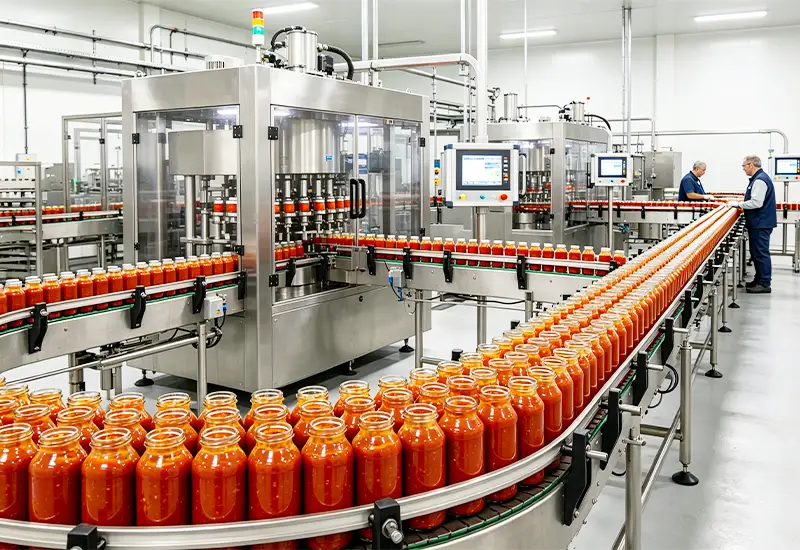
6. Filtration or Particle Management
Traditional beverage filling lines often use fine filtration before filling.
Sauce filling lines are different.
If the product intentionally contains chili seeds, herbs, garlic pieces, onion fragments, or vegetable particles, fine filtration would remove part of the recipe.
Instead, the system must be designed to allow those particles to pass.
This influences:
- Pump selection
- Pipe diameter
- Valve opening
- Filling nozzle diameter
For example, if the largest ingredient particle is approximately 5 mm, using a very narrow 6–8 mm product passage could create unnecessary blockage risk.
A larger sanitary passage provides more margin.
The correct approach is not simply selecting the largest possible pipe. Oversized pipelines can increase product retention and cleaning volume.
The goal is to create enough passage area for stable flow while minimizing dead space.
7. Product Transfer to the Filling Area
After processing, the sauce must move from the cooking or mixing section to a buffer tank or filling machine.
This stage is sometimes underestimated.
Thin sauces may be transferred using centrifugal pumps, but highly viscous sauces often need positive-displacement pumps.
Depending on product characteristics, options may include:
- Lobe pumps
- Screw pumps
- Progressive cavity pumps
- Piston-type transfer systems
The transfer pump should maintain a relatively stable feed pressure.
If pressure changes significantly, filling performance may also change.
For this reason, the buffer tank serves an important role between processing and packaging.
It isolates the filling machine from fluctuations in the mixing section.
Instead of sending sauce directly from a large cooking tank to the filler, the line can maintain a smaller, controlled volume near the filling machine.
8. Bottle Feeding and Preparation
While the sauce is being prepared, empty containers enter the packaging section.
Depending on the factory, bottles may arrive through:
- Manual loading
- Unscramblers
- Bottle conveyors
- Automatic bottle feeding systems
Container cleanliness becomes increasingly important when products are hot-filled or have long shelf-life targets.
Some sauce lines rinse bottles before the filling stage. For compact layouts, rinsing, filling, and capping can be integrated into one monoblock system.
This reduces bottle transfer distance between separate machines.
However, sauce lines require different filling configurations from water or beverage lines because the product is much thicker.
9. Filling High-Viscosity Sauces
The filling machine is one of the most sensitive sections of the line.
For sauces with medium to high viscosity, servo piston filling is commonly suitable.
The operating principle is straightforward.
A piston draws a controlled volume of sauce into a cylinder and then pushes that volume into the container.
Servo control allows the piston stroke and movement profile to be adjusted according to the product.
This gives several advantages.
The machine can slow down near the end of the filling cycle to reduce splashing or stringing. Different bottle volumes can also be stored as recipes.
Depending on the product and machine design, filling accuracy may reach approximately ±0.5–1%.
For a 500 g package, ±1% represents around ±5 g.
In sauce production, accuracy affects both regulatory compliance and production cost.
Consider a line producing 10,000 bottles per day.
If each bottle receives only 3 g of unnecessary overfill:
10,000 × 3 g = 30 kg of sauce per day
Over 250 production days, that becomes approximately 7.5 tonnes of excess product.
This demonstrates why improving filling accuracy can have a significant financial effect.
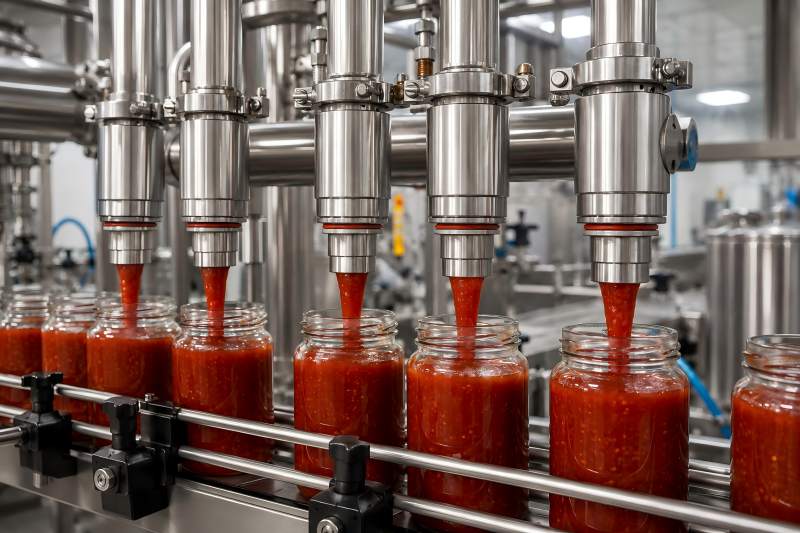
10. Anti-Drip Control Becomes More Important as Consistency Increases
Thin liquids tend to stop flowing quickly after the filling valve closes.
Viscous sauces may behave differently.
Ketchup, honey-like sauces, and concentrated dressings can form strings between the nozzle and bottle.
If this material falls onto the bottle neck, it may interfere with capping and create an untidy final package.
Anti-drip nozzles help by closing the product outlet mechanically.
A suck-back function can also create slight reverse movement after filling.
This pulls the remaining sauce away from the nozzle tip.
For high-viscosity production, this small design feature can significantly improve line cleanliness.
11. Capping
Once filled, containers move directly into the capping section.
Cap types may include:
- Screw caps
- Flip-top caps
- Press-on closures
- Metal twist-off caps
Capping must be synchronized closely with filling.
If filling is too fast compared with capping capacity, bottles accumulate between the two machines.
If capping is too fast, unnecessary conveyor gaps appear.
A well-designed line does not maximize each individual machine speed. Instead, the machines are balanced around the required line output.
For example, if the target is 3,000 bottles per hour, selecting every machine for 8,000 BPH may increase investment without improving actual production.
A small capacity margin—often around 10–20% depending on the process—is generally more useful than excessive oversizing.
12. Labeling and Coding
After capping, bottles move toward labeling.
Labeling options depend on bottle design and brand requirements.
Common systems include:
- Self-adhesive labeling
- Sleeve labeling
- Hot-melt labeling
A date coder or laser coder can then apply production dates, batch numbers, or other traceability information.
At this point, container stability becomes important.
Tall or narrow sauce bottles may require guide rails and controlled conveyor spacing.
Sudden acceleration can cause bottles to tip, especially when product distribution inside the container has not fully stabilized after filling.
13. Inspection
Higher-output lines may include inspection systems before secondary packaging.
Typical checks include:
- Cap presence
- Label position
- Coding quality
- Bottle fill level
- Container integrity
Automatic inspection reduces dependence on continuous manual checking.
Even on smaller lines, however, operators should periodically verify fill weight and cap torque.
A machine can remain mechanically operational while slowly drifting away from the desired process settings.
Quality control should therefore be connected directly to production data.
14. Secondary Packaging
Finished bottles normally enter carton packing, shrink wrapping, or tray packing.
This stage is sometimes treated separately from the filling line, but it affects overall line efficiency.
If the filler produces 4,000 bottles per hour but the carton packing section can only process 3,200 bottles per hour, the practical production capacity is close to 3,200 BPH.
The slowest sustained process determines the real output.
This is why complete line planning should include packaging equipment from the beginning rather than adding it after the main machines have already been selected.
15. Cleaning the Complete Sauce Line
Cleaning sauce equipment is usually more difficult than cleaning water filling equipment.
Thick product can remain in:
- Pipe elbows
- Pump chambers
- Valve bodies
- Filling cylinders
- Tank corners
The system should therefore minimize dead zones and unnecessary pipeline length.
Where suitable, CIP cleaning can circulate water and cleaning solutions through tanks, pipes, pumps, and product passages.
However, some fillers and valves may still require opening or disassembly depending on their structure.
The more varieties produced on one line, the more important cleaning design becomes.
Switching from garlic chili sauce to mayonnaise, for example, requires much more than simply flushing a small amount of water through the pipes.
16. Designing the Line as One System
A complete sauce line can be viewed as the following continuous flow:
Ingredient Preparation → Mixing → Heating → Homogenization → Buffer Storage → Product Transfer → Bottle Feeding → Filling → Capping → Labeling → Coding → Inspection → Secondary Packaging
A viscosity change in the mixing tank affects pump pressure. Pump pressure influences filling stability. Filling stability affects bottle cleanliness. Bottle cleanliness can influence capping and labeling.
This is why solving a filling problem sometimes requires looking upstream rather than adjusting the filling machine itself.