
A complete beer filling line is not simply a packaging machine. It is a connection between brewing equipment, storage systems, filtration, carbonation control, filling technology, packaging automation, and quality management. Every stage influences the final product. A small problem in oxygen control, temperature stability, or filling accuracy can affect beer flavor, shelf life, and production efficiency.
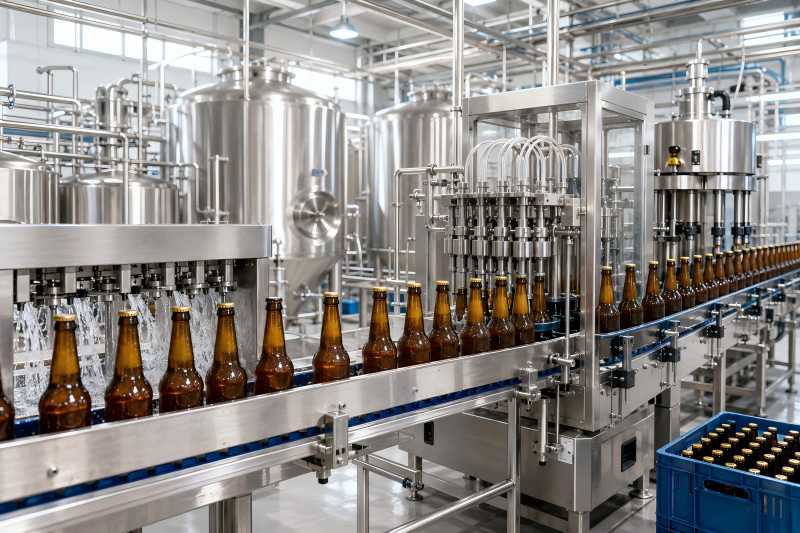
The Complete Beer Production Flow: From Raw Materials to Finished Bottles
A modern beer production system can generally be divided into two major sections:
Brewing Section → Beer Processing Section → Filling and Packaging Section
The brewing section creates the beer, while the filling line preserves the quality of the finished product and prepares it for the market.
A typical commercial beer production flow includes:
| Stage | Main Equipment | Main Purpose |
| Raw Material Preparation | Malt Mill, Grain Handling System | Prepare malt and ingredients |
| Mashing | Mash Tun | Transform starch into fermentable sugars |
| Filtration | Lauter Tun / Mash Filter | Separate wort from grain |
| Boiling | Brew Kettle | Sterilize wort and extract hop characteristics |
| Whirlpool | Whirlpool Tank | Remove solids and improve wort clarity |
| Cooling | Wort Cooler | Reduce temperature before fermentation |
| Fermentation | Fermentation Tank | Convert sugars into alcohol |
| Maturation | Bright Beer Tank | Stabilize flavor and carbonation |
| Filtration | Beer Filter System | Improve clarity and stability |
| Filling | Beer Filling Machine | Package beer without quality loss |
| Packaging | Labeling, Cartoning, Palletizing | Prepare finished products |
Although filling is the final stage, it depends heavily on the stability of the previous brewing and processing steps.
Brewing Equipment: Creating the Foundation of Beer Quality
Before beer reaches the filling line, it has already gone through a complex production process.
The purpose of brewing equipment is not only to produce alcohol but also to control flavor, color, aroma, and consistency.
Malt Milling System
The first step is preparing malt.
Starch in malt grains is converted into fermentable sugars for brewing. A malt mill breaks the grain structure while maintaining suitable particle size.
If the malt is ground too finely:
- Filtration becomes slower.
- Wort flow becomes unstable.
- Energy consumption increases.
If the particles are too large:
- Sugar extraction efficiency decreases.
- Beer yield may drop.
For most breweries, controlling the crushing size is a balance between extraction efficiency and filtration performance.
Mashing System
After milling, malt enters the mash tun.
During mashing, hot water activates enzymes inside the malt. Enzymes transform starch into fermentable sugars.
Temperature control is critical because different temperature ranges influence different characteristics:
| Temperature Range | Effect |
| Around 60–65°C | Produces more fermentable sugars |
| Around 65–70°C | Creates a fuller beer body |
| Above 70°C | Enzyme activity decreases |
A stable mashing process creates consistent wort quality, which directly affects fermentation performance.
Wort Separation and Boiling
After mashing, the liquid portion (wort) must be separated from grain residues.
The wort then enters the boiling stage.
The boiling process performs several functions:
- Sterilizes the wort.
- Removes unwanted volatile compounds.
- Extracts hop bitterness and aroma.
- Concentrates sugar content.
A typical brewing system may operate for approximately 60–90 minutes during boiling, depending on recipe requirements.
After boiling, a whirlpool tank separates hop particles and solids before the wort moves toward fermentation.
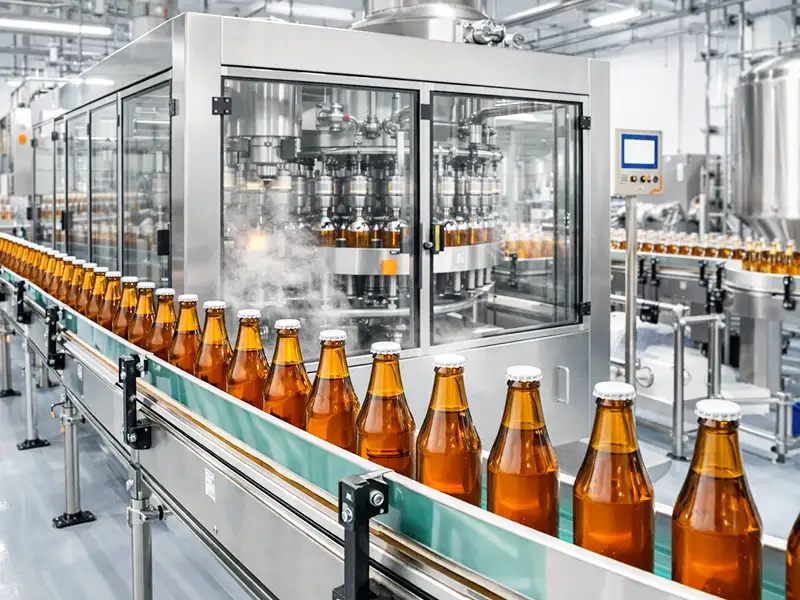
Fermentation and Beer Maturation: Preparing Beer for Filling
After brewing, the wort is cooled and transferred into fermentation tanks.
Fermentation Tanks
During fermentation, yeast converts sugars into alcohol and carbon dioxide, with breweries carefully tracking key parameters:
- Temperature
- Pressure
- Yeast activity
- Alcohol content
- Fermentation time
Each beer style needs specific fermentation conditions. For example:
- Lager production often requires lower fermentation temperatures and longer maturation.
- Ale production usually uses higher temperatures and shorter fermentation cycles.
Depending on the beer style, fermentation may require days or several weeks to complete.
Bright Beer Tanks
Beer then enters bright beer tanks after fermentation. These tanks are especially important before filling because they provide:
- Final beer storage.
- Carbonation adjustment.
- Temperature stabilization.
- Pressure control.
Before entering the filling machine, beer should usually be:
- Properly filtered.
- Stable in temperature.
- Controlled in carbonation level.
- Protected from oxygen exposure.
A stable beer supply makes the filling process much more reliable.
Beer Treatment Before Filling
The filling line does not directly receive beer from fermentation tanks.
Several preparation steps are usually required.
Filtration
Filtration removes unwanted particles and improves product stability.
Depending on beer type and quality requirements, breweries may use:
- Coarse filtration.
- Fine filtration.
- Membrane filtration.
The goal is not always to remove everything. Some craft beers intentionally retain certain characteristics. Therefore, filtration selection depends on product positioning.
Carbonation Adjustment
Carbon dioxide is one of the most important factors in beer packaging.
Unlike many beverages, beer quality is strongly connected with carbonation.
Incorrect CO₂ control can cause:
- Excessive foam during filling.
- Flat taste.
- Reduced shelf life.
For bottled beer, carbonation levels are often controlled within approximately:
- 2.2–2.8 volumes of CO₂
- depending on beer style.
The filling system must maintain this carbonation level during packaging.
How a Beer Filling Machine Works
The filling machine connects freshly brewed beer with efficient packaging solutions. Unlike ordinary liquid filling machines, beer filling requires special technology because beer contains dissolved carbon dioxide and is sensitive to oxygen.
The main challenge is:
How to transfer beer into bottles while keeping carbonation and preventing oxygen contamination.
Bottle Handling and Preparation
Before filling begins, empty bottles enter the production line through the conveyor system.
A complete beer filling line usually includes:
- Bottle conveyor.
- Bottle inspection system.
- Bottle rinsing machine.
- Filling machine.
- Capping machine.
- Labeling machine.
- Packaging equipment.
Depending on production requirements, bottles may first be cleaned or rinsed using sterile water or air.
For returnable glass bottles, cleaning requirements are much higher because bottles must be washed and inspected before reuse.
The Counter Pressure Filling Process
Most commercial beer filling machines use counter pressure filling technology.
The reason is simple:
Beer contains CO₂ under pressure. If beer enters a bottle under normal atmospheric conditions, CO₂ escapes rapidly, causing foam and quality loss.
The counter pressure filling process generally follows these steps:
Step 1: Bottle Positioning
The bottle moves upward and forms a seal with the valve.
Step 2: CO₂ Pre-Pressurization
The bottle is filled with CO₂ gas before beer enters. This reduces pressure differences between the tank and bottle.
Step 3: Beer Filling
Beer flows into the bottle slowly under controlled pressure.
Because pressure is balanced:
- Less foam is generated.
- Carbonation remains stable.
- Beer loss is reduced.
Step 4: Pressure Release
After filling, pressure is gradually released to avoid sudden foaming.
Step 5: Capping
The bottle is immediately sealed to protect beer quality.
Why Filling Speed and Accuracy Matter
The required production volume is a major factor in beer filling line selection. Different breweries require different solutions.
| Brewery Type | Typical Capacity Range |
| Small Craft Brewery | 500–3,000 bottles/hour |
| Medium Brewery | 5,000–15,000 bottles/hour |
| Large Commercial Brewery | 20,000+ bottles/hour |
However, higher speed does not always mean better performance.
A filling machine running at high speed must still maintain:
- Stable filling volume.
- Low oxygen pickup.
- Low foam generation.
- Reliable sealing.
For example, a machine producing 10,000 bottles/hour with unstable filling may create more losses than a stable 8,000 bottles/hour system.
The Role of Capping and Packaging Equipment
After filling, bottles immediately move to the capping station.
The purpose of the cap is not only to close the bottle but also to maintain internal pressure.
A good capping system ensures:
- Consistent sealing force.
- Low leakage risk.
- Long shelf stability.
After capping, the bottles normally pass through:
Labeling Machine
Applies product labels and batch information.
Inspection System
Checks:
- Filling level.
- Cap position.
- Bottle condition.
Packaging Machine
Depending on market requirements, packaging may include:
- Cartons
- Shrink wrapping.
- Trays
- Palletizing systems.
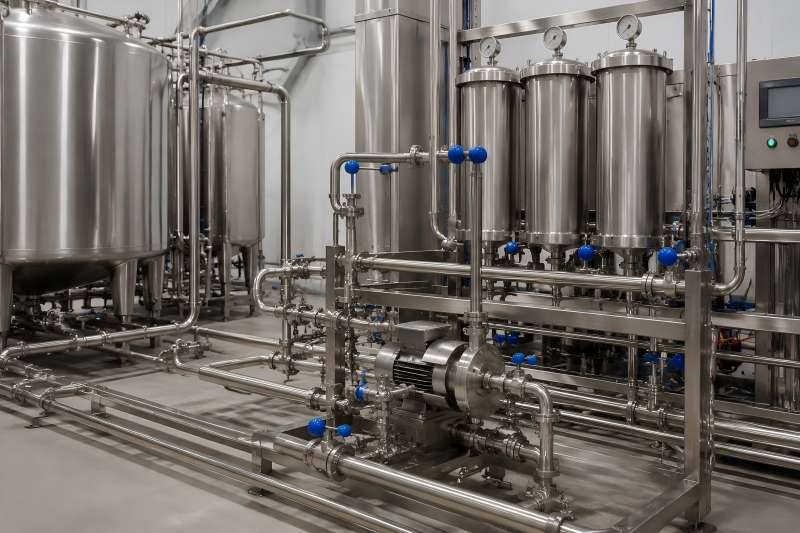
CIP System: Maintaining Hygiene Across the Whole Line
Because beer is a food product, cleaning is essential.
A complete beer production system usually integrates CIP (Clean-in-Place).
The CIP system cleans:
- Brewing tanks.
- Transfer pipes.
- Fermentation tanks.
- Bright beer tanks.
- Filling machine pipelines.
A typical CIP cycle includes:
| Cleaning Stage | Purpose |
| Water Rinse | Remove remaining beer |
| Alkaline Cleaning | Remove organic residues |
| Acid Cleaning | Remove mineral deposits |
| Final Rinse | Prepare for production |
Without effective CIP management, breweries may experience:
- Microbial contamination.
- Flavor changes.
- Product inconsistency.
How Brewing Equipment and Filling Equipment Work Together
A common mistake when designing a brewery is focusing only on the filling machine capacity.
In reality, the entire system must be balanced.
For example:
A filling machine capable of producing 12,000 bottles/hour requires enough beer supply from upstream equipment.
If fermentation capacity is insufficient:
- The filling machine cannot operate continuously.
- Production efficiency decreases.
If the filtration system cannot provide stable beer flow:
- Filling pressure fluctuates.
- Foam increases.
Therefore, brewery design should consider:
Brewing Capacity → Storage Capacity → Filtration Capacity → Filling Capacity → Packaging Capacity
Automation and Smart Control in Modern Beer Filling Lines
Modern breweries increasingly use automated control systems to improve consistency.
A complete automated beer filling line may include:
- PLC control.
- Touch screen operation.
- Automatic pressure adjustment.
- Production data recording.
- Remote monitoring.
Automation helps breweries:
- Reduce operator workload.
- Improve repeatability.
- Reduce production waste.
For example, automatic filling valve control can maintain more consistent filling volume compared with manual adjustment.
Common Challenges in Beer Filling Operations
Even with advanced equipment, breweries still face several challenges.
Excessive Foam
Possible causes:
- Beer temperature too high.
- Pressure imbalance.
- Incorrect filling parameters.
Oxygen Pickup
Possible causes:
- Poor CO₂ flushing.
- Improper filling sequence.
- Air leakage.
Uneven Filling Volume
Possible causes:
- Valve wear.
- Unstable pressure.
- Incorrect calibration.
Product Loss
Possible causes:
- Excessive foam.
- Slow filling cycles.
- Poor line coordination.
The solution is usually not only adjusting the filling machine but checking the entire production process.
Designing the Right Beer Filling Line for Your Brewery
There is no single filling line suitable for every brewery.
The right configuration depends on:
- Beer type.
- Production capacity.
- Bottle size.
- Packaging format.
- Automation requirements.
- Future expansion plans.
For example:
A craft brewery producing several specialty beers may prioritize flexibility and gentle handling.
A large commercial brewery may prioritize:
- High speed.
- Low downtime.
- Automatic control.
- Energy efficiency.
A complete beer filling line is much more than a bottle packaging system. It is a carefully connected production chain that begins with malt preparation and brewing, continues through fermentation and beer treatment, and ends with precise filling, sealing, and packaging.
The quality of bottled beer depends on every stage working together. Brewing equipment creates the product, storage and filtration systems stabilize it, and the beer filling machine protects its original flavor during packaging.
For breweries planning expansion, investing in a complete and balanced production system is often more important than choosing the fastest individual machine. A well-designed beer filling line helps maintain consistent quality, reduce production losses, and support long-term commercial growth.