
Starting a water bottling business can be a profitable opportunity for investors, especially in markets with growing demand for safe drinking water, convenient packaged beverages, and reliable local supply. Bottled water is widely used in homes, offices, schools, hotels, supermarkets, convenience stores, restaurants, outdoor events, and emergency supply channels.
However, a successful water bottling business requires more than buying a filling machine. Investors need to study the market, confirm the water source, choose the right production capacity, understand local regulations, select suitable equipment, build a hygienic factory, control product quality, and develop strong sales channels.
In the U.S., FDA regulates bottled water; EPA oversees tap water. FDA rules cover bottled water safety, quality standards, processing, bottling, holding, and transportation conditions. In other countries, investors should follow local food safety and drinking water regulations.
Understand the Bottled Water Market
Before starting a water bottling business, investors should first study local market demand. Bottled water demand is affected by population size, drinking habits, tap water quality, tourism, retail development, weather conditions, delivery channels, and consumer income level.
Some markets mainly need low-cost drinking water for daily consumption. Others have stronger demand for premium mineral water, purified water, alkaline water, sparkling water, or private label bottled water.
Key Market Research Points
| Research Item | What to Check | Why It Matters |
| Local demand | Household, office, retail, hotel, and restaurant consumption | Determines sales potential |
| Competitors | Local bottled water brands and distributors | Helps set pricing and positioning |
| Water preference | Purified water, mineral water, spring water, alkaline water | Affects equipment and branding |
| Bottle size | 250 ml, 330 ml, 500 ml, 1 L, 1.5 L, 5 L, gallon bottles | Determines filling line configuration |
| Sales channels | Supermarkets, wholesalers, delivery, online, hotels | Affects packaging and distribution |
| Regulation | Food safety license, water testing, labeling rules | Reduces legal and quality risks |
A good water bottling business should be built in a market with stable demand, reliable water supply, manageable competition, and clear sales channels.
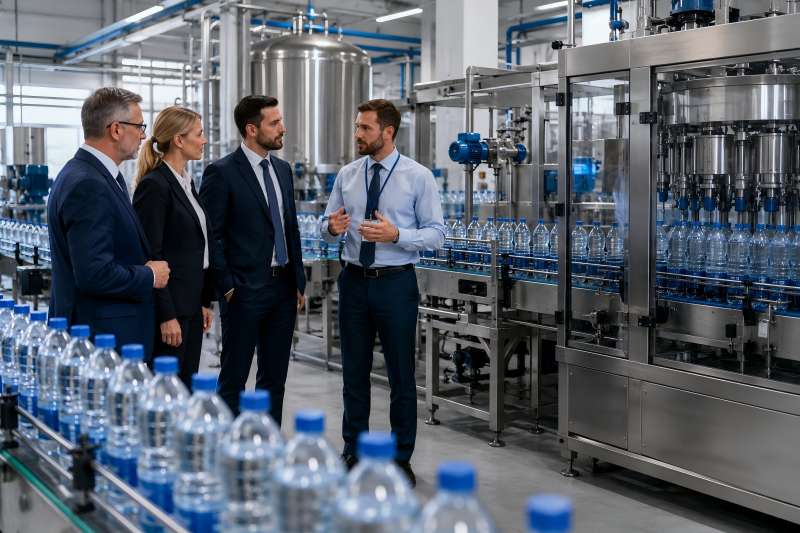
Plan Your Bottled Water Brand Positioning
Investors can select a bottled water business model based on their market and budget. Some focus on mass-market drinking water, while others target premium retail, hotel supply, customized labels, or bulk office delivery.
For new investors, it is usually better to start with a clear product category instead of trying to cover every market from the beginning.
Common Water Bottling Business Models
| Business Model | Main Products | Suitable Investor Type |
| Standard bottled water plant | 330 ml, 500 ml, 1 L, 1.5 L bottled water | Start-up and regional investors |
| Premium water brand | Mineral water, spring water, glass bottle water | Brand-focused investors |
| Private label bottling | OEM bottled water for hotels, events, retailers | Contract manufacturing businesses |
| 5-gallon water plant | Large bottles for homes and offices | Local delivery businesses |
| Beverage expansion plant | Water first, then juice, tea, or carbonated drinks | Investors planning long-term growth |
For many start-up investors, standard purified bottled water is a practical entry point. After the business becomes stable, the company can expand into mineral water, flavored water, private label products, or larger bottle formats.
Prepare a Feasibility Study
A feasibility study shows whether a water bottling project can deliver profits. It should cover market demand, product type, factory location, water source, treatment process, production capacity, equipment investment, labor cost, packaging cost, logistics, selling price, and expected payback period.
Feasibility Study Checklist
| Section | Key Questions |
| Market demand | Who are your target bottled water customers? How much can they buy monthly? |
| Product type | Will the product be purified water, mineral water, or spring water? |
| Water source | Is the water source stable, safe, and legally available? |
| Treatment process | What filtration, purification, and sterilization systems are needed? |
| Bottle size | Which bottle sizes are most popular in the target market? |
| Investment budget | What budget covers land, equipment, and operations? |
| Sales price | What are local wholesale and retail prices? |
| Operating cost | What are the costs of water, bottles, caps, labels, power, labor, and delivery? |
| Profit estimate | What profit remains after production and delivery costs? |
Investors should consider quality, service, and reliability, not just equipment price. A low-cost but unstable water bottling line may cause downtime, leakage, poor filling accuracy, contamination risks, and higher maintenance costs.
Select a Suitable Production Capacity
Water bottling production lines are usually planned by bottles per hour, also called BPH. Capacity should match demand, budget, bottle size, workforce, space, and sales channels.
A small investor does not always need the largest line at the beginning. A well-matched capacity can reduce investment pressure and improve cash flow.
Water Bottling Plant Capacity Reference
| Plant Type | Typical Output Range | Best Fit | Key Advantages |
| Entry-Level Plant | 1,000–3,000 BPH | New investors and small local markets | Lower startup cost, easier operation, smaller space requirement |
| Mid-Scale Plant | 5,000–12,000 BPH | Growing regional bottled water brands | Good balance between capacity, automation, and investment |
| High-Capacity Plant | 15,000–30,000 BPH | Large water brands and beverage factories | Strong production efficiency, higher automation, stable bulk supply |
| Tailored Production Line | Designed by project needs | Special bottle formats, OEM orders, or custom layouts | Flexible configuration for capacity, bottle size, and factory planning |
For many new investors, a medium-capacity line is often practical. It can support regional sales without requiring very high initial investment.
Confirm Water Source and Treatment Requirements
A reliable water source is essential, including treated groundwater, spring, municipal, or surface water. Each source has different mineral content, microbial risk, hardness, odor, turbidity, and chemical composition.
Before confirming the project, investors should arrange professional water testing. The test results help decide which treatment equipment is needed.
Common Water Treatment Systems
| Treatment Equipment | Main Function | Common Application |
| Sand filter | Removes suspended solids and turbidity | Pre-treatment |
| Activated carbon filter | Reduces odor, color, chlorine, and organic matter | Taste improvement |
| Water softener | Reduces hardness | Protects RO membrane and equipment |
| Precision filter | Removes fine particles | Pre-treatment before RO or sterilization |
| Reverse osmosis system | Filters dissolved minerals and impurities. | Clean drinking water production |
| UV sterilizer | Controls microorganisms | Final sterilization support |
| Ozone system | Helps maintain bottled water safety | Bottled water disinfection |
| CIP system | Cleans pipes, tanks, and filling system | Hygiene management |
WHO drinking-water guidelines support global water safety regulations and quality standards. Investors should also follow the standards required by their own country or region.
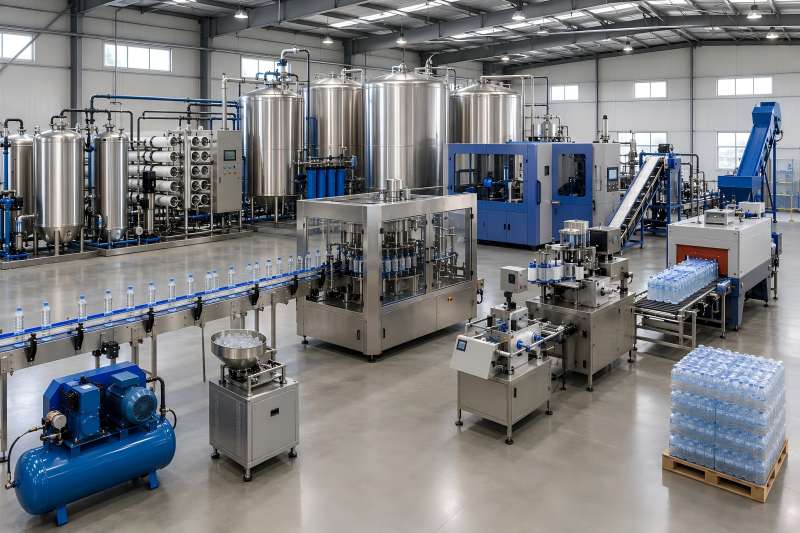
Buy the Right Water Bottling Equipment
The core of the business is the complete water bottling production line. A complete line is not just one machine. It usually includes water treatment, bottle blowing, air conveying, rinsing, filling, capping, labeling, date coding, packing, and inspection systems.
Main Water Bottling Line Equipment
| Production Section | Main Equipment | Function |
| Water treatment | Filters, RO system, UV, ozone, storage tanks | Produces safe and clean water |
| Bottle making | PET bottle blowing machine, molds, air compressor | Produces empty bottles |
| Bottle conveying | Air conveyor, bottle conveyor | Transfers bottles smoothly |
| Rinsing, filling, capping | Monoblock rinsing-filling-capping machine | Completes core bottling process |
| Labeling | Sleeve labeling or sticker labeling machine | Applies product label |
| Date coding | Inkjet printer or laser coder | Prints production date and batch code |
| Packing | Shrink wrapping machine, carton packing machine | Prepares products for delivery |
| Inspection | Light inspection, cap inspection, level inspection | Improves quality control |
| Control system | PLC cabinet, touch screen, sensors | Supports stable automatic operation |
Investors should evaluate speed, bottle compatibility, accuracy, hygiene, automation, energy use, maintenance, spare parts, and service.
Plan the Factory Layout
Factory layout influences efficiency, hygiene, labor, logistics, and future growth. A good water bottling plant should allow smooth movement from water treatment to filling, packing, storage, and delivery.
The layout should also separate clean areas from general operation areas. The filling area requires higher hygiene control than bottle storage or finished product storage.
Main Areas in a Water Bottling Plant
| Factory Area | Main Purpose |
| Water treatment room | Treats raw water before filling |
| Bottle blowing area | Produces PET bottles if bottles are made in-house |
| Filling room | Rinses, fills, and caps bottles |
| Packaging area | Labels, codes, wraps, and cartons products |
| Finished product warehouse | Stores bottled water before delivery |
| Raw material warehouse | Stores preforms, caps, labels, film, and cartons |
| Quality testing room | Tests water quality and finished products |
| Maintenance area | Stores tools and spare parts |
| Office and management area | Supports sales, purchasing, and administration |
The factory should also consider drainage, ventilation, floor cleaning, pest control, worker access, forklift movement, truck loading, and future equipment expansion.
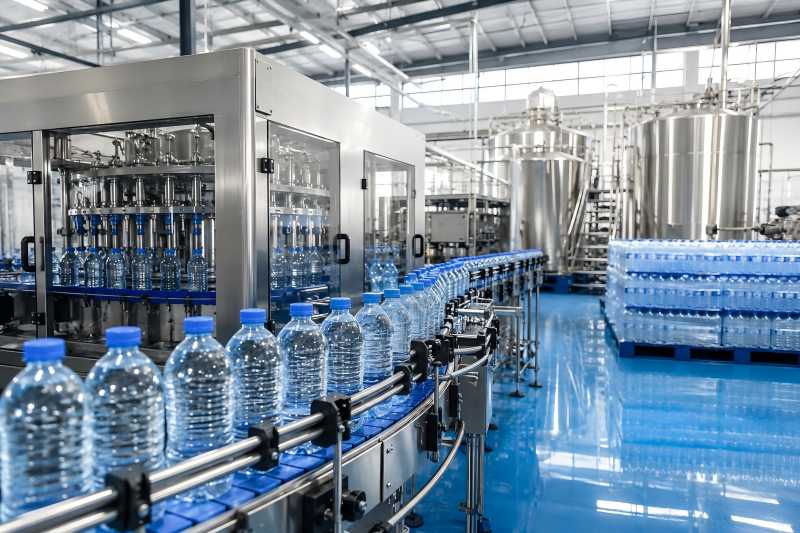
Understand the Water Bottling Production Process
The water bottling process must be stable, hygienic, and controlled. Every stage affects the final product quality.
First, raw water enters the treatment system. After filtration, purification, and sterilization, the treated water is stored in clean water tanks. PET preforms are blown into bottles or purchased bottles are prepared for filling. Empty bottles are rinsed, filled with treated water, and capped. Then bottles are labeled, date coded, packed, inspected, stored, and delivered.
Water Bottling Production Flow
| Step | Process | Key Control Point |
| 1 | Raw water testing | Microbiology, minerals, hardness, odor, turbidity |
| 2 | Water treatment | Filtration accuracy and system stability |
| 3 | Sterilization | UV, ozone, or other approved process |
| 4 | Bottle preparation | Bottle cleanliness and shape stability |
| 5 | Rinsing | Clean bottle interior before filling |
| 6 | Filling and capping | Filling accuracy and cap sealing quality |
| 7 | Labeling and coding | Clear label position and traceable batch code |
| 8 | Packing | Stable shrink wrapping or carton packing |
| 9 | Storage | Clean warehouse and proper stacking |
| 10 | Delivery | Efficient logistics and product protection |
A stable process helps reduce leakage, contamination, product loss, customer complaints, and production downtime.
Estimate Investment and Operating Costs
The total investment of a water bottling business includes land, factory construction, water source development, water treatment system, bottling equipment, bottle blowing system, packaging equipment, utilities, laboratory equipment, installation, staff training, raw materials, and working capital.
Operating cost mainly includes bottles, caps, labels, film, cartons, water, electricity, labor, maintenance, testing, transportation, and marketing.
Main Cost Items
| Cost Category | Examples | Notes |
| Fixed investment | Land, workshop, equipment, installation | One-time major investment |
| Water source | Well, municipal supply, water testing | Depends on local conditions |
| Water treatment | Filters, RO, UV, ozone, tanks | Must match water quality |
| Packaging materials | PET preforms, bottles, caps, labels, film, cartons | Usually a major recurring cost |
| Labor | Operators, technicians, QC staff, warehouse workers | Depends on automation level |
| Utilities | Power, water, compressed air | Affects production cost |
| Maintenance | Spare parts, lubricants, repairs | Needed for stable operation |
| Quality testing | Lab equipment, third-party testing | Supports compliance and brand trust |
| Logistics | Trucks, fuel, pallets, warehouse | Important for delivery radius |
| Marketing | Branding, distributor support, online promotion | Helps build sales channels |
| Working capital | Initial materials and daily operation funds | Reduces cash flow pressure |
Higher automation may increase initial investment, but it can reduce labor cost, improve production consistency, and support larger orders.
Build a Quality Control System
Quality control is vital for safe, consistent bottled water production. Customers buy bottled water because they expect safety, clean taste, stable quality, and reliable packaging.
Investors should build a quality control system before mass production starts. This includes raw water testing, treated water testing, bottle inspection, cap sealing inspection, filling level inspection, microbiological testing, production record management, and batch traceability.
Bottled Water Quality Control Points
| Quality Item | Why It Matters |
| Raw water quality | Determines treatment difficulty |
| Treated water safety | Protects consumer health |
| Microbiological control | Prevents contamination |
| Filling accuracy | Controls product consistency |
| Cap sealing | Prevents leakage and contamination |
| Bottle strength | Reduces deformation during transport |
| Label accuracy | Supports branding and compliance |
| Batch coding | Enables traceability |
| Warehouse hygiene | Protects finished products |
| Equipment cleaning | Maintains long-term safety |
Workers should be trained to follow hygiene rules, cleaning procedures, equipment operation standards, and quality inspection methods. Stable quality supports lasting partnerships with distributors, retailers, and institutional buyers.
Develop Sales Channels
Production is only one part of the business. Sales channels decide whether the water bottling plant can run continuously and profitably.
Before full production begins, investors should already contact potential buyers, distributors, retailers, hotels, restaurants, schools, companies, and local delivery partners.
Common Bottled Water Customers
| Customer Type | Buying Focus |
| Supermarkets and convenience stores | Brand image, price, packaging, supply stability |
| Wholesalers and distributors | Margin, delivery speed, product consistency |
| Hotels and restaurants | Bottle appearance, taste, label design |
| Offices and schools | Stable supply and competitive price |
| Event companies | Customized labels and fast delivery |
| Online customers | Convenience and brand trust |
| Government or emergency supply | Compliance, capacity, and reliability |
Useful sales methods include distributor cooperation, retail shelf placement, local delivery service, private label cooperation, online marketing, social media promotion, free sampling, and brand partnerships.
Select a Trusted Water Bottling Line Supplier
A reliable water bottling equipment manufacturer supports equipment selection, plant layout, water treatment design, installation, training, spare parts, and after-sales service.
A reliable supplier should not only sell machines, but also help investors match the production line with bottle size, capacity, water quality, budget, and market plan.
Supplier Selection Checklist
| Factor | What to Check |
| Industry experience | Does the supplier have experience with similar bottled water projects? |
| Complete line ability | Can it provide water treatment, filling, labeling, and packing equipment? |
| Customization | Can the line be designed for your bottle size and capacity? |
| Machine quality | Are key parts stable, hygienic, and easy to maintain? |
| Automation level | Does the line match your labor and output plan? |
| Installation support | Does the supplier provide installation guidance and commissioning support? |
| Operator training | Can workers learn operation and maintenance? |
| Spare parts | Can essential spare parts be supplied quickly? |
| After-sales service | Do they provide reliable long-term technical support? |
Choosing the right supplier can reduce equipment matching problems, shorten commissioning time, and improve production stability after the plant starts running.
Careful planning can reduce investment risk and help the business become profitable faster.