
Designing a complete carbonated beverage filling line requires a system-level approach. The manufacturer must consider product formula, carbonation level, packaging type, production capacity, filling method, equipment layout, cleaning system, automation, utilities, and quality control.
The most important part of the line is usually the cooling, carbonation, and isobaric filling section because it directly affects foam control, CO₂ retention, filling accuracy, and final product taste. However, supporting systems such as water treatment, syrup blending, conveyor design, capping, inspection, CIP, and packaging are also essential for stable production.
Understand the Product Before Designing the Line
Before selecting machines, the manufacturer should first define the product details. Different carbonated beverages require different processing and filling conditions. For example, sparkling water has a simpler formula, while cola, flavored soda, energy drinks, and sparkling juice may require syrup blending, filtration, sterilization, or special ingredient handling.
Important product information includes:
- Beverage type: soda water, cola, sparkling juice, flavored drink, energy drink, etc.
- Sugar content and viscosity
- CO₂ volume requirement
- Bottle or can size
- Packaging material: PET bottle, glass bottle, aluminum can
- Required shelf life
- Production capacity
- Hygiene standard
- Local regulatory requirements
- Future product expansion plans
For carbonated drinks, CO₂ content is one of the most important design factors. Higher carbonation levels usually require lower filling temperature, more stable pressure control, and better sealing performance.
Basic Process Flow of a Carbonated Beverage Filling Line
A complete carbonated beverage filling line usually includes several connected sections. The actual configuration depends on the product type and packaging format, but the general process is similar.
Typical process flow:
Raw water treatment → Syrup preparation → Beverage blending → Cooling → Carbonation → Bottle/can rinsing → Isobaric filling → Capping or sealing → Inspection → Labeling → Date coding → Shrink wrapping or carton packing → Palletizing
For PET bottle carbonated drinks, the line may also include bottle blowing equipment before filling. For glass bottle drinks, bottle washing and inspection are more important. For cans, the line needs depalletizing, can rinsing, can filling, and seaming.
A good filling line design should keep the process smooth, reduce material transfer distance, and avoid unnecessary waiting time between carbonation and filling.
Main Equipment in a Complete Carbonated Beverage Filling Line
A complete line is made of multiple equipment modules. Each module should match the capacity, bottle type, product formula, and automation level.
Water Treatment System
Water quality has a direct influence on beverage taste and stability. A typical water treatment system may include quartz sand filtration, activated carbon filtration, softening, precision filtration, reverse osmosis, UV sterilization, and ozone sterilization.
The system removes suspended solids, odor, chlorine, hardness, microorganisms, and other impurities. For sparkling water and flavored carbonated drinks, stable water quality is especially important because the taste profile is more noticeable.
Syrup Preparation System
For sweetened carbonated beverages, syrup preparation is a key section. The system usually includes sugar dissolving tanks, mixing tanks, filters, pumps, and storage tanks. Ingredients such as sugar, flavor, color, acidulants, preservatives, and functional additives are mixed according to the formula.
The syrup room should be designed for accurate dosing, easy cleaning, and hygienic operation. If the plant produces multiple flavors, separate tanks and clear recipe management are useful.
Beverage Blending System
The blending system mixes treated water and syrup according to a fixed ratio. Accuracy is important because incorrect mixing can affect sweetness, acidity, flavor strength, and product consistency.
Modern systems may use flow meters, ratio control valves, PLC control, and recipe storage. Automatic blending improves consistency and reduces manual mistakes in high-volume production.
Cooling and Carbonation System
Carbon dioxide dissolves better at low temperature. Therefore, the beverage is usually cooled before carbonation. Plate heat exchangers or beverage chillers are commonly used.
After cooling, the beverage enters the carbonation tank or mixer, where CO₂ is injected under controlled pressure. The carbonation system must maintain stable pressure, temperature, and flow to achieve the required gas volume.
Isobaric Filling Machine
Carbonated drinks are commonly filled by isobaric filling, also called counter-pressure filling. The container is pre-pressurized with CO₂ or clean gas. Then the product flows into the container under balanced pressure. This helps reduce foaming and carbon dioxide loss.
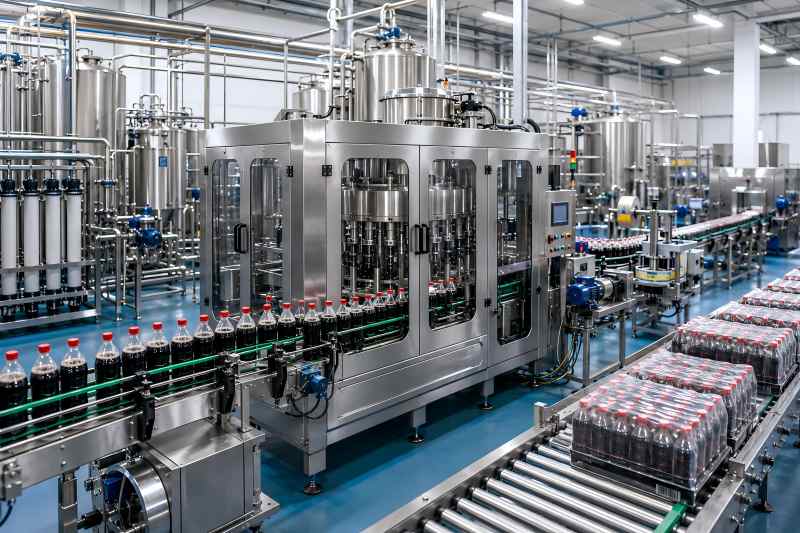
A common PET bottle carbonated beverage line uses a rinsing-filling-capping monoblock machine. The bottle is rinsed, filled, and capped in one integrated machine. This design saves space, improves hygiene, and reduces bottle transfer problems.
Capping or Seaming System
PET bottles are sealed with plastic screw caps. Glass bottles may use crown caps, screw caps, or aluminum caps. Aluminum cans require a can seamer.
Sealing quality is critical for carbonated drinks. Poor sealing can cause gas leakage, low carbonation, package deformation, or product spoilage. The capping or seaming system should be matched with the container and closure type.
Labeling and Packaging System
After filling and sealing, containers move to labeling, coding, inspection, and secondary packaging. Labeling options include shrink sleeve labeling, OPP hot melt labeling, self-adhesive labeling, and wet glue labeling.
Packaging options include shrink film packing, carton packing, tray packing, or wrap-around case packing. The choice depends on market requirements, distribution method, and brand presentation.
Typical Line Capacity and Equipment Configuration
Capacity is one of the first decisions in line design. A small beverage plant may need 2,000 to 6,000 bottles per hour. A medium plant may need 8,000 to 18,000 bottles per hour. Large factories may require 24,000 bottles per hour or more.
| Production Scale | Typical Capacity | Suitable Business Type | Common Configuration |
| Small line | 2,000–6,000 BPH | Startup beverage brand, local drink factory | Semi-automatic or compact automatic line |
| Medium line | 8,000–18,000 BPH | Regional beverage producer | Automatic rinsing-filling-capping monoblock, labeling, packing |
| Large line | 24,000–48,000+ BPH | Large beverage manufacturer | High-speed rotary filling, automatic conveying, inspection, packing, palletizing |
| Pilot line | 500–1,500 BPH | R&D, small batch testing | Flexible filling system with quick changeover |
BPH means bottles per hour. When designing capacity, the plant should not only consider current orders. It should also consider seasonal demand, future product launches, and packaging expansion. Choosing a slightly higher capacity can reduce future upgrade pressure, but oversized equipment may increase investment and energy cost.
Key Technical Parameters for Carbonated Beverage Filling
Carbonated beverage filling is strongly affected by temperature, pressure, CO₂ level, and filling speed. If the beverage temperature is too high, CO₂ escapes more easily and foam increases. If filling pressure is unstable, filling level and gas retention may become inconsistent.
| Parameter | Typical Range | Design Purpose |
| Beverage temperature before filling | 2°C–6°C | Improves CO₂ dissolution and reduces foam |
| Carbonation pressure | 0.25–0.45 MPa | Helps achieve target gas volume |
| CO₂ volume | 2.0–4.5 volumes | Depends on beverage type and taste |
| Filling method | Isobaric filling | Maintains pressure balance during filling |
| PET bottle pressure resistance | Usually designed for carbonated products | Prevents deformation or burst risk |
| Filling accuracy | Often within ±1% depending on machine | Controls product consistency and cost |
| Final sealing check | Required | Prevents gas leakage and low carbonation |
These values are general reference ranges. The final settings should be adjusted according to beverage formula, bottle design, CO₂ target, local climate, and equipment supplier recommendations.
Choose the Right Packaging Format
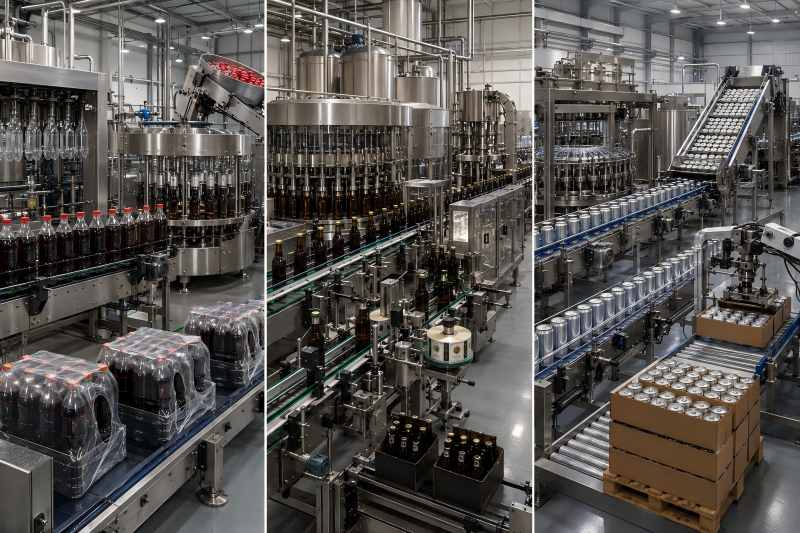
Packaging format affects the entire filling line design. PET bottles, glass bottles, and cans each require different equipment.
PET Bottle Line
PET bottles are popular for carbonated drinks due to low weight, affordability, and easy shipping. A PET line may include bottle blowing, air conveyor, rinsing-filling-capping monoblock, cap feeding, labeling, coding, shrink wrapping, and palletizing.
The bottle must withstand carbonation pressure. Ordinary still water bottles may not have enough pressure resistance. The bottle base, wall thickness, neck finish, and cap compatibility should be tested before mass production.
Glass Bottle Line
Glass bottles are often used for premium soda, craft beverages, beer-style drinks, and returnable bottle systems. Glass bottle lines include washing, inspection, filling, capping, labeling, and final packaging.
Glass bottle filling requires careful handling to prevent breakage. If returnable bottles are used, the washing and inspection section becomes more complex.
Aluminum Can Line
Cans are popular for sparkling water, energy drinks, soft drinks, and ready-to-drink beverages. A can line generally includes depalletizing, can rinsing, isobaric filling, seaming, inspection, coding, shrink wrapping, carton packing, and palletizing.
Can seaming quality is extremely important. Seam defects can cause leakage, contamination, or pressure loss. Regular seam inspection is necessary during production.
Design the Line Layout Carefully
A good layout improves production efficiency and reduces contamination risk. Poor layout can cause bottle jams, long transfer distance, difficult maintenance, and inefficient operator movement.
Key layout principles include:
- Keep raw material area, processing area, filling area, and packaging area clearly separated.
- Place the carbonation system close to the filling machine.
- Avoid long product pipelines after carbonation.
- Design enough space for operators, maintenance, and cleaning.
- Keep wet areas and dry packaging areas reasonably separated.
- Reserve space for future capacity expansion.
- Plan drainage, compressed air, steam, electricity, and CO₂ supply in advance.
- Reduce crossing between people, materials, and finished products.
The filling area should usually have better hygiene control than the outer packaging area. For high-standard beverage plants, air cleanliness, positive pressure, floor drainage, and CIP return design should be considered early.
Conveyor and Buffer Design
Conveyors connect different machines into one complete production line. For carbonated beverage lines, conveyor design should reduce bottle shaking, bottle falling, and pressure buildup.
The conveyor speed should match the filling machine, labeling machine, packing machine, and inspection system. Buffer sections are useful because different machines may stop or slow down temporarily.
For PET bottles, air conveyors are often used between bottle blowing and filling. Chain conveyors are used after filling. For cans, magnetic elevators, mass conveyors, and accumulation tables may be used.
Smooth conveyor design can reduce downtime and improve line efficiency.
Cleaning and CIP System Design
Hygiene is essential in beverage production. A CIP system, or clean-in-place system, allows tanks, pipes, and filling circuits to be cleaned without full disassembly.
A typical CIP process may include water rinsing, alkaline cleaning, hot water rinsing, acid cleaning, final rinsing, and sanitizing. The exact process depends on the beverage formula and hygiene requirements.
Carbonated beverage lines with sugar syrup need effective cleaning because sugar residues can support microbial growth. Flavor changeover also requires proper cleaning to prevent cross-flavor contamination.
Important CIP design points include:
- Correct cleaning flow rate
- Proper temperature control
- Chemical concentration control
- Cleanable tank and pipeline design
- Drainability
- Automatic recipe control
- Separate cleaning circuits for different sections
A well-designed CIP system reduces cleaning time, saves water and chemicals, and improves product safety.
Automation and Control System
Automation level depends on budget, capacity, and management requirements. A modern carbonated beverage filling line usually uses PLC and HMI control. Operators can monitor machine status, speed, temperature, pressure, alarm information, and production data.
Advanced systems may include recipe management, automatic CIP records, filling level monitoring, cap inspection, reject control, remote diagnosis, and production data collection.
Automation can help with:
- Stable filling pressure
- Accurate blending ratio
- Consistent carbonation level
- Reduced operator error
- Faster product changeover
- Easier troubleshooting
- Better production traceability
For plants producing multiple SKUs, recipe storage and quick changeover settings are especially valuable.
Quality Control Points in the Filling Line
For carbonated beverages, the most important control points include water quality, syrup ratio, CO₂ content, filling level, cap torque, seam quality, bottle pressure resistance, labeling accuracy, and package appearance.
| Control Point | Inspection Method | Why It Matters |
| Water quality | Conductivity, microbiological test, filtration check | Ensures clean and stable base water |
| Syrup ratio | Brix test or automatic ratio monitoring | Controls sweetness and flavor consistency |
| CO₂ content | Carbonation tester | Ensures correct gas level and mouthfeel |
| Filling level | Visual or automatic level inspection | Prevents underfilling or overfilling |
| Cap torque | Torque tester | Prevents leakage and opening problems |
| Can seam | Seam inspection tools | Prevents leakage and pressure loss |
| Label position | Vision inspection or manual sampling | Protects brand appearance |
| Package integrity | Drop test or compression check | Supports transport safety |
A strong quality control system helps reduce complaints, recalls, product waste, and brand damage.
Utilities Required for the Filling Line
A carbonated beverage filling line needs reliable utility support. These utilities should be calculated before installation.
Common utilities include:
- Treated water
- Chilled water
- CO₂ gas
- Compressed air
- Electricity
- Steam or hot water
- Cleaning chemicals
- Drainage
- Ventilation
- Packaging material storage
CO₂ supply must be stable because unstable gas pressure can affect carbonation and filling performance. Compressed air should be dry and clean, especially when used for pneumatic valves, actuators, and bottle handling. Chilled water capacity should match beverage cooling demand during peak production.
Common Design Mistakes to Avoid
Many production problems come from poor early planning. Some common mistakes include:
Choosing Capacity Only Based on Current Orders
If demand grows quickly, the line may become a bottleneck. It is better to plan for reasonable future expansion.
Ignoring Bottle Compatibility
Not all PET bottles can handle carbonated drinks. Bottle design must be tested for pressure, deformation, sealing, and transport strength.
Long Distance Between Carbonation and Filling
Long pipelines after carbonation can cause gas loss, temperature rise, and unstable filling. The carbonation system should be close to the filler.
Weak Cooling Capacity
If beverage temperature is too high, foaming increases and CO₂ retention decreases. Cooling capacity should be calculated according to flow rate and inlet temperature.
Poor Conveyor Planning
Bottle jams and unstable transfer can reduce the efficiency of the whole line, even if the filling machine itself is fast.
Insufficient Cleaning Design
Difficult-to-clean pipelines or tanks increase hygiene risk and cleaning time. CIP design should be considered before equipment installation.
How to Plan a Flexible Line for Future Growth
Many beverage factories start with one or two products but later expand to more flavors, bottle sizes, or packaging styles. A flexible line can reduce future investment.
Design flexibility can include:
- Adjustable bottle change parts
- Multi-size cap handling
- Recipe-based blending control
- Extra tank ports for new flavors
- Reserved space for a second labeling machine
- Conveyor layout for future packaging equipment
- Modular CIP circuits
- Space for higher-capacity utilities
- Compatible control system for future automation upgrade
Flexibility is especially important for brands producing seasonal drinks, private label beverages, or small-batch flavors.
Example Design Plan for a Medium Carbonated Beverage Line
A medium PET bottle carbonated beverage line may be designed for 12,000 bottles per hour using 500 ml PET bottles. The line could include water treatment, syrup preparation, blending, cooling, carbonation, bottle blowing, air conveyor, rinsing-filling-capping monoblock, cap sterilization, bottle inspection, sleeve labeling, date coding, shrink wrapping, and palletizing.
The beverage would be cooled to around 4°C before carbonation. The filling machine would use isobaric filling to reduce foaming. Automatic cap torque inspection and liquid level inspection would help protect product quality. The plant could reserve space for a future 1 L bottle format and additional flavor tanks.
This type of design is suitable for regional beverage factories that need stable output, good automation, and room for product expansion.