
A labeling machine should not be selected as a separate machine only. In a complete bottle packaging line, it must match the filling machine, capping machine, conveyor, bottle shape, label type, coding system, and inspection process.
A good filling and capping line can still lose efficiency if the labeler becomes the bottleneck. Packaging lines usually run at the speed of the slowest machine, so the real line output depends on how well each station works together.
For bottled products, labeling is often placed after filling and capping. At this stage, the bottle has already been filled, closed, and transferred downstream. If the bottle is unstable, the cap is not seated correctly, or the conveyor speed changes suddenly, label accuracy may drop.
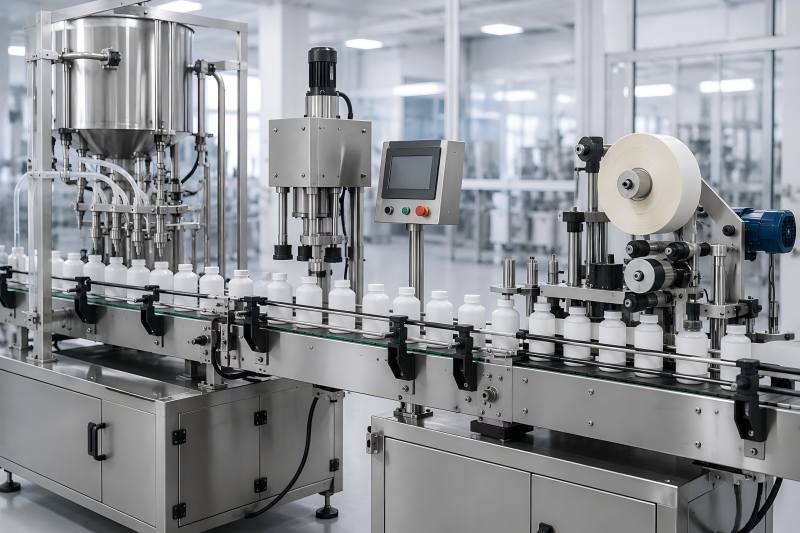
Start with the Full Line Layout
A standard automatic bottle packaging line usually includes bottle feeding, rinsing or cleaning, filling, capping, labeling, coding, inspection, and collection. Some lines also include induction sealing, sleeve shrinking, carton packing, or case packing.
The labeling machine should be positioned where bottles are stable and dry enough for label application. For most liquid products, it is installed after capping because the filled bottle has its final weight and shape. This helps the labeler handle the bottle in the same condition customers will see.
A simple line flow may look like this:
| Line Section | Main Function | Matching Point for Labeling |
| Bottle feeding | Supplies empty bottles | Stable bottle spacing before filling |
| Filling machine | Fills liquid, paste, powder, or granules | Output speed determines downstream demand |
| Capping machine | Applies caps, pumps, sprays, or lids | Cap height and bottle stability affect labeling |
| Labeling machine | Applies front, back, wrap-around, top, or tamper label | Must match speed, bottle shape, and label position |
| Coding system | Prints date, batch, QR code, or barcode | Coding position must align with label design |
| Inspection / collection | Checks label, code, cap, and finished product | Reject system must match final line speed |
The goal is smooth bottle transfer. If the filler runs faster than the labeler, bottles accumulate. If the labeler runs faster than upstream stations, it may wait too often and reduce overall efficiency.
Match the Labeler Speed with Real Line Output
Many buyers compare machines by maximum speed, but maximum speed is not the same as stable production speed. A labeler may be rated at 120 bottles per minute, but actual output can change with bottle size, label length, label material, product stability, and operator settings.
Evaluate the real output of the filling and capping line first. For example, if a filler can produce 80 bottles per minute but the capper can only handle 60 bottles per minute, the real target for the labeler should be based around 60 bottles per minute, not 80.
Some entry-level automatic bottle labeling systems may run around 30 bottles per minute, while high-speed systems can reach hundreds of labels per minute depending on product size and configuration.
| Production Target | Suggested Labeler Capacity | Reason |
| 20–30 bottles/min | 30–40 bottles/min | Allows small buffer for stable operation |
| 40–60 bottles/min | 60–80 bottles/min | Matches common automatic filling and capping lines |
| 80–120 bottles/min | 120–150 bottles/min | Suitable for medium to high-volume production |
| 150+ bottles/min | Custom high-speed labeling system | Requires stronger control, spacing, inspection, and reject design |
A practical rule is to choose a labeling machine with slightly higher stable capacity than the upstream line. This prevents the labeler from limiting production when the filler and capper run normally.
However, oversizing the labeler too much can also create waste. A very high-speed labeler may need more space, stronger bottle handling, better sensors, higher investment, and more skilled operators.
Check Bottle Shape and Stability
Bottle shape is one of the most important factors when matching a labeling machine with a filling and capping line. A round bottle, square bottle, flat bottle, oval bottle, tapered bottle, or small vial may need a different labeling structure.
Round bottles often use wrap-around labeling. Square and flat bottles may need front and back labeling. Tapered bottles may require special positioning and label compensation. Small bottles may need vertical feeding, star wheel handling, or screw separation.
Bottle stability also changes after filling. A light empty bottle may be easy to move, but a filled bottle becomes heavier and may behave differently on the conveyor. Tall slim bottles may shake or fall during transfer. Soft plastic bottles may deform under pressure.
Before selecting the labeler, buyers should confirm:
- Bottle diameter, height, and shape
- Filled bottle weight
- Bottle surface material
- Cap type and cap height
- Label area and label direction
- Bottle balance on the conveyor
- Whether the bottle is wet, oily, dusty, or cold
This information helps the supplier choose the right bottle separation, guide rail, pressing belt, wrap belt, sponge roller, star wheel, or side-holding system.
Match Label Type with Product and Line Design
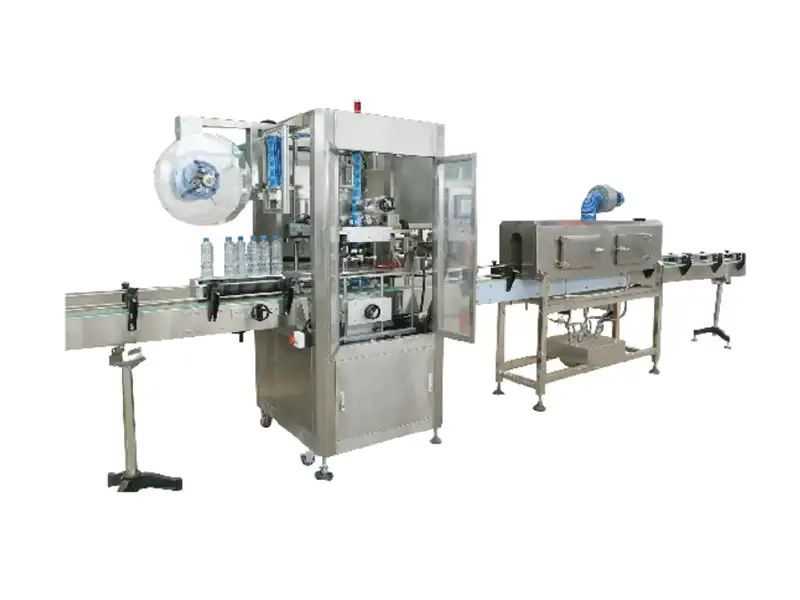
Different label types require different machine structures. A self-adhesive labeler is common for food, beverage, cosmetics, medicine, daily chemical, and household products. Sleeve labeling uses heat shrink film and needs a shrink tunnel. Wet glue labeling is more common for some glass bottles and high-volume beverage applications.
For a filling and capping line, the labeler should match both the product container and the production environment.
| Label Type | Common Application | Line Matching Focus |
| Self-adhesive label | Bottled water, cosmetics, sauces, chemicals, supplements | Label roll direction, sensor type, adhesive performance |
| Wrap-around label | Round bottles and jars | Bottle rotation, label overlap, surface friction |
| Front and back label | Flat, oval, square bottles | Bottle orientation and side pressure control |
| Top label | Lids, caps, boxes, flat containers | Product height and top surface stability |
| Tamper-evident label | Pharma, food safety, sealed products | Cap position, neck shape, label folding accuracy |
| Shrink sleeve label | Beverages, dairy, full-body decoration | Steam or electric shrink tunnel matching |
For self-adhesive labels, the test should include initial adhesion, long-term adhesion, label edge lifting, and label position after conveyor transfer. If bottles are cold or wet after filling, adhesive performance may drop.
Consider the Capping Machine Before Labeling
Capping quality affects labeling more than many buyers expect. If the cap is crooked, loose, too high, or not fully pressed, the bottle may not pass smoothly through the labeler. For neck labels, tamper labels, or labels near the cap area, cap consistency becomes even more important.
A screw cap line should control torque. A pump cap line should control cap direction and tube placement. A trigger spray line may require bottle orientation before labeling. A press cap line should confirm that caps are fully seated before the product reaches the labeling station.
If the capping machine has unstable output, the labeler may receive bottles with different heights or angles. This can cause label skewing, wrinkles, bubbles, or inaccurate positioning.
For better matching, the line should include enough distance or accumulation between capping and labeling. This gives the conveyor time to stabilize bottle flow before label application.
Match Conveyor Speed and Bottle Spacing
The conveyor is not only a transfer device. It manages bottle movement across filling, capping, and labeling. If the conveyor is too fast, bottles may shake, tilt, or collide. If it is too slow, the line cannot reach the target output.
Packaging conveyor systems must be designed to balance flow between stations and avoid jams, spills, or inefficient production.
Bottle spacing is especially important for automatic labeling. The labeler needs enough space to detect each bottle, release the label, apply it, and reset for the next product. If bottles are too close, the sensor may miss bottles or apply labels at the wrong time.
Common spacing methods include screw separation, timing belts, star wheels, indexing systems, or bottle spacing wheels. The right choice depends on speed, bottle shape, and accuracy requirements.
A high-speed line usually needs more controlled spacing than a small line. For cosmetic, pharmaceutical, or premium food products, stable spacing also improves visual quality.
Check Control System Compatibility
A modern filling, capping, and labeling line should have coordinated controls. The machines may use independent PLCs, but they should communicate clearly through signals such as start, stop, ready, fault, low label, bottle jam, no bottle, and emergency stop.
For larger packaging lines, PackML can help standardize machine states, machine data, and line integration. OMAC describes PackML as a standard that supports consistent machine data transfer, while the OPC Foundation notes that PackML uses standard states and tags for machine status and control.
For buyers, this means the supplier should discuss:
- PLC brand
- HMI language
- Speed synchronization
- Bottle sensor signals
- Alarm display
- Emergency stop connection
- No-bottle-no-label function
- Low-label warning
- Reject control
- Data collection and OEE monitoring
Even if the buyer does not need a fully advanced control system, basic signal matching is still necessary. A labeler that cannot communicate properly with upstream and downstream machines may cause frequent stops.
Plan for Coding and Inspection
Many labeling machines are integrated with coding systems. These may print production date, expiry date, batch number, barcode, QR code, or traceability information.
The coding system can be installed before or after label application, depending on the label material and code position. For printed labels, coding is often applied directly on the label. For transparent labels or special surfaces, the printer type and ink adhesion should be tested carefully.
Common coding options include thermal transfer overprinter, inkjet printer, laser coder, and ribbon coder.
Inspection is also important. A complete line may check whether the label is present, whether the code is readable, whether the cap is present, and whether the bottle is rejected correctly. The reject device must match the conveyor speed and product weight.
For regulated products such as pharmaceuticals, supplements, and food products, label accuracy and code readability are not only appearance issues. They are related to compliance, traceability, and product safety.
Test with Real Bottles, Labels, and Filled Samples
A machine test should not use empty bottles only. Empty bottles are lighter and may move differently from filled bottles. The best test uses real bottles, real caps, real labels, real filling weight, and real conveyor speed.
During testing, buyers should check:
- Label position tolerance
- Wrinkles and bubbles
- Label edge lifting
- Bottle rotation stability
- Front and back label alignment
- Label overlap on round bottles
- Code clarity
- Bottle jams
- Reject accuracy
- Changeover time
A short test can show whether the labeler works. A longer test can show whether it stays stable. For production lines, stability is more valuable than a short high-speed demonstration.
Plan for Future Product Changes
Many filling and capping lines handle more than one bottle size. A labeling machine should support future product changes when possible. This is especially important for cosmetics, sauces, beverages, detergents, pharmaceuticals, and supplement brands.
Buyers should ask whether the machine can handle different bottle heights, diameters, label lengths, label widths, and label positions. Tool-free adjustment, recipe storage, servo control, and clear scale markings can reduce changeover time.
If the brand expects more SKUs in the future, it may be better to choose a more flexible labeling machine rather than a machine designed for only one bottle.
Common Matching Mistakes
One common mistake is choosing the labeler only by maximum speed. Another is ignoring bottle stability after filling. Some buyers also forget that cap type, conveyor layout, label roll direction, and coding position can all affect final label quality.
A third mistake is leaving too little space between capping and labeling. Without proper spacing, bottles may enter the labeler too closely or with unstable movement.
A fourth mistake is testing with ideal samples only. Real production includes label roll changes, cap variation, bottle tolerance, conveyor vibration, and operator adjustment. These details should be considered before mass production.
Matching a labeling machine with a filling and capping line requires more than comparing machine prices or rated speed. The right labeler should fit the real bottle, real cap, real label, real output, and real line layout.
A properly matched line ensures smooth bottle flow through each stage. It reduces jams, improves label accuracy, protects product appearance, and helps the whole packaging line reach stable production.