
Improving labeling accuracy in bottle production requires control over the full process, not only the labeling machine. Bottle consistency, label material, machine calibration, sensor setup, bottle spacing, line speed, operator training, and inspection standards all work together.
What Does Labeling Accuracy Mean?
Labeling accuracy refers to how consistently a label is applied to the correct position on a bottle. It includes vertical position, horizontal position, front-back alignment, wrap-around overlap, label tilt, edge matching, and barcode readability.
In bottle production, accuracy is usually measured in millimeters. For many automatic bottle labeling machines, a common production target is within ±1 mm to ±2 mm under stable conditions. Higher-precision systems with servo control, accurate bottle spacing, and vision inspection may reach tighter tolerances, depending on bottle shape, label type, speed, and material quality.
Labeling accuracy is affected by three main factors:
| Factor | What It Affects | Common Problem |
| Bottle consistency | Label position and contact surface | Label shift, wrinkles, poor adhesion |
| Label quality | Feeding, peeling, and adhesion | Label breakage, skewing, curling |
| Machine control | Timing, pressure, and positioning | Misalignment, repeated offset, unstable accuracy |
Manufacturers need more than one correctly applied label. The real goal is to keep accuracy stable during long production runs, different batches, and frequent product changeovers.
Start with Consistent Bottle Quality
Bottle quality has a direct effect on labeling accuracy. If bottles vary in diameter, height, wall shape, shoulder angle, or surface flatness, the labeling machine must deal with unstable positioning. Even a well-calibrated automatic bottle labeling machine cannot fully correct poor bottle consistency.
Round bottles need stable diameter and smooth rotation. Flat bottles need consistent side panels and reliable orientation. Square bottles require accurate corner positioning. Tapered bottles need special label design and machine adjustment because the label must follow a changing surface.
Before mass production, manufacturers should inspect bottle dimensions from different batches. A simple check can include bottle height, body diameter, label panel width, surface smoothness, and deformation after filling or heat treatment.
| Bottle Type | Key Accuracy Risk | Recommended Control Point |
| Round bottle | Label overlap mismatch | Check diameter tolerance and rotation stability |
| Flat bottle | Front label off-center | Use side guides and bottle orientation control |
| Square bottle | Corner misalignment | Control bottle positioning before labeling |
| Tapered bottle | Wrinkles or angled label | Use tapered label design and matched rollers |
| Soft plastic bottle | Pressure deformation | Adjust label pressure and conveyor grip |
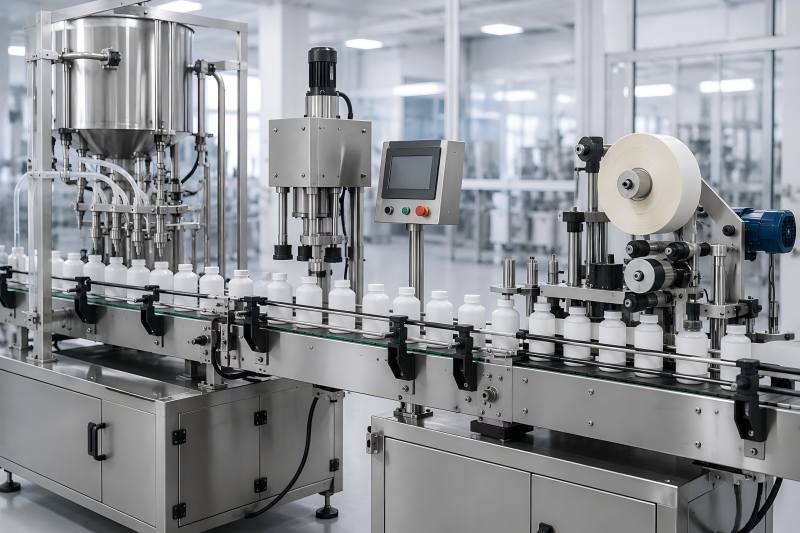
If bottles are squeezed, oval, dusty, oily, or wet, labels may not attach evenly. For PET, HDPE, glass, and aluminum bottles, surface condition should be checked before labeling. Cleaning, drying, and static control can greatly reduce labeling defects.
Choose the Right Label Material
Label material also plays a major role in labeling accuracy. A label that is too stiff may not wrap smoothly around small-diameter bottles. A label that is too thin may stretch, curl, or wrinkle during feeding. Adhesive strength must also match the bottle material and production environment.
Self-adhesive labels are widely used in automatic bottle labeling because they are easy to apply and suitable for many products. However, the release liner, adhesive layer, label thickness, and die-cutting quality must remain stable. Poor die-cutting may cause labels to peel unevenly, while uneven liner tension can affect feeding accuracy.
For bottled products stored in refrigerators, bathrooms, warehouses, or outdoor environments, adhesive performance should be tested under real conditions. Cold bottles, wet surfaces, curved containers, and oily products can all reduce adhesion.
Useful label checks include:
- Label roll direction should match the machine feeding direction.
- Label gap should be consistent for sensor detection.
- Label edges should be clean without adhesive overflow.
- The liner should release smoothly without tearing.
- Printed barcodes should be tested for readability.
For barcode quality, GS1 recommends building a barcode quality plan and refers to ISO/IEC 15416 for linear barcodes and ISO/IEC 15415 for 2D symbols. These standards help evaluate barcode print quality beyond simple scan testing.
Calibrate the Labeling Machine Carefully
Machine calibration is one of the most effective ways to improve labeling accuracy. Even a small change in conveyor speed, bottle spacing, sensor position, or label dispensing timing can cause visible label offset.
Before production starts, operators should set the bottle guides, conveyor speed, label sensor, peeling plate, pressing roller, and labeling head according to the bottle and label size. Inspect the initial bottles carefully before increasing the line to full speed.
Important calibration points include:
- Bottle guides should hold the bottle firmly without squeezing it.
- The label sensor should detect each label gap correctly.
- The peeling plate should release the label smoothly.
- The labeling head should match the bottle surface angle.
- The pressing roller should remove air bubbles without deforming the bottle.
- The conveyor speed and label feeding speed should stay synchronized.
A common mistake is adjusting only the label position on the control panel while ignoring mechanical alignment. If the bottle is already unstable before reaching the labeling head, software correction alone will not solve the problem.
Control Bottle Spacing and Positioning
Stable bottle spacing is essential for accurate automatic labeling. If bottles enter the labeling station too close together, too far apart, or at different angles, the label trigger timing becomes unstable.
Bottle separation wheels, star wheels, spacing screws, side belts, and guide rails can help maintain correct spacing. For round bottles, wrap-around labeling often requires the bottle to rotate smoothly while the label is applied. For flat or square bottles, orientation control ensures the label is applied to the correct panel.
In high-speed bottle production, spacing errors often appear when the upstream filling or capping machine runs unevenly. The labeling machine may be accurate by itself, but inconsistent bottle flow from the previous machine can still cause defects.
A good bottle production line should balance filling, capping, labeling, coding, inspection, and packing speeds. When one section runs faster or slower than the others, bottle pressure can build up on the conveyor and affect label placement.
Use Sensors and Vision Inspection
Sensors are critical for accurate label detection and bottle detection. A label sensor detects the gap between labels on the roll, while a bottle sensor detects the bottle position before labeling. If either sensor is dirty, misaligned, or unsuitable for the material, label placement may shift.
Transparent labels require special sensors because the gap may be difficult to detect. Metallic labels, dark labels, and glossy labels may also need careful sensor selection. For difficult materials, ultrasonic or advanced photoelectric sensors may perform better than standard sensors.
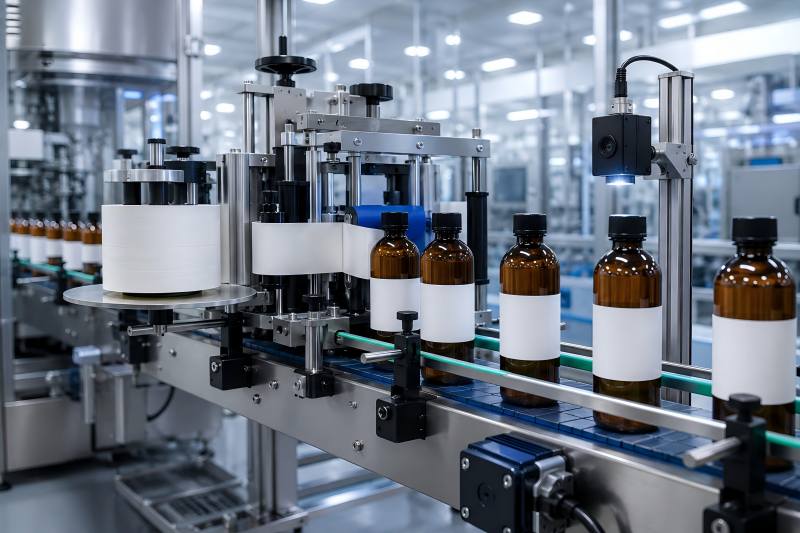
Vision inspection can further improve labeling quality. A camera system can check label position, missing labels, tilted labels, barcode quality, date code presence, and front-back matching. PMMI has noted that automated changeovers, servo-driven systems, and versatile machines continue to support packaging innovation, especially as manufacturers look for practical efficiency improvements.
Vision inspection is especially useful for products with strict retail or regulatory requirements. For example, food, beverage, pharmaceutical, and cosmetic bottles often require correct ingredient labels, warning labels, batch codes, and barcodes.
Reduce Speed Before Increasing Accuracy
Many labeling problems happen when production speed is increased too quickly. A machine may label accurately at 60 bottles per minute but become unstable at 120 bottles per minute if bottle spacing, label feeding, and pressing control are not optimized.
Speed should be increased step by step. At each speed level, operators should inspect label position, wrinkles, bubbles, barcode readability, and reject rate. If the defect rate rises sharply after a certain speed, the line may need mechanical adjustment or material improvement before further speed increases.
Here is an example of how speed may affect labeling accuracy in a bottle production line:
| Line Speed | Average Label Offset | Defect Rate | Main Observation |
| 60 bottles/min | ±0.8 mm | 0.3% | Stable feeding and good alignment |
| 90 bottles/min | ±1.2 mm | 0.8% | Minor label shift appears |
| 120 bottles/min | ±2.0 mm | 2.5% | Bottle spacing becomes unstable |
| 150 bottles/min | ±3.5 mm | 5.8% | Wrinkles and skewing increase |
This data is an example for production analysis. Actual results depend on bottle shape, label material, machine design, operator skill, and line layout. The key point is that higher speed should not come at the cost of unstable labeling accuracy.
Maintain Correct Label Roll Tension
Label roll tension affects feeding accuracy. If the tension is too loose, the label web may move unevenly and cause label shift. If the tension is too tight, the liner may stretch, labels may peel early, or the web may break.
The unwinding system, dancer arm, rewinding shaft, and label path should be checked regularly. Operators should also make sure the label roll is installed straight and centered. A poorly installed roll can cause continuous label drift during production.
Store label rolls properly before production. High humidity, heat, dust, and pressure can affect label flatness and adhesive performance. If a roll is damaged, curled, or uneven, it may cause repeated labeling errors even when the machine is adjusted correctly.
Improve Changeover Control
Many bottle production lines handle multiple bottle sizes, label types, and product batches. Every changeover creates a risk of labeling error. If operators rely only on manual adjustment without clear records, accuracy may vary between shifts.
A better method is to create standard changeover settings for each product. These records can include guide rail width, sensor position, conveyor speed, label delay value, pressure roller setting, and sample approval standard.
For machines with recipe memory, each bottle and label combination should have a saved parameter set. This reduces setup time and helps operators repeat the same accuracy after future changeovers.
Changeover samples should be inspected before mass production. At least several bottles from the beginning of the run should be checked for label height, center position, tilt, adhesion, barcode readability, and date code position.
Train Operators to Find Root Causes
Operator training is essential because labeling accuracy problems often look similar but have different causes. A tilted label may come from poor bottle positioning, uneven label tension, wrong sensor setting, or an angled peeling plate. A wrinkle may come from bottle shape, excessive pressure, weak label flexibility, or poor surface cleaning.
Operators should learn how to identify the source of the problem instead of only adjusting the label offset. A simple root-cause checklist can improve response speed during production.
Common examples include:
- Repeated same-direction offset often means timing or sensor position needs adjustment.
- Random offset may indicate unstable bottle spacing or inconsistent bottle shape.
- Wrinkles near the edge may mean pressure or label flexibility is wrong.
- Poor overlap on round bottles may come from unstable bottle rotation.
- Missing labels may be caused by sensor failure or label roll feeding issues.
When operators understand these differences, they can solve problems faster and reduce material waste.
Use Preventive Maintenance
A labeling machine needs regular maintenance to stay accurate. Worn belts, loose screws, dirty sensors, damaged rollers, and unstable motors can all reduce label placement precision.
Preventive maintenance should include cleaning sensors, checking guide rails, inspecting belts, testing rollers, tightening mechanical parts, checking electrical connections, and confirming emergency stop functions. Servo motors and drives should also be monitored if the machine uses servo control.
Packaging line performance is often measured through OEE, which helps manufacturers track downtime and identify root causes of lost production time. For labeling operations, OEE data can show whether stoppages are caused by label roll changes, sensor faults, bottle jams, machine adjustment, or material defects.
Build a Labeling Accuracy Inspection Standard
A clear inspection standard helps production teams judge labeling quality consistently. Without a standard, one operator may accept a label that another operator rejects.
A practical inspection standard can include:
- Maximum vertical offset
- Maximum horizontal offset
- Maximum label tilt
- Allowed overlap tolerance
- Allowed bubble or wrinkle size
- Barcode scan requirement
- Date code position
- Missing label rejection rule
The standard should suit each product category. A luxury cosmetic bottle may require very tight visual alignment. A chemical bottle may focus more on warning label readability and durability. A beverage bottle may require high-speed consistency and barcode readability.