
For many breweries, investing in a filling line is not the first priority during the early development stage. Most breweries start with basic equipment, focusing on brewing quality, recipe development, and market expansion. A small bottling system may be enough when production volume is limited and product varieties are still being tested.
However, as the brewery grows, the filling process often becomes one of the biggest factors restricting production efficiency and product consistency.
A beer filling line does much more than transfer beer into bottles. It directly affects oxygen pickup, carbonation retention, filling accuracy, hygiene control, packaging speed, and final product quality. When the existing system can no longer match production requirements, upgrading the filling line becomes a necessary step rather than an optional investment.
But how can a brewery determine the right time to upgrade?
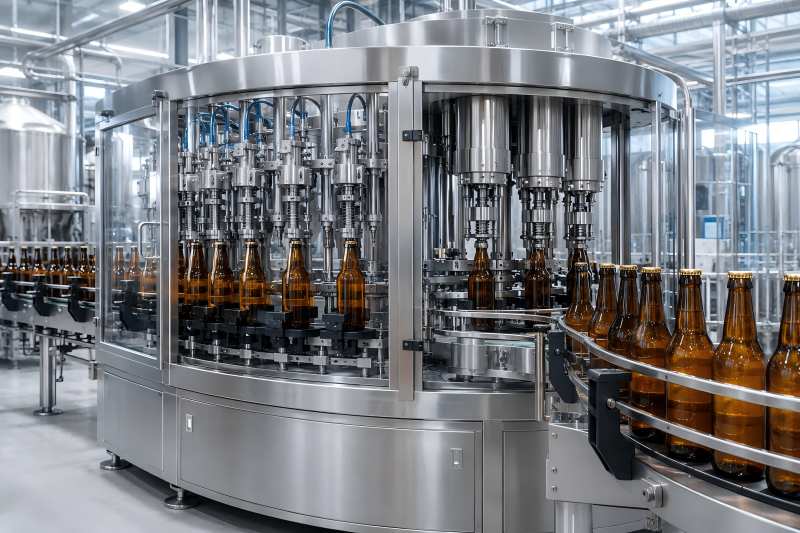
Production Capacity Has Become the Main Limitation
One of the clearest signs that a brewery needs an upgrade is when brewing capacity exceeds packaging capacity.
Many breweries expand their fermentation tanks or brewing systems first, but the filling section remains unchanged. As a result, beer production increases while packaging becomes a bottleneck.
For example:
| Brewing Capacity | Existing Filling Capacity | Possible Result |
| 2,000 L/day | 1,000 L/day filling capacity | Beer waiting time increases |
| 5,000 L/day | 2,000 L/day filling capacity | Fermentation tanks cannot be fully utilized |
| 10,000 L/day | 5,000 L/day filling capacity | Additional labor and longer shifts required |
A filling line that operates near its maximum capacity every day usually experiences:
- Longer production hours
- Increased operator workload
- More frequent maintenance
- Higher risk of unexpected downtime
A properly sized filling line should not only meet current demand but also provide reasonable growth space.
For example, if a brewery currently produces 3,000 bottles per hour but expects demand to increase within the next few years, upgrading to a higher-capacity 3-in-1 filling machine can avoid repeated equipment replacement.
Filling Quality Becomes Difficult to Maintain
Beer is a sensitive product. Small changes during packaging can affect flavor stability and shelf life.
Unlike water or juice, beer contains dissolved carbon dioxide. During filling, pressure differences between the tank and bottle can cause excessive foaming or CO₂ loss.
An aging filling system may struggle with:
- Unstable filling levels
- Excessive foam
- Increased beer loss
- Different carbonation levels between bottles
A modern beer filling machine controls the filling process more precisely through:
- Pressure balancing before filling
- Controlled filling speed
- Accurate filling valves
- Stable bottle positioning
The purpose of upgrading is not only faster production but also better consistency.
A comparison:
| Item | Older Filling System | Modern 3-in-1 Filling Machine |
| Bottle rinsing | Separate process | Integrated rinsing station |
| Filling control | Manual adjustment | Automatic pressure control |
| Capping | Separate equipment | Integrated capping system |
| Bottle transfer | Multiple connections | Shorter product path |
| Operation stability | Depends heavily on operators | More automated control |
When customers begin noticing differences between batches, the filling line should be carefully evaluated.
Oxygen Pickup Becomes a Quality Concern
Oxygen is one of the biggest enemies of beer quality.
During filling, unnecessary oxygen exposure can lead to:
- Faster flavor degradation
- Reduced freshness
- Shorter shelf life
- Changes in aroma characteristics
A brewery may have excellent brewing technology, but poor packaging control can reduce the final product quality.
Older filling equipment often has limitations in:
- Bottle preparation
- Filling environment control
- Pressure management
- Filling valve performance
A modern 3-in-1 beer filling machine improves oxygen control by combining several processes:
Bottle Rinsing
Before filling, bottles can be rinsed to remove dust and foreign particles. This creates a cleaner packaging environment.
Controlled Filling
The filling system maintains stable pressure conditions to reduce unnecessary turbulence and foam generation.
Integrated Capping
After filling, bottles move directly to the capping station, reducing exposure time before sealing.
For breweries producing premium craft beer, these improvements can have a direct impact on product stability.
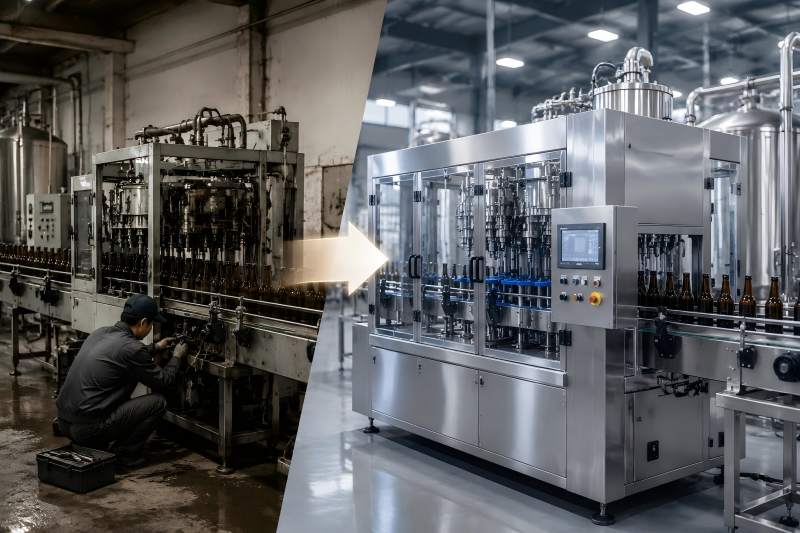
Labor Costs Increase Due to Manual Operations
Many small breweries initially rely on manual or semi-automatic filling systems because they require lower investment.
This approach works during the early stage.
However, as production increases, manual operation creates several challenges:
- More operators are required
- Production speed depends on worker experience
- Quality inspection becomes more difficult
- Labor costs increase continuously
A typical production comparison:
| Filling System | Operators Required | Production Stability |
| Manual filling | 3–5 people | Highly operator-dependent |
| Semi-automatic system | 2–4 people | Moderate consistency |
| Automatic 3-in-1 filling machine | 1–2 people | High repeatability |
Automation does not simply replace workers. It allows operators to focus on monitoring, maintenance, quality control, and production management.
For breweries facing labor shortages or increasing labor expenses, upgrading the filling line can significantly improve operational efficiency.
The Existing Equipment Requires Frequent Maintenance
Maintenance is normal for any industrial equipment. Frequent repairs often indicate that the system is approaching the end of its reliable operation period.
Common warning signs include:
- Filling valves frequently need adjustment
- Bottle transfer problems occur regularly
- Capping defects increase
- Sensors fail repeatedly
- Spare parts become difficult to source
Frequent downtime creates hidden costs:
- Lost production time
- Delayed customer delivery
- Increased maintenance labor
- Emergency repair expenses
A brewery should compare annual maintenance costs with the investment of a new filling system.
If repair expenses continue increasing, upgrading may become more economical than maintaining outdated equipment.
Bottle Size and Product Variety Are Increasing
Many breweries expand their product range after gaining market recognition.
For example, a brewery may start with:
- 500 ml glass bottles
Then later introduce:
- 330 ml bottles
- 650 ml bottles
- Different bottle shapes
- Seasonal products
Older filling equipment may not easily handle these changes.
A modern 3-in-1 beer filling machine can often be configured with adjustable components to support different bottle specifications.
Important customization points include:
- Bottle handling structure
- Filling valve configuration
- Capping system adjustment
- Conveyor design
- Control system settings
A flexible filling system allows breweries to introduce new products without purchasing completely separate packaging equipment.
Hygiene Requirements Become More Important
As brewery production grows, hygiene management becomes increasingly important.
A filling machine directly contacts the final packaged product, meaning cleaning performance directly affects beer safety.
Older equipment may have:
- Complex product paths
- Difficult-to-clean areas
- More manual cleaning procedures
- Higher contamination risks
A modern integrated filling machine focuses on hygienic design:
- Stainless steel contact parts
- Simplified product channels
- Easier cleaning access
- Better drainage design
For breweries producing premium beer, equipment hygiene is not only a production requirement but also part of brand protection.
The Brewery Wants to Reduce Product Waste
Packaging waste is often overlooked.
During beer filling, losses may come from:
- Overfilling
- Excessive foaming
- Bottle rejection
- Incorrect capping
- Product remaining in pipelines
A small loss percentage can become significant at large production volumes.
Example:
Assume a brewery fills:
- 10,000 bottles/day
- 500 ml per bottle
- Beer value: $2/bottle
If filling problems cause only 1% product loss:
10,000 × 1% = 100 bottles/day
Annual loss:
100 × 300 production days = 30,000 bottles
Reducing waste through more accurate filling control can create measurable financial benefits.
The Brewery Needs Better Production Data and Control
Modern breweries increasingly rely on production data to improve efficiency. Legacy filling systems provide less process information:
- Production speed
- Equipment status
- Downtime reasons
- Filling performance
Newer filling machines can integrate:
- Touchscreen control
- Automatic monitoring
- Parameter adjustment
- Production tracking
Better data helps breweries identify problems faster and optimize operation.
For growing breweries, equipment visibility becomes as important as mechanical performance.
The Current Filling Line Does Not Match Future Business Goals
The final decision to upgrade should not only consider current problems.
A brewery should also consider future plans:
- Is production expected to double?
- Will more retail channels be developed?
- Will export markets be targeted?
- Will more beer varieties be introduced?
A filling line is usually a long-term investment.
Choosing equipment only based on today’s production may create limitations later.
A better approach is to evaluate:
| Consideration | Question |
| Capacity | Can the machine support future growth? |
| Product type | Can it handle different beers and bottles? |
| Quality | Can it maintain carbonation and freshness? |
| Maintenance | Are spare parts and service available? |
| Automation | Can it reduce labor dependence? |
How a 3-in-1 Beer Filling Machine Supports Brewery Upgrades
For breweries considering an upgrade, a 3-in-1 filling machine provides several advantages by combining three critical processes:
1. Bottle Rinsing
The rinsing section prepares bottles before filling, helping remove dust and improving packaging hygiene.
2. Beer Filling
The filling section controls pressure, filling speed, and product level to maintain beer quality and reduce foam.
3. Bottle Capping
The capping section completes sealing immediately after filling, improving packaging efficiency and reducing exposure time.
By integrating these processes into one system, breweries can achieve:
- Shorter production flow
- Reduced bottle handling
- Lower contamination risk
- More stable operation
- Easier line management
The Right Time to Upgrade Is Before Growth Becomes Limited
A brewery does not need to wait until the existing filling line completely fails before upgrading.
The best time to consider a new beer filling system is when warning signs begin appearing:
- Production demand exceeds packaging capacity
- Filling quality becomes inconsistent
- Oxygen control becomes difficult
- Labor requirements increase
- Maintenance costs rise
- Product variety expands
- Hygiene requirements become stricter
A modern 3-in-1 beer filling machine with rinsing, filling, and capping functions can help breweries improve efficiency while protecting beer quality.
For breweries planning long-term growth, upgrading the filling line is not simply an equipment replacement decision. It is a long-term investment that improves production reliability, beer quality, and business growth potential.