
Ultrafiltration and reverse osmosis are commonly considered when designing a mineral water treatment system. Although both use membrane separation, they solve different water-quality problems and should not be treated as interchangeable technologies.
Ultrafiltration mainly removes suspended particles, colloids, microorganisms, and high-molecular-weight substances. Reverse osmosis provides deeper treatment by removing most dissolved salts, hardness ions, heavy metals, and other small dissolved substances.

What Is Ultrafiltration?
Ultrafiltration, commonly called UF, is a pressure-driven membrane separation process. Its membrane pores are generally designed to retain particles, bacteria, colloids, and some organic substances while allowing water and dissolved minerals to pass through.
A UF membrane normally has a nominal pore size of approximately 0.01–0.1 microns. This range is small enough to block most suspended contaminants but not small enough to remove dissolved calcium, magnesium, sodium, or other mineral ions.
UF systems are often used for spring water, mountain water, groundwater, and other sources with acceptable dissolved mineral levels. They can also protect downstream sterilization, filling, and polishing equipment from particle contamination.
Typical Substances Removed by Ultrafiltration
UF membranes can effectively reduce:
- Suspended solids
- Fine sand and sediment
- Rust particles
- Colloidal substances
- Bacteria
- Some viruses
- Large organic molecules
- Turbidity-causing impurities
UF does not significantly reduce total dissolved solids, conductivity, hardness, or salinity. A water source with excessive dissolved contaminants will therefore require additional treatment.
What Is Reverse Osmosis?
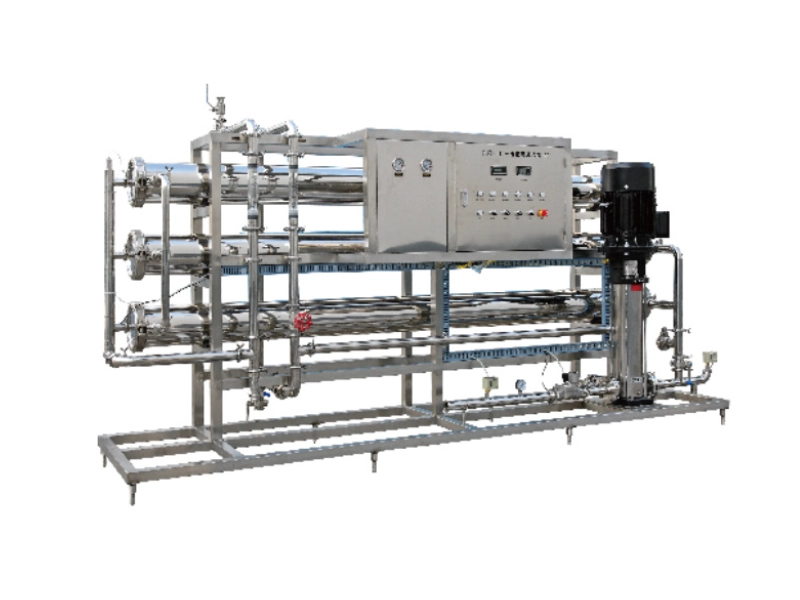
Reverse osmosis, commonly called RO, uses pressure to force water through a dense semipermeable membrane. The membrane allows water molecules to pass while rejecting most dissolved ions and many small contaminants.
RO membranes do not work like conventional filters with visible pores. Separation depends on diffusion through the membrane material, which allows the system to achieve much higher dissolved-solids removal than ultrafiltration.
A properly designed RO system can reduce dissolved salts by approximately 95%–99.5%. It can also remove calcium, magnesium, fluoride, nitrate, heavy metals, and many dissolved organic compounds.
After RO treatment, some plants use a remineralization system to rebuild a stable mineral profile. Calcium, magnesium, and other approved mineral components can be added according to the intended product taste and quality specification.
Main Differences Between UF and RO
The fundamental difference is the type of contamination each process removes. UF targets suspended and biological contaminants, while RO provides deeper removal of dissolved substances.
| Comparison Item | Ultrafiltration | Reverse Osmosis |
| Main treatment purpose | Particle and microbial control | Dissolved-solids reduction |
| Typical separation range | About 0.01–0.1 microns | Molecular and ionic separation |
| Dissolved mineral removal | Very limited | Approximately 95%–99.5% |
| Operating pressure | About 0.1–0.5 MPa | About 0.8–1.6 MPa for many groundwater applications |
| Typical recovery rate | About 90%–98% | About 60%–85% |
| Energy consumption | Approximately 0.05–0.20 kWh/m³ | Approximately 0.8–2.5 kWh/m³ |
| Mineral retention | Most minerals remain | Most minerals are removed |
| Wastewater generation | Relatively low | Higher concentrate discharge |
| Pretreatment requirement | Moderate | More demanding |
| Typical application | Good-quality natural source water | High-hardness or high-TDS raw water |
These figures are practical design ranges rather than fixed values. Actual performance depends on feedwater quality, membrane type, operating temperature, system pressure, recovery setting, and maintenance condition.
Mineral Retention and Product Positioning
Mineral retention is often the most important consideration when comparing UF and RO for mineral water production.
Consumers generally expect mineral water to contain naturally occurring or carefully controlled minerals. Calcium, magnesium, bicarbonate, potassium, and other dissolved components influence taste and product identity.
Because UF allows dissolved minerals to remain, it can preserve the natural character of the source water. This makes it suitable when laboratory tests confirm that the existing mineral composition is stable, safe, and commercially desirable.
RO creates a much more neutral water base. It is useful when the mineral content is excessive, inconsistent, or unsuitable, but it may also remove the characteristics that make the source water distinctive.
A plant using RO must decide whether the final product will remain low-mineral water or pass through remineralization. This decision affects equipment layout, ingredient control, quality testing, and operating procedures.
Raw Water Quality Determines the Better Process
Selecting UF or RO without a complete water report can lead to incorrect equipment investment. Two water sources that look equally clear may contain very different dissolved contaminants.
A proper analysis should include:
- Turbidity
- Total dissolved solids
- Conductivity
- Hardness
- Calcium and magnesium
- Iron and manganese
- Chloride and sulfate
- Nitrate
- Fluoride
- Silica
- Organic matter
- Bacterial count
- pH
- Alkalinity
UF may be sufficient when turbidity and microorganisms are the main concerns while dissolved mineral levels remain acceptable. RO becomes more appropriate when hardness, salinity, nitrate, fluoride, or other dissolved substances exceed the plant’s target limits.
For example, groundwater with low turbidity but very high hardness may pass through a UF membrane without any meaningful hardness reduction. The water may still create scale in pipes, heaters, sterilizers, filling valves, and bottles.
In contrast, a clean spring water source with balanced minerals may lose its desirable taste if processed through full RO treatment. Installing RO in this situation could increase operating costs without creating a better product.
Example Performance for a 10 m³/h Treatment Line
The following example compares two systems designed to produce treated water for a medium-sized bottling plant. The calculation assumes 20 operating hours per day and is intended to illustrate the operational difference.
| Operating Indicator | UF System | RO System |
| Feedwater capacity | 10 m³/h | 10 m³/h |
| Operating time | 20 h/day | 20 h/day |
| Daily feedwater | 200 m³ | 200 m³ |
| Assumed recovery | 95% | 75% |
| Daily product water | 190 m³ | 150 m³ |
| Daily reject or backwash water | 10 m³ | 50 m³ |
| Assumed energy use | 0.15 kWh/m³ | 1.50 kWh/m³ |
| Estimated daily electricity | 28.5 kWh | 225 kWh |
| Mineral retention | High | Low |
| Remineralization requirement | Normally unnecessary | Often considered |
At the same feedwater capacity, the UF system produces approximately 40 m³ more usable water per day in this example. It also consumes significantly less electricity.
However, this does not mean UF is always more economical. When dissolved contaminants must be removed, the UF system cannot achieve the required water quality regardless of its lower operating cost.
The comparison shows why water quality should be evaluated before utility cost. Treatment equipment only creates value when it produces water that meets the intended specification.
Wastewater and Water Recovery
UF systems normally have high water recovery because most of the feed passes through the membrane. Water is mainly lost during backwashing, chemical cleaning, flushing, and concentrate discharge.
RO systems continuously divide the feed into permeate water and concentrated reject water. The reject stream contains the salts and contaminants prevented from passing through the membrane.
Increasing RO recovery can reduce water loss, but excessive recovery increases membrane scaling risk. Higher concentrations of calcium, silica, sulfate, and other substances may deposit on the membrane surface.
A practical RO design must balance water recovery with membrane reliability. Operating at the highest possible recovery is not always the lowest-cost strategy if it causes frequent cleaning and early membrane replacement.
Energy Consumption and Pumping Requirements
UF operates at relatively low pressure. Its energy demand normally comes from feed pumps, backwash pumps, air scouring, control systems, and chemical dosing equipment.
RO requires a high-pressure pump capable of overcoming the natural osmotic pressure of the feedwater. As dissolved salt concentration increases, the required operating pressure normally rises.
For a plant producing 150 m³ of water per day, a difference of 1.35 kWh per cubic metre would equal approximately 202.5 kWh of additional daily energy consumption. Over 300 operating days, this represents about 60,750 kWh.
The financial impact depends on local electricity prices. It should nevertheless be included in equipment selection instead of evaluating only the initial purchase quotation.
Pump efficiency also matters. An oversized or poorly selected high-pressure pump may consume unnecessary electricity even when the RO membranes are operating normally.
Variable-frequency control can improve efficiency when production demand changes. It also allows the system to maintain stable pressure as membrane condition and feedwater temperature vary.
Pretreatment Requirements
UF usually requires basic pretreatment to prevent large particles and excessive contamination from reaching the membrane. A common arrangement may include a raw water tank, multimedia filter, activated carbon filter, cartridge filter, and UF membrane unit.
The exact configuration depends on the source water. High iron, manganese, oil, or organic content may require additional treatment before UF.
RO membranes are more sensitive to fouling, scaling, oxidation, and particle damage. Their pretreatment system therefore requires closer control.
A typical RO pretreatment line may include:
- Raw water pumping
- Multimedia filtration
- Activated carbon filtration
- Water softening or antiscalant dosing
- Fine cartridge filtration
- pH adjustment when required
- UF pretreatment for difficult water
- Sodium bisulfite dosing when residual chlorine must be removed
RO membrane protection should not be treated as optional. Weak pretreatment may reduce flow, increase pressure, lower salt rejection, and shorten membrane life.
In many high-capacity plants, UF is installed before RO. The UF system removes particles and microorganisms, while RO controls dissolved salts.
Cleaning and Maintenance
UF membranes require regular backwashing to remove accumulated particles. Depending on the water source, chemically enhanced backwashing may also be used to control organic and biological fouling.
RO membranes cannot normally be restored through simple backwashing. They require chemical cleaning when pressure drop increases, permeate flow falls, or salt rejection changes.
Cleaning chemicals may include acidic, alkaline, disinfecting, or specialized formulations. The correct chemical depends on whether the membrane is affected by scale, biological growth, organic deposits, or metal contamination.
Operators should monitor pressure, flow, conductivity, turbidity, temperature, and differential pressure. Waiting until output drops significantly often makes membrane recovery more difficult.
A well-managed UF membrane may operate for several years before replacement. RO membrane life can also reach several years, but unstable pretreatment or aggressive recovery settings may shorten it considerably.
Taste and Mineral Balance
Water taste is influenced by the type and concentration of dissolved minerals. Water with extremely low mineral content may taste flat, while excessive hardness or salinity may create an unpleasant aftertaste.
UF normally causes little change to the original taste because dissolved ions pass through the membrane. It is therefore useful for preserving a naturally balanced source.
RO produces water with much lower mineral content and conductivity. This gives manufacturers greater control but may require post-treatment.
A remineralization unit can use a mineral dosing system, calcite contactor, or controlled blending process. The objective is not simply to increase total dissolved solids but to create a stable and pleasant mineral balance.
For example, adding only calcium may raise hardness without producing the intended taste. A controlled ratio of calcium, magnesium, bicarbonate, and overall alkalinity may provide a more balanced result.
Remineralization also affects pH stability. Very low-mineral RO water may be more corrosive to metal components and can require adjustment before storage and filling.
Can UF and RO Be Used Together?
UF and RO are not always competing choices. In many modern mineral water plants, they are used as complementary treatment stages.
UF can be installed before RO to reduce turbidity, bacteria, and colloidal contamination. This lowers the particle load on cartridge filters and creates more stable RO operating conditions.
A combined system may follow this sequence:
Raw water tank → multimedia filter → activated carbon filter → UF system → cartridge filter → RO system → remineralization → UV or ozone sterilization → finished water tank.
This arrangement requires higher initial investment, but it can improve membrane protection when the raw water is difficult to treat. It is particularly useful for surface water, variable groundwater, and sources with seasonal turbidity changes.
A combined system should not be installed automatically. When the raw water is already clean, adding unnecessary treatment stages increases capital cost, floor-space requirements, chemical consumption, and maintenance workload.
Equipment Selection Matrix
| Raw Water Condition | Recommended Process | Main Reason |
| Low TDS, balanced minerals, moderate turbidity | UF | Retains minerals while improving clarity |
| Low turbidity but high hardness | RO or softening plus RO | UF cannot remove dissolved hardness |
| High bacteria with acceptable minerals | UF plus final sterilization | Controls microorganisms while retaining minerals |
| High nitrate or fluoride | RO | Dissolved contaminants require ionic separation |
| Variable source-water quality | RO with suitable pretreatment | Produces more consistent treated water |
| High colloids and high TDS | UF plus RO | UF protects RO while RO removes dissolved salts |
| Desirable natural spring-water profile | UF | Minimizes changes to natural composition |
| Controlled remineralized bottled water | RO plus remineralization | Creates a stable base for mineral adjustment |
This matrix can support initial discussions, but it cannot replace laboratory testing and pilot evaluation. Membrane type, recovery rate, pretreatment, and post-treatment must be designed around the specific project.