
Preventive maintenance is not just a routine task—it is a strategic investment in the reliability and efficiency of your monoblock filling machine. By implementing a structured checklist that covers daily, weekly, monthly, and annual tasks, manufacturers can significantly reduce downtime, improve product quality, and extend equipment lifespan.
A well-maintained monoblock system ensures:
- Consistent production output
- Compliance with hygiene standards
- Lower operational costs
- Increased customer satisfaction
In today’s competitive manufacturing environment, preventive maintenance is the key to sustainable performance and long-term success.

Importance of Preventive Maintenance
Preventive maintenance proactively identifies and fixes issues before they become costly failures.
Key Benefits
- Reduced downtime: Avoid unexpected breakdowns
- Improved product quality: Maintain consistent filling accuracy
- Extended equipment life: Reduce wear and tear
- Enhanced safety: Minimize risks for operators
- Lower maintenance costs: Prevent major repairs
Without regular maintenance, even the most advanced monoblock systems can experience:
- Valve leakage or clogging
- Sensor malfunction
- Conveyor misalignment
- Increased false rejects or fill inconsistencies
Key Components of a Monoblock Filling Machine
Before reviewing the checklist, identify the key components that require maintenance attention.
- Filling System(valves, nozzles, flow meters)
- Capping Unit(capping heads, torque system)
- Conveyor System(chains, belts, guides)
- Drive System(motors, gearboxes, belts)
- Control System(PLC, sensors, HMI)
- Cleaning System (CIP)(pipes, pumps, tanks)
Each of these subsystems has specific maintenance requirements.
Daily Preventive Maintenance Checklist
Daily maintenance focuses on basic inspections and cleaning tasks to ensure smooth operation.
Daily Maintenance Checklist
| Task Category | Checklist Item | Purpose |
| Visual Inspection | Check for leaks, loose parts, unusual noise | Early fault detection |
| Cleaning | Clean filling nozzles and contact surfaces | Prevent contamination |
| Lubrication Check | Verify lubrication levels (no over-lubrication) | Reduce friction |
| Sensors | Ensure sensors are clean and aligned | Accurate detection |
| Conveyor System | Inspect belt alignment and tension | Prevent jams |
| Air Pressure | Check compressed air levels | Ensure proper actuation |
| Electrical Panel | Observe indicators and alarms | Detect system issues |
Daily Best Practices
- Use food-grade cleaning agentsfor hygiene-critical parts
- Record observations in a maintenance log
- Address minor issues immediately to avoid escalation
Weekly Preventive Maintenance Checklist
Weekly maintenance involves deeper inspection and calibration tasks.
Key Weekly Tasks
- Inspect and clean filling valves thoroughly
- Check capping head torque consistency
- Tighten bolts and fasteners
- Inspect pneumatic components (valves, cylinders)
- Verify sensor accuracy and recalibrate if needed
- Clean and inspect filters (air and liquid lines)
Focus Areas
Filling Accuracy
- Measure fill volumes across multiple samples
- Adjust flow control systems if deviation occurs
Mechanical Stability
- Check for vibration or misalignment
- Inspect rotating parts for wear
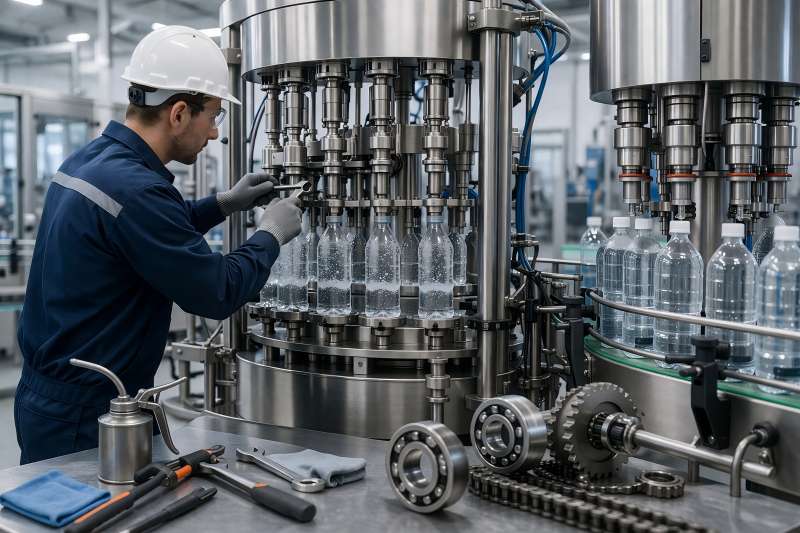
Monthly Preventive Maintenance Checklist
Monthly maintenance focuses on performance optimization and component longevity.
Monthly Maintenance Checklist
| Component | Maintenance Task | Expected Outcome |
| Filling Valves | Disassemble and deep clean | Prevent clogging and residue |
| Capping System | Inspect torque heads and replace worn parts | Consistent sealing |
| Conveyor System | Lubricate chains and inspect guides | Smooth bottle movement |
| Motors & Gearboxes | Check oil levels and temperature | Prevent overheating |
| Electrical System | Inspect wiring and connections | Avoid electrical faults |
| CIP System | Test cleaning cycles and flow rates | Maintain hygiene standards |
Additional Monthly Checks
- Inspect seals and gaskets for wear
- Replace worn-out O-rings
- Check alignment of machine components
- Test emergency stop and safety features
Quarterly and Annual Maintenance
Quarterly Tasks
- Perform vibration analysis on motors
- Inspect and clean internal pipelines
- Test PLC and control system backups
- Calibrate all sensors and measuring devices
Annual Tasks
- Replace critical wear parts (valves, seals, belts)
- Conduct full system overhaul
- Upgrade software or firmware if needed
- Perform comprehensive safety inspection
Lubrication Management
Adequate lubrication minimizes wear and significantly prolongs the lifespan of machine components.
Guidelines
- Use manufacturer-recommended lubricants
- Avoid over-lubrication (can attract dust and contaminants)
- Maintain a lubrication schedule
- Clearly label lubrication points
Common Lubrication Points
- Bearings
- Chains and sprockets
- Gearboxes
- Guide rails
Cleaning and Sanitation (CIP Systems)
Cleaning is critical, especially in food and beverage applications.
CIP Best Practices
- Use correct cleaning chemicals (alkaline/acidic cycles)
- Monitor temperature and flow rate
- Validate cleaning effectiveness regularly
- Avoid residue buildup in pipelines
Common Cleaning Issues
- Incomplete cleaning cycles
- Chemical concentration imbalance
- Blocked spray nozzles
Common Problems Prevented by Maintenance
A strong preventive maintenance program helps avoid:
Inconsistent Fill Levels
- Caused by clogged valves or faulty sensors
- Prevented through regular calibration
Machine Downtime
- Caused by mechanical failure
- Prevented through routine inspection
Contamination Risks
- Caused by poor cleaning
- Prevented through CIP validation
Excessive Wear
- Caused by lack of lubrication
- Prevented through scheduled lubrication
Maintenance Documentation and Record Keeping
Documentation is often neglected but critically important.
What to Record
- Maintenance activities performed
- Parts replaced
- Observed issues
- Calibration results
- Downtime incidents
Benefits
- Track machine performance trends
- Improve maintenance planning
- Ensure compliance with industry regulations
Spare Parts Management
Keeping essential spare parts minimizes equipment downtime.
Recommended Spare Parts
- Filling valves and seals
- O-rings and gaskets
- Sensors and switches
- Bearings and belts
- Pneumatic components
Tips
- Store parts in clean, dry conditions
- Use original or high-quality replacements
- Monitor usage rates to predict needs
Training and Safety Considerations
Even the best maintenance plan fails without proper execution.
Operator Training
- Understand machine components
- Follow maintenance schedules
- Identify early warning signs
Safety Measures
- Lockout/tagout procedures during maintenance
- Use proper PPE
- Follow manufacturer guidelines
Best Practices for an Effective Maintenance Program
- Follow Manufacturer Guidelines
- Implement a Preventive Maintenance Schedule
- Use Digital Maintenance Systems (CMMS)
- Train Staff Regularly
- Analyze Maintenance Data for Improvements