
Backwashing, membrane cleaning and filler CIP serve different functions and affect bottling availability in different ways. Scheduling them requires clear equipment boundaries and realistic recovery times.
Usable storage can protect production during limited interruptions, but it cannot replace safe isolation or compensate for a sustained water deficit. All numerical examples below are illustrative.
Understand the Three Maintenance Activities
A water bottling line contains several processes that require different maintenance approaches. Pretreatment backwashing removes accumulated solids from applicable filter media, membrane cleaning addresses fouling, and filler CIP cleans designated product-contact circuits.
These activities should have separate triggers, procedures and time allowances. Combining them into a single maintenance window without examining their actual requirements can underestimate water consumption, utility demand and production downtime.
| Activity | Main purpose | Scheduling considerations | Production impact |
| Pretreatment backwashing | Remove accumulated solids from applicable filter media | Backwash flow, rinse duration, drainage capacity and treated-water availability | May reduce or interrupt downstream water supply, depending on system configuration |
| RO membrane cleaning | Address membrane fouling and restore performance where cleaning is appropriate | Cleaning preparation, isolation, approved cleaning procedure, rinsing and performance verification | The affected membrane train may be unavailable; supply depends on validated system redundancy and storage |
| Filler CIP | Clean the designated product-contact circuit | Circuit isolation, cleaning stages, rinsing, inspection and required quality release | Filling through the same circuit must stop during CIP and remain stopped until authorized release |
The distinction matters because the three activities do not necessarily require the same equipment to stop.
A backwash cycle may affect only a pretreatment unit, while membrane cleaning can remove a major treatment component from service.
Filler CIP is different because it concerns the product-contact path. The same circuit cannot undergo CIP while simultaneously being used for filling.
Any alternative production arrangement must use an independent, suitably designed and safely isolated circuit.
Cleaning frequency should follow actual equipment condition, operating data and approved procedures. There is no universal backwashing interval, membrane cleaning frequency or filler CIP duration suitable for every bottling plant.
For example, increasing the frequency of membrane cleaning without investigating the underlying operating conditions may not solve persistent fouling.
Similarly, shortening a filler CIP cycle simply to recover production time can compromise required cleaning and release procedures.
Map Equipment Boundaries and Isolation Requirements
Before developing a maintenance calendar, engineers should map the complete water and product flow paths. The map should identify pretreatment filters, membrane units, purified-water storage, transfer pumps, filling equipment and any shared utility connections.
The purpose is to determine which activities can proceed independently and which ones depend on the same equipment or supply. Equipment names alone are insufficient; actual piping, valve arrangements and control logic determine operational independence.
A plant may have multiple treatment units, but that does not automatically mean one can remain operational while another undergoes cleaning. Shared manifolds, common pumps, cross-connections or inadequate isolation can prevent independent operation.
Review the following boundaries before approving any overlap:
-
Water supply: Identify which treatment units supply each storage tank and whether an alternative source is available during maintenance.
-
Product-contact circuits: Document the path from the relevant product supply through the filler and associated equipment that requires cleaning.
-
Isolation points: Confirm that valves and other isolation arrangements can safely separate equipment without creating unintended cross-connections.
-
Utility connections: Identify shared water, power, compressed air, heating and drainage resources that could restrict simultaneous activities.
-
Control and monitoring: Check whether interlocks, alarms and operating procedures prevent filling when required supply, cleaning or release conditions are not satisfied.
A standby membrane train or independent treatment path may allow continued production during maintenance, but only if its capacity, water quality and operating arrangement support the intended duty.
It must not be treated as an available backup simply because it appears on the equipment layout.
The same principle applies to filling. A second filler or separate product circuit may provide scheduling flexibility if its capacity and sanitary separation are adequate.
It does not justify continuing to use a circuit that is undergoing CIP. Engineers should also identify activities that appear independent but compete for the same resources.
For instance, pretreatment backwashing and membrane cleaning might use different equipment while drawing from the same water supply or discharging into the same drainage system.
The resulting equipment map becomes the foundation for the maintenance schedule. It shows which activities require a full production stop, which affect only part of the treatment system, and which overlaps are technically acceptable.
Calculate Usable Storage and Water Balance
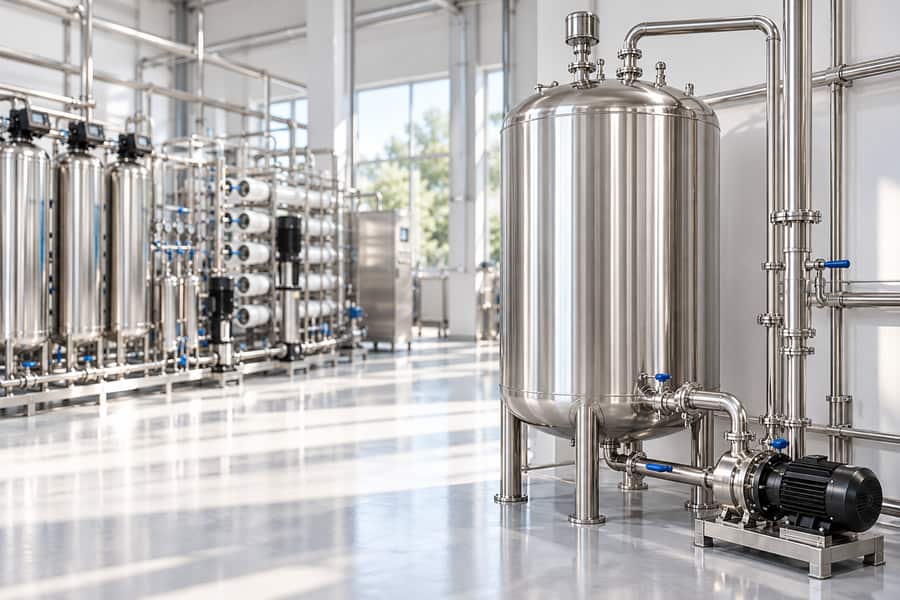
Purified-water storage is often the first place to look when planning maintenance without interrupting bottling.
However, the relevant figure is not the tank’s nominal capacity; it is the volume available for use while maintaining the required operating limits.
A tank may contain water that cannot be withdrawn without affecting pump operation or other process requirements. Engineers should therefore distinguish nominal capacity, current inventory, minimum operating level and any separately designated contingency reserve.
The basic balance is:
Ending inventory = Starting inventory + Inflow − Production demand − Other water consumption − Losses
Use consistent units and a common time interval. If production demand changes during maintenance, calculate consumption for each operating period rather than applying an average rate that hides peak demand.
For a preliminary buffer calculation, consider an illustrative bottling plant with the following assumptions:
-
Nominal storage capacity: 5.0 m³.
-
Starting tank inventory: 4.5 m³.
-
Minimum operating inventory: 1.0 m³.
-
Separately protected contingency reserve: 0.5 m³.
-
Bottling water demand: 2.4 m³/h.
-
Other simultaneous water demand: 0.3 m³/h.
-
Planned treatment interruption: 50 minutes, with no replenishment during the interruption.
These values are illustrative, not recommended design specifications. Actual demand, minimum inventory and reserve requirements must be established from the installed system and operating records.
First, calculate the water available above the minimum operating level:
4.5 − 1.0 = 3.5 m³ Then deduct the separately protected contingency reserve:
3.5 − 0.5 = 3.0 m³ The planned maintenance window must therefore be supported by 3.0 m³ of available water, while preserving the minimum inventory and the separate contingency reserve.
Next, calculate the combined consumption rate. Bottling requires 2.4 m³/h, while other simultaneous activities consume another 0.3 m³/h, giving a total demand of 2.7 m³/h.
For a 50-minute interruption, the estimated consumption is:
2.7 × (50 ÷ 60) = 2.25 m³ Subtracting this consumption from the volume available for planned use gives:
3.0 − 2.25 = 0.75 m³ The calculation indicates that the planned interruption fits within the illustrative buffer, leaving 0.75 m³ above the protected minimum and contingency allowance.
It does not establish that the actual plant can safely operate for the same duration.
This result assumes the stated demand remains constant and no additional losses occur. Startup flushing, backwash consumption or other maintenance-related demands must be added when they are not already included in the estimated consumption rate.
The calculation must also reflect the actual timing of water demand. If backwashing occurs before the planned interruption or several activities overlap, the storage balance should be recalculated for each time interval.
Finally, storage only shifts water availability across time.
If average treated-water production remains below average demand over a sustained operating period, a larger tank cannot correct that underlying deficit.
The treatment system’s sustainable output, operating hours and daily consumption must also balance.
Build a Practical Maintenance Schedule
Put maintenance on the production calendar after confirming equipment boundaries, expected duration, storage balance and return-to-service criteria. The schedule must protect production targets without weakening hygiene controls.
Use operating evidence, such as filter differential pressure, membrane performance trends or the approved filler cleaning plan, to determine when work is needed. Avoid universal intervals based only on a convenient shift or weekday.
The sequence below is illustrative; times are planning placeholders, not recommended cleaning durations. The treatment interruption is 50 minutes only if backwashing, rinsing and required checks finish before supply resumes.
| Illustrative time | Planned activity | Scheduling control |
| 05:30–05:50 | Pre-job review and inventory check | Confirm storage, demand, staffing, utilities, drainage and isolation points |
| 06:00–06:50 | Backwash, rinse and required checks | Assume a 50-minute supply interruption; extend it if acceptance checks are incomplete |
| 06:50 onward | Restore supply and rebuild inventory | Confirm stable operation and track tank recovery |
| Planned downtime | RO membrane cleaning, if indicated | Isolate the affected train; stop dependent production unless a separate validated supply path is available |
| After final filling | Filler CIP | Stop filling on the circuit being cleaned until cleaning and release requirements are satisfied |
| Before next production | Readiness review | Verify records, quality status, valve positions, supply capacity and opening inventory |
If actual checks extend the illustrative 50-minute interruption, recalculate the buffer for the longer outage. Do not assume storage can cover an unverified extension.
Resolve Utility, Drainage and Crew Conflicts
Backwashing and CIP may compete for water, drainage, heating, electrical capacity or operators. A drain suitable for one discharge may not safely handle two simultaneous flows, particularly when temperature or chemical compatibility differs.
-
Water supply: Confirm whether backwash or rinse demand reduces water available for treatment, cleaning or filling.
-
Drainage: Check discharge capacity, routing and site wastewater requirements before combining flows.
-
Utilities: Identify shared heating, power or compressed-air resources that could delay cleaning or affect other equipment.
-
Staffing: Assign trained personnel for isolation, cleaning, inspection, sampling and release.
-
Materials: Confirm approved cleaning materials, protective equipment and disposal arrangements are ready before work starts.
Separate activities when resource conflicts cannot be resolved.
Isolate Equipment Before Work Starts
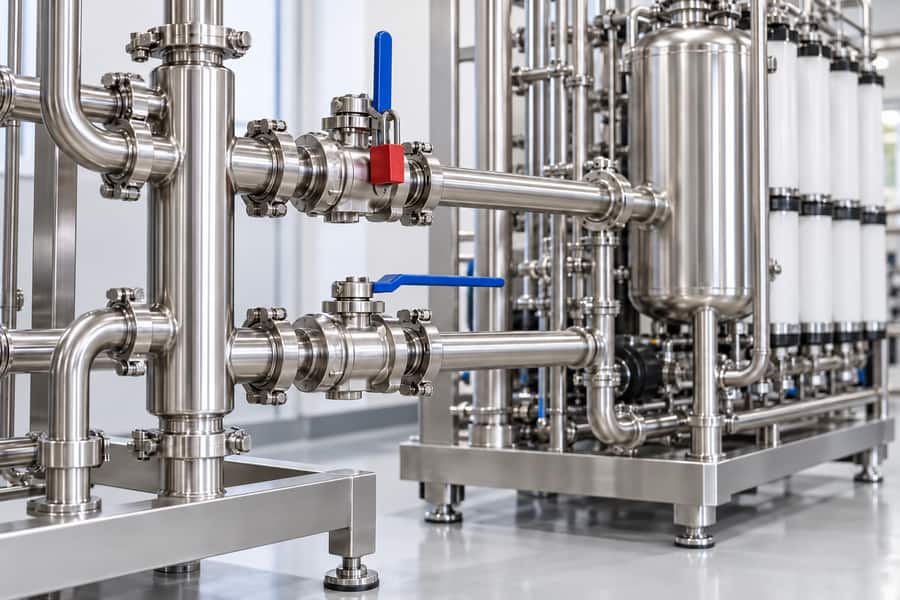
Identify the exact equipment and piping section being taken out of service. Confirm the approved isolation method, valve positions, energy controls and required permits with responsible plant personnel.
A control-system status alone does not prove that a product-contact circuit is isolated. The physical arrangement and approved procedure must prevent unintended flow, cross-connection or contamination.
For filler CIP, filling through the same product circuit must stop before cleaning begins. Filling can resume only after the CIP cycle, required rinsing, inspections and applicable release checks are complete.
Production may continue during cleaning elsewhere only when an independent supply path is suitably designed, safely isolated and validated for the intended water quality and demand.
A standby unit or tank connection alone does not establish this condition.
Set Contingency and Go/No-Go Rules
Define decision points before maintenance begins. The plan should state who can authorize continued production, reduced output, a pause or a full stop if storage falls or cleaning takes longer than expected.
A go decision requires sufficient usable inventory, acceptable conditions on equipment remaining online, available utilities and drainage, trained staff, and confirmed isolation and release arrangements.
A no-go decision is appropriate when a critical condition is uncertain or unmet. Examples include an unexplained tank-level discrepancy, unavailable drainage, failed isolation checks, missing cleaning materials or no validated supply path for dependent production.
Set low-inventory triggers, escalation points and a protected minimum reserve using plant-specific operating limits. Operators should know when to slow or stop filling before the minimum operating level is reached.
If work overruns, update the expected completion time and water balance. Never skip required cleaning, omit rinsing or release equipment early simply to recover production.
Plan Recovery and Replenishment
After maintenance, confirm that the affected unit has returned to its required operating condition before counting its output as available supply.
Replenishment starts only when the treatment path is authorized to operate and its output meets applicable acceptance criteria.
Track tank level over time rather than assuming a pump restart immediately restores inventory. The net recovery rate is treated-water inflow minus concurrent bottling demand and other water use.
In a separate illustrative recovery example, if inflow is 1.5 m³/h and combined demand is 1.0 m³/h, net recovery is 0.5 m³/h.
Replacing an illustrative 2.0 m³ inventory deficit would take about four hours if both rates remain constant.
Do not count water as available before it reaches the appropriate storage point and passes required quality checks. Include backwash, flushing and cleaning consumption when it is not already captured in demand data.
If the tank does not recover as expected, investigate reduced treatment output, leakage, additional use or inaccurate flow measurements. Storage can bridge a temporary interruption but cannot solve a sustained daily production deficit.
Verify Performance Before Restart
Restart is a controlled release decision, not simply the moment a pump or filler switches on. Has the maintenance task reached completion, with all planned work finished? Is the unit fit to carry out the duty it is assigned to perform?
Use a checklist matched to the installed system and approved procedures:
-
Cleaning completion: Confirm required steps, rinsing and inspections are complete and recorded.
-
Isolation restoration: Verify valves, temporary connections and bypasses are returned to approved positions.
-
Treatment performance: Check relevant flow, pressure, differential pressure, membrane performance or other operating indicators.
-
Water quality: Review applicable results and acceptance criteria; no single measurement proves every aspect of water safety.
-
Sanitary readiness: Confirm the product-contact circuit has met required CIP and post-cleaning conditions.
-
Storage and supply: Verify usable inventory, expected inflow and capacity for the planned production period.
-
Authorization: Record who reviewed the evidence and approved return to service.
For line planning, Brenu’s water bottling line options provide context for how treatment, purified-water storage, filling and downstream equipment may be configured. The schedule must reflect the actual supplied layout and selected options.
Keep Records and Refine the Schedule
Record planned and actual times, cleaning duration, water consumption, inventory changes, test results, deviations and restart authorization. These records help distinguish poor scheduling from equipment or supply problems.
Compare actual downtime with the plan and identify the largest delay. Repeated overruns may indicate shared-utility constraints, insufficient storage, slow replenishment, incomplete preparation or unrealistic release allowances.
The objective is predictable production without compromising sanitation, isolation or water quality.