
Select product-contact materials and seals from the complete exposure profile: product composition, cleaning chemicals, temperature, pressure, contact time, and mechanical duty. Specify the exact metal grade and seal compound for each wetted component, then require compatibility evidence and traceable documentation. A general description such as “stainless steel with food-grade seals” is not enough to define the delivered system.
The material must remain suitable during production, cleaning, idle storage, and any specified sanitizing cycle. A seal that tolerates the product may fail during cleaning, while a corrosion-resistant metal can still be installed in a poorly draining joint. Review material selection and component design together.
What Exposure Information Should Be Collected?
Build an exposure sheet for every product family and cleaning stage. Identify relevant ingredients, concentrations, pH, salts, oils, solvents, and temperatures. Include abnormal but permitted conditions such as an extended hold or the maximum approved cleaning concentration.
Describe the sequence as well as the extremes. Repeated movement between hot cleaning liquid and cooler product can affect a seal differently from continuous immersion at one temperature. Include the expected cycle frequency and the intended maintenance interval.
- Record product and cleaning-fluid identities rather than trade names alone where composition matters.
- State normal operating values and approved limits separately.
- Include exposure duration and frequency.
- Identify static, reciprocating, and rotating sealing duties.
- List any steam or other sanitizing treatment actually required.
Provide this information when specifying the monoblock filling machine’s product circuit. Ask the supplier to identify any exposure that falls outside the proposed material combination.
Which Components Belong on the Wetted-Parts List?
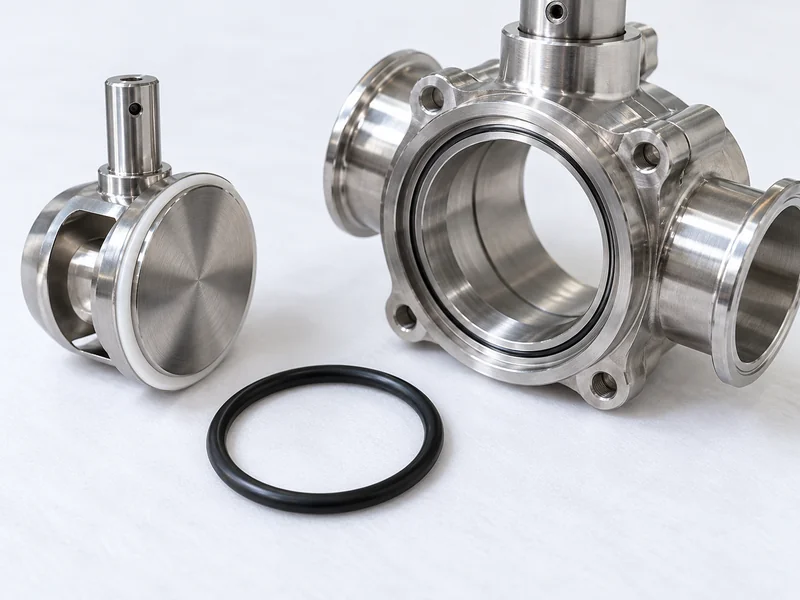
Trace the product path from the machine inlet through the tank, manifold, valves, meters, filling elements, and return connections as applicable. Include small items such as instrument diaphragms, gasket faces, hose liners, valve seats, and sampling fittings. These can be overlooked when the review focuses only on the main tank.
Distinguish product contact from external splash exposure and structural components. The frame may use a different material from the internal circuit without that distinction being obvious in a sales description. Require a component-level schedule that makes the boundaries visible.
For assemblies purchased from another supplier, request the relevant wetted-material information for that assembly. A stainless outer housing does not identify the internal seat, diaphragm, or polymer bearing. Link the document to the supplied model and revision.
How Should the Stainless Grade Be Chosen?
Evaluate the actual fluid environment rather than treating one common grade as universally sufficient. Chlorides, acidity, temperature, and oxidizing conditions can affect localized corrosion. Outokumpu’s corrosion guidance also emphasizes that crevices and service conditions influence the risk.
Ask the machine supplier to justify the proposed grade against the exposure sheet. Where the application is uncertain, obtain a material specialist’s assessment or a representative compatibility test. Laboratory reference tables are a starting point, not proof for every formulated beverage or cleaner.
Specify material certificates at the level needed for the project and identify how the supplied components are traced to them. Clarify whether the certificate applies to plate, tube, cast parts, or a finished bought-in component. Avoid accepting an unrelated sample certificate as evidence for the delivered wetted circuit.
Why Do Finish and Joint Design Matter?
Inspect the fabricated product path as well as the material specification. Check internal welds, changes in section, gasket seating, drainability, and the means of inspecting concealed areas. Where a surface finish is specified, identify the measurement procedure and the particular surfaces subject to acceptance.
Ask how welds are inspected and how the finished surface is treated after fabrication where required. A highly polished external appearance says little about an internal weld or a hidden gasket recess. Inspection records should refer to the relevant product-contact locations.
Check that replacement seals and components preserve the designed geometry. An apparently similar gasket can protrude into the flow path or leave a recess if its dimensions differ. Material identity cannot compensate for an incorrect fit.
How Do You Compare Seal Materials?
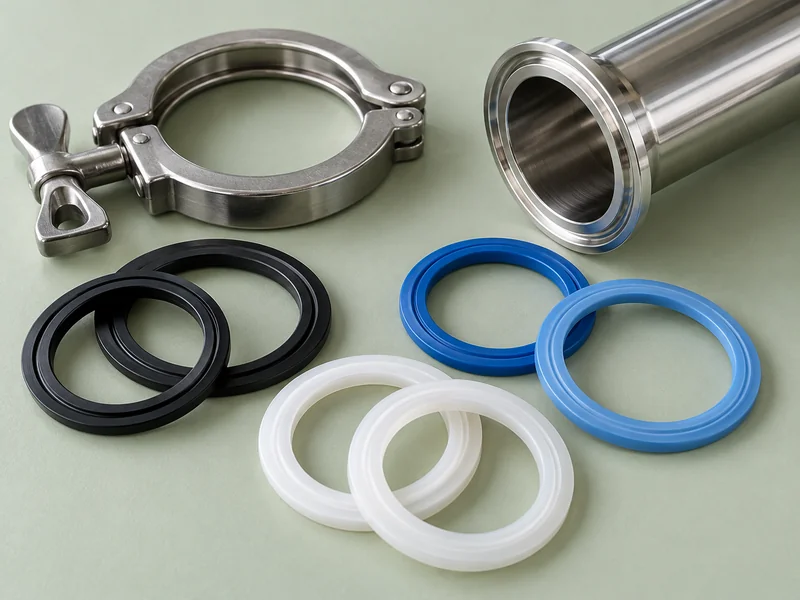
Use the exact compound designation, not only the polymer family. Trelleborg’s CIP and SIP testing notes that compounds within one family can behave differently under demanding cleaning conditions. Ask for compatibility evidence that matches the selected compound and your temperature, concentration, and exposure duration.
EPDM, FKM, silicone, and PTFE-based options offer different combinations of chemical and mechanical behavior. Their suitability depends on the formulation and application. A family-level chart should guide a more specific review, not become an automatic approval.
| Selection Factor | What to Establish | Why It Matters |
| Chemical exposure | Product and complete cleaning sequence | One compatible fluid does not represent the full duty |
| Temperature | Operating range and repeated transitions | Exposure can change material behavior |
| Mechanical duty | Motion, pressure, groove, and assembly | Static compatibility does not prove dynamic performance |
| Contact documentation | Exact compound and intended conditions | Generic descriptions may not cover the supplied part |
| Replacement control | Part number and approved alternatives | Substitution can alter performance and traceability |
What Should Be Checked Beyond Chemical Resistance?
Review compression, recovery, abrasion, extrusion risk, and friction as appropriate to the sealing duty. A valve seal experiences movement and assembly loads that an immersion coupon does not reproduce. Confirm that the seal geometry and mating surfaces suit the chosen material.
Include sensory concerns where the product is sensitive to odor, flavor, or carryover between batches. Ask whether the evaluation covers the intended product and cleaning sequence. Do not infer an acceptable sensory result solely from a material’s appearance or broad chemical rating.
What Documentation Should Be Requested?
Request material identification, supplier references, and applicable contact declarations for the intended market and use conditions. Have the responsible compliance team review the scope. A declaration for a polymer family or a different temperature range may not cover the actual component.
Keep documentation associated with the bill of materials and replacement part numbers. Record approved alternatives explicitly rather than allowing a purchasing description such as “equivalent black O-ring” to control substitutions. Color alone does not identify a compound.
Separate material compliance from cleaning performance and machine acceptance. These are related but different questions. A documented contact material still needs to function in the assembly and remain cleanable under the approved operating process.
How Should Compatibility Be Verified?
Use the supplier’s evidence to identify uncertainties and decide whether a representative trial is needed. A test may examine dimensional change, mass change, hardness, surface condition, or other properties relevant to the duty. Define the exposure sequence and acceptance criteria before testing.
Follow material testing with an assembly-level review where movement or sealing performance matters. Inspect for leakage, sticking, wear, or altered valve response after the agreed cycles. Record the component identity and test conditions so the result applies to a controlled configuration.
Do not turn a short successful trial into an unsupported service-life promise. Establish an initial inspection interval and refine it using actual condition and operating history. Retain failed parts for examination when the cause is uncertain.
How Should Spares and Changes Be Controlled?
Supply a spare-parts list that includes compound designation, dimensions, quantity, and installation location. Store seals according to the supplier’s instructions and preserve their identification. Mixing similar rings in an unmarked container defeats the original selection work.
Review changes to the product, cleaner, temperature, or cycle duration before introducing them. A revised cleaning chemical can alter the exposure even if the filler hardware remains untouched. Update the compatibility assessment and operating instructions together.
When a recurring failure occurs, examine the failed part, groove condition, assembly method, and actual exposure records. Replacing it with a more expensive polymer without understanding the mechanism may leave the problem unresolved. Use the evidence to decide whether the remedy is material, geometry, handling, or process control.
How Do You Finalize the Purchase Specification?
Make the exposure sheet, wetted-parts schedule, material documentation, and verification plan part of the agreed technical package. Identify unresolved selections and the evidence needed to close them. Confirm that the delivered spare kit uses the same approved materials as the installed assemblies.
To review a proposed configuration, send Brenu your product and cleaning conditions. Request a component-specific response so material suitability can be evaluated against the complete process rather than a generic machine description.