
A factory may already have an automatic filling and capping line but still rely on operators for case packing. Another plant may have automated packaging equipment but require two or three workers to stack finished cartons onto pallets. Some manufacturers are still using semi-automatic equipment throughout the line and need to decide where their first serious automation investment should go.
So where should the budget go first: packaging, case packing, or palletizing?
The best choice depends on where the production line faces its biggest efficiency or labor bottleneck.
For filling and packaging plants, the best automation investment is usually the one that removes the largest bottleneck from the complete line.
Evaluate the Complete Packaging Line
A typical automated liquid filling line may include several connected processes:
Bottle Feeding → Filling → Capping → Labeling → Secondary Packaging → Case Packing → Palletizing
These machines may look like independent pieces of equipment, but their performance is closely connected.
A filling machine running at 6,000 bottles per hour provides little benefit if downstream packaging can only handle 4,000 bottles per hour.
Similarly, installing a high-speed case packer does not improve plant output if filling and capping remain the bottleneck.
This is why automation decisions should begin with the complete line, rather than individual machine specifications.
| Stage | Main Function | Common Bottleneck |
| Filling | Dispenses product into containers | Filling speed or accuracy |
| Capping | Applies and tightens closures | Cap feeding and placement |
| Labeling | Applies product labels | Container spacing and label speed |
| Packaging | Groups or wraps finished products | Manual handling |
| Case Packing | Loads products into cartons | Labor and packing speed |
| Palletizing | Stacks cases for storage/shipping | Manual lifting and end-of-line accumulation |
Before purchasing new equipment, manufacturers should identify which stage is actually restricting production.
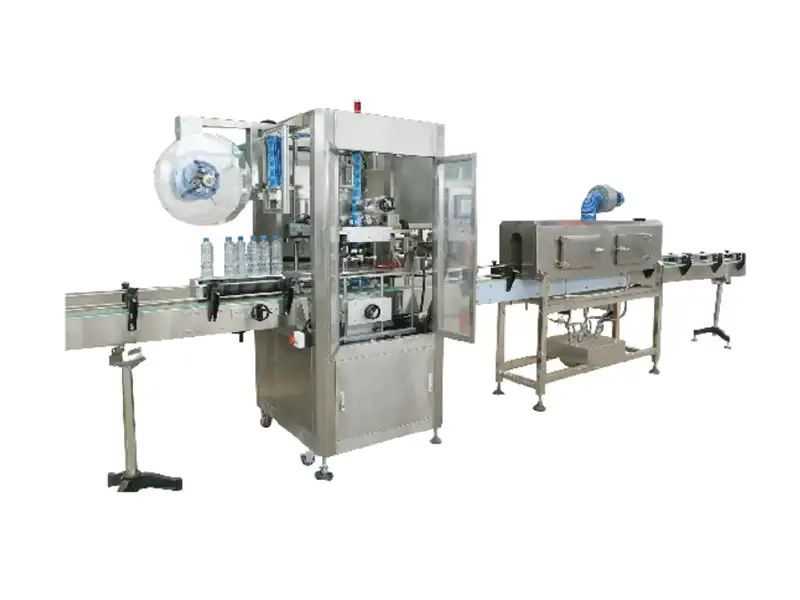
When Packaging Automation Should Come First
For many small and medium-sized manufacturers, packaging is the first major step toward a more automated production line.
The factory may already use an automatic filling machine but still depend heavily on manual operations after filling.
Workers may manually arrange bottles, apply secondary packaging, shrink-wrap products, or prepare them for case packing.
This arrangement can work at lower volumes.
The problem appears when filling capacity increases.
Suppose a filling line produces 3,000 bottles per hour while manual downstream packaging can sustainably handle only around 2,000–2,300 bottles per hour.
The filling machine will eventually have to slow down or stop.
In this situation, increasing filling capacity again would produce very little return. The better investment is downstream packaging automation.
Packaging should usually receive priority when:
- Finished bottles accumulate after filling or labeling.
- Several operators are required for repetitive packaging work.
- Manual packaging cannot maintain filling-line speed.
- Product presentation varies between operators.
- Packaging errors create rework.
- Production frequently stops while workers clear downstream products.
- Future production volume is expected to increase.
For filling plants, the important point is that the rated speed of the filling machine is not the same as the output of the production line.
The slowest sustained process determines how many finished products actually leave the factory.
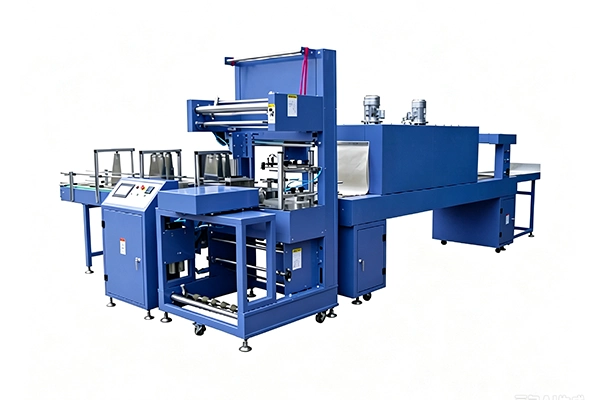
When Case Packing Becomes the Better Investment
Case packing often requires significant manual labor in a bottle filling and packaging line. Finished bottles may leave the labeling or shrink-wrapping section continuously, while operators manually count, arrange, and load them into shipping cartons.
At moderate production speeds, manual case packing may be economical.
But as line speed increases, labor requirements rise quickly.
A plant may eventually need two, three, or even more operators around the case packing area simply to keep products moving.
This is where an automatic case packing system can become financially attractive.
Case packing becomes a strong automation candidate when:
- Multiple operators are stationed at the end of the packaging line.
- Bottles frequently accumulate before carton loading.
- Manual counting creates packing errors.
- Output varies depending on operator speed.
- Production requires multiple shifts.
- Labor availability makes further capacity expansion difficult.
The advantage is not simply reducing labor.
Automatic case packing creates a controlled transition between product packaging and warehouse handling.
Once bottles arrive at predictable spacing, they can be grouped into the required configuration, loaded into cartons, sealed, and transferred toward palletizing without continuous manual intervention.
For higher-volume filling lines, this can significantly improve production continuity.
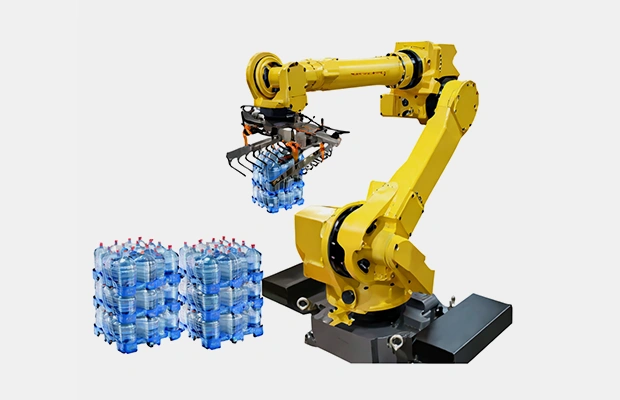
When Palletizing Should Be Automated First
Palletizing is further downstream, but that does not mean it should always be automated last.
In some factories, it can actually provide one of the clearest automation opportunities.
Imagine that filling, capping, labeling, and case packing are already operating reliably.
Finished cartons arrive continuously at the end of the conveyor.
Operators then manually lift every carton and build pallets.
If a line produces 20 cases per minute, that can mean:
1,200 cases per hour.
Even when cases are relatively light, repeating the same lifting, turning, reaching, and stacking movements throughout a shift creates a substantial manual workload.
When cartons are heavier, the ergonomic concern becomes even more important.
Robotic palletizing becomes particularly attractive when:
- Finished cartons are relatively standardized.
- Case output is high and predictable.
- Operators perform repetitive lifting throughout the shift.
- Multiple production shifts are running.
- Labor turnover is high.
- Pallet patterns are consistent.
- Finished cases accumulate because palletizing cannot keep pace.
A robotic palletizing system can continuously receive cartons, orient them, and build predefined pallet patterns.
For factories where upstream automation is already mature, this can be a logical next step toward a more complete end-of-line system.
Compare the Three Investments Based on the Real Problem
There is no universal rule saying packaging must come first and palletizing last.
| Production Problem | Packaging | Case Packing | Palletizing |
| Bottles accumulate after filling | ★★★ | ★ | — |
| Too many workers at carton loading | ★ | ★★★ | — |
| Finished cases accumulate | — | ★ | ★★★ |
| Inconsistent product presentation | ★★★ | ★ | — |
| Manual counting/packing errors | ★ | ★★★ | — |
| Heavy repetitive lifting | ★ | ★★ | ★★★ |
| Need to increase complete-line output | ★★★ | ★★★ | ★★ |
| Reduce end-of-line labor dependency | ★★ | ★★★ | ★★★ |
The important word here is complete-line output.
If a new machine runs faster but does not increase the number of finished, packed, palletized products produced per shift, its financial return may be lower than expected.
Calculate Automation ROI Beyond Labor Savings
Automation ROI is often calculated only from labor:
Payback Period = Equipment Investment ÷ Annual Labor Savings
This provides a useful starting point, but it can underestimate the real value of packaging-line automation.
A more practical calculation is:
Annual Automation Benefit = Labor Savings + Additional Production Contribution + Reduced Downtime + Reduced Rework + Reduced Overtime + Other Measurable Operational Savings
Consider a simplified example.
A manufacturer is evaluating a $180,000 automated case packing project.
| Potential Benefit | Annual Value |
| Direct labor reduction/reallocation | $65,000 |
| Reduced overtime | $15,000 |
| Additional saleable production contribution | $40,000 |
| Reduced packing errors and damage | $8,000 |
| Reduced line stoppages | $12,000 |
| Total Estimated Benefit | $140,000/year |
The simple estimated payback would therefore be:
$180,000 ÷ $140,000 ≈ 1.29 years
But there is an important qualification.
A machine capable of producing more bottles does not automatically create more revenue.
The manufacturer must actually have demand for that additional production.
For this reason, BRENU recommends evaluating automation using real production conditions rather than rated machine speed alone.
Measure Cost per Finished Bottle, Not Just Machine Speed
When evaluating filling and packaging automation, bottles per hour is one of the first specifications manufacturers compare.
It should not be the sole factor considered. A more useful operational metric is:
Total Production Cost per Finished Bottle
That cost can include:
- Direct production labor
- Packaging labor
- Packaging materials
- Product giveaway
- Rejects and rework
- Downtime
- Changeover time
- Maintenance
- Energy consumption
Consider two lines.
Line A produces 3,000 bottles per hour with two operators.
Line B produces 5,000 bottles per hour but requires six operators and frequent manual intervention.
Looking only at production speed makes Line B appear significantly better.
Looking at cost per finished, saleable bottle may tell a different story.
This is why filling-line automation should focus on overall operating efficiency rather than simply maximizing the speed of one machine.
Do Not Over-Automate a Low-Volume Line
More automation is not always better.
This is especially important for manufacturers producing many products in relatively small batches.
A fully automated line may require automatic bottle feeding, filling, capping, labeling, packing, case packing, conveyors, palletizing, inspection, and centralized controls.
Technically, this may be an excellent production system.
Financially, it may be unnecessary.
If the factory only runs a particular product for two hours per day, a flexible semi-automatic process may provide a better return than a highly specialized automatic system.
Automation becomes more attractive as:
- Production volume increases.
- Production hours increase.
- SKU variation decreases.
- Labor requirements increase.
- Manual processes become production bottlenecks.
The objective should therefore be appropriate automation, not maximum automation.
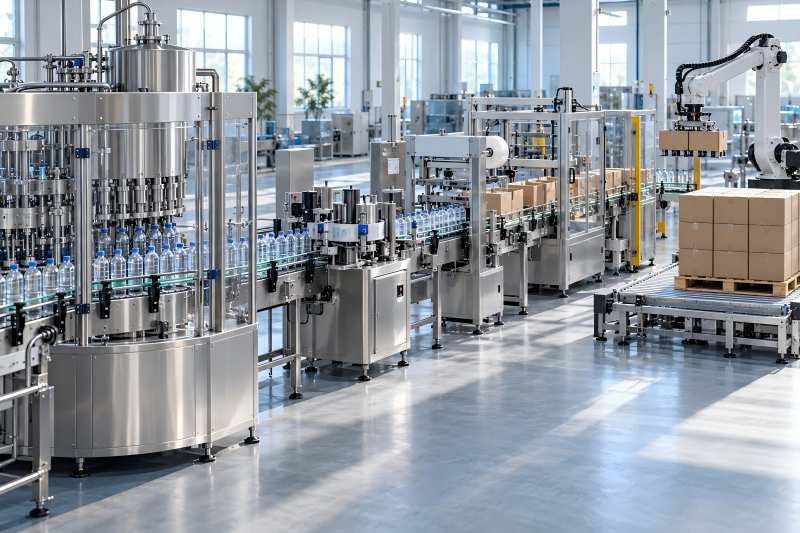
Product and Container Variety Changes the ROI
This is particularly important in filling operations.
A production line may handle:
- 100 mL bottles
- 250 mL bottles
- 500 mL bottles
- 1 L bottles
- Round containers
- Square containers
- Different caps
- Different carton configurations
Every variation can affect automation complexity.
A filling machine may accommodate different bottles with relatively simple adjustments, while a downstream case packing system may require different guides, product grouping patterns, or change parts.
Palletizing may require multiple pallet recipes.
Before selecting automation equipment, manufacturers should therefore evaluate SKU complexity together with production volume.
A machine with slightly lower maximum speed but faster, simpler changeovers can sometimes deliver a better annual return than a high-speed system optimized for one format.
Build the Automation Roadmap Around the Bottleneck
For manufacturers that cannot automate the entire line at once, a phased investment strategy is often more practical.
Consider a factory where filling is already automatic but packaging and palletizing remain manual.
Its roadmap might be:
Phase 1 — Automatic Packaging
Remove the immediate bottleneck after filling and labeling.
Phase 2 — Automatic Case Packing
Reduce labor around carton loading and stabilize downstream product flow.
Phase 3 — Robotic Palletizing
Automate repetitive case handling and complete the end-of-line process.
But another factory may require a completely different sequence.
For example:
Phase 1 — Robotic Palletizing
because heavy manual case handling is currently the largest labor and ergonomic issue.
Phase 2 — Case Packing
because production growth begins to exceed manual carton-loading capacity.
Phase 3 — Filling Line Upgrade
because market demand eventually requires higher production speed.
The equipment sequence should follow the factory’s constraints—not a standard automation checklist.
Design Automation as One Connected Production System
One of the most important lessons in filling-line automation is that individual machines should not be selected in isolation.
- Suppose a filling machine is designed for: 6,000 bottles/hour
- The labeler handles: 8,000 bottles/hour
- The case packing system handles the equivalent of: 7,000 bottles/hour
- And the palletizing system can process: 10,000 bottles/hour equivalent.
The line is still fundamentally a 6,000 BPH system.
These figures alone do not fully reflect real production performance.
Real production must account for bottle feeding, product characteristics, filling accuracy, cap supply, conveyor accumulation, label changes, carton supply, pallet replacement, machine stops, and changeovers.
A successful automated filling and packaging line therefore requires more than connecting several fast machines together.
The machines must be balanced around the required production output.
So, Which Automation Investment Comes First?
Start with the operation that currently costs the factory the most in lost capacity, labor, downtime, quality, or operating stability.
If manual packaging prevents the filling machine from operating continuously, automate packaging first.
If several operators are required to keep up with carton loading, case packing may provide the stronger return.
If upstream production is already automated but every finished carton still has to be manually lifted and stacked, robotic palletizing may be the logical next investment.
And if filling itself cannot meet required production volume, improving downstream automation first will not solve the main constraint.
The goal is to achieve the right level of automation for efficient, reliable production. The goal is to build a line in which filling, capping, labeling, packaging, case packing, and palletizing operate at compatible speeds with the minimum necessary manual intervention.
That is where automation begins to produce a meaningful return—not from one faster machine, but from a better-balanced production system.