
Pressure control is one of the most important factors in carbonated drink filling because carbonation is not only about adding CO₂ to a beverage. It is also about keeping that CO₂ dissolved from the mixing tank to the sealed bottle or can.
For carbonated water, soda, sparkling juice, beer, energy drinks, and flavored sparkling beverages, poor pressure control can quickly lead to foam, CO₂ loss, low fill accuracy, inconsistent taste, unstable headspace, and messy production. A carbonated beverage filling machine must therefore manage pressure before filling, during filling, and after filling.
Carbon dioxide solubility increases when gas pressure rises, and it decreases when pressure drops. This is why carbonated drinks release bubbles when opened: the pressure above the liquid suddenly falls, so dissolved CO₂ escapes as gas.
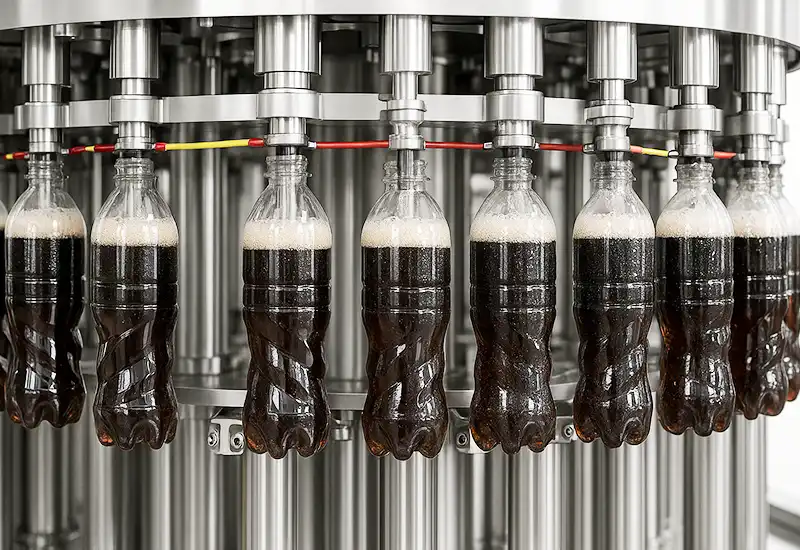
How Pressure Affects Carbonated Drinks
Carbonated beverages contain dissolved CO₂. This dissolved gas creates the sparkling mouthfeel, sharp taste, aroma release, and refreshing drinking experience. According to beverage carbonation guidance from the University of Florida IFAS Extension, the most significant factors affecting carbonation level are CO₂ pressure and temperature.
In filling production, the same principle applies. When pressure is stable, CO₂ remains inside the liquid more easily. When pressure changes too fast, CO₂ leaves the liquid and forms foam.
This is why carbonated drink filling usually uses counter pressure filling or isobaric filling. The container is pressurized before the product enters, so the pressure inside the bottle or can is close to the pressure in the beverage tank. This reduces sudden pressure difference and helps the drink flow into the container with less foam.
Carbonation Levels and Pressure Requirements
Carbonation levels vary by beverage type. A low-carbonated sparkling juice does not need the same filling condition as highly carbonated soda or sparkling water.
| Beverage Type | Typical CO₂ Level | Filling Difficulty | Pressure Control Focus |
| Light sparkling juice | 1.5–2.5 volumes | Medium | Gentle filling, lower foam generation |
| Beer/lager style drinks | 2.4–2.8 volumes | Medium | Foam control and oxygen reduction |
| Club soda / tonic water | 2.5–3.5 volumes | High | Stable tank pressure and smooth venting |
| High-carbonated soda | 3.5–4.0 volumes | High | Strong counter pressure and accurate filling valve control |
| Sparkling wine/champagne style | 4.6–6.0 volumes | Very high | High-pressure packaging and controlled decompression |
Most soft drinks are commonly carbonated around 3–3.5 volumes of CO₂, while high-carbonated soda can reach about 3.5–4 volumes. One volume of CO₂ is approximately equal to 1.96 g/L, although exact values vary with formulation.
For manufacturers, this means pressure control should match the product category. Using the same pressure setting for all carbonated drinks may cause unstable filling performance.
Pressure and Temperature Work Together
Pressure control cannot be separated from temperature control. Cold liquid holds CO₂ better than warm liquid. When the beverage temperature rises, the same pressure may no longer be enough to keep CO₂ dissolved.
Reference carbonation levels vary by pressure and temperature as shown below. Actual results may change with sugar, alcohol, acidity, and beverage formula, but the trend is useful for production planning.
| CO₂ Pressure | CO₂ Level at 5°C | CO₂ Level at 10°C | CO₂ Level at 15°C | Production Meaning |
| 10 PSIg | 2.30 vol | 1.97 vol | 1.70 vol | Suitable for lower carbonation |
| 15 PSIg | 2.76 vol | 2.37 vol | 2.05 vol | Moderate carbonation range |
| 20 PSIg | 3.23 vol | 2.77 vol | 2.39 vol | Common for sparkling drinks |
| 25 PSIg | 3.69 vol | 3.17 vol | 2.74 vol | Higher carbonation products |
| 30 PSIg | 4.16 vol | 3.57 vol | 3.08 vol | High-carbonated soda range |
These reference values are based on Henry’s law calculations for water in equilibrium with CO₂.
For a bottling line, this explains why beverage cooling is often required before filling. If the drink becomes warmer during transfer, the filling machine may face more foam even when the pressure setting looks correct.
What Happens When Pressure Is Too Low?
Low pressure is one of the most common causes of foam in carbonated drink filling. When bottle pressure drops below tank pressure, liquid rushes in forcefully. CO₂ escapes from the liquid, bubbles expand, and foam rises quickly.
This creates several production problems. The filling valve may shut off too early because foam reaches the sensing area before the liquid reaches the target level. Some bottles may look full at first but become underfilled after foam collapses. Operators may also need to slow down the machine to control overflow.
Low pressure can also reduce carbonation quality. Even if the drink was correctly carbonated in the mixing tank, CO₂ loss during filling can make the final product taste flat.
What Happens When Pressure Is Too High?
Higher pressure is not always better. Excessive pressure can make venting difficult, slow down filling speed, and place more stress on bottles, cans, caps, seals, and filling valves.
If the container pressure is too high, the beverage may not flow smoothly from the product tank. The machine may need more time to balance pressure, fill, and release gas. This lowers production efficiency.
Overpressure can also increase safety risks, especially when filling lightweight PET bottles or thin-wall cans. A good carbonated beverage filling line should use pressure sensors, safety valves, and automatic alarms to avoid unsafe operation.
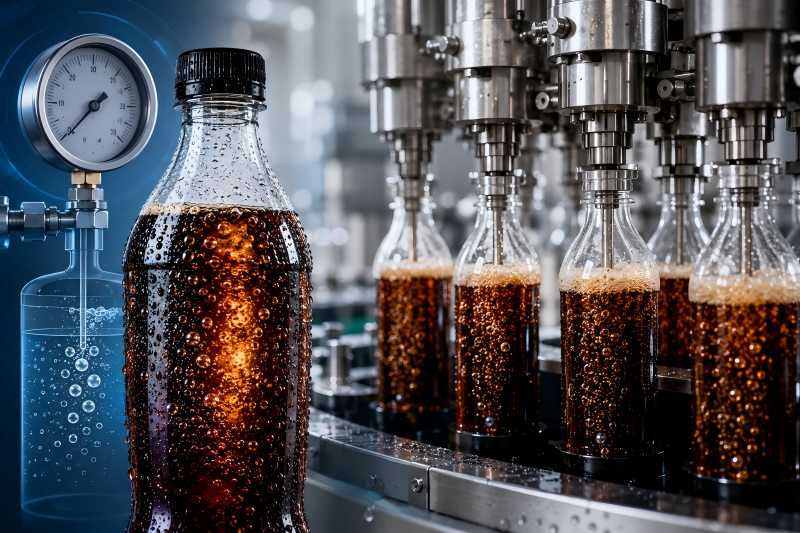
Key Pressure Control Points in a Carbonated Drink Filling Line
Pressure control is not limited to the filling valve. It starts before filling and continues until the container is sealed.
| Process Stage | Pressure Control Target | Poor Control Result |
| Carbonation tank | Maintain target CO₂ pressure | Inconsistent carbonation level |
| Product transfer pipe | Avoid sudden pressure drop | CO₂ breakout before filling |
| Filling bowl/product tank | Keep stable working pressure | Uneven filling between heads |
| Bottle or can pre-pressurization | Match container pressure with tank pressure | Foam, splashing, underfill |
| Filling valve opening | Control flow speed under pressure | Turbulence and bubble formation |
| Gas venting | Release gas smoothly | Slow filling or foam overflow |
| Pressure release after filling | Reduce pressure gradually | Product eruption or cap area foam |
| Capping/seaming | Seal before CO₂ loss increases | Flat taste, unstable shelf quality |
A well-designed carbonated drink filling machine controls all these points as one system. If only the main tank pressure is stable but the venting process is poor, the line can still produce foam and inaccurate filling.
Pressure Control Improves Filling Accuracy
Fill accuracy is a major concern for beverage producers. Underfilled bottles can cause customer complaints or regulatory problems, while overfilled bottles increase product loss.
In carbonated drink filling, foam makes accuracy harder to control. The machine may measure liquid level, weight, or flow, but foam can interfere with the real filling result. Stable pressure reduces foam formation and makes the liquid level more predictable.
For high-speed rotary filling machines, this becomes even more important. At thousands of bottles per hour, a small pressure fluctuation can affect many containers in a short time. Automatic pressure regulation helps each filling head work under similar conditions.
Pressure Control Reduces Product Waste
Foam overflow is not only messy. It directly increases beverage waste, cleaning time, and production cost.
When foam spills onto bottles, conveyors, machine surfaces, and caps, operators may need to stop the line for cleaning. Sticky soft drinks can attract dust, affect label application, and increase the risk of microbial issues around wet machine areas.
| Pressure Problem | Possible Waste Impact | Operational Cost |
| Sudden pressure drop | Foam overflow and CO₂ loss | More rejected bottles |
| Unstable tank pressure | Inconsistent fill level | More inspection work |
| Poor venting control | Slow filling or splashing | Lower line speed |
| Warm product with low pressure | Heavy foaming | Higher cleaning frequency |
| Fast pressure release | Product eruption at bottle mouth | More downtime |
Reducing foam can improve material yield. Even a small reduction in overflow is meaningful for factories running long production shifts.
Pressure Control Protects Taste and Mouthfeel
Customers notice pressure control through the drink’s first fizz. A well-filled carbonated beverage should have consistent fizz, clean aroma release, and the expected sharpness on the tongue.
If too much CO₂ is lost during filling, the drink may taste weak or flat. If pressure is poorly balanced, some bottles in the same batch may taste different from others.
For brand owners, this affects product consistency. A customer who buys the same sparkling drink in different stores expects the same drinking experience. Stable pressure control helps protect that expectation.
Pressure Control Helps Capping and Seaming
The filling process does not end when the liquid enters the container. The drink must be capped or seamed quickly and securely.
If foam remains at the bottle mouth, it can interfere with cap application. In glass bottle filling, foam may wet the sealing area. In PET bottle filling, unstable internal pressure may affect cap torque and bottle shape. In can filling, excessive foam can disturb seaming quality and increase product loss.
Good pressure control allows the container to move from filling to sealing with a more stable headspace. This helps preserve carbonation and improves packaging reliability.
Pressure Control for PET Bottles, Glass Bottles, and Cans
Different packages react differently to pressure. PET bottles are lightweight and flexible, so they may expand or deform if the pressure setting is not suitable. Glass bottles are more rigid but require careful safety control. Cans need stable filling and seaming conditions because the container wall is thin.
| Container Type | Pressure Sensitivity | Main Filling Concern |
| PET bottle | Medium to high | Bottle expansion, cap torque, shape stability |
| Glass bottle | High safety requirement | Breakage risk, controlled pressure release |
| Aluminum can | High process sensitivity | Foam control before seaming |
| Slim can | Very high | Small opening area and fast foam rise |
| Large bottle | Medium | Longer filling time and headspace control |
A carbonated drink filling machine should be selected based on both beverage carbonation level and container type. A line designed for still water is usually not suitable for highly carbonated soda.
Common Signs of Poor Pressure Control
Operators can often identify pressure problems by watching the filling area. Heavy foam, unstable liquid level, bottle overflow, and frequent machine alarms are clear warning signs.
| Symptom | Possible Cause | Suggested Check |
| Foam rises immediately after filling starts | Bottle pressure too low | Check pre-pressurization setting |
| Liquid fills too slowly | Pressure balance too high or poor venting | Check vent valve and gas return path |
| Bottles look full, then become low | Foam collapse after filling | Reduce turbulence and improve pressure balance |
| Different fill levels between heads | Uneven valve pressure | Inspect filling valves and pressure sensors |
| Product sprays during pressure release | Release speed too fast | Adjust decompression step |
| Drink tastes flat after packing | CO₂ loss during filling | Check product temperature and filling pressure |
These problems should not be solved only by reducing machine speed. Speed reduction may hide the issue, but correct pressure control improves both quality and efficiency.
How Modern Filling Machines Control Pressure
Modern carbonated drink filling machines usually use automatic pressure control systems. These systems may include pressure sensors, pneumatic control valves, CO₂ supply control, product tank pressure monitoring, and PLC-based alarms.
In a rotary carbonated beverage filling machine, each filling station must complete several steps quickly: container sealing, CO₂ pressurization, pressure balance, liquid filling, gas venting, pressure release, and discharge. The smoother these steps are, the more stable the final product becomes.
Advanced machines may also connect pressure control with temperature monitoring. When beverage temperature changes, operators can adjust pressure settings to reduce foaming and maintain CO₂ retention.
Practical Pressure Control Recommendations
For stable carbonated drink filling, factories should manage pressure as part of a complete process instead of treating it as a single machine setting.
Keep the beverage cold before filling. Stable low temperature helps improve CO₂ retention and reduces foam risk.
Avoid sharp pressure drops in pipes and tanks. Product transfer should be smooth, with suitable pump selection and pipe layout.
Use proper pre-pressurization. The container should be pressurized before liquid enters, especially for high-carbonated drinks.
Control filling speed and venting together. Fast filling without smooth venting can create turbulence and foam.
Release pressure gradually after filling. Sudden decompression can cause product eruption at the container mouth.
Inspect valves and seals regularly. Air leakage, worn seals, or unstable valve response can affect pressure balance.
For beverage manufacturers, a reliable carbonated drink filling machine should do more than fill containers. It should maintain stable pressure, balance the container before filling, control gas venting, support smooth pressure release, and protect carbonation until sealing.
When pressure, temperature, filling speed, and container type are managed together, the filling line can run faster, cleaner, and more consistently. This helps producers deliver carbonated drinks with stable fizz, accurate fill level, and better shelf performance.