
An isobaric filling machine, also called a counter-pressure filling machine, is a beverage filling system designed to fill carbonated or gas-sensitive liquids under controlled pressure. The word “isobaric” means “same pressure,” and this principle is the core of the machine’s operation: the container and the product tank are kept at nearly equal pressure during filling. This helps prevent dissolved carbon dioxide from escaping too quickly, reducing foam, product loss, and carbonation instability.
Isobaric filling machines are widely used for carbonated soft drinks, sparkling water, beer, cider, sparkling wine, kombucha, soda water, and other CO₂-containing beverages. Compared with normal-pressure filling, isobaric filling is more suitable for drinks that contain dissolved gas because it keeps the filling environment stable. A counter-pressure filling process normally pressurizes the bottle or can with CO₂, opens the product valve, and then allows gas to vent while liquid enters the container from the bottom or along the container wall.
Why Isobaric Filling Matters for Carbonated Beverages
Carbonated beverages hold carbon dioxide dissolved in the liquid. When pressure drops suddenly, CO₂ escapes from the liquid and forms bubbles or foam. Henry’s law explains that higher gas pressure helps more gas stay dissolved in liquid at constant temperature.
In simple terms, higher pressure helps keep CO₂ inside the beverage, while lower pressure allows CO₂ to leave the beverage. When opened, pressure drops, causing dissolved CO₂ to escape and form bubbles.
For beverage manufacturers, uncontrolled foaming can create several problems. It can slow down production, cause inaccurate fill levels, increase product waste, affect package appearance, and reduce carbonation consistency. An isobaric filling machine helps solve these problems by maintaining pressure balance during the filling process.
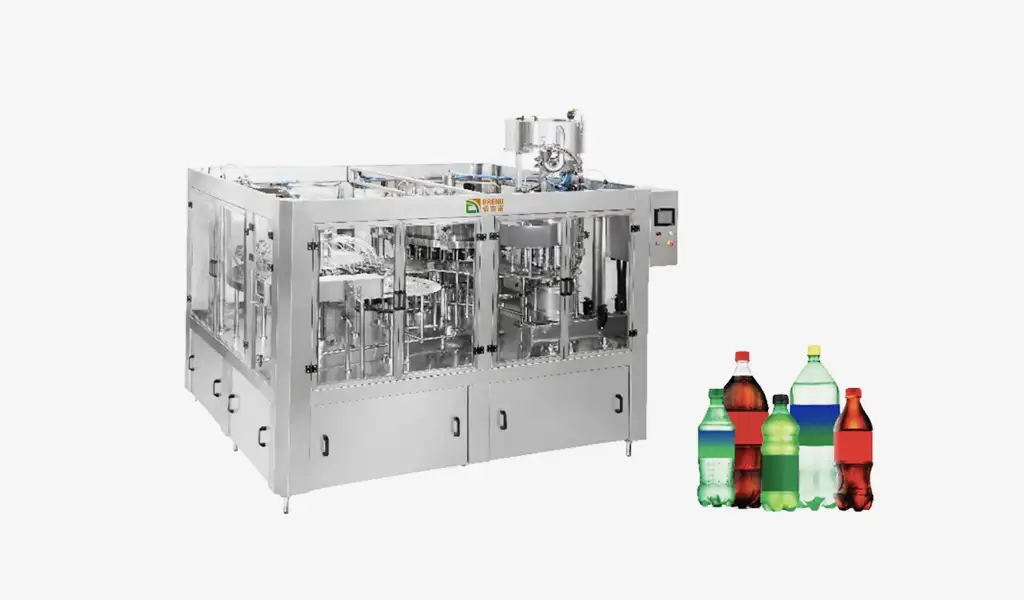
Common Products Filled by Isobaric Filling Machines
Isobaric filling is mainly used for beverages that are carbonated or easily affected by pressure changes. It is especially useful when the product must maintain a stable gas content after filling.
| Product Type | Why Isobaric Filling Is Suitable | Common Container Types |
| Carbonated soft drinks | Helps reduce foam and maintain CO₂ level | PET bottles, glass bottles, cans |
| Sparkling water | Supports stable carbonation and clean filling | PET bottles, cans, glass bottles |
| Beer and cider | Helps preserve carbonation and reduce oxygen pickup | Glass bottles, cans |
| Sparkling wine | Maintains pressure-sensitive beverage quality | Glass bottles |
| Kombucha | Suitable for naturally or artificially carbonated products | Glass bottles, cans |
| Soda water and mixers | Helps maintain bubbles and consistent fill level | Cans, PET bottles, glass bottles |
For still water, juice, edible oil, or non-carbonated products, gravity filling, normal-pressure filling, vacuum filling, or flow-meter filling may be more suitable. The best choice depends on product viscosity, gas content, container type, required speed, and hygiene level.
Main Components of an Isobaric Filling Machine
A typical isobaric filling machine is built around a pressure-controlled filling system. Although designs vary by manufacturer and production capacity, most machines include the following parts.
Product Tank or Filling Bowl
The product tank stores the beverage before it enters the container. In an isobaric system, this tank is usually sealed and pressurized. The pressure inside the tank must match or closely coordinate with the container pressure during filling.
CO₂ Pressurization System
Before filling, the bottle or can is usually pressurized with CO₂. This creates a counter-pressure environment inside the empty container. CO₂ is commonly used because it matches the gas already present in carbonated beverages and helps reduce oxygen exposure.
Filling Valves
Filling valves control the flow of beverage into the container. High-quality valves are important for filling accuracy, foam control, sanitation, and speed. Many modern machines use mechanical, pneumatic, or electronically controlled valves.
Gas Return or Venting Channel
Gas inside the container is released slowly during filling to ensure smooth liquid flow. The venting system allows CO₂ or gas from the container headspace to return or release slowly, so the liquid can enter smoothly without violent foaming.
Container Lifting or Sealing Mechanism
The bottle or can must be sealed tightly against the filling valve before pressure is applied. The sealing mechanism prevents gas leakage and keeps pressure stable during the filling cycle.
Control System
Modern isobaric filling machines often use PLC control, touchscreen operation, pressure sensors, level control, and automatic alarms. These systems help operators monitor pressure, filling speed, fill level, and machine status.
CIP Cleaning System
For beverage production, sanitation is very important. Many machines are designed with CIP, or cleaning-in-place, functions to clean product-contact surfaces without disassembling every part. Food-contact equipment and processing surfaces are considered food-contact substances or surfaces under FDA guidance, so hygienic design and proper cleaning are important in beverage plants.
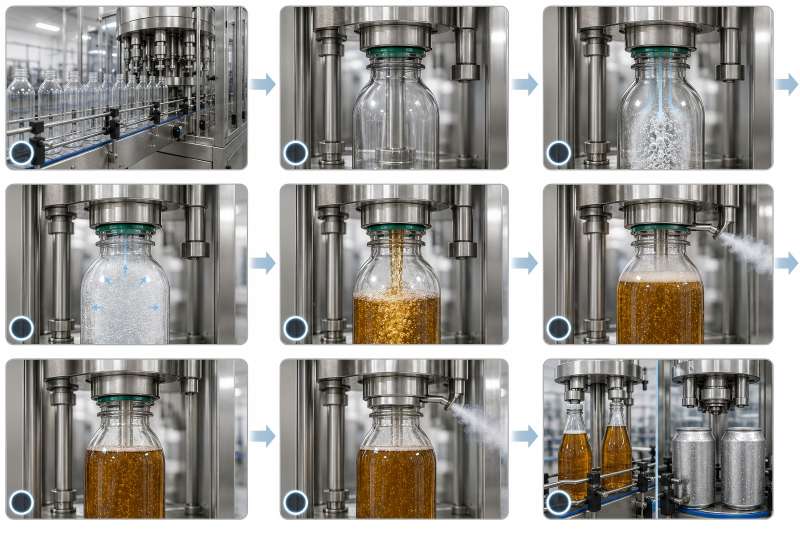
How Does an Isobaric Filling Machine Work?
The isobaric filling process can be explained in several steps. The exact sequence may vary depending on the machine type, container, beverage, and production line configuration, but the basic logic is similar.
Step 1: Container Feeding
Empty bottles or cans enter the filling machine through a conveyor, rotary star wheel, or linear feeding system. Containers must be clean, stable, and correctly positioned before filling. For carbonated beverages, container quality is important because pressure resistance and sealing performance affect the whole process.
Step 2: Container Sealing
The container is lifted or positioned against the filling valve. A sealing gasket tightly connects the container mouth to the filling valve. If the seal is poor, pressure can leak, foam can increase, and fill accuracy can become unstable.
Step 3: CO₂ Purging
Some machines first purge the container with CO₂ to remove air. This step can help reduce oxygen inside the container, which is especially important for beer, cider, sparkling wine, and other oxygen-sensitive beverages.
Step 4: Pressurization
The machine introduces CO₂ into the container until the internal pressure of the container is close to the pressure in the product tank. This is the “counter-pressure” stage. Pressure balance is the key to reducing sudden CO₂ release from the beverage.
Step 5: Filling
Once the pressure is balanced, the product valve opens. Liquid enters the container smoothly. Because the container and tank are under similar pressure, the beverage does not experience a sudden pressure drop. This helps reduce foaming and keeps more CO₂ dissolved in the drink.
Step 6: Gas Venting
As beverage enters the container, gas inside the headspace must leave. The machine vents gas in a controlled way, allowing the liquid level to rise steadily. If venting is too fast, foam may increase. If venting is too slow, filling speed may drop.
Step 7: Fill Level Control
The machine stops filling when the target level is reached. Different machines may control fill level by level tube, sensor, valve timing, flow meter, weight, or mechanical structure. Stable fill level is important for packaging appearance, label compliance, and customer satisfaction.
Step 8: Pressure Release
Before the container leaves the filling valve, pressure must be released carefully. Sudden depressurization can cause the beverage to foam out of the container. Controlled pressure release improves filling stability and reduces product loss.
Step 9: Capping or Seaming
After filling, the container is sealed quickly. Bottles are capped, while cans are seamed. Fast and reliable sealing helps preserve carbonation and reduce oxygen pickup.
Isobaric Filling vs Normal-Pressure Filling
Isobaric filling is not always necessary. For non-carbonated liquids, a normal-pressure filling machine may be simpler and more cost-effective. However, for carbonated beverages, isobaric filling offers clear advantages.
| Comparison Item | Isobaric Filling Machine | Normal-Pressure Filling Machine |
| Filling pressure | Fills under controlled pressure | Fills at atmospheric pressure |
| Best for | Carbonated and gas-sensitive drinks | Still water, juice, oil, non-carbonated liquids |
| Foam control | Strong foam reduction | Not suitable for high-carbonation products |
| CO₂ retention | Helps maintain carbonation | CO₂ may escape quickly |
| Machine complexity | More complex pressure system | Simpler structure |
| Cost | Usually higher | Usually lower |
| Typical applications | Beer, soda, sparkling water, cider | Water, tea, juice, edible oil |
The main advantage of isobaric filling is not simply speed. Its real value is controlled filling quality. It helps preserve carbonation, reduce foam, stabilize fill levels, and improve finished product appearance.
Key Factors That Affect Isobaric Filling Performance
Even with a good machine, filling performance depends on process conditions. Beverage producers should pay attention to the following factors.
Beverage Temperature
Temperature strongly affects carbonation stability. Cold beverages usually foam less because CO₂ is more stable in chilled liquid. If the beverage is too warm, CO₂ can escape more easily, increasing foam during filling.
Tank Pressure and Container Pressure
Tank and container pressure should stay balanced to prevent excessive pressure gaps that cause beverage foaming. If pressure is too high, operation may become inefficient or unsafe.
CO₂ Content
Carbonation levels vary by beverage type. Soda water may need higher carbonation than beer. A machine must be selected and adjusted according to the product’s CO₂ volume and target package format.
Filling Valve Design
Valve design affects flow stability, sanitation, accuracy, and foam control. Bottom filling, wall-flow filling, or special low-foam valve design can help improve performance for sensitive beverages.
Container Type
PET bottles, glass bottles, and aluminum cans behave differently under pressure. PET bottles may expand slightly, glass bottles are rigid, and cans require fast transfer to seaming. Machine configuration should match the container material and size.
Hygiene and Cleaning
For beverage plants, sanitary design is not optional. FDA and eCFR guidelines require safe food-contact materials and sanitary-quality water for food, equipment surfaces, and packaging materials.
Common Types of Isobaric Filling Machines
| Machine Type | Features | Suitable Production Scale |
| Semi-automatic isobaric filler | Lower investment, manual container handling, flexible for small batches | Craft beverage, pilot production, small factories |
| Linear isobaric filling machine | Straight-line layout, easier maintenance, moderate speed | Small to medium beverage lines |
| Rotary isobaric filling machine | High-speed continuous filling, suitable for large-scale production | Medium to large beverage factories |
| Isobaric filling-capping monoblock | Filling and capping integrated in one machine | Bottled carbonated drinks |
| Isobaric filling-seaming monoblock | Filling and can seaming integrated | Canned beer, soda, sparkling water |
For high-volume beverage production, rotary filling systems are commonly used because they offer higher speed and more stable continuous operation. For small craft brands, semi-automatic or compact linear machines may be enough.
Benefits of Using an Isobaric Filling Machine
1. Better Carbonation Retention
Because the machine maintains pressure during filling, the beverage can retain more dissolved CO₂. This helps keep the final product fizzy and consistent.
2. Less Foam and Product Waste
Foam is one of the biggest challenges in carbonated beverage filling. Isobaric filling reduces sudden pressure changes and helps control foam formation.
3. More Accurate Fill Levels
Stable pressure and controlled venting make it easier to achieve consistent fill levels. This improves package appearance and reduces giveaway.
4. Improved Product Quality
For beer, cider, and other sensitive beverages, reducing oxygen exposure is important. CO₂ purging and quick sealing can help protect flavor, aroma, and shelf stability.
5. Higher Production Efficiency
With proper adjustment, isobaric filling can support stable high-speed production. Less foaming also means fewer interruptions and less cleaning around the filling area.
6. Suitable for Multiple Carbonated Drinks
One machine can often be adapted for different carbonated products, container sizes, and filling volumes, depending on its design.
Limitations of Isobaric Filling Machines
Isobaric filling machines also have limitations. They are usually more expensive than normal-pressure filling machines. They require pressure control, CO₂ supply, stronger sealing parts, and more careful operation. Operators must understand pressure settings, beverage temperature, carbonation level, and cleaning procedures.
Maintenance is also important. Filling valves, seals, gaskets, pressure sensors, and gas channels should be inspected regularly. Poor maintenance may cause leakage, inaccurate filling, foaming, or sanitation problems.
How to Choose the Right Isobaric Filling Machine
First, identify the product type. Beer, soda, sparkling water, and kombucha may require different pressure ranges, oxygen control levels, and cleaning requirements. Second, confirm the container type. Bottle filling and can filling require different sealing systems. Third, calculate production capacity. A small craft beverage line may only need a semi-automatic or linear filler, while a large factory may need a rotary filling-capping or filling-seaming monoblock.
Sanitary design is also important. EHEDG publishes guideline categories related to hygienic design principles, closed equipment for liquid food processing, valves, pumps, aseptic filling machines, CIP installations, and cleaning/disinfection in food manufacturing. These topics are highly relevant when evaluating beverage filling equipment for hygiene and cleanability.
Finally, consider after-sales support, spare parts, installation service, operator training, and future expansion. A good filling solution should fit current production needs and support future product growth.