
Automatic labeling machines can label many bottle types, including round bottles, square bottles, flat bottles, oval bottles, tapered bottles, small vials, large containers, glass bottles, and plastic bottles. Machine choice depends on bottle design, label needs, and output speed.
Round bottles are usually the easiest to label, while tapered, oval, flexible, and irregular bottles may require more careful machine design. For special bottles, sample testing is the safest way to confirm performance.
Common Bottle Types Suitable for Automatic Labeling Machines
Different bottles require different feeding, positioning, and pressing methods. A round water bottle is much easier to label than a curved cosmetic bottle or a flat detergent bottle with a handle.
| Bottle Type | Common Labeling Method | Typical Label Position | Common Products | Main Buyer Focus |
| Round bottle | Wrap-around labeling | Full wrap or partial wrap | Water, juice, oil, medicine | Rotation stability |
| Square bottle | Single-side or multi-side labeling | Front, back, side | Sauce, chemical, supplements | Corner alignment |
| Flat bottle | Single-side or double-side labeling | Front and back | Shampoo, detergent, lotion | Bottle guiding |
| Oval bottle | Front/back labeling | Curved front and back | Cosmetics, personal care | Label wrinkle control |
| Tapered bottle | Angle-adjusted labeling | Front, wrap, or partial wrap | Skincare, beverage, specialty bottles | Label deformation |
| Small vial | High-precision wrap labeling | Small cylindrical label | Pharma, essential oils | Accuracy and speed |
| Large bottle | Side or wrap labeling | Front, back, or full wrap | Oil, chemicals, cleaners | Bottle stability |
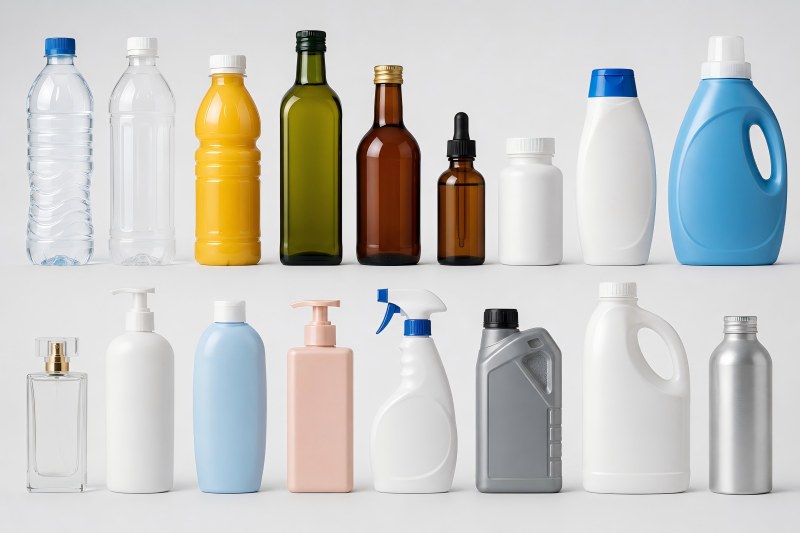
Round Bottles
Round bottles are the most common containers labeled by automatic labeling machines. Their cylindrical shape allows the label to wrap smoothly around the surface when the bottle rotates.
Typical round bottles include water bottles, juice bottles, medicine bottles, essential oil bottles, milk bottles, edible oil bottles, and shampoo bottles. The machine usually uses a wrap-around belt, roller, or three-point positioning system to rotate the bottle while the label is applied.
Round bottle labeling can be very fast because the bottle shape is stable and easy to guide. Depending on bottle size and label length, common automatic round bottle labeling speeds may range from about 30 to 300 bottles per minute.
For full-wrap labels, label length must match the bottle circumference carefully. If the label is too long, overlap may be excessive; if it is too short, the bottle may look unfinished.
Square Bottles
Square bottles can also be labeled by automatic labeling machines, but they need more accurate positioning than round bottles. Since the bottle has flat panels and corners, the label must be placed neatly on the correct surface.
Square bottles are often used for sauce, honey, nutritional supplements, chemical liquids, cosmetic products, and specialty food packaging. Square bottles create a premium look and display neatly on shelves.
An automatic labeling machine can apply one label to the front, two labels to the front and back, or multiple labels to different sides. For multi-side labeling, the machine may need a positioning system to control bottle orientation.
The main challenge is corner accuracy. If the bottle rotates or shifts slightly, the label may appear tilted or too close to the edge.
Flat Bottles
Flat bottles are widely used in shampoo, body wash, lotion, detergent, hand sanitizer, and cleaning products. These bottles usually have two large flat surfaces, making them suitable for front and back labels.
Automatic flat bottle labeling machines often use side belts or guide rails to keep the bottle stable. A double-side labeler applies front and back labels simultaneously.
Flat bottles may look simple, but they can create labeling problems when the bottle body is thin, flexible, or slightly curved. Soft plastic bottles may deform under pressure, so the pressing rollers must be adjusted carefully.
For cosmetic and personal care products, label appearance is especially important. Buyers should check whether the machine can keep label edges straight and avoid bubbles on glossy surfaces.
Oval Bottles
Oval bottles are common in cosmetics, skincare, toiletries, and personal care packaging. Their curved front and back surfaces create a more elegant appearance, but they are harder to label than flat bottles.
The label must attach smoothly to a curved surface without wrinkles. Oversized or rigid labels may peel up along the edges.
Automatic labeling machines for oval bottles usually require soft pressing rollers, sponge belts, or flexible brushes. These parts help the label follow the bottle curve.
Bottle positioning is also important. If the oval bottle is not centered before labeling, the label may shift to one side and affect the final appearance.
Tapered Bottles
Tapered bottles have a body that becomes narrower or wider from top to bottom. This shape is often used for cosmetics, beverages, specialty foods, and high-end personal care products.
Tapered bottles can be more difficult to label because the surface is not a perfect cylinder. A straight label may wrinkle if applied around a conical surface.
For tapered bottle labeling, the machine may need angle adjustment, customized rollers, or specially designed labels. In some cases, the label shape must be curved instead of rectangular.
Before buying a machine, factories should send real bottle samples and label samples to the supplier for testing. This helps confirm whether the label can be applied smoothly during continuous production.
Small Vials and Mini Bottles
Small vials, ampoule-style bottles, essential oil bottles, and small pharmaceutical bottles can be labeled automatically. These bottles require higher precision because the labeling area is small.
Even a 1 mm position error can look obvious on a small bottle. For pharmaceutical and laboratory products, label position may also affect barcode scanning and product traceability.
High-speed vial labeling machines often use precise bottle feeding systems, star wheels, or horizontal labeling structures. Some machines can label small round bottles at very high speeds when the bottle size and label roll are stable.
For small bottles, label stiffness and adhesive quality matter. If the label is too thick, it may not wrap tightly around a small diameter.
Large Bottles and Containers
Automatic labeling machines can also label larger bottles, such as edible oil bottles, chemical containers, cleaning liquid bottles, lubricant bottles, and large beverage bottles.
Large bottles need stronger conveyors, wider guide rails, and stable side support. If the bottle is heavy, the conveyor motor and machine frame must be strong enough for long-term production.
For large round bottles, wrap-around labeling is possible, but the machine must control rotation evenly. For large flat or handled bottles, front and back labeling is more common.
A large bottle may move more slowly through the machine, so labeling speed is usually lower than small bottle labeling. However, the machine can still improve consistency and reduce manual labor.
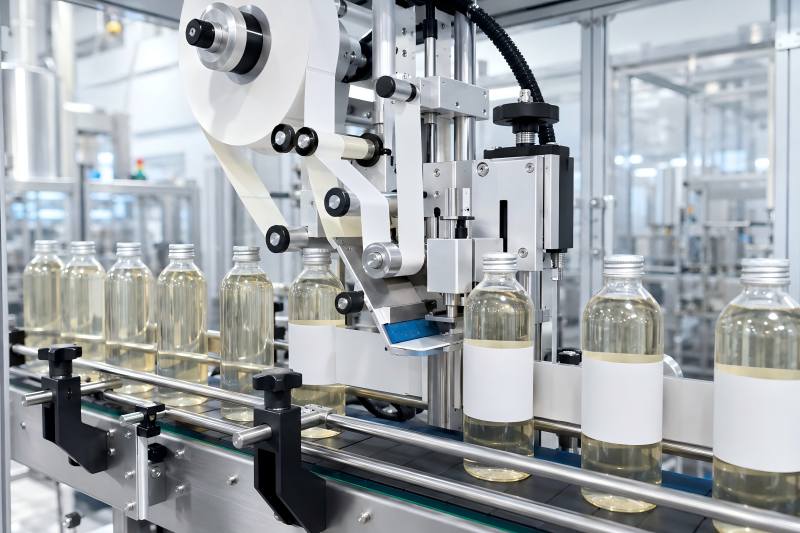
Bottle Materials Suitable for Automatic Labeling
Bottle material affects label adhesion, sensor detection, and surface pressure. Glass, PET, HDPE, PP, and metal bottles can all be labeled, but each material has different requirements.
| Bottle Material | Labeling Difficulty | Common Label Types | Key Notes |
| PET plastic | Low to medium | Self-adhesive, shrink sleeve | Lightweight bottles need gentle pressure |
| HDPE plastic | Medium | Self-adhesive, wrap labels | Surface treatment may affect adhesion |
| Glass | Low to medium | Paper, film, transparent labels | Smooth surface but fragile handling |
| PP plastic | Medium to high | Film labels, special adhesive labels | Adhesion may need testing |
| Metal | Medium | Paper, film, barcode labels | Surface oil or coating must be clean |
| Flexible plastic | High | Soft film labels | Bottle deformation must be controlled |
Glass Bottles
Glass bottles are widely used for beverages, wine, sauce, medicine, perfume, and essential oils. Their smooth surface allows labels to attach well when the bottle is clean and dry.
Glass bottles need gentler handling due to weight and fragility. The conveyor, guide rails, and bottle separation system must handle them gently.
Transparent glass bottles may also create sensor reflection issues. A suitable photoelectric sensor helps improve detection accuracy.
For premium products, glass bottle labeling often requires high visual accuracy. Wine, perfume, and cosmetic brands usually pay close attention to label height, symmetry, and front-facing position.
Plastic Bottles
Plastic bottles are used in almost every industry, including beverage, food, cosmetics, chemicals, personal care, and household cleaning. PET, HDPE, PP, and PVC bottles are all common.
Plastic bottles are lighter than glass, so they may shake or fall more easily during high-speed labeling. Guide rails and side belts help keep them stable.
Some plastic bottles have slightly uneven or textured surfaces. These surfaces may require stronger adhesive labels or special pressing structures.
For soft squeeze bottles, pressure control is very important. Too much pressure can deform the bottle, while too little pressure may leave bubbles or loose edges.
Bottles with Special Labeling Requirements
Some bottles need more than a basic front label. They may require wrap-around labels, front and back labels, neck labels, tamper-evident labels, barcode labels, or multi-layer labels.
| Labeling Requirement | Suitable Bottle Type | Machine Configuration | Typical Application |
| Full wrap label | Round bottles | Wrap-around labeling machine | Water, juice, medicine |
| Front and back labels | Flat, oval, square bottles | Double-side labeling machine | Shampoo, sauce, detergent |
| Neck label | Glass or beverage bottles | Additional labeling head | Wine, sauce, beverage |
| Tamper-evident label | Medicine, food, cosmetics | Top or corner labeling unit | Pharma, health products |
| Barcode label | Cartons, bottles, vials | Precision label applicator | Logistics, traceability |
| Transparent label | Clear bottles | Transparent label sensor | Cosmetics, beverages |
Bottles That May Need Customized Labeling Solutions
Not every bottle can be labeled well with a standard machine. Some bottle designs need customization.
Irregular bottles, bottles with handles, bottles with deep grooves, highly curved bottles, and bottles with uneven surfaces may need special fixtures or positioning devices. The machine may need extra guide rails, bottle holders, custom rollers, or orientation systems.
For example, a detergent bottle with a handle may need accurate side positioning before front and back labeling. A cosmetic bottle with a curved body may need a soft pressing belt to reduce wrinkles.
In these cases, sample testing is more important than machine specifications. A supplier should test the actual bottle and label before confirming the final configuration.
Factors That Decide Whether a Bottle Can Be Labeled Well
The bottle shape is only one factor. Labeling success also depends on label material, adhesive type, bottle surface, production speed, and environmental conditions.
A clean, dry, and smooth bottle surface usually gives better results. Dust, oil, moisture, and static electricity can reduce label adhesion.
Label size should match the available labeling area. A label that is too large for a curved surface may wrinkle, while a label that is too small may not provide enough product information.
The production speed should also be realistic. A complex oval bottle with front and back labels cannot usually run at the same speed as a simple round water bottle.
How Buyers Should Confirm Machine Compatibility
Before purchasing an automatic labeling machine, buyers should prepare complete product details. This helps suppliers choose the right machine and prevent later issues.
Useful information includes:
- Bottle shape and dimensions
- Bottle material
- Bottle weight when empty and filled
- Label size and label roll direction
- Label material and adhesive type
- Required label position
- Production speed target
- Need for date coding or barcode printing
- Need for visual inspection
- Connection with filling, capping, or packing machines
Real samples are always helpful. A drawing can show size, but an actual bottle shows stability, surface quality, and labeling difficulty.