
A water treatment system is the quality foundation of a water bottling line. It removes impurities, controls microorganisms, improves taste, protects equipment, and supports stable filling performance.
What Does a Water Treatment System Do in a Bottling Line?
Each source has different risks, so the treatment process should be designed according to water test results.
In a typical water bottling line, treatment may include raw water storage, sand filtration, activated carbon filtration, softening, precision filtration, reverse osmosis, ultraviolet sterilization, ozone sterilization, and sterile water storage. The setup should match the water source, product type, regulations, output, and market needs.
For purified water, reverse osmosis is usually a core process. For mineral water or spring water, the system may focus more on filtration, microbial control, and mineral balance, because excessive treatment may change the natural mineral profile.
Common Raw Water Problems and Treatment Goals
| Raw Water Issue | Possible Effect on Bottled Water | Common Treatment Method | Buyer Focus |
| Sand, rust, suspended solids | Cloudy appearance, blocked filters, pump wear | Sand filter, cartridge filter | Filter size, backwash design |
| Chlorine or odor | Poor taste, unpleasant smell | Activated carbon filter | Carbon quality, contact time |
| High hardness | Scaling in pipelines, RO membrane fouling | Softener, antiscalant dosing | Hardness level, regeneration system |
| High TDS | Unstable taste, mineral imbalance | Reverse osmosis | Recovery rate, membrane quality |
| Bacteria or coliform risk | Safety issue, short shelf life | UV, ozone, sterile filtration | Sterilization strength, monitoring |
| Iron and manganese | Color change, metallic taste, deposits | Oxidation, media filtration | Raw water analysis |
| Organic matter | Odor, microbial growth risk | Carbon filtration, RO, ozone | TOC control, sanitation design |
WHO notes that microbial contamination from faeces poses the greatest risk to drinking-water safety, which is why filtration, disinfection, hygienic storage, and regular testing are essential.
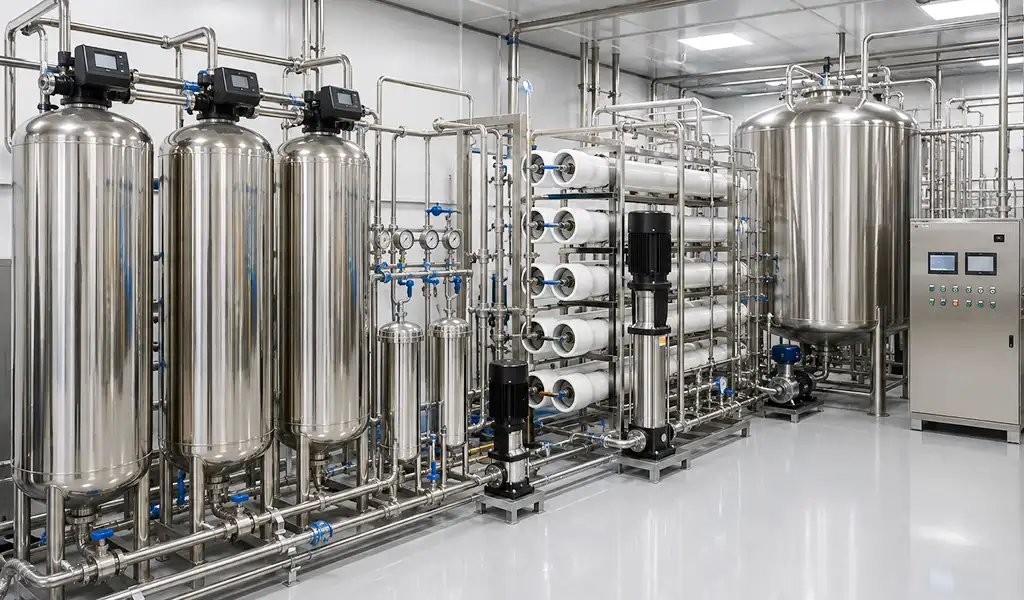
Main Components of a Water Treatment System
A complete system is usually built in stages. Each stage removes a specific type of impurity or reduces a specific risk. This layered design is important because one single machine cannot solve all water quality problems.
Raw Water Tank and Feed Pump
The raw water tank stores incoming water and helps balance flow before treatment. A stable feed supply prevents pressure fluctuation and protects filters and membranes.
Food-grade stainless steel or approved materials are recommended for tank construction. It should also have a proper drain, vent filter, level control, and cleanable structure.
Sand Filter
The sand filter removes larger particles, sediment, and visible impurities. It is often used early in treatment.
A sand filter lowers downstream filtration burden and prolongs cartridge and RO membrane life. Automatic backwashing can improve operation stability and reduce manual work.
Activated Carbon Filter
Activated carbon helps reduce chlorine, unpleasant taste, odor, color, and certain organics, making it useful for treating municipal water before bottling.
Chlorine can damage RO membranes, so carbon filtration also protects the reverse osmosis system. For bottled drinking water, it improves taste and helps create a cleaner final product.
Water Softener or Antiscalant System
These minerals can form scale on RO membranes, pipelines, heating systems, and filling equipment.
A softener lowers hardness through ion exchange resin. In some RO systems, antiscalant dosing is used instead of or together with softening. The right choice depends on raw water hardness, capacity, operating cost, and maintenance preference.
Precision Cartridge Filter
A cartridge filter is normally installed before the RO membrane or before final filling. Common filter ratings include 5 micron, 1 micron, 0.45 micron, or 0.22 micron, depending on the process requirement.
This filter removes fine particles and protects sensitive equipment. This small part greatly improves system stability.
Reverse Osmosis System
Reverse osmosis is widely used in purified water production. It removes dissolved salts, heavy metals, microorganisms, and many other dissolved impurities by forcing water through a semi-permeable membrane.
RO system design should consider inlet TDS, recovery rate, membrane brand, pump pressure, pretreatment quality, and cleaning method. Poor pretreatment will shorten membrane life and increase operating cost.
UV Sterilizer
UV sterilization uses ultraviolet light to control microorganisms without adding chemicals. It is often installed after RO or before the purified water tank.
UV is useful, but it has no long-lasting residual effect. That means treated water must still be stored and transferred in a hygienic system.
Ozone Sterilization
Ozone is commonly used in bottled water production because it supports final disinfection and helps maintain microbial control before filling. It can be mixed into treated water and held in a contact tank before the filling machine.
The ozone system must be carefully controlled. Too little ozone may not provide enough disinfection support, while too much may affect odor, materials, or product characteristics. FDA bottled water CGMPs require product water sampling after processing and before bottling as often as needed to assure uniformity and effectiveness of processing.
Typical Treatment Flow in a Water Bottling Line
| Process Stage | Main Function | Typical Equipment | Key Control Point |
| Raw water intake | Supply and buffering | Raw water tank, feed pump | Source quality, flow stability |
| Pre-filtration | Remove visible particles | Sand filter, multimedia filter | Turbidity, backwash cycle |
| Odor and chlorine removal | Improve taste and protect RO | Activated carbon filter | Chlorine level, carbon replacement |
| Hardness control | Reduce scaling risk | Softener or antiscalant dosing | Hardness, dosing rate |
| Fine filtration | Protect membrane and filler | Cartridge filter | Filter rating, pressure difference |
| Desalination/purification | Reduce TDS and dissolved impurities | RO system | Conductivity, recovery rate |
| Disinfection | Control microorganisms | UV, ozone | UV intensity, ozone residual |
| Hygienic storage | Maintain treated water quality | Stainless steel sterile tank | Tank sanitation, vent filter |
| Final transfer | Deliver water to filling machine | Sanitary pump, pipes, final filter | Pipeline hygiene, pressure stability |
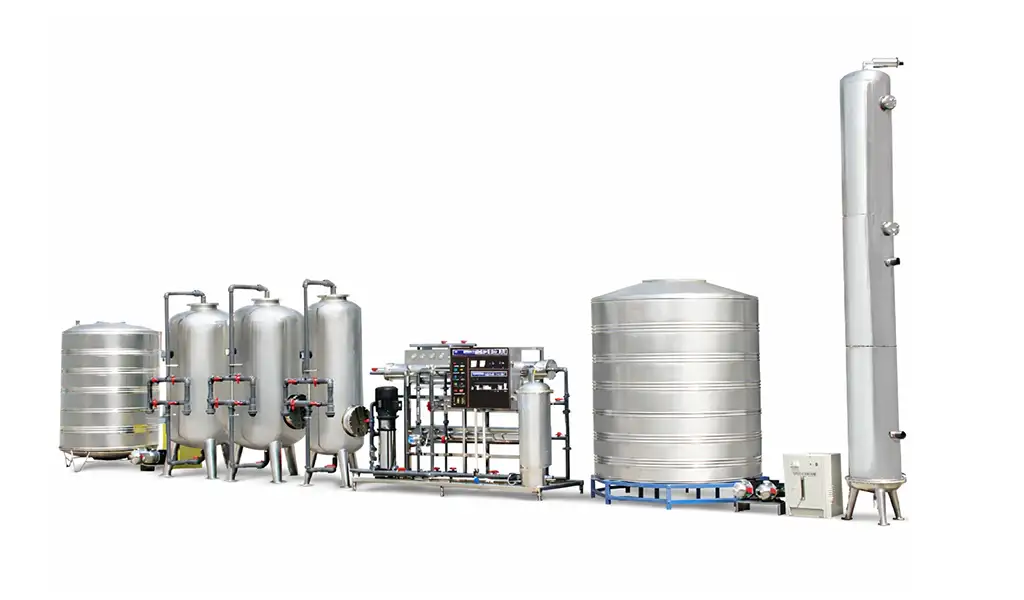
This flow can be adjusted. For example, a small bottled water plant may use a compact RO system with UV and ozone. A large plant may use multi-stage pretreatment, double-pass RO, CIP cleaning, automatic monitoring, and centralized control.
Why the Water Treatment System Matters
1. It Protects Product Safety
Water is the main ingredient in bottled water. Any contamination in the water source can directly affect the final product. A well-designed system controls contaminants before water enters the bottle.
FDA states that bottled water must be sampled, analyzed, and found safe and sanitary, and that proper plant and equipment design, bottling procedures, and record keeping are required. This means water treatment is not just a production choice; it is part of quality management.
2. It Improves Taste and Appearance
Consumers expect bottled water to be clear, clean, and pleasant to drink. Odor, chlorine taste, high minerals, iron, or organic matter can make water less acceptable.
Activated carbon, RO, filtration, and ozone treatment help create a more stable sensory profile. For brands selling premium bottled water, consistent taste is especially important because customers notice small changes between batches.
3. It Extends Equipment Life
Untreated water can damage equipment. Sand and rust can wear pumps and valves. Hardness can create scale. Chlorine can damage RO membranes. Microbial growth can contaminate tanks and pipes.
Good pretreatment reduces maintenance pressure and helps the full bottling line run more smoothly. It benefits bottling plants of all sizes.
4. It Supports Stable Filling Performance
A filling machine needs clean and stable water supply. If filters clog frequently, pressure may fluctuate. If the storage tank is not hygienic, microorganisms may grow. If ozone control is unstable, product quality may vary.
The treatment capacity should align with filling output. A 2,000 BPH line and a 24,000 BPH line require different tank volumes, pump sizes, membrane capacity, and control systems.
5. It Helps Meet Regulatory and Testing Requirements
Drinking water and bottled water are subject to safety expectations and testing requirements. EPA drinking water rules set enforceable contaminant limits for U.S. public water systems. Bottled water requirements vary by country and product type, but routine source water and finished water testing remains a core requirement in many markets.
FDA guidance also notes that bottled water manufacturers must monitor certain residual disinfectants and disinfection byproducts at least once each year in finished bottled water products, with source water monitoring also required unless exemptions apply.
Key Water Quality Data to Monitor
| Parameter | Common Control Purpose | Typical Monitoring Point | Practical Note |
| Turbidity | Check clarity and filtration effect | Raw water, after sand filter | High turbidity increases filter load |
| TDS / Conductivity | Check dissolved solids and RO performance | Raw water, after RO | Sudden change may show membrane issue |
| pH | Control taste and process stability | Raw water, finished water | Different products may need different ranges |
| Hardness | Prevent scaling | Before RO | High hardness needs softening or dosing |
| Free chlorine | Protect RO membrane | Before RO | Carbon filter should reduce chlorine |
| Microbial count | Control hygiene risk | Finished water, tank, filler | Requires regular lab testing |
| E. coli / Coliform | Safety verification | Source water, finished water | E. coli presence is a serious warning sign |
| Ozone residual | Support final disinfection | After ozone contact, before filling | Should be controlled by product requirement |
| Pressure difference | Check filter clogging | Across filters | Rising pressure difference means replacement may be needed |
E.coli detection can make bottled water legally unsafe for sale. This makes microbial testing and hygienic process design essential.
Common Mistakes to Avoid
One common mistake is buying a standard RO system without checking raw water quality. If the water contains high hardness, iron, manganese, or organic matter, the RO membrane may foul quickly.
Another mistake is ignoring the sterile water tank. Even if the water is clean after RO and UV, poor tank design can cause recontamination. The tank should support easy cleaning and prevent airborne contamination.
A third mistake is treating ozone as a simple add-on. Ozone needs correct mixing, contact time, residual control, and material compatibility. It should be designed as part of the full process.
Some plants also forget maintenance planning. Filters, carbon media, resin, UV lamps, RO membranes, seals, and ozone parts all have service lives. Without a replacement schedule, water quality can decline slowly before operators notice.