
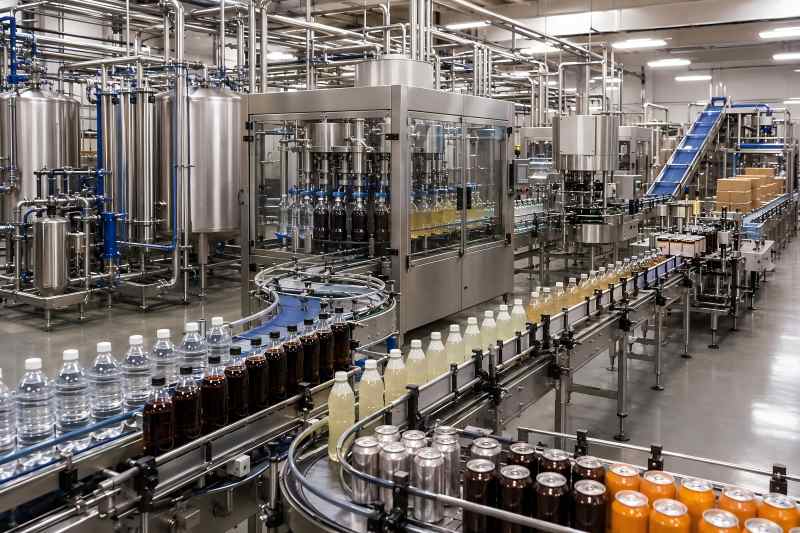
Soda, sparkling water, and soft drinks may share some equipment, but they should not be planned as the same production line. Soda needs stronger syrup preparation and flavor control. Sparkling water needs excellent water treatment and stable carbonation. Soft drink production lines require the most flexible design because the product range can include carbonated drinks, juice drinks, tea drinks, and other beverages.
Understanding the Three Beverage Types
1. Soda Production Line
In many markets, “soda” usually refers to a flavored carbonated drink, such as cola, lemon soda, orange soda, or energy-style fizzy drinks. It normally contains treated water, sugar or sweetener, flavor, acid regulator, color, preservative, and carbon dioxide.
A soda production line usually needs a complete syrup preparation system, sugar melting tank, blending tank, carbonation system, isobaric filling machine, capper or seamer, labeling machine, and packaging equipment. Compared with sparkling water, soda production has more formula control points and more cleaning requirements because sugar and flavor residues can remain inside pipes and tanks.
2. Sparkling Water Production Line
Sparkling water contains water infused with carbon dioxide. It may be plain, mineralized, lightly flavored, or functional, but it usually contains fewer ingredients than soda. The key production focus is water purity, mineral balance, carbonation stability, and clean taste.
A sparkling water production line often includes water treatment, optional mineral dosing, cooling, deaeration, carbonation, filling, capping, labeling, and packing. Because the formula is simpler, the production process can be cleaner and easier to manage. However, poor water quality or unstable CO₂ absorption can immediately affect taste and bubble performance.
3. Soft Drink Production Line
“Soft drink” is the broadest term. It can include carbonated soda, fruit-flavored drinks, energy drinks, tea drinks, juice drinks, and some non-carbonated beverages. The FAO food category system also covers carbonated and non-carbonated varieties and concentrates under water-based flavored drinks.
From a factory planning angle, a soft drink production line may be carbonated, non-carbonated, hot-fill, cold-fill, aseptic, or mixed-use. Therefore, buyers should first define the product formula, carbonation level, packaging format, shelf-life target, and production capacity before selecting equipment.
Basic Process Flow Comparison
Although the three production lines may look similar from the outside, the internal process design is different. Soda focuses on syrup blending. Sparkling water focuses on water treatment and carbonation. Soft drink lines depend on the product category and may require more flexible equipment.
| Item | Soda Production Line | Sparkling Water Production Line | Soft Drink Production Line |
| Main ingredients | Water, syrup, flavor, acid, CO₂ | Water, CO₂, optional minerals/flavor | Water, sugar/sweetener, juice, tea, flavor, CO₂ or no CO₂ |
| Key process | Syrup preparation + carbonation | Water treatment + carbonation | Formula blending + filling technology selection |
| Carbonation need | Usually medium to high | Usually medium to strong | Depends on product type |
| Equipment complexity | Medium to high | Low to medium | Medium to high |
| Cleaning requirement | High, due to sugar/flavor | Medium, usually cleaner formula | Depends on ingredients |
| Typical packaging | PET bottle, glass bottle, can | PET bottle, glass bottle, can | PET, glass, can, carton, pouch |
| Main buyer concern | Flavor consistency and filling pressure | Water taste and CO₂ stability | Product flexibility and shelf life |
Water Treatment Is the Starting Point
For all three lines, water quality directly affects the final beverage. In soda and soft drinks, water works as the base of the formula. In sparkling water, water is almost the entire product, so any odor, hardness issue, or microbial risk becomes more obvious.
A common water treatment system may include raw water tank, quartz sand filter, activated carbon filter, water softener, precision filter, reverse osmosis system, UV sterilizer, and storage tank. For premium sparkling water, mineral dosing may also be added to adjust taste.
For soda, water treatment supports stable syrup dilution and carbonation. For soft drinks containing juice, tea, or dairy-style ingredients, water treatment must also match the sanitation level required by the formula and filling method.
Syrup Preparation: Needed for Soda, Optional for Sparkling Water
Syrup preparation is one of the biggest differences between soda and sparkling water lines. Soda usually requires sugar dissolving, syrup cooling, filtration, flavor addition, acid adjustment, and final blending.
A typical soda syrup room may include:
- Sugar melting tank
- Mixing tank
- Syrup filter
- Plate heat exchanger
- Dosing system
- Storage tank
- CIP cleaning system
Sparkling water normally does not need a full syrup room unless it is flavored sparkling water. Even then, the flavor dosage is often much lower than soda. This keeps the sparkling water line simpler and cleaner.
Soft drink production may require a more advanced blending system because formulas vary widely. Some products use concentrated syrup, some use juice pulp, and some use tea extract or functional ingredients. Processing equipment suppliers commonly include blending, batching, carbonation, deaeration, and filling systems for carbonated soft drink applications.
Carbonation: The Core of Fizzy Beverage Production
The carbonation level is mainly affected by liquid temperature, CO₂ pressure, contact time, and product composition. The University of Florida’s small-scale carbonation guidance also notes that carbonation level is primarily determined by CO₂ pressure and temperature, and that forced carbonation is widely used industrially.
For production lines, colder liquid usually absorbs CO₂ more easily. That is why many carbonated beverage lines include a cooling unit before carbonation. Stable pressure is also important because sudden pressure drops can cause foaming, inaccurate filling, and CO₂ loss.
| Beverage Type | Typical CO₂ Range | Common Filling Temperature | Main Carbonation Challenge |
| Plain sparkling water | 3.0–4.5 volumes | 2–6°C | Strong bubbles without over-foaming |
| Flavored sparkling water | 2.5–4.0 volumes | 2–8°C | Flavor stability and clean mouthfeel |
| Cola-style soda | 3.0–4.2 volumes | 2–6°C | Consistent fizz and foam control |
| Fruit soda | 2.5–3.8 volumes | 4–8°C | Acid, sugar, and flavor balance |
| Carbonated soft drink | 2.0–4.2 volumes | 2–8°C | Formula-dependent carbonation control |
| Non-carbonated soft drink | 0 volumes | Depends on filling type | Shelf life and microbial control |
Data are common engineering reference ranges. Actual settings depend on formula, bottle type, filling machine design, and local product standards.
Filling Machine Differences
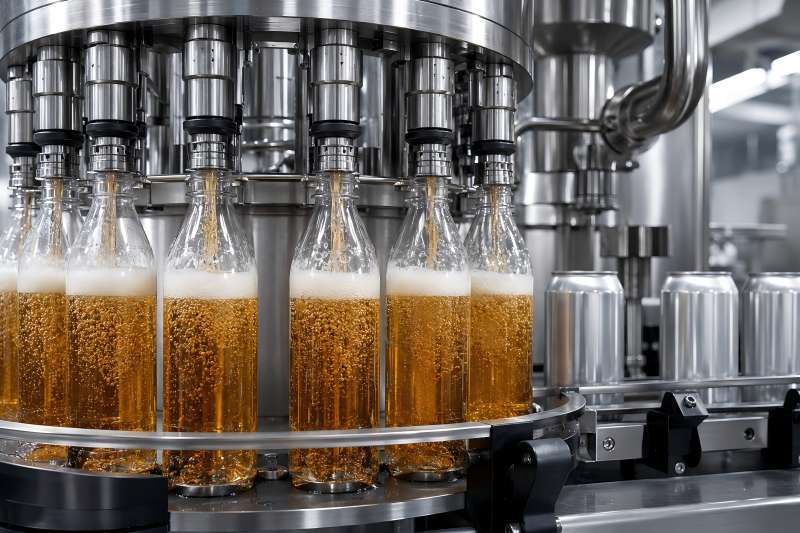
Carbonated drinks usually require an isobaric filling machine, also called a counter-pressure filling machine. The bottle or can is pressurized before filling, so the pressure inside the container is close to the pressure inside the product tank. This helps reduce foaming and CO₂ loss.
For soda, the filler must handle sugar-containing liquid and maintain accurate fill levels. For sparkling water, the filler must protect carbonation and avoid oxygen pickup. For carbonated soft drinks, the filler may need to support different bottle sizes, formulas, and carbonation levels.
Non-carbonated soft drinks can use gravity filling, normal pressure filling, hot filling, or aseptic filling depending on the product. This is why “soft drink production line” is not always the same as “soda production line.”
Equipment Configuration Comparison
The equipment list changes according to beverage type. A buyer who only produces plain sparkling water does not need the same syrup preparation system as a soda factory. A soft drink manufacturer with many SKUs may need flexible tanks, recipe control, and quick changeover design.
| Equipment Section | Soda Line | Sparkling Water Line | Soft Drink Line |
| Water treatment | Required | Very important | Required |
| Sugar melting system | Required for sugar soda | Usually not needed | Depends on formula |
| Syrup blending tank | Required | Optional for flavored products | Usually required |
| Deaeration system | Recommended | Recommended | Depends on product |
| Chiller | Required for stable carbonation | Required | Depends on carbonation |
| Carbonator | Required | Required | Required only for carbonated types |
| Isobaric filler | Required | Required | Required for carbonated products |
| Hot-fill system | Usually not used | Usually not used | Used for some juice/tea drinks |
| CIP system | Strongly recommended | Recommended | Strongly recommended |
| Labeling machine | Required | Required | Required |
| Shrink wrapper/carton packer | Required | Required | Required |
Packaging Format: PET, Glass, or Can
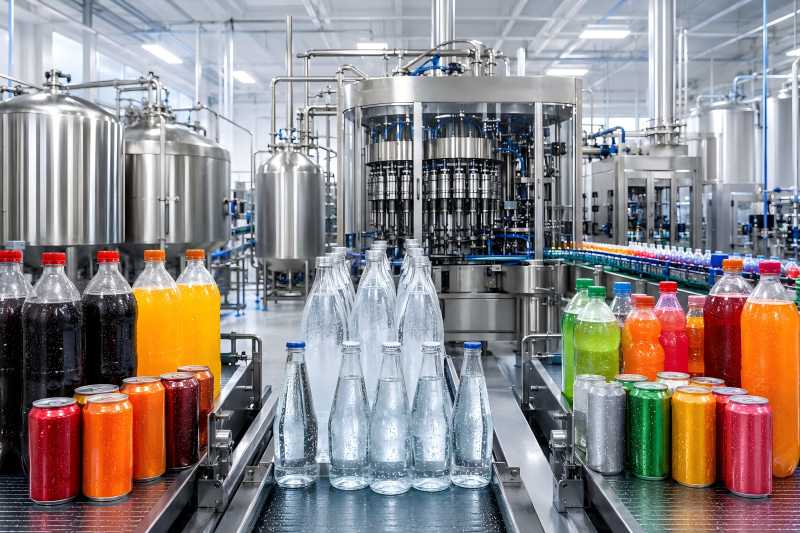
Packaging affects both machine selection and beverage quality. PET bottles are lightweight, economical, and ideal for large-scale production. Glass bottles are often used for premium soda or sparkling water because they provide a higher-end look and better gas barrier performance. Cans are popular for high-speed production, easy transport, and modern retail channels.
For carbonated beverages, bottle strength and closure quality are critical. The container must withstand internal pressure after filling. Caps, crowns, or can seams must seal properly to prevent CO₂ loss and leakage.
Typical production capacity may vary widely:
| Production Scale | PET Bottle Line | Can Line | Suitable Factory Type |
| Small scale | 2,000–6,000 bottles/hour | 3,000–8,000 cans/hour | Startup brand, local beverage factory |
| Medium scale | 8,000–18,000 bottles/hour | 12,000–24,000 cans/hour | Regional beverage producer |
| Large scale | 24,000–48,000 bottles/hour | 36,000–72,000 cans/hour | Large beverage group or OEM plant |
Capacity data are reference ranges. Final output depends on bottle size, filling valves, product foaming behavior, labeling speed, and packing method.
Cleaning and Hygiene Requirements
Soda and soft drink lines usually require stronger cleaning management than plain sparkling water lines. Sugar, flavor, juice, tea extract, and color ingredients may leave residues in tanks, pipelines, valves, and filling machines. Without proper cleaning, the line may face microbial growth, flavor carryover, or product contamination.
A CIP system can clean tanks and pipelines with water, alkali, acid, and hot water according to the cleaning program. For multi-flavor soda production, CIP design is especially important because different flavors should not mix during changeover.
Sparkling water lines may seem simple, but hygiene is still important. Since the product has a clean taste profile, even small contamination or odor problems can be easy to detect.
Quality Control Points
Each beverage type has different quality control priorities. Soda requires Brix, acidity, flavor, carbonation, and fill level control. Sparkling water requires TDS, pH, taste, CO₂ content, and microbial control. Soft drinks may require more testing because ingredients and shelf-life targets are more diverse.
Common quality checks include:
- Water conductivity and hardness
- pH value
- Brix level
- CO₂ volume
- Filling temperature
- Bottle pressure
- Cap torque or seam quality
- Microbial testing
- Label position
- Final package strength
For carbonated products, pressure control should be monitored from carbonation to filling and sealing. A stable process helps reduce foam, short filling, bottle deformation, and gas loss.
Which Line Should Buyers Choose?
A soda production line is suitable for factories producing cola, fruit soda, flavored carbonated drinks, or energy-style fizzy drinks. The buyer should focus on syrup preparation, accurate mixing, carbonation stability, and hygienic cleaning.
A sparkling water production line is suitable for plain sparkling water, mineral sparkling water, and light flavored sparkling water. The buyer should pay more attention to water treatment, mineral adjustment, cooling, carbonation, and clean filling.
A soft drink production line is suitable for companies that plan to produce multiple beverage categories. The buyer may need a more flexible design, especially when producing both carbonated and non-carbonated drinks. In this case, the production line may require modular blending, different filling technologies, and more advanced recipe management.