
A small water bottling line is usually the safer choice for new brands, local water plants, trial projects, and companies with limited budget. It offers flexibility, easier operation, lower investment, and enough capacity for early market development.
A large water bottling line is better for businesses with proven demand, stable bottle formats, strong distribution, and enough capital for automation. It can reduce unit cost, improve efficiency, and support large-scale supply.
In global high-speed water projects, large PET bottling lines can reach very high outputs. For example, Sidel has published PET filling equipment with speeds up to 90,000 bottles per hour, while Krones has shared water line references rated at 81,000 and even 100,000 bottles per hour.
Comparison Table
| Item | Small Water Bottling Line | Large Water Bottling Line |
| Typical Capacity Range | 1,000–6,000 bottles/hour | 12,000–60,000+ bottles/hour |
| Best For | Start-ups, local brands, test production | Established factories, distributors, large orders |
| Investment Level | Lower | Higher |
| Factory Space | Smaller workshop | Larger plant layout |
| Labor Requirement | More manual support possible | Higher automation preferred |
| Changeover Flexibility | Easier for varied bottle sizes | Better for stable bottle formats |
| Unit Production Cost | Higher at low volume | Lower when fully utilized |
| Risk Level | Lower financial pressure | Higher planning pressure |
| Expansion Method | Add equipment step by step | Build full line capacity from the start |
| Main Buyer Concern | Budget, flexibility, simple operation | Speed, efficiency, uptime, return on investment |
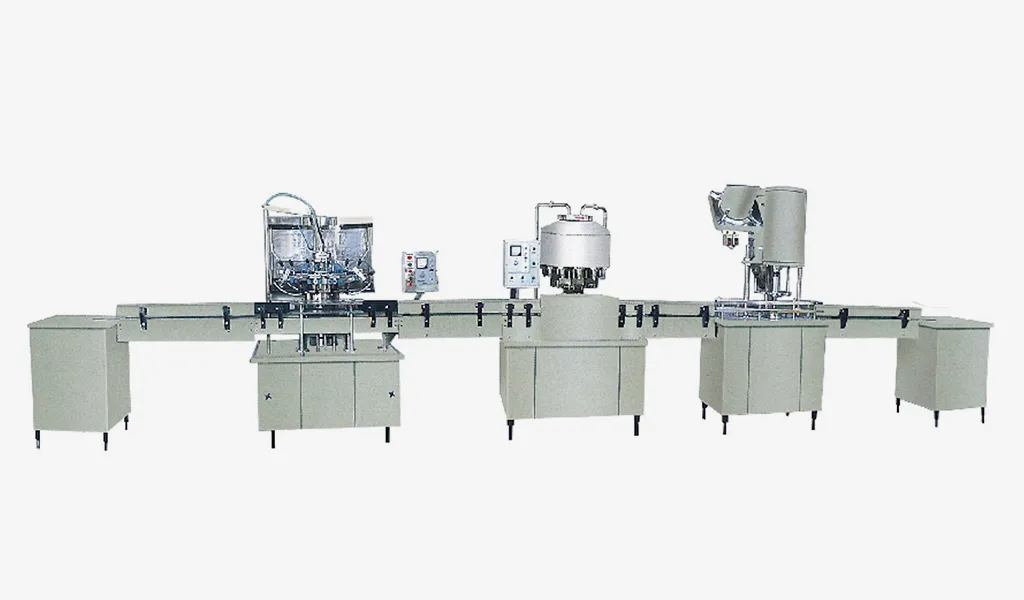
What Is a Small Water Bottling Line?
A small water bottling line is a compact production system for washing, filling, capping, labeling, date coding, and packing bottled water. It is commonly used for PET bottled water, purified water, mineral water, spring water, drinking water, and small regional beverage projects.
Many small lines use semi-automatic or lower-speed automatic equipment. The line may include a water treatment system, bottle rinsing machine, filling and capping machine, labeling machine, inkjet printer, shrink wrapping machine, and basic conveying system.
Small lines are practical when the business is still testing its sales channels. A local water brand may start with 500 ml and 1.5 L bottles, sell to nearby shops, offices, schools, or distributors, and then upgrade capacity when orders become stable.
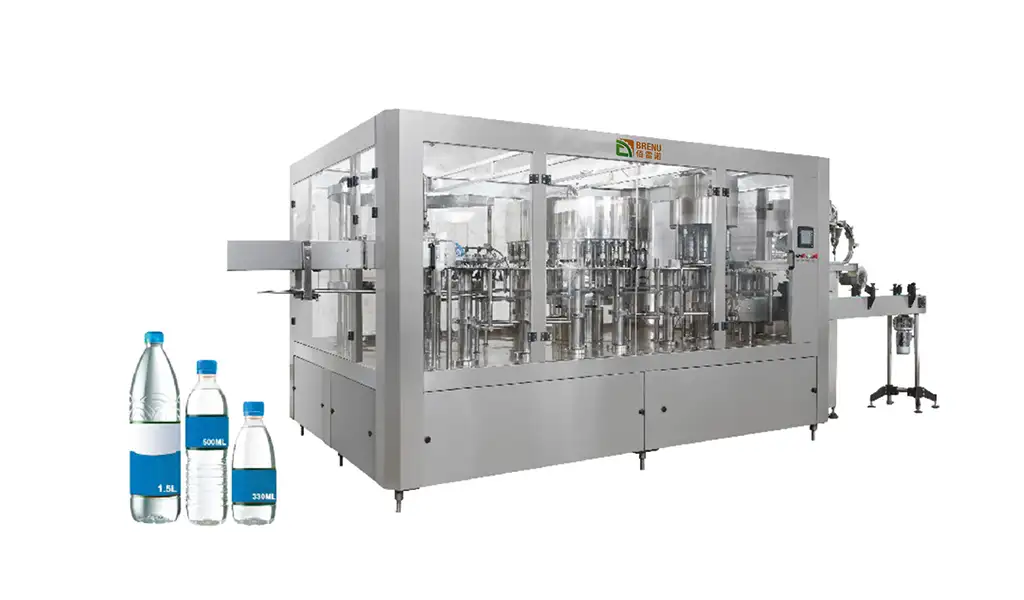
What Is a Large Water Bottling Line?
A large water bottling line is a high-capacity production system designed for continuous output. It usually includes automatic water treatment, bottle blowing, rinsing, filling, capping, labeling, coding, shrink wrapping or carton packing, handle application, palletizing, and automatic conveying.
This type of line is built for stable bottle formats and long production runs. It is often used by factories supplying supermarkets, chain stores, wholesale markets, hotels, government projects, and large distribution networks.
Large lines need stronger engineering coordination. Bottle design, cap feeding, label application, film wrapping, pallet layout, compressed air, power supply, water supply, drainage, and factory logistics must work together smoothly.
Capacity Is the First Question
Production capacity is usually the biggest difference between a small and large water bottling line. However, the right capacity should come from real sales demand, not only from the highest machine speed.
A machine rated at 12,000 bottles per hour does not always produce 12,000 sellable bottles every hour. Actual output is affected by bottle changeover, film replacement, label roll replacement, cleaning time, operator skill, cap feeding, and unexpected stops.
A safer planning method is to calculate daily demand first, then add extra capacity for growth. Many factories plan around 70%–85% effective production efficiency instead of assuming perfect operation.
Capacity Planning Table
| Business Stage | Suggested Line Capacity | Daily Output at 8 Hours | Suitable Business Type |
| Trial Stage | 1,000–2,000 BPH | 8,000–16,000 bottles/day | New brand, local testing |
| Small Commercial Stage | 3,000–6,000 BPH | 24,000–48,000 bottles/day | Regional sales, small distributor |
| Growing Factory Stage | 8,000–12,000 BPH | 64,000–96,000 bottles/day | Stable wholesale orders |
| Medium-Large Stage | 18,000–24,000 BPH | 144,000–192,000 bottles/day | Supermarket and dealer supply |
| High-Speed Stage | 36,000–60,000+ BPH | 288,000–480,000+ bottles/day | Large-scale bottled water plant |
BPH means bottles per hour. These figures are planning examples, and actual output depends on bottle size, line configuration, automation level, and factory management.
Investment Difference
A small water bottling line requires less initial capital. It gives the buyer more room to test the market, adjust bottle design, improve branding, and learn production management without taking on heavy financial pressure.
A large line needs more budget before production starts. The investment is not only the filling machine. It also includes bottle blowing equipment, air compressors, water treatment, conveyors, labeling system, packing equipment, spare parts, installation, factory utilities, and operator training.
The main advantage of a large line is lower unit cost when orders are strong. Once the line is running at high utilization, labor cost, energy use, and management cost can be spread across more bottles.
Estimated Investment and Operating Focus
| Cost Area | Small Line Focus | Large Line Focus |
| Equipment Purchase | Basic automatic or semi-automatic line | Fully automatic high-speed system |
| Factory Preparation | Smaller layout, simpler utilities | Larger workshop, stronger power and air supply |
| Labor Cost | Operators may handle more steps manually | Automation reduces labor per bottle |
| Maintenance | Easier daily maintenance | Requires planned maintenance system |
| Spare Parts | Lower stock pressure | More critical parts inventory needed |
| Packaging Materials | Lower order quantity possible | Bulk purchasing improves cost control |
| Cash Flow Pressure | Lower at the beginning | Higher before sales volume is stable |
| Payback Logic | Slow but safer growth | Faster only with strong order volume |
For buyers, the real question is not only “How much is the line?” A better question is “How many bottles can I sell every month, and how quickly can the line pay back the investment?”
Factory Space and Layout
A small water bottling line can fit into a smaller workshop. It is easier to arrange the filling area, labeling area, packing area, finished goods area, and storage space.
A large line needs more careful factory layout. The wet area, dry area, bottle blowing area, packing area, palletizing area, forklift route, warehouse entrance, and loading area should be planned before equipment is confirmed.
Poor layout can reduce the advantage of a high-speed line. When finished products cannot move out quickly, pallets block the packing area, or operators walk too far between stations, the line may stop even when the filling machine itself is fast.
Automation Level
Small lines often keep some manual processes. Workers may load bottles, feed caps, collect packed products, or move cartons by hand.
Large lines usually need higher automation. Automatic cap elevators, bottle unscramblers, air conveyors, automatic labeling machines, film shrink wrappers, carton packers, palletizers, and central control systems help keep production stable.
Automation also affects consistency. A large water bottling line should reduce human handling, improve hygiene, protect bottle appearance, and maintain steady output during long shifts.
Bottle Size and Product Range
Small water bottling lines are usually more flexible for different bottle sizes. A start-up brand may need 330 ml, 500 ml, 1 L, and 1.5 L bottles in smaller batches.
Large lines work best when bottle formats are stable. Frequent changeovers reduce production time and make high-speed equipment less efficient.
Before choosing a line, buyers should list all bottle sizes, cap types, label types, and packaging styles. A line designed only for 500 ml bottles may need extra parts or adjustment if 1.5 L bottles are added later.
Bottle Format Comparison
| Bottle Format | Small Line Suitability | Large Line Suitability | Buyer Notes |
| 330 ml PET Water | Good for testing small retail packs | Strong for high-volume markets | Label accuracy matters on small bottles |
| 500 ml PET Water | Most common starting size | Excellent for mass production | Main format for supermarkets and distributors |
| 1 L Bottle | Suitable with adjusted filling range | Suitable if conveyor and packing match | Bottle stability should be checked |
| 1.5 L Bottle | Good for local family-use products | Good for large wholesale orders | Requires stronger bottle handling |
| 5 L Bottle | Better with special filling setup | Less suitable for standard high-speed small-bottle lines | Needs different packing and conveying design |
| Sports Cap Bottle | Possible with customized capping | Suitable when orders are stable | Cap feeding system must be confirmed |
Packaging and End-of-Line Equipment
Many buyers focus on the filling machine first, but the end-of-line system can decide whether production runs smoothly. Bottles must be labeled, coded, grouped, shrink-wrapped, packed, and moved to storage without delays.
A small line may use a simple shrink wrapping machine and manual stacking. This is enough when output is limited and labor is available.
A large line needs a stronger packing solution. Automatic film wrapping, carton packing, handle applicators, palletizing, and conveyor control become important because finished bottles are produced too quickly for manual handling.
Labor and Management
Small lines can run with fewer technical staff. Operators can learn the process quickly, and daily management is easier.
Large lines need better training and stronger production discipline. The team should understand machine adjustment, cleaning procedures, basic troubleshooting, material preparation, quality inspection, and maintenance scheduling.
A high-speed line can lose many bottles in a short time if something goes wrong. Label skew, loose caps, unstable bottles, poor shrink wrapping, or wrong date coding must be detected quickly.
Product Quality and Hygiene
Both small and large water bottling lines need reliable hygiene control. Water treatment, bottle rinsing, filling accuracy, cap sealing, and packaging cleanliness are all important.
For small lines, quality control often depends more on operator discipline. The factory should set clear inspection steps for water quality, bottle appearance, filling volume, cap torque, label position, and package sealing.
For large lines, inline inspection systems become more valuable. Bottle inspection, cap detection, fill level checking, label detection, and coding inspection can reduce defective products before they enter the market.
Unit Cost Difference
A small line has lower investment but higher unit cost. Labor, electricity, rent, management, and maintenance are spread across fewer bottles.
A large line can reduce unit cost through scale. Packaging materials can be purchased in larger quantities, production runs can be longer, and automation can reduce manual work.
Still, a large line only becomes cost-effective when sales volume is strong. A high-speed line running at low utilization may create pressure from loan payments, idle equipment, storage cost, and unsold inventory.
Simple Unit Cost Example
| Item | Small Line Example | Large Line Example |
| Rated Capacity | 3,000 BPH | 24,000 BPH |
| Effective Efficiency | 75% | 80% |
| Real Output per Hour | 2,250 bottles | 19,200 bottles |
| 8-Hour Daily Output | 18,000 bottles | 153,600 bottles |
| Labor per Shift | 5–8 people | 8–15 people |
| Best Use Case | Local sales and flexible batches | Stable bulk orders |
| Main Cost Risk | Higher labor cost per bottle | Idle capacity if orders are weak |
This table is only a planning model. Real costs depend on local wages, electricity price, bottle weight, packaging material price, financing cost, and machine configuration.
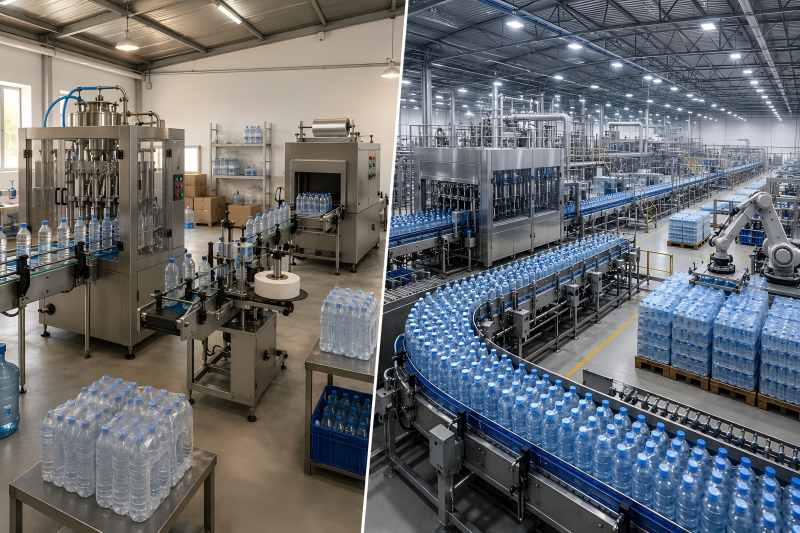
When a Small Water Bottling Line Is Better
A small line fits your business when your market is still developing. It gives you time to test product design, sales channels, pricing, and customer feedback.
It is also suitable when your factory space is limited. Instead of building a large plant at the beginning, you can start with a compact line and upgrade later.
A small line is a smart choice when you need flexibility. Different bottle sizes, private label orders, seasonal promotions, and small-batch production are easier to manage at lower speed.
When a Large Water Bottling Line Is Better
A large line fits your business when sales volume is already clear. If you have contracts with distributors, supermarkets, wholesalers, or chain stores, higher capacity can support faster delivery.
It also works well when your product format is stable. A factory producing the same 500 ml bottle every day can benefit from high-speed filling, automatic packing, and bulk material purchasing.
A large line is more suitable when labor cost is rising. With better automation, the factory can increase output without increasing workers at the same rate.
Do Not Buy Capacity You Cannot Use
One common mistake is buying a line that looks impressive but does not match real demand. High speed can become a burden when the market is not ready.
Unused capacity affects cash flow. Equipment sits idle, operators lose efficiency, packaging materials take storage space, and the business waits longer for payback.
A better strategy is to match the first line with current demand and near-term growth. When monthly sales become stable, expansion becomes easier to justify.
Expansion Strategy
A small line does not mean a small future. Many businesses start with a compact line and add more automation later.
Possible upgrades include automatic bottle blowing, faster labeling, automatic shrink wrapping, higher-capacity water treatment, stronger conveying, and palletizing equipment.
When buying the first line, discuss future expansion with the supplier. The line layout should leave space for additional equipment, better conveyors, or higher-speed machines.
How to Choose Between Small and Large Lines
Start with your sales target. Estimate monthly bottle demand, daily working hours, number of shifts, and expected growth over the next two to three years.
Then review your factory conditions. Check workshop size, ceiling height, power capacity, compressed air, water source, drainage, storage space, and delivery area.
Finally, compare total cost, not only equipment price. A low-cost machine may become expensive when it limits output, creates unstable production, or needs too much manual work.
Practical Selection Checklist
| Question | Choose Small Line When… | Choose Large Line When… |
| How stable are your orders? | Orders are still growing | Orders are already strong |
| How many bottle sizes do you need? | Several formats change often | One or two formats dominate |
| How much space do you have? | Workshop space is limited | Factory layout supports full automation |
| What is your budget level? | You need controlled investment | You can support higher upfront cost |
| How important is low unit cost? | Flexibility matters more | Scale efficiency matters more |
| How fast do you need delivery? | Local demand is moderate | Bulk orders require fast output |
| What is your risk tolerance? | You prefer gradual growth | You want aggressive expansion |
The right line should match your sales volume, factory space, bottle design, packaging method, labor plan, and future expansion path. For many buyers, the most practical solution is to start with a line that fits today’s orders while leaving room for tomorrow’s growth.