
Self-adhesive labeling machines, shrink sleeve labeling machines, and paste labeling machines are three common solutions in food, beverage, pharmaceutical, cosmetics, chemical, and daily-use product packaging. They can all be used in industrial production, but they work in very different ways.
A self-adhesive labeling machine applies pressure-sensitive labels that already contain adhesive. A shrink sleeve labeling machine applies film sleeves and then uses heat to shrink the film around the container. A paste labeling machine, also called a wet glue labeling machine, applies glue to paper labels or containers during the labeling process.
Comparison Table
| Item | Self-Adhesive Labeling Machine | Shrink Sleeve Labeling Machine | Paste Labeling Machine |
| Label type | Pressure-sensitive label with backing paper | PVC, PET, OPS, or similar shrink film sleeve | Paper label with wet glue or paste |
| Adhesive method | Adhesive is already on the label | Heat shrink, usually no glue on main body | Glue is applied during labeling |
| Common container types | Bottles, jars, boxes, tubes, flat containers | Bottles, shaped containers, cups, cans | Glass bottles, cans, jars, round containers |
| Visual coverage | Partial label, front/back, wrap-around | 360° full-body decoration possible | Usually partial or wrap-around paper label |
| Typical speed range | Around 30–300 bottles/min, depending on model | Around 30–450 bottles/min, depending on model | Around 60–160 bottles/min, depending on model |
| Label cost | Medium to high | Medium to high | Usually lower for paper labels |
| Machine complexity | Medium | High, because it needs sleeve cutting and shrinking | Medium, but glue system needs cleaning |
| Best for | Flexible SKUs, cosmetics, pharma, food jars | Beverage, full-body branding, shaped bottles | High-volume glass bottles, economy packaging |
| Main limitation | Liner waste and label material cost | Heat tunnel energy use and sleeve recycling concerns | Glue cleaning and slower format changeover |
Some machine specifications show shrink sleeve equipment working at 120 bottles per minute, while higher-speed models can reach 400–450 bottles per minute depending on bottle size, sleeve length, and machine configuration. Wet glue labeling machines are often listed around 60–100 bottles per minute or higher, and some models can reach about 160 bottles per minute depending on bottle diameter and label size.
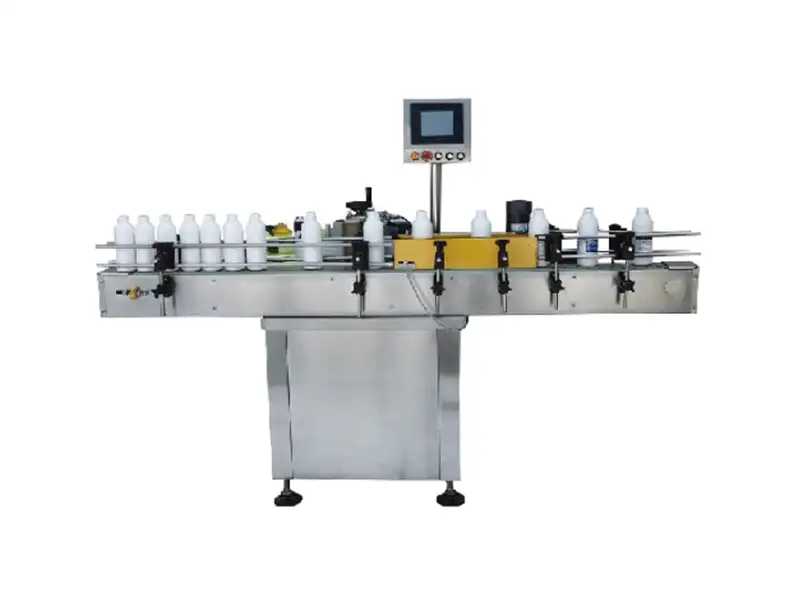
What Is a Self-Adhesive Industrial Labeling Machine?
A self-adhesive labeling machine applies labels that already have adhesive on the back. These labels are also called pressure-sensitive labels. The label is supplied on a roll with release liner. During operation, the machine peels the label away from the backing paper and applies it to the container surface with a labeling head, brush, roller, or pressing belt.
This system is widely used because it is flexible. It can label round bottles, square bottles, flat boxes, plastic jars, metal cans, tubes, and cartons. It can also apply one label, two labels, top labels, bottom labels, tamper labels, wrap-around labels, or multi-side labels.
For factories with many product sizes or frequent SKU changes, self-adhesive labeling is often the easiest choice. The operator usually changes the label roll, adjusts the sensor, sets label position, and fine-tunes guide rails. Compared with paste labeling, it does not require glue preparation. Compared with shrink sleeve labeling, it does not require a shrink tunnel.
Main advantages of self-adhesive labeling machines include:
- Good flexibility for different container shapes
- Clean labeling process without wet glue
- Suitable for small, medium, and large production lines
- Easy integration with filling, capping, coding, and packing machines
- Good labeling accuracy for pharmaceutical, cosmetics, and food products
- Suitable for transparent labels, metallic labels, paper labels, film labels, and security labels
A typical self-adhesive labeling machine may reach 30–120 bottles per minute for standard models, while higher-speed rotary systems can run much faster. Actual output depends on bottle shape, label length, container spacing, conveyor stability, and whether the machine applies one label or multiple labels.
The main disadvantage is label material cost. Pressure-sensitive labels include face material, adhesive, and release liner. After labeling, the liner becomes waste unless the factory has a liner recycling process. For products with large label areas or very high daily output, this cost difference can become important.
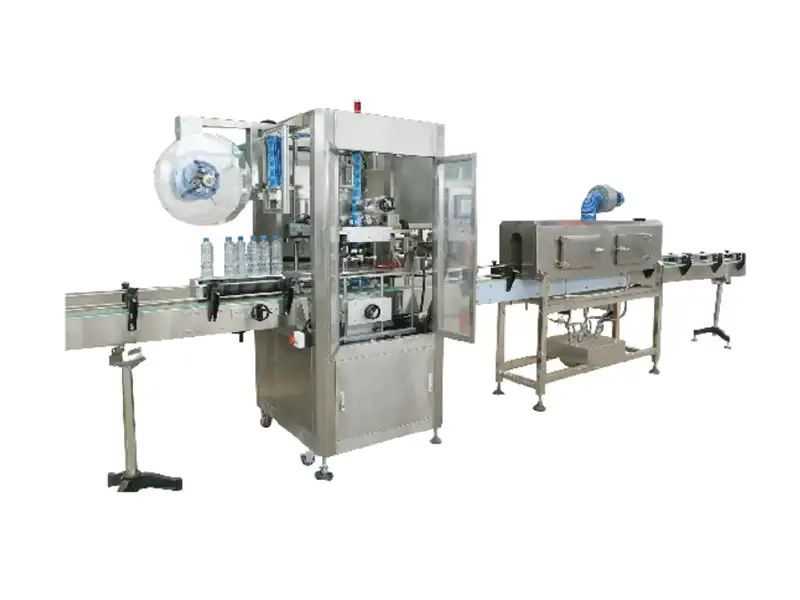
What Is a Shrink Sleeve Industrial Labeling Machine?
A shrink sleeve labeling machine applies a pre-printed plastic film sleeve around a container. After the sleeve is placed, the container passes through a steam, electric, or hot air shrink tunnel. Heat causes the sleeve to shrink tightly around the bottle or container.
This method is popular in beverage, dairy, juice, tea drink, energy drink, cosmetics, household chemical, and promotional packaging. The biggest advantage is 360-degree decoration. A shrink sleeve can cover almost the entire container body, including curved, irregular, and contoured shapes.
A shrink sleeve labeling system usually includes:
- Film roll holder
- Sleeve forming unit
- Cutting system
- Label positioning sensor
- Bottle separating device
- Sleeve applicator
- Shrink tunnel
- Steam generator or heat system
- Conveyor and control panel
Some shrink sleeve machines specify film materials such as PVC, PET, and OPS, with common film thickness ranges around 0.035 mm to 0.08 mm depending on material and model. This makes shrink sleeve labeling suitable for full-body packaging, neck labels, tamper-evident bands, and promotional sleeves.
Shrink sleeve labeling is especially useful when the bottle shape itself is part of the brand identity. For example, a curved beverage bottle or irregular cosmetic bottle may not work well with a flat self-adhesive label. A shrink sleeve can conform to the shape and create a more complete visual effect.
Main advantages of shrink sleeve labeling machines include:
- 360° full-body branding
- Strong shelf impact for beverage and consumer products
- Suitable for irregular bottle shapes
- Can combine decoration and tamper evidence
- Good moisture resistance when using film labels
- Can cover old packaging for promotional or seasonal editions
However, shrink sleeve systems are usually more complex than self-adhesive systems. The machine must cut the sleeve accurately, apply it at the correct height, and shrink it evenly. If the tunnel temperature, steam distribution, or conveyor speed is not stable, the sleeve may wrinkle, twist, shrink unevenly, or cover the wrong area.
Energy consumption is another factor. Shrink tunnels require heat, and steam tunnels may need water treatment and steam generation. For high-speed beverage production, this is normal and acceptable. For small production lines, it may increase operating cost and machine footprint.
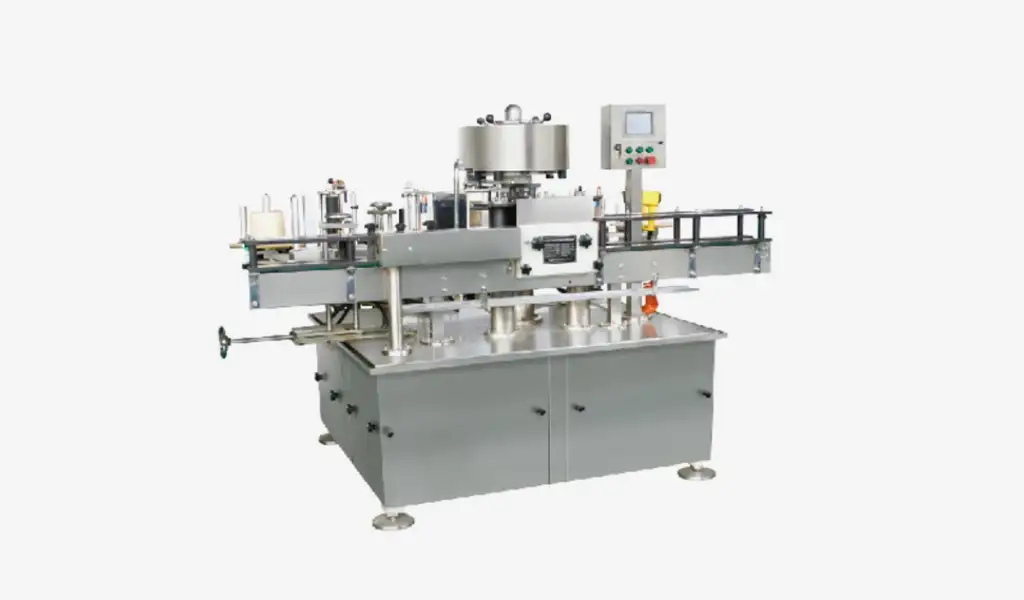
What Is a Paste Industrial Labeling Machine?
A paste labeling machine uses glue to apply paper labels to containers. The glue may be applied to the label or container, depending on machine design.
This method has been used for many years in beer, water, sauce, canned food, glass bottle, chemical bottle, and traditional consumer goods packaging. It is especially common when factories want to use low-cost paper labels in large quantities.
They can apply front labels, back labels, neck labels, body labels, or wrap-around labels. Some high-speed wet glue machines are designed for glass bottle lines where label cost control is very important.
Main advantages of paste labeling machines include:
- Lower label material cost when using paper labels
- Suitable for high-volume standard containers
- Good choice for glass bottles and cans
- Mature technology with stable operation
- No release liner waste
- Suitable for traditional beverage, food, and chemical packaging
Some automatic wet glue labeling machines list output around 3,600 to 9,000 containers per hour, which is about 60 to 150 containers per minute. Other equipment examples show labeling speeds around 60–100 pieces per minute with accuracy around ±1 mm.
The main disadvantage is cleaning. Glue trays, rollers, brushes, pumps, and contact parts need regular maintenance. If glue viscosity changes, label adhesion may become unstable. If too much glue is applied, the container may look dirty. If too little glue is applied, the label may lift or fall off.
Paste labeling is not as flexible as self-adhesive labeling for frequent SKU changes. It works best when the container shape, label size, and production batch are relatively stable.
Cost Comparison
| Cost Factor | Self-Adhesive | Shrink Sleeve | Paste |
| Label material cost | Medium to high | Medium to high | Low to medium |
| Machine investment | Medium | Medium to high | Medium |
| Energy cost | Low | Medium to high | Low to medium |
| Cleaning cost | Low | Medium | Medium to high |
| Changeover cost | Low to medium | Medium | Medium |
| Waste type | Release liner | Film trim and rejected sleeves | Glue waste and paper waste |
| Best cost advantage | Flexible production | High-impact packaging | Large-volume economy labeling |
For a simple round bottle with a small front label, self-adhesive labeling is usually easier and cleaner. For full-body branding, shrink sleeve labeling offers better visual value. For large-volume glass bottle production, paste labeling may reduce label material cost.
A practical cost example:
| Production Scenario | Suggested Labeling Type | Reason |
| 5,000 bottles/day, 10 SKUs, cosmetics | Self-adhesive | Frequent product changes and high label accuracy |
| 50,000 bottles/day, beverage line | Shrink sleeve | Strong shelf display and high-speed full-body labeling |
| 80,000 glass bottles/day, standard beer or sauce bottle | Paste labeling | Lower paper label cost and stable bottle format |
| Small food factory with jars and flat bottles | Self-adhesive | Flexible for multiple container shapes |
| Promotional drink bottle with curved design | Shrink sleeve | Sleeve fits shaped containers better |
| Traditional canned food label | Paste labeling | Paper label is economical for large batches |
Labeling Accuracy and Production Speed
Labeling accuracy depends on machine structure, sensor quality, conveyor control, bottle positioning, and label material stability. For self-adhesive labeling, accuracy is often strong because the machine can control label dispensing through sensors and servo motors. For paste labeling, accuracy depends on label pickup, glue transfer, bottle rotation, and mechanical timing. For shrink sleeves, accuracy depends on sleeve cutting, bottle spacing, sleeve dropping position, and shrink tunnel performance.
Typical industrial data can be summarized as follows:
| Labeling Type | Typical Speed Range | Common Accuracy Range | Better for High-Speed Lines? |
| Self-adhesive | 30–300 bottles/min | About ±0.5 mm to ±1.5 mm | Yes, especially rotary systems |
| Shrink sleeve | 30–450 bottles/min | About ±1 mm to ±2 mm before shrinking | Yes, especially beverage lines |
| Paste labeling | 60–160 bottles/min | About ±1 mm to ±2 mm | Yes, for standard round bottles |
These figures are general reference ranges. A small tabletop labeling machine may be much slower, while a high-end rotary labeling system can be much faster. Bottle diameter, label height, label length, surface material, production layout, and operator skill all affect the final speed.
Label Material Differences
The label material is one of the biggest differences among the three systems.
Self-adhesive labels can use paper, PP, PE, PET, transparent film, metallic film, textured paper, thermal paper, and security materials. They are suitable for premium packaging, pharmaceutical tracking, barcode labels, logistics labels, and cosmetics branding.
Shrink sleeve labels usually use heat-shrinkable films such as PETG, PVC, OPS, or related film materials. PET and other films are often selected when brands need better shrink performance, gloss, durability, or recyclability planning. Shrink sleeve labels are also widely used for tamper-evident neck bands.
Paste labels are usually paper-based. They are often printed in large quantities and then applied with glue. This makes them cost-effective, especially for beer bottles, food jars, and mass-market glass packaging.
| Label Material | Self-Adhesive | Shrink Sleeve | Paste |
| Paper | Yes | Rare | Yes |
| Transparent film | Yes | Possible | No |
| PET/PVC/OPS film | Sometimes | Yes | No |
| Metallic effect | Yes | Yes | Limited |
| Full-body decoration | Limited | Excellent | Limited |
| Tamper-evident neck label | Yes | Excellent | Limited |
| Low-cost mass paper label | Possible | No | Excellent |
Machine Maintenance Comparison
Maintenance should not be ignored when choosing an industrial labeling machine. A machine that looks cheaper at purchase may become expensive if it requires long cleaning time, frequent adjustment, or skilled operators.
Self-adhesive labeling machines are generally clean and easy to maintain. Operators mainly check label rolls, sensors, peeling plates, rollers, conveyor belts, and pressing parts. Dust and adhesive residue should be cleaned regularly, but there is no glue circulation system.
Shrink sleeve labeling machines require more attention. The cutting blade, film feeding system, sleeve mandrel, bottle separating screw, shrink tunnel, steam nozzles, and heating system all affect performance. If the shrink tunnel is not adjusted correctly, the sleeve may look poor even if the applicator is accurate.
Paste labeling machines need regular glue system maintenance. Glue thickness, glue temperature, roller cleanliness, and label magazine condition all matter. After production, operators may need to clean glue tanks, rollers, brushes, and surrounding machine parts.
Daily inspection list:
- Check label roll direction and label quality before startup
- Confirm bottle size, label size, and machine settings
- Test label position before full-speed production
- Inspect conveyor speed and bottle spacing
- Clean sensors and remove dust or glue residue
- Check rejected bottles during the first 10–20 minutes
- Record common problems for future changeover setup
- Keep spare blades, belts, sensors, rollers, and glue parts ready
Which Machine Is Better for Different Industries?
Different industries have different priorities. Food and beverage factories often focus on speed, water resistance, cost, and shelf appeal. Pharmaceutical factories care more about accuracy, traceability, barcode readability, and compliance. Cosmetics brands usually value appearance, premium texture, and flexible packaging design.
| Industry | Recommended Option | Why |
| Bottled water | Shrink sleeve or paste | Shrink sleeve for branding, paste for low-cost paper labels |
| Juice and tea drinks | Shrink sleeve | Strong 360° shelf display |
| Beer bottles | Paste or self-adhesive | Paste for traditional glass bottles, self-adhesive for premium craft products |
| Cosmetics | Self-adhesive or shrink sleeve | Self-adhesive for premium labels, sleeve for shaped bottles |
| Pharmaceuticals | Self-adhesive | Accurate labeling, barcode, batch number, security label |
| Chemical bottles | Self-adhesive or shrink sleeve | Durable labels and container coverage |
| Food jars | Self-adhesive or paste | Flexible SKUs or economical paper labels |
| Promotional packaging | Shrink sleeve | Seasonal and full-body design impact |
How to Choose the Right Industrial Labeling Machine
The best choice depends on the product, container, label design, production speed, and budget. Buyers should not choose only by machine price. A better decision comes from calculating total packaging cost and long-term production needs.
Before purchasing, check these points:
- Container material: glass, PET, HDPE, metal, paperboard, or composite
- Container shape: round, square, oval, flat, tapered, or irregular
- Label area: front only, front/back, wrap-around, full-body, or neck label
- Production speed: bottles per minute and daily output
- SKU quantity: one stable product or many product changes
- Label material: paper, film, transparent label, shrink film, or special material
- Required accuracy: normal branding label or barcode/serialization label
- Factory space: labeling machine only or labeling machine plus shrink tunnel
- Cleaning requirement: dry labeling or wet glue system
- Long-term cost: label cost, energy cost, labor cost, downtime, and spare parts
A self-adhesive industrial labeling machine is the best all-round choice for factories that need flexibility, clean operation, accurate label placement, and frequent product changes. It is especially suitable for cosmetics, pharmaceuticals, food jars, chemical bottles, and small-to-medium production lines.
A shrink sleeve industrial labeling machine is better when the product needs strong shelf impact, full-body design, tamper-evident packaging, or labeling for irregular bottle shapes.The machine investment and energy use are higher, but the visual effect is usually stronger.
A paste industrial labeling machine is a practical option for large-volume standard containers, especially glass bottles and round cans. It can reduce label material cost and avoid release liner waste, but it requires more glue system cleaning and works best with stable bottle formats.