
A linear bottle labeling machine is usually better for flexible production, medium speed, frequent changeover, and lower investment. Suitable for factories handling varied bottle sizes and product types.
A rotary bottle labeling machine is better for high-speed, long-run, and stable production. It delivers better bottle handling and output, but needs higher investment and careful format planning.
Comparison Table
| Item | Linear Bottle Labeling Machine | Rotary Bottle Labeling Machine |
| Bottle movement | Straight-line conveyor | Circular rotary turret |
| Typical use | Small to medium production | Medium to high-speed production |
| Speed range | Often suitable for lower to medium output | Designed for higher continuous output |
| Changeover | Easier and faster | More complex, often needs change parts |
| Bottle types | Flexible for many shapes and sizes | Best for stable, repeated bottle formats |
| Machine cost | Lower initial investment | Higher initial investment |
| Floor space | Longer footprint | More compact for high-speed output |
| Maintenance | Easier access | More mechanical and servo components |
| Best for | Multi-SKU production | High-volume single or limited SKU production |
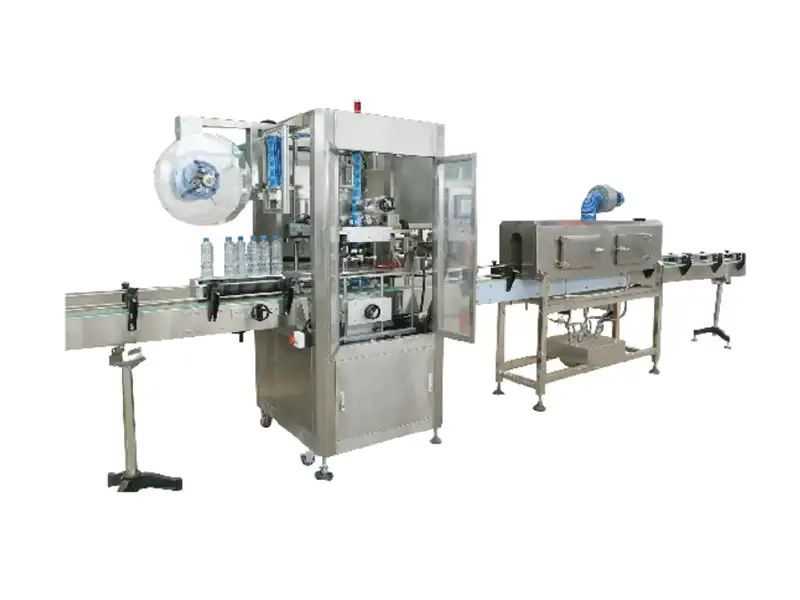
What Is a Linear Bottle Labeling Machine?
A linear bottle labeling machine uses a conveyor to move bottles through labeling stations in a straight line. The bottle may pass through spacing wheels, guide rails, pressing belts, wrap belts, or side stabilizers before the label is applied.
This structure is common in beverage, cosmetics, food, chemical, and daily care packaging lines. It is often used for round bottle wrap-around labeling, front-and-back labeling, side labeling, and flat surface labeling.
Linear machines are valued because they are simple to understand and easy to adjust. Operators can usually change guide rails, sensors, label heads, and pressing positions without replacing many mechanical parts.
For factories with many bottle sizes, this flexibility is important. A company may label 250 ml, 500 ml, and 1 L bottles on the same line with different adjustments.
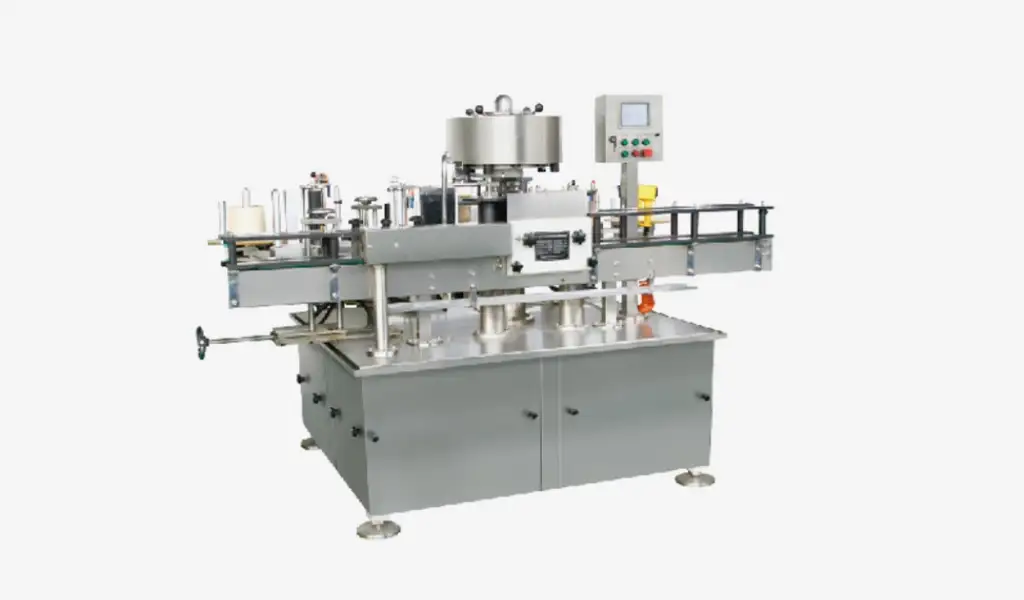
What Is a Rotary Bottle Labeling Machine?
A rotary bottle labeling machine uses a rotating carousel to hold and move bottles through labeling positions. Bottles are transferred into the turret by an infeed screw or star wheel, then controlled during label dispensing, pressing, and discharge.
This structure is designed for high-speed and stable labeling. Because bottles are positively controlled during rotation, the machine can keep better spacing and repeatable label placement at higher speeds.
Rotary labelers are commonly used in beverage, pharmaceutical, personal care, and high-volume food production. They are suitable when the bottle shape, label size, and production format stay consistent for long runs.
Manufacturer-published data shows that rotary labeling machines may range from around 120 bottles per minute to 500+ containers per minute, depending on model, bottle size, label dimensions, and product characteristics. Some high-speed systems are advertised with even higher capacities under suitable conditions.
Capacity and Output Data
| Machine Type | Typical Practical Range | Hourly Output Estimate | Suitable Production Scale |
| Entry linear labeler | 20–60 bottles/min | 1,200–3,600 bottles/hour | Small batch, multi-SKU |
| Standard linear labeler | 60–120 bottles/min | 3,600–7,200 bottles/hour | Medium production |
| High-speed linear labeler | 120–200 bottles/min | 7,200–12,000 bottles/hour | Stable medium-to-high output |
| Standard rotary labeler | 120–300 bottles/min | 7,200–18,000 bottles/hour | High-volume line |
| High-speed rotary labeler | 300–500+ bottles/min | 18,000–30,000+ bottles/hour | Large continuous production |
The data above is a practical reference, not a fixed guarantee. Actual speed depends on bottle diameter, label length, label material, feeding stability, sensor response, coding system, and downstream equipment.
Some automatic bottle labeling machines are published with speed ranges around 60–200 labels per minute, while high-speed rotary sticker labeling systems may reach 120–500+ containers per minute depending on configuration.
Labeling Accuracy
Labeling accuracy depends on mechanical control, bottle stability, sensor quality, label tension, and servo control. Linear machines can achieve accurate labeling at moderate speeds, especially when the bottle is well guided.
Rotary machines usually perform better when speed increases. The bottle is held by a turret, plate, star wheel, or centering system, which reduces movement during label application.
For round bottles, both systems can apply wrap-around labels effectively. For square or oval bottles, the machine must control bottle orientation before labeling.
If the label must align with a logo, cap, handle, embossing, or bottle seam, rotary systems may offer better repeatability in high-speed production. However, a well-designed linear machine can still be suitable when speed is moderate.
Bottle Shape Compatibility
Linear labeling machines are often more flexible for different containers. They can handle round bottles, flat bottles, square bottles, oval bottles, jars, tubes, and small containers with suitable fixtures.
Rotary machines can also support different shapes, but each bottle format may require dedicated change parts. These may include star wheels, bottle plates, screws, guides, and positioning components.
If your factory changes bottle formats every day, a linear machine is usually easier to manage. If your factory runs the same bottle for long periods, rotary labeling becomes more efficient.
Label Type Compatibility
Both linear and rotary machines can support different label types, depending on machine design. Common applications include:
- Full wrap-around labels for round bottles
- Front and back labels for flat or oval bottles
- Single-side labels for square bottles or jars
- Top labels for caps, lids, or flat containers
- Neck labels or tamper-evident labels
- Transparent labels for cosmetics or beverages
- Self-adhesive paper, film, PP, PET, or BOPP labels
A rotary system is often selected when the label needs to be applied at high speed with strong repeatability. A linear system is often selected when the buyer needs more flexibility and lower investment.
Changeover Time
Changeover requirements often differ between linear and rotary systems. A linear bottle labeling machine usually needs rail adjustment, sensor adjustment, label head positioning, and belt positioning.
A rotary bottle labeling machine may need mechanical change parts when switching bottle size or shape. This can increase downtime if the production line handles many SKUs.
For contract packers and private label manufacturers, quick changeover matters. They may process different bottle sizes, label designs, and product categories in one week.
For large beverage plants, changeover time may be less important than continuous high-speed output. In that case, rotary labeling may offer better total efficiency.
Cost Difference
A linear labeling machine usually has a lower purchase cost. It also has simpler mechanical structure, easier maintenance access, and fewer specialized change parts.
A rotary labeler needs a higher upfront cost. It often uses more servo controls, star wheel systems, bottle plates, safety guarding, and synchronized transfer systems.
Machine selection should consider more than price. Buyers should compare cost per bottle, labor saving, downtime, defect rate, spare parts, and future capacity demand.
Low-cost machines can raise costs by restricting output. A high-speed machine may also be unnecessary if the filling line cannot supply enough bottles.
Production Line Matching
A labeling machine should match the whole bottling line. If the filler produces 80 bottles per minute, a 500-bottle-per-minute rotary labeler may not improve real output.
For a smooth line, the labeling machine should match the speed of filling, capping, coding, inspection, cartoning, and packing. Buffer conveyors may also be needed to avoid line stoppage.
A linear labeler fits well in compact or medium-speed lines. A rotary labeler is better when the entire line is designed for high-speed continuous production.
Selection Guide by Application
| Application | Better Choice | Reason |
| Startup beverage brand | Linear | Lower cost and flexible setup |
| Cosmetics with many bottle shapes | Linear | Easier adjustment for different SKUs |
| Pharmaceutical vial production | Rotary | High-speed and repeatable positioning |
| Large water bottling plant | Rotary | Better for continuous high-volume output |
| Sauce or condiment factory | Linear or rotary | Depends on bottle shape and output |
| Contract packaging line | Linear | Faster format changes |
| Single-SKU beverage line | Rotary | High efficiency for long runs |
| Small batch chemical bottles | Linear | Practical and cost-effective |
When to Choose a Linear Bottle Labeling Machine
Choose a linear bottle labeling machine if your production volume is small to medium. It is also a good choice when your factory handles many bottle sizes, product categories, or label styles.
A linear system is easier for operators to learn. It also gives buyers more flexibility when product designs change frequently.
This machine is suitable for bottled water, juice, cosmetics, shampoo, lotion, sauce, oil, medicine bottles, chemical bottles, and household products.
It is especially useful when you need a practical automatic labeling solution without building a very high-speed production line.
When to Choose a Rotary Bottle Labeling Machine
Choose a rotary bottle labeling machine when output speed is the main priority. It is suitable for factories that run large batches with stable bottle formats.
A rotary labeler can reduce handling instability at high speed. It also helps maintain label consistency when the line runs for many hours each day.
This system is commonly used in beverage, pharmaceutical, dairy, personal care, and large food packaging plants.
If your line requires over 150–200 bottles per minute for long production runs, rotary labeling should be considered seriously. Published supplier data shows rotary systems are commonly promoted for high-speed operation, including 120 bottles per minute models and 120–500+ containers per minute configurations.
Common Buying Mistakes
Many buyers choose a labeling machine only by speed. This can lead to poor matching with the real production line.
Another mistake is ignoring bottle quality. If bottles are unstable, soft, irregular, or inconsistent in diameter, labeling defects may still happen even with a good machine.
Some buyers also forget to test real labels. Label thickness, adhesive strength, backing paper quality, and roll tension can affect labeling results.
Before purchasing, buyers should send real bottles, caps, filled samples, labels, and production speed requirements to the machine supplier. Video testing or sample testing is very helpful before confirming the order.
Key Data to Confirm Before Buying
| Data to Confirm | Why It Matters |
| Bottle size range | Affects guides, belts, star wheels, and change parts |
| Bottle shape | Determines orientation and pressing method |
| Label size | Affects dispensing speed and label head selection |
| Label material | Influences peeling, adhesion, and wrinkle risk |
| Required speed | Determines linear or rotary structure |
| SKU quantity | Affects changeover requirements |
| Filling line speed | Prevents overbuying or bottleneck issues |
| Coding requirement | Checks printer and label synchronization |
| Factory layout | Confirms conveyor direction and machine footprint |
| Future expansion | Avoids replacing the machine too early |
For most small and medium bottling lines, a linear labeler is the safer and more flexible choice. For large factories with stable bottle formats and high daily output, a rotary labeler can deliver better long-term efficiency.