
For buyers planning a new bottling project, the first question is simple: Is the product carbonated or non-carbonated? If the drink contains dissolved CO₂, such as sparkling water, soda, beer, cider, or kombucha, isobaric filling is usually the safer choice. If the product is still water, juice, tea, vinegar, or another free-flowing non-carbonated liquid, gravity filling can often provide a simpler and more cost-effective solution.
The difference comes from pressure. Carbonated drinks need pressure control because CO₂ escapes when pressure drops or temperature rises. Non-carbonated drinks do not have this problem, so they can flow into bottles under their own weight with fewer control requirements.
What Is Isobaric Filling?
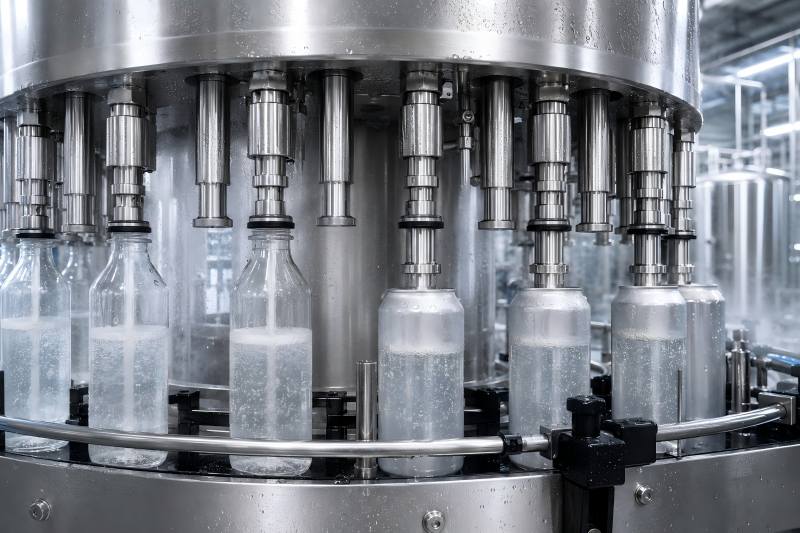
Isobaric filling is commonly known as counter-pressure filling in beverage production. The basic idea is to keep the pressure inside the bottle or can close to the pressure inside the filling tank during the filling process.
The container is sealed and CO₂-pressurized before filling. Then the beverage enters the container under controlled pressure. The pressure balance helps keep dissolved CO₂ inside the drink instead of letting it escape as foam. Counter-pressure filling normally uses chilled product and stable CO₂ pressure to reduce foaming during filling.
According to beverage carbonation guidance from the University of Florida IFAS Extension, the most important factors affecting carbonation level are CO₂ pressure and temperature. Lower temperatures and higher pressure help more CO₂ stay dissolved in the beverage.
In real production, isobaric filling is common for:
- Sparkling water
- Carbonated soft drinks
- Beer
- Hard cider
- Kombucha
- Sparkling wine
- Carbonated juice drinks
- RTD cocktails with carbonation
The main goal is not only to fill the container. It is to fill it while protecting carbonation, reducing foam, limiting oxygen pickup, and preparing the product for immediate sealing.
What Is Gravity Filling?
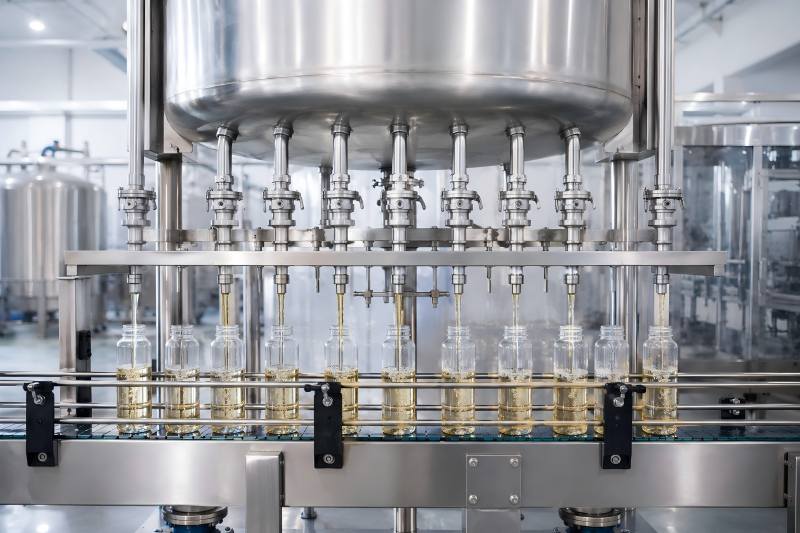
Gravity filling uses the natural flow of liquid from a higher tank into containers below. The product flows through filling valves because of gravity, not because of carbonation pressure.
This method is usually used for thin, free-flowing, non-carbonated liquids. Non-carbonated beverages such as water, juice, milk, tea, and similar products do not need the same pressure control as carbonated drinks. Gravity fillers are often suitable for low-viscosity liquids because these products flow easily and are less likely to foam during filling.
Gravity filling is common for:
- Still water
- Non-carbonated juice
- Tea drinks
- Vinegar
- Wine without carbonation
- Light edible oils
- Some liquid seasonings
- Low-viscosity cleaning liquids
For many small and medium beverage plants, gravity filling is attractive because the structure is simpler. It usually has fewer pressure-related parts, fewer CO₂ control requirements, and easier daily operation.
Key Difference Between Isobaric Filling and Gravity Filling
| Comparison Point | Isobaric Filling | Gravity Filling |
| Main purpose | Fill carbonated drinks while preserving CO₂ | Fill non-carbonated liquids simply and efficiently |
| Pressure control | Required | Usually not required |
| Best product type | Sparkling water, soda, beer, cider, kombucha | Still water, juice, tea, vinegar, wine |
| Foam control | Stronger control through pressure balance | Limited foam control |
| Equipment complexity | Higher | Lower |
| Typical line cost | Higher | Lower |
| Operator skill requirement | Higher | Lower |
| Filling environment | Sealed and pressurized | Open or semi-open flow system |
| Main risk | Pressure instability, foam, CO₂ loss | Dripping, inaccurate level, slow flow for thicker liquids |
| Best buyer scenario | Carbonated beverage production line | Still beverage or simple liquid filling line |
Carbonation Data Buyers Should Understand
Carbonation is often measured in “volumes of CO₂.” One volume means one volume of CO₂ gas dissolved in one equal volume of liquid under standard conditions. The University of Florida guide notes that 1 vol/vol is approximately equal to 1.96 g/L of CO₂.
This number matters because higher carbonation creates more pressure inside the container and increases the risk of foaming during filling.
| Beverage Type | Typical CO₂ Volume Range | Filling Implication |
| British ales | 1.5–2.2 volumes | Lower carbonation, but pressure control is still useful |
| Typical lager beer | 2.4–2.6 volumes | Stable counter-pressure filling is recommended |
| Club soda and tonic water | 2.5–3.5 volumes | Strong foam control is important |
| Many soft drinks | 3–3.5 volumes | Isobaric filling is usually required |
| High-carbonated soda | 3.5–4 volumes | More sensitive to temperature and pressure changes |
| Champagne | 4.6–6 volumes | Requires strict pressure-rated packaging and process control |
Most soft drinks are around 3–3.5 volumes of CO₂, while many craft and lager-style beers are around 2.4–2.6 volumes. Champagne can reach much higher levels, around 4.6–6 volumes.
These figures explain why carbonated drinks cannot be handled like still water. When a carbonated drink enters an unpressurized bottle too quickly, the pressure drops, CO₂ escapes, and foam rises. Foam is not just a visual issue. It can cause underfilling, product loss, sticky bottles, unstable capping, and lower carbonation in the final product.

Why Isobaric Filling Works Better for Carbonated Drinks
It Reduces CO₂ Loss
The main advantage of isobaric filling is carbonation protection. The bottle or can is pressurized before product flow begins. Balanced tank and container pressure allows the beverage to flow with less turbulence.
This pressure balance reduces the sudden release of CO₂. Less CO₂ release means less foam, better fill accuracy, and a more stable drinking experience after the product reaches the customer.
This matters greatly for sparkling water producers. Consumers often judge the product by the strength and freshness of the bubbles. If the filling process allows too much gas to escape, the drink may taste flat even when the formula is correct.
It Helps Control Foam
Foam control is critical in carbonated beverage filling. A little foam can help push oxygen out of the headspace in some products, but too much foam creates production problems.
Foam may cause:
- Product overflow
- Inaccurate fill levels
- Wet bottle necks
- Poor cap sealing
- More frequent machine cleaning
- Higher product waste
- Lower actual carbonation after sealing
Isobaric filling controls foam by keeping pressure stable and reducing turbulence. The process often works together with product chilling, smooth valve design, and quick capping.
It Supports Better Shelf Quality
For beer, cider, kombucha, and sparkling wine, oxygen pickup can damage flavor and shelf life. Counter-pressure filling can include pre-evacuation or CO₂ purging before filling. This helps reduce air inside the bottle before product enters. Some counter-pressure filling processes use vacuum or repeated air removal before filling, especially for products where oxidation is a major issue.
This matters for buyers selling through supermarkets, distributors, or export channels. A beverage may leave the factory with good taste, but poor oxygen control can cause flavor changes during storage and shipping.
Why Gravity Filling Works Better for Still Drinks
It Has a Simpler Structure
Gravity filling is mechanically easier than isobaric filling. Liquid enters containers through valves from the tank. Because the product is not carbonated, there is no need to equalize pressure with CO₂ before filling.
This makes the machine easier to operate, clean, and maintain. For many still beverage producers, that simplicity is a major advantage.
It Can Be Cost-Effective for Small and Medium Plants
Gravity filling equipment can fit many production stages, from small manual systems to automatic rotary lines. Small gravity fillers may produce several hundred to over one thousand bottles per hour, depending on bottle size, nozzle number, operator speed, and setup. For example, one 3-nozzle gravity filler is listed at 630+ bottles per hour, while a 4-nozzle version is listed at 850+ bottles per hour.
Some compact or semi-automatic liquid fillers can reach higher small-scale outputs. Accutek lists a six-head timed-flow filler where an experienced operator can fill up to 2,500 bottles per hour, depending on application conditions.
For startups producing still water, juice, tea, or vinegar, this lower entry cost can be important. They may not need the pressure system, CO₂ supply, and more complex valve arrangement used in carbonated beverage lines.
It Is Suitable for Free-Flowing Liquids
Gravity filling performs best when the product flows easily. Still water, clear juice, tea, and vinegar are good examples.
If the product is too thick, contains pulp, or has suspended particles, gravity filling may become slower or less accurate. In that case, buyers may need piston filling, volumetric filling, pump filling, or flowmeter filling instead.
Production Speed Comparison
Production speed depends on bottle size, number of filling valves, product viscosity, container material, automation level, and upstream/downstream equipment. A filling machine cannot run faster than the bottle feeding, capping, labeling, and packaging sections allow.
| Production Level | Gravity Filling Reference | Isobaric Filling Reference |
| Small manual or semi-auto line | Around 425–1,200+ bottles/hour for small gravity fillers | Small counter-pressure fillers vary widely by nozzle count and container type |
| Compact automatic line | Around 2,000–5,000 bottles/hour depending on design | Often used for craft beer, soda, kombucha, and sparkling water |
| Medium beverage line | 6,000–18,000+ bottles/hour | Common for regional carbonated beverage plants |
| High-speed industrial line | High-speed still beverage fillers can exceed 90,000 bottles/hour in advanced PET systems | Advanced fillers for still and carbonated drinks can reach very high industrial outputs |
Sidel states that its EvoFILL PET for water and still beverages can reach outputs of over 90,000 bottles per hour. Sidel also reports that its Matrix Filler SF300 FM can fill still and carbonated drinks at up to 80,000 bottles per hour with up to 98% efficiency.
These figures show an important point: the filling method alone does not define speed. Machine design, valve number, filling technology, container handling, and line integration all matter.
Product Quality Comparison
Isobaric filling is stronger when the product quality depends on carbonation retention. It helps maintain bubble strength, reduce foam, and protect the expected mouthfeel of the drink.
Gravity filling is stronger when the product is simple, still, and free-flowing. It avoids unnecessary complexity and gives buyers a practical way to produce stable non-carbonated beverages.
| Quality Factor | Isobaric Filling | Gravity Filling |
| Carbonation retention | Excellent | Poor for carbonated products |
| Foam control | Strong | Weak for carbonated products |
| Fill level consistency | Good when pressure is stable | Good for thin still liquids |
| Oxygen control | Better when CO₂ purge or vacuum is included | Basic unless extra nitrogen or vacuum systems are added |
| Product waste | Low when well adjusted | Low for still liquids, high risk if used for carbonated drinks |
| Taste stability | Better for sparkling and sensitive drinks | Suitable for still beverages |
Cost and Maintenance Differences
Isobaric filling machines cost more because they need pressure-resistant tanks, special filling valves, CO₂ systems, pressure sensors, snifting control, sealing components, and stronger process control.
Maintenance also requires more attention. Operators need to monitor pressure stability, gasket condition, valve sealing, CO₂ lines, product temperature, and cleaning procedures. A small leak or unstable pressure setting can directly affect foam and fill level.
Gravity filling is easier to maintain. Common maintenance points include filling valve cleaning, tank sanitation, nozzle adjustment, seal inspection, and drip control. Because there is no carbonation pressure to manage, troubleshooting is usually faster.
For buyers comparing investment, the decision should not focus only on machine price. A cheaper gravity filler may become expensive if it causes foam, product loss, and flat drinks. A more expensive isobaric filler may be unnecessary if the product is still water or tea.
Which Filling Method Should Buyers Choose?
Choose isobaric filling if the product contains carbonation. This includes sparkling water, soda, beer, cider, kombucha, and carbonated cocktails. The machine should be selected based on target CO₂ level, bottle or can type, filling temperature, expected speed, capping method, and hygiene requirements.
Choose gravity filling if the product is non-carbonated, thin, and easy to flow. It is a practical option for still water, tea, clear juice, vinegar, and similar products. Buyers should check viscosity, bottle shape, fill volume accuracy, cleaning method, and future production capacity.
For mixed product factories, the choice can be more complex. Some advanced filling systems can handle both still and carbonated beverages, but the line layout, valve design, cleaning program, and changeover time must be confirmed before purchase. Sidel notes that some filling solutions support both still and carbonated drinks, while different machine models are designed for different beverage categories and filling needs.
Practical Buying Checklist
Before selecting a filling machine, buyers should prepare real production details instead of only asking for a machine quotation.
Useful information includes:
- Product type
- Carbonated or non-carbonated
- Target CO₂ volume
- Filling temperature
- Bottle or can material
- Container size
- Required bottles per hour
- Product viscosity
- Foam sensitivity
- Hot fill, cold fill, or ambient fill
- Capping method
- Cleaning and sanitation requirements
- Budget range
- Future product expansion plan
For carbonated beverages, the supplier should confirm pressure range, CO₂ purging method, snifting process, filling valve design, and capper synchronization. For non-carbonated beverages, the supplier should confirm flow speed, filling accuracy, drip control, valve material, and whether gravity filling is enough for the product viscosity.