
Maintaining an automatic bottle labeling machine is not only about repairing problems after they happen. It is about preventing unstable labeling, reducing downtime, and keeping the whole packaging line efficient.
Daily cleaning, weekly inspection, monthly lubrication, sensor care, label material control, and operator training all work together. Small actions such as cleaning the dispensing plate, tightening guide rails, checking belt tension, and recalibrating sensors can make a big difference in labeling quality.
Why Regular Maintenance Matters
An automatic bottle labeling machine works through several coordinated actions. Bottles are transported by a conveyor, separated by a spacing device, detected by sensors, and then labeled by a label dispensing system. Labels are firmly smoothed onto the bottle using brushes, rollers, or sponge belts.
For example, a dirty sensor may fail to detect bottles accurately. A worn label roller may cause label deviation. A loose conveyor belt may change bottle speed and create unstable label placement.
Good maintenance brings several benefits:
- More stable labeling accuracy
- Fewer label wrinkles and bubbles
- Lower downtime during production
- Longer service life of belts, rollers, motors, and sensors
- Less label waste and material loss
- Better barcode and batch code readability
- Safer operation for workers
Many labeling issues come from minor production line faults. They are often caused by small issues that could be prevented through routine inspection.
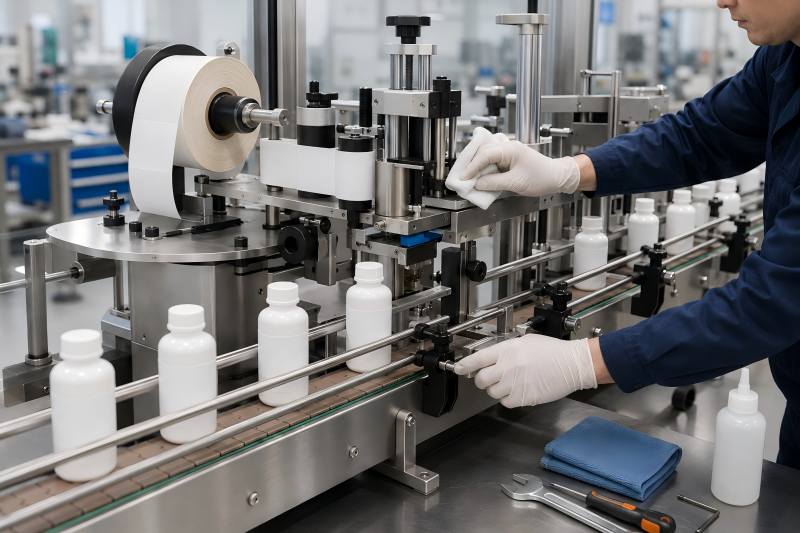
Main Parts That Need Maintenance
Understand the machine’s key parts before planning maintenance.
| Machine Part | Main Function | Common Maintenance Focus |
| Conveyor belt | Moves bottles through the labeling station | Clean surface, check tension, inspect wear |
| Bottle separator | Keeps bottles at the correct distance | Check timing, clean wheels or screws |
| Label roll holder | Holds the label roll | Check roll position and tension |
| Label dispensing plate | Separates the label from backing paper | Remove adhesive residue, check edge condition |
| Label sensor | Detects label gap or mark | Clean lens, adjust sensitivity |
| Bottle sensor | Detects bottle arrival | Clean lens, check position |
| Pressing roller or brush | Presses label onto bottle | Clean adhesive, check pressure |
| Drive motor and belt | Controls movement | Check noise, vibration, and belt tension |
| Control panel | Sets speed, delay, and label length | Keep dry, check settings |
| Emergency stop and guards | Protect operator safety | Test regularly |
A good maintenance routine should cover both visible mechanical parts and less visible electrical components.
Daily Maintenance Before Production
Daily maintenance does not need to be complicated. A 10–15 minute inspection before production can prevent many labeling problems.
First, check whether the machine surface is clean. Dust, product residue, oil, or adhesive may affect bottle movement and label application. Use a soft cloth to clean the conveyor, guide rails, label dispensing plate, and pressing rollers.
Second, check the label roll. The label roll should be installed in the correct direction and centered on the roll holder. If the label roll is loose, tilted, or installed incorrectly, the label may shift during operation.
Third, inspect the label path. The backing paper should pass through each roller smoothly. Make sure there is no twisting, folding, or abnormal tension.
Fourth, check the bottle path. Guide rails should match the bottle size. If the guide rails are too tight, bottles may get stuck. If they are too loose, bottles may shake during labeling.
Finally, run the machine at low speed for a short test. Check that bottles run smoothly and labels stay correctly positioned.
Daily Cleaning After Production
Cleaning after production is just as important as inspection before production. Adhesive residue can build up on rollers, brushes, and the dispensing plate. If it is not removed, it may cause label dragging, poor peeling, or label sticking.
After shutting down the machine, remove unused labels and backing paper from the label path. Wipe the label dispensing plate carefully because this area often collects adhesive. Clean the conveyor belt, bottle guide rails, pressing roller, and sponge belt.
Keep water away from electrical parts during cleaning. For food, beverage, and pharmaceutical production, cleaning methods should also match hygiene requirements. If alcohol or cleaning solvent is used, make sure it is compatible with machine materials and label adhesive.
Weekly Maintenance Checklist
Weekly maintenance should focus on parts that gradually loosen or wear during operation.
| Maintenance Item | Suggested Frequency | Reference Standard |
| Clean label sensor and bottle sensor | Daily or weekly | No dust, oil, or label residue on lens |
| Check conveyor belt tension | Weekly | Belt moves smoothly without slipping |
| Inspect pressing roller pressure | Weekly | Label surface is flat without wrinkles |
| Check label roll tension | Weekly | Label feeds smoothly without sudden pulling |
| Tighten visible screws and knobs | Weekly | No loose guide rails or brackets |
| Test emergency stop button | Weekly | Machine stops immediately |
| Inspect air pressure if pneumatic parts are used | Weekly | Usually 0.4–0.6 MPa, depending on machine design |
| Check label accuracy | Weekly | Typical deviation within ±1 mm to ±2 mm for stable bottles |
These values are general references. The actual standard may vary depending on machine type, bottle shape, label material, and production speed.
Monthly Maintenance Tasks
Monthly maintenance requires a more thorough inspection. It should include mechanical inspection, electrical inspection, lubrication, and performance testing.
Check all belts, chains, gears, rollers, and bearings. Look for wear, cracks, abnormal noise, or vibration. If a belt is loose or damaged, replace it before it breaks during production.
Inspect the motor and drive system. Listen for unusual sound during operation. A motor that becomes too hot, shakes heavily, or produces abnormal noise should be checked immediately.
Review the control panel settings. Some labeling problems come from incorrect parameter changes. Record common settings for each bottle size and label size, such as conveyor speed, label delay, label length, and sensor sensitivity. This makes future changeover faster and reduces operator errors.
Also check the machine frame and guards. The machine should stand firmly without shaking. Safety guards should be complete and correctly installed.
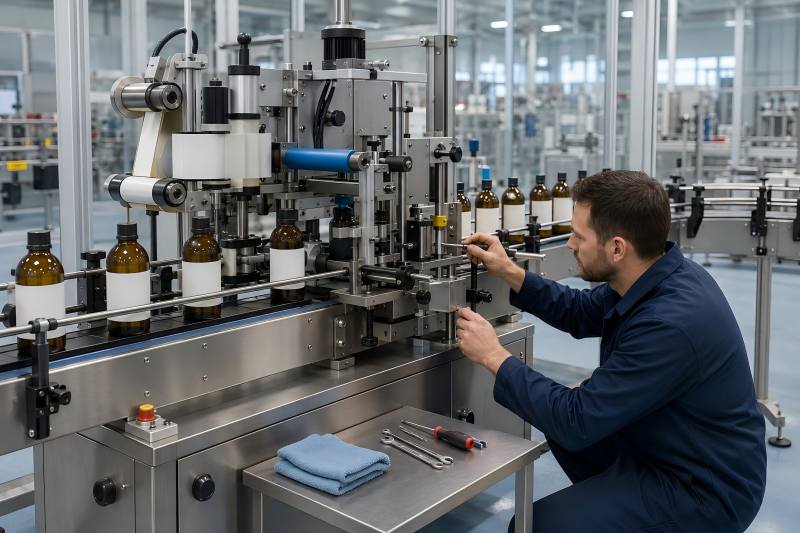
Lubrication and Moving Parts
Many automatic bottle labeling machines include moving parts such as bearings, shafts, chains, adjustment screws, and guide rail sliders. Proper lubrication helps minimize friction and component wear.
Lubrication must be applied with care. Too much oil may attract dust or contaminate bottles and labels. In food and pharmaceutical production, only suitable lubricants should be used according to plant requirements.
A basic lubrication plan may include:
| Part | Maintenance Method | Typical Interval |
| Bearings | Add suitable grease if required | Every 1–3 months |
| Chains | Apply a small amount of chain lubricant | Monthly |
| Adjustment screws | Clean and lightly lubricate | Monthly |
| Guide rail sliders | Clean dust and apply light lubricant | Monthly |
| Gear transmission parts | Inspect and lubricate if required | Every 3–6 months |
Some modern labeling machines use low-maintenance bearings or enclosed drive systems. Always follow the machine manual for exact lubrication points.
Sensor Maintenance and Adjustment
Sensors are very important for automatic labeling accuracy. A bottle sensor detects when the bottle reaches the labeling position. A label sensor detects the label gap, transparent label edge, or color mark.
If the sensor is dirty or misaligned, labels may be dispensed too early, too late, or not at all. Transparent labels are especially sensitive because they may require special ultrasonic or photoelectric sensors.
For proper sensor maintenance:
- Avoid scratching the sensor surface
- Check whether the sensor bracket is loose
- Ensure the sensor targets the correct detection area.
- Recalibrate the sensor after changing label material
- Adjust sensitivity when switching from paper labels to transparent labels
If label detection becomes unstable, do not immediately increase machine speed. First check sensor cleanliness, label gap consistency, and backing paper quality.
Label Roll and Material Handling
Label material quality has a strong effect on machine performance. Poor labels can still cause issues on a well-maintained machine.
Store labels dry to protect adhesive performance. Heat may cause labels to curl or become difficult to peel. Dust on label rolls may contaminate rollers and sensors.
Before loading a label roll, check whether the roll edge is flat. A damaged or uneven roll may cause label feeding deviation. Also check label spacing. If the gap between labels is inconsistent, the sensor may not detect each label correctly.
For high-speed labeling, label roll tension should be stable. Sudden tension changes can cause label stretching, skewing, or broken backing paper.
Maintenance for Different Labeling Machine Types
Different automatic bottle labeling machines require slightly different maintenance focus.
A round bottle labeling machine needs special attention to bottle rotation rollers, wrap-around belts, and guide wheels. If these parts are dirty or uneven, the label may not wrap smoothly around the bottle.
A double-sided labeling machine needs careful alignment of left and right labeling heads. If both sides are not synchronized, front and back labels may appear uneven.
A top labeling machine requires a flat product surface and stable conveyor support. The pressing device should be checked often to avoid bubbles.
A shrink sleeve labeling machine has additional parts such as sleeve cutting units and heat shrink tunnels. These parts require more attention to blade condition, heat distribution, and steam or hot air systems.
Common Problems and Maintenance Solutions
Many labeling issues can be solved through maintenance instead of major repair.
If labels are skewed, check bottle guide rails, label roll alignment, and conveyor speed. If labels have wrinkles, inspect pressing roller pressure and bottle surface cleanliness. If labels do not peel well, clean the dispensing plate and check label tension. If labels are missing, clean and adjust the bottle sensor or label sensor.
When troubleshooting, change only one factor at a time. Changing multiple settings at once makes fault tracing harder.
| Problem | Possible Cause | Maintenance Solution |
| Label skewing | Guide rails loose, label roll not centered | Adjust guide rails and align label roll |
| Label wrinkles | Uneven pressure, bottle shaking | Adjust pressing roller and bottle guides |
| Label bubbles | Poor pressing, dusty bottle surface | Clean bottle surface and check sponge roller |
| Missing labels | Sensor dirty or misaligned | Clean and recalibrate sensor |
| Label not peeling | Adhesive residue on dispensing plate | Clean dispensing plate and check label tension |
| Broken backing paper | Too much tension or damaged label roll | Reduce tension and inspect label roll |
| Unstable speed | Belt slipping or motor issue | Check belt tension and drive system |
| Repeated label waste | Wrong parameters | Reset label length, delay, and sensor sensitivity |
Operator Training Is Part of Maintenance
A machine is only as reliable as the people who operate it. Many labeling problems happen after product changeover because operators forget to adjust guide rails, sensors, label roll position, or saved parameters.
Operators should know how to:
- Load label rolls correctly
- Adjust bottle guide rails
- Set labeling speed and delay
- Clean sensors and rollers
- Identify common labeling defects
- Stop the machine safely
- Report abnormal noise, smell, or vibration
Simple training can greatly reduce downtime. It is also useful to prepare a maintenance record sheet. Operators can record cleaning time, inspection results, replaced parts, and problems found during production.
Spare Parts Management
For factories that rely heavily on automatic labeling, spare parts should be prepared in advance. Waiting for small parts can stop the whole packaging line.
Common spare parts include sensors, belts, pressing rollers, sponge wheels, label peeling plates, bearings, fuses, switches, and emergency stop buttons. If the machine uses pneumatic parts, spare air tubes and fittings may also be useful.
The spare parts list should be based on machine model, production intensity, and supplier recommendation. High-wear parts should be checked more frequently and replaced before failure.
Maintenance Schedule Example
A clear schedule helps operators know what to do and when to do it.
Daily tasks should include cleaning, sensor inspection, label path check, bottle path check, and test running. Weekly tasks should include belt tension check, screw tightening, emergency stop testing, and label accuracy testing. Monthly tasks should include lubrication, electrical inspection, motor check, and full performance review. Every six months, the machine should receive a deeper inspection, especially if it runs for long shifts.
For high-speed production lines running more than 8 hours per day, maintenance frequency should be increased. For machines used occasionally, cleaning after each use is still necessary because adhesive residue may harden over time.
Safety During Maintenance
Safety should always come first. Before cleaning or replacing parts, turn off the machine and disconnect power if required. Do not put hands near moving belts, rollers, or cutting parts during operation.
Only trained workers should open the electrical cabinet. Wet cleaning should not be performed near electrical parts. If the machine has pneumatic systems, release air pressure before working on related components.
Regularly inspect emergency stops, guards, warnings, and safety switches. A labeling machine may look simple, but moving belts and rollers can still cause injury if safety rules are ignored.