
For beverage manufacturers, inaccurate filling can cause product loss, unstable bottle appearance, customer complaints, labeling issues, and higher production costs. In carbonated beverages, the challenge is even greater because the product contains dissolved CO₂. When pressure, temperature, flow speed, or container quality is not controlled properly, the drink may foam, lose carbonation, or produce inconsistent fill levels.
Understand What Filling Accuracy Means
In carbonated drink production, filling accuracy usually refers to how closely the actual filled volume or weight matches the target value. For example, a 500 ml bottle should be filled as close as possible to the required level, without underfilling or excessive overfilling.
Filling accuracy can be measured in different ways:
| Measurement Method | What It Checks | Common Use |
| Fill level inspection | Whether the liquid reaches the correct height | PET bottles and glass bottles |
| Net weight checking | Whether the filled product weight is correct | Bottles, cans, and premium products |
| Volumetric control | Whether the machine dispenses a fixed volume | Small and medium filling lines |
| Mass flow control | Whether the product flow is measured by mass | High-accuracy automatic lines |
For carbonated drinks, the visible fill level may change if foam is present. A bottle may look full during filling but settle too low after foam collapses. This is why manufacturers should check both immediate fill appearance and settled fill level after a short stabilization period.
Keep Product Temperature Stable
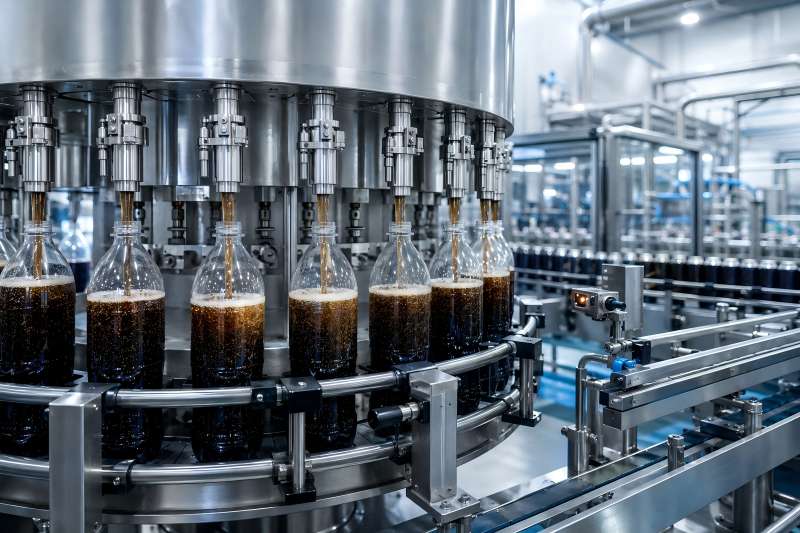
Temperature has a major influence on carbonation and foam behavior. When the beverage is too warm, CO₂ escapes more easily, which increases foam and reduces filling stability. A colder beverage usually holds CO₂ better and helps create smoother filling. The University of Florida IFAS guide on carbonating beverages explains that carbonation performance is affected by factors such as pressure, temperature, and the desired carbonation level.
To improve filling accuracy, the product temperature should remain stable before and during filling. Large temperature changes can cause different foam levels from one batch to another. In practical production, this means the beverage chiller, carbonation tank, buffer tank, and pipelines should be properly insulated and controlled.
Manufacturers should also avoid long product residence time in warm pipelines. If carbonated liquid sits too long before filling, it may absorb heat from the environment and become less stable. Shorter transfer distance, insulated pipes, and proper cooling capacity can help reduce this problem.
Control Carbonation Level Before Filling
Carbonation level directly affects filling behavior. Too much CO₂ can cause excessive foam, unstable flow, and inconsistent fill height. Too little CO₂ may reduce product quality, mouthfeel, and customer satisfaction. Research on bubbles and foam in carbonated beverages also shows that bubble and foam-related parameters are important for quality control and consumer perception.
The carbonation process should be controlled before the product enters the filler. Operators should monitor CO₂ level, pressure, temperature, and flow rate regularly. If the carbonation tank does not provide consistent CO₂ dissolution, the filling machine will be forced to handle unstable product conditions.
A good practice is to define a carbonation control range for each product. Cola, sparkling water, beer-style beverages, fruit soda, and energy drinks may have different foam behavior. Each beverage formula needs customized filling settings for stable and accurate production.
Use Proper Counter-Pressure Filling
Most carbonated drinks are filled by isobaric or counter-pressure filling. In this method, the bottle or can is pressurized before liquid enters. It helps balance pressure between the product tank and container. When pressure is balanced, CO₂ is less likely to escape suddenly, which helps reduce foam and improve filling accuracy.
A typical counter-pressure filling process includes:
- Container positioning
- Air evacuation or pre-purging
- CO₂ pressurization
- Liquid filling under pressure
- Pressure release or snifting
- Capping or seaming
If the counter-pressure setting is too low, the drink may foam heavily as it enters the container. If the pressure is too high or pressure release is too fast, the container may show unstable fill levels or product splash. Therefore, filling pressure, bowl pressure, snift timing, and valve opening speed should be adjusted carefully.
Optimize Filling Valve Performance
The filling valve is the core part of the filling system. Worn, dirty, or poorly adjusted filling valves can cause major filling errors. Common problems include uneven flow, delayed valve closing, dripping, air leakage, and inconsistent venting.
To improve filling accuracy, each filling valve should be inspected regularly. Keep valve seals, springs, flow paths, and vent tubes clean and well-maintained. Even one unstable valve can create repeated underfilled or overfilled containers in the same filling station.
For automatic filling lines, manufacturers can record fill-level defects by filling head number. If the same station frequently produces inaccurate fills, the problem is probably related to that valve rather than the whole machine.
| Problem Area | Possible Cause | Improvement Method |
| Excessive foam | Product too warm, low counter pressure, fast filling speed | Lower product temperature, adjust pressure, slow valve opening |
| Low fill level | Foam collapse, early valve closing, unstable product supply | Check valve timing, stabilize carbonation, inspect flow path |
| High fill level | Late valve closing, incorrect sensor setting | Calibrate sensors, inspect valve response |
| Uneven fills by station | Worn seals or blocked valve | Clean and rebuild affected filling valve |
| Product dripping | Damaged valve seal or poor closing | Replace seals and check valve alignment |
| CO₂ loss | Poor pressure balance or slow capping | Improve counter pressure and shorten cap application time |
Improve Container Quality and Consistency
Filling accuracy is not only controlled by the filler. Bottle and can quality also matters. PET bottles with inconsistent volume, poor neck finish, or unstable shape can affect fill level. Glass bottles with dimensional variation may also cause sealing or filling problems. Aluminum cans must be properly formed and handled to avoid dents or flange damage.
For PET bottles, manufacturers should control bottle blowing quality. Bottle weight, wall thickness, neck finish, and base stability should remain consistent. If bottle volume varies too much, the same filled volume may appear at different visual levels. This can create false fill-level rejection even when the actual net content is correct.
Before filling, containers should be clean, dry enough for inspection, and correctly positioned. Misaligned bottles may not seal properly against the filling valve, allowing pressure leakage and foam formation.
Reduce Oxygen and Air in the Container
Air trapped inside the container can disturb pressure balance and increase foaming. It may also affect product quality. In many carbonated drink lines, CO₂ flushing or pre-pressurization is used before filling. This helps remove air and create a more stable filling environment.
For sensitive beverages, oxygen control is especially important. Although soft drinks are generally less oxygen-sensitive than some alcoholic beverages, oxygen can still affect flavor stability, color, and shelf life in certain formulas. A stable purging process helps improve both product quality and filling consistency.
Maintain Stable Product Supply Pressure
The filling machine requires a stable product supply. If the product pump, buffer tank, or pipeline pressure changes frequently, the filler may produce inconsistent volumes. Sudden pressure changes can also increase turbulence and foam.
To improve supply stability, the production line should use proper pump selection, pressure control, and tank level control. Avoid allowing the buffer tank level to become too high or too low. A stable liquid level in the filling bowl or tank helps maintain consistent pressure at each filling valve.
Flow control should also be smooth. Sharp bends, undersized pipes, rough internal surfaces, and sudden diameter changes can create turbulence. Turbulence may release CO₂ before the product reaches the container.
Calibrate Measuring and Inspection Systems
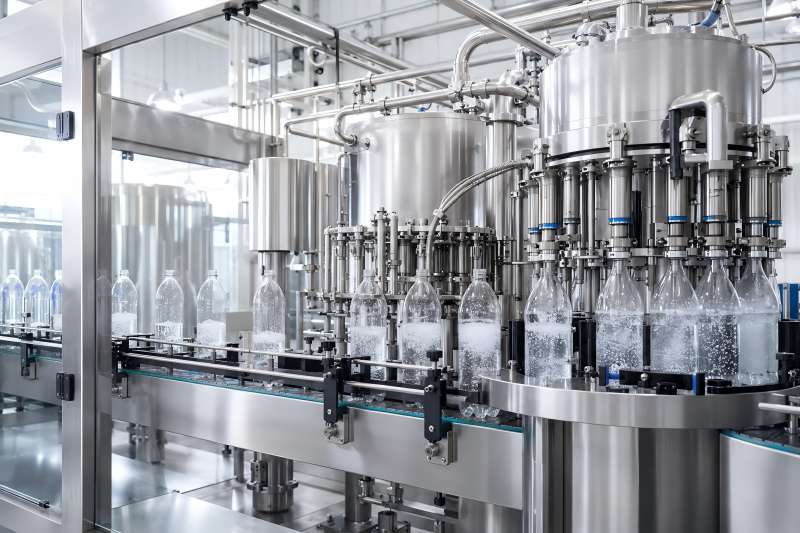
Accurate filling depends on accurate measurement. NIST Handbook 44 provides technical requirements related to weighing and measuring devices, emphasizing accuracy and repeatability in commercial measurement systems. For beverage plants, this principle is useful even when the filling line is not directly used for retail measurement at the machine level.
Regularly calibrate checkweighers, flowmeters, level sensors, pressure sensors, and temperature sensors. If the sensor reading is wrong, operators may make incorrect adjustments and create more variation.
A recommended calibration program should include:
| Device | Why It Matters | Suggested Control Action |
| Temperature sensor | Affects carbonation and foam control | Compare with a certified reference thermometer |
| Pressure gauge | Controls counter-pressure filling | Calibrate and inspect for drift |
| Flowmeter | Measures product flow accuracy | Verify with known volume or weight |
| Checkweigher | Confirms actual filled quantity | Test with certified weights |
| Fill-level detector | Rejects low or high fills | Test using sample bottles at known levels |
| CO₂ meter | Confirms carbonation consistency | Check according to supplier procedure |
Calibration records should be kept as part of the plant’s quality management system. These records help identify long-term drift and support troubleshooting when filling accuracy changes suddenly.
Adjust Filling Speed Carefully
Higher filling speed can increase output, but it may also increase foam and reduce accuracy if the product is unstable. The best filling speed is not always the highest possible speed. It should be the speed at which the machine can maintain stable fill volume, low foam, good cap sealing, and acceptable rejection rate.
For carbonated drinks, filling speed should be optimized together with product temperature, CO₂ volume, container size, and filling valve design. A small bottle may tolerate faster filling than a large bottle. A lightly carbonated drink may fill more easily than a highly carbonated soda. A sugar-free beverage may also behave differently from a high-sugar formula because viscosity and surface tension can influence foam behavior.
During line commissioning, engineers should test different speeds and record foam height, settled fill level, rejection rate, CO₂ loss, and product temperature. The final production speed should be based on data, not only on machine capacity.
Control Capping or Seaming Immediately After Filling
After filling, the container should be closed quickly and correctly. Delayed capping allows CO₂ to escape and foam to rise. Poor cap torque, damaged caps, incorrect crown application, or poor can seaming can also lead to carbonation loss after filling.
For bottled carbonated drinks, cap torque should be checked regularly. Incorrect torque can cause leakage, cap damage, or bottle neck deformation. For canned drinks, seam quality must be inspected according to the can supplier’s requirements.
A stable closing system helps maintain internal pressure and protects filling accuracy after the product leaves the filling station.
Improve Cleaning and Sanitation
Sticky syrup residue, pulp particles, mineral scale, and biofilm can change valve flow performance. Dirty vent tubes may cause poor pressure release. Blocked channels may produce slow or incomplete filling.
Carbonated drink plants should follow proper cleaning and sanitation procedures. The FDA states that carbonated soft drink manufacturers must follow Current Good Manufacturing Practices to support safety and sanitary production. Equipment parts that contact beverages should be cleaned according to a validated CIP or manual cleaning schedule.
After cleaning, the line should be checked before production starts. Operators should confirm that valves open and close correctly, sensors respond normally, and no cleaning solution remains in the system.
Use Data to Find the Root Cause
Modern filling lines can collect useful data from sensors, inspection systems, and rejection stations. Instead of only reacting to defects, manufacturers should analyze patterns.
For example:
- If defects appear across all filling heads, check product temperature, carbonation, tank pressure, or supply flow.
- If defects appear only on one filling head, inspect that valve.
- If low fills happen after machine restart, review start-up pressure and product stabilization.
- If high foam appears after product changeover, check cleaning residues or incorrect recipe settings.
- If defects increase during hot afternoons, check ambient heat influence and cooling capacity.
Data-based troubleshooting reduces guesswork and helps operators solve problems faster.
Train Operators on Carbonated Filling Behavior
Operator training is essential. Carbonated beverage filling is sensitive to small changes. Operators should understand why temperature, pressure, CO₂ level, valve timing, and capping speed matter.
Training should include:
- How to identify normal and abnormal foam
- How to read pressure and temperature trends
- How to perform fill-level checks
- How to respond to repeated low-fill alarms
- How to inspect caps, bottles, and valves
- How to record adjustments properly
When operators understand the process, they can prevent problems instead of only correcting them after many defective bottles have already been produced.
Build a Standard Filling Accuracy Control Plan
A practical control plan helps keep production stable. The plan should define target values, acceptable ranges, inspection frequency, responsible operators, and corrective actions.
Example control points include:
| Control Point | Inspection Frequency | Corrective Action |
| Product temperature | Start-up and regular intervals | Adjust chiller or reduce line hold time |
| CO₂ level | Each batch or scheduled checks | Adjust carbonation pressure and flow |
| Filling pressure | Continuous monitoring | Reset counter-pressure parameters |
| Fill level or weight | Regular sampling | Adjust valve timing or inspect filling heads |
| Cap torque or seam quality | Scheduled quality checks | Adjust capper or seamer |
| Rejection rate | Continuous monitoring | Identify station-specific or line-wide cause |
| Valve condition | Preventive maintenance schedule | Clean, rebuild, or replace worn parts |
Improving filling accuracy in carbonated drink production requires a complete process approach. The filling machine is important, but it cannot work well if the product temperature is unstable, carbonation is inconsistent, bottles vary too much, valves are worn, or measurement systems are not calibrated.
The most effective improvements usually come from controlling product temperature, stabilizing carbonation, using proper counter-pressure filling, maintaining filling valves, improving container consistency, calibrating inspection systems, and training operators. Manufacturers should also use production data to identify whether filling errors are caused by one filling head, the whole machine, or upstream beverage preparation.