
Choosing the right label type for bottled products requires more than selecting a material or design. The label must match the bottle shape, bottle material, product environment, labeling machine, production speed, and brand appearance.
Self-adhesive labels are flexible and widely used, shrink sleeves offer full-body visual impact, wrap-around labels suit high-speed round bottles, wet glue labels work well for some glass bottles, and waterproof film labels are better for wet or oily conditions.
Common Label Types for Bottled Products
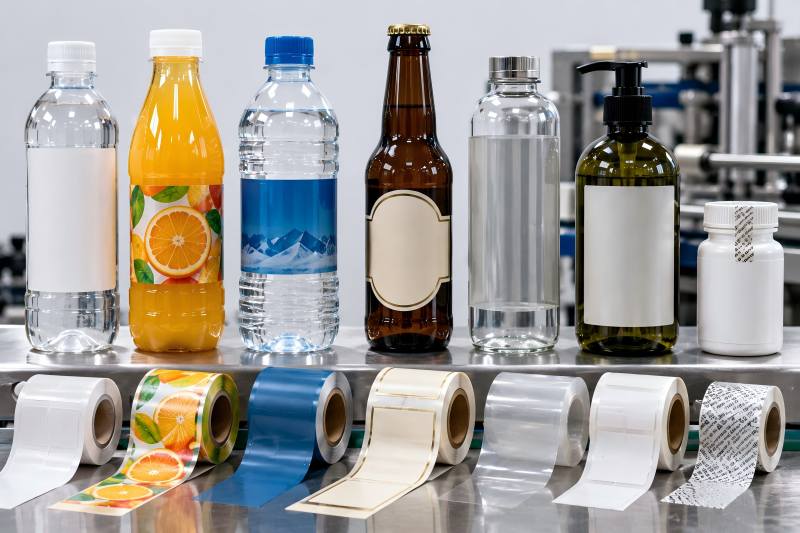
Different label types are suitable for different bottle materials, shapes, and production goals. The table below gives a quick comparison.
| Label Type | Main Feature | Suitable Bottles | Common Products | Buyer Focus |
| Self-adhesive label | Easy to apply, flexible use | Round, flat, square, oval bottles | Cosmetics, food, medicine, chemicals | Adhesive strength and label accuracy |
| Shrink sleeve label | Covers large bottle area | Curved, irregular, tapered bottles | Beverages, dairy, personal care | Shrink quality and heat control |
| Wrap-around label | Covers bottle circumference | Round bottles | Water, juice, soft drinks | Label length and overlap control |
| Wet glue label | Lower label material cost | Glass and round bottles | Beer, sauce, canned drinks | Glue amount and drying stability |
| Transparent label | Clean “no-label” look | Clear glass or PET bottles | Cosmetics, beverages, skincare | Sensor detection and bubble control |
| Waterproof film label | Resists moisture and oil | Plastic, glass, metal bottles | Drinks, shampoo, chemical bottles | Durability and surface adhesion |
| Tamper-evident label | Shows opening or damage | Caps, necks, medicine bottles | Pharma, food, health products | Security and position accuracy |

Start with Bottle Shape
Bottle shape is the first factor when choosing a label type. A label that works well on a round bottle may not work well on an oval, tapered, or irregular bottle.
Round bottles are the easiest to label because the bottle can rotate smoothly during application. Self-adhesive labels, wrap-around labels, and wet glue labels are all common choices.
Flat and square bottles usually need front labels, back labels, or side labels. Self-adhesive labels are often suitable because they can be applied accurately on flat panels.
Oval bottles and curved cosmetic bottles need more careful label design. Oversized or rigid labels can wrinkle along the edges during application.
Tapered bottles are more difficult because the bottle diameter changes from top to bottom. Shrink sleeve labels or specially shaped self-adhesive labels may be better choices.
Match the Label to Bottle Material
Bottle material affects label adhesion, sensor detection, and final appearance. Glass, PET, HDPE, PP, metal, and flexible plastic bottles all behave differently during labeling.
Glass bottles usually have a smooth surface, so labels attach well when the surface is clean and dry. They are common for beverages, sauces, perfume, wine, and pharmaceutical products.
PET bottles are lightweight and widely used for water, juice, cooking oil, and personal care products. They can use self-adhesive labels, shrink sleeves, or wrap-around labels.
HDPE and PP bottles may need stronger adhesives because their surfaces can be harder to bond. These materials are common for detergent, shampoo, lotion, chemicals, and household cleaners.
Metal bottles or aluminum containers need labels that can bond to coated or brushed surfaces. Check for oil, dust, and surface coatings before mass production.
Choose by Product Environment
A bottled product may face water, oil, heat, cold, friction, sunlight, or refrigeration. The label must stay readable and attractive during storage, shipping, and use.
For bottled water, juice, dairy drinks, and refrigerated products, moisture resistance is important. Paper labels can wrinkle or lift when exposed to condensation.
For shampoo, body wash, and cleaning products, the label should resist water and repeated hand contact. Film labels are often better than standard paper labels.
For cooking oil, sauce, lubricant, and chemical bottles, oil resistance should be tested. Some adhesives become weak when exposed to oily surfaces.
For outdoor or warehouse storage, UV resistance and scratch resistance may also matter. A label that looks good after labeling may still fail after weeks of handling.
Self-Adhesive Labels
Self-adhesive labels already have adhesive on the back, so they can be applied directly by an automatic bottle labeling machine.
This label type is flexible and suitable for many bottle shapes. It can be used for front labels, back labels, wrap labels, neck labels, barcode labels, and warning labels.
Self-adhesive labels work well for cosmetics, food, pharmaceuticals, chemicals, essential oils, and daily care products. They support paper, film, transparent, metallic, and textured materials.
The main points to check are adhesive type, label thickness, roll direction, backing paper quality, and label gap accuracy. Poor label roll quality can cause skewed labels, double labels, or feeding problems.
Shrink Sleeve Labels
Shrink sleeves use heat to fit printed film tightly around bottles. They can cover the full bottle body and create strong shelf impact.
This label type is suitable for curved, irregular, tapered, and uniquely shaped bottles. Commonly used for drinks, dairy, cosmetics, cleaners, and promotional packs.
Shrink sleeves allow 360-degree printing, so brands can use more design space. They also protect the bottle surface and can include tamper-evident neck coverage.
However, shrink sleeve labeling requires a sleeve applicator and heat shrink tunnel. Buyers should check shrink ratio, film thickness, heat control, bottle heat resistance, and sleeve distortion risk.
Wrap-Around Labels
Wrap-around labels are commonly used for round bottles. The label wraps around the bottle body and may cover most or all of the circumference.
This label type is often used for bottled water, carbonated drinks, juice, milk drinks, and edible oil. It is suitable for high-speed production when the bottle shape is consistent.
Wrap-around labels are available in paper or film. Film wrap labels are more common for beverage products that need moisture resistance.
The label length must match the bottle circumference. If overlap is too large, the seam looks heavy; if overlap is too small, the label may open or shift.
Wet Glue Labels
Wet glue labels require glue during application. The label itself does not have adhesive before application.
This method is common for glass bottles, beer bottles, sauce bottles, and some high-volume beverage products. It can reduce label material cost in large production runs.
Wet glue labels can create a traditional and premium appearance, especially on glass packaging. Paper labels with good printing quality are often used for this method.
However, glue control is important. Too much glue may cause stains, while too little glue may lead to edge lifting. Drying time and bottle surface cleanliness also affect final quality.
Transparent Labels
Transparent labels create a clean, premium “no-label” look. They are often used on clear PET bottles, glass bottles, skincare bottles, and beverage bottles.
This label type is suitable when the brand wants the product color or bottle clarity to remain visible. It works well for cosmetics, mineral water, health drinks, and premium food products.
The challenge is that bubbles, dust, and wrinkles become more visible. The automatic labeling machine may also need a special transparent label sensor.
For transparent labels, bottle cleanliness is very important. Even small particles can affect the final visual result.
Waterproof Film Labels
Waterproof film labels are made from materials such as PP, PE, PET, or other synthetic films. They are stronger than standard paper labels in wet or oily environments.
This label type is suitable for shampoo, body wash, drinks, cleaning products, chemical bottles, and refrigerated products. It can resist moisture, tearing, and handling better than paper.
Film labels are also useful for flexible plastic bottles because they can bend slightly with the bottle surface. However, the adhesive must still match the bottle material.
Buyers should test film label stiffness before production. Overly rigid labels may peel on curved surfaces.
Tamper-Evident Labels
Tamper-evident labels help show whether a bottle has been opened or damaged. They are often applied across caps, bottle necks, lids, or sealing areas.
This label type is common for medicine, health supplements, food, cosmetics, chemicals, and safety-sensitive products. It improves product security and customer confidence.
Tamper-evident labels may use destructible material, special adhesive, security cuts, or void effects. The structure depends on product risk and packaging design.
Position accuracy is important. If the label is not placed correctly, it may fail to protect the opening area.
Typical Label Selection by Product Category
| Product Category | Recommended Label Type | Reason | Common Machine Type |
| Bottled water | Wrap-around film label, shrink sleeve | High speed and moisture resistance | Rotary or high-speed wrap labeling machine |
| Juice and dairy drinks | Shrink sleeve, waterproof film label | Strong shelf display and condensation resistance | Sleeve labeling machine |
| Cosmetics | Self-adhesive film label, transparent label | Premium look and accurate placement | Double-side or round bottle labeling machine |
| Shampoo and body wash | Waterproof film label, shrink sleeve | Water resistance and curved bottle coverage | Double-side or sleeve labeling machine |
| Medicine bottles | Self-adhesive label, tamper-evident label | Traceability and safety | High-precision labeling machine |
| Chemical bottles | Self-adhesive film label, waterproof label | Durability and warning information | Flat or round bottle labeling machine |
| Essential oil bottles | Self-adhesive label | Small size and precise positioning | Small round bottle labeling machine |
Consider Labeling Speed
Label type can affect production speed. A simple self-adhesive label on a round bottle can usually run faster than a front-and-back label on an oval bottle.
High-speed beverage lines often use wrap-around labels or shrink sleeves because they are suitable for continuous production. Cosmetic and pharmaceutical lines may run slower because label accuracy is more important.
The label size also matters. Larger labels require longer feeding time and more stable pressing. Small labels need more precise sensor control.
Before choosing a label, buyers should confirm the target speed in bottles per minute. The label supplier and machine supplier should both understand this requirement.
Check Printing and Barcode Needs
Labels may carry logos, ingredients, warnings, batch numbers, barcodes, QR codes, and traceability information. The label type must support clear printing and stable scanning.
Paper labels usually provide good print quality and a natural texture. Film labels offer stronger durability and moisture resistance.
For barcode and QR code labels, the surface should be flat and wrinkle-free. Codes placed on curved edges, seams, or shrink distortion areas may be difficult to scan.
If date coding is needed, the label material should match the printer type. Inkjet, thermal transfer, laser, and hot stamping systems may require different surfaces.
Use This Checklist Before Choosing a Label
Before confirming the final label type, buyers should check these points:
- Bottle shape: round, flat, square, oval, tapered, or irregular
- Bottle material: PET, HDPE, PP, glass, metal, or flexible plastic
- Product environment: dry, wet, oily, cold, hot, or outdoor storage
- Label position: front, back, wrap-around, neck, cap, or tamper seal
- Label material: paper, PP, PE, PET, PVC, or special film
- Adhesive type: standard, strong, removable, cold-resistant, or oil-resistant
- Labeling speed: small batch, medium speed, or high-speed line
- Machine type: self-adhesive, sleeve, wrap-around, or wet glue labeling machine
- Printing needs: barcode, QR code, batch number, date, or variable data
- Final appearance: premium, transparent, full-body, simple, or promotional style
Testing Before Mass Production
Testing is the safest way to confirm the right label type. Buyers should test labels on real bottles, not only on flat sample sheets.
The test should include labeling speed, label position, adhesion strength, wrinkle control, barcode scanning, and storage performance. Filled bottles should be tested when possible because bottle weight affects machine stability.
For shrink sleeves, heat tunnel testing is necessary. The sleeve should shrink evenly without distortion, burning, or poor seam position.
Self-adhesive labels should be tested for both immediate bonding and lasting adhesion. Labels should be checked after 24 hours, after storage, and after transport simulation if needed.