
An automatic bottle labeling machine works by feeding bottles, separating them, detecting their position, dispensing labels, applying labels accurately, pressing them smoothly, and sending finished bottles to the next process.
The core of the process is coordination. Conveyor speed, bottle spacing, sensor timing, label tension, motor control, and pressing pressure must work together.
Automatic Bottle Labeling Machine Working Process
An automatic bottle labeling machine runs in a continuous sequence. Bottles enter the machine, are separated at a stable distance, detected by sensors, labeled by a labeling head, pressed by rollers or brushes, and then discharged to the next packaging step.
| Working Step | Main Function | Key Component | Typical Requirement |
| Bottle feeding | Moves bottles into the labeling area | Conveyor | Stable speed and smooth transfer |
| Bottle spacing | Keeps equal distance between bottles | Separating wheel or screw | Prevents label misplacement |
| Bottle detection | Confirms bottle position | Photoelectric sensor | Fast and accurate signal |
| Label dispensing | Peels label from backing paper | Labeling head | Stable tension control |
| Label application | Places label on bottle surface | Peel plate and servo motor | Accurate label position |
| Label pressing | Removes bubbles and improves adhesion | Roller, belt, or brush | Smooth label surface |
| Discharge | Sends labeled bottles forward | Conveyor | Connects with filling or packing line |
Bottle Feeding and Conveying
Bottles first enter the conveyor for steady movement. In a fully automatic production line, bottles usually come from the filling machine, capping machine, or bottle unscrambler.
The conveyor moves the bottles at a controlled speed. If the speed is unstable, the label may be applied too early, too late, or at an uneven angle.
For round bottles, the machine often uses a side belt or wrap-around roller to rotate the bottle during labeling. For square, flat, or oval bottles, the machine may use side guide rails to keep the bottle straight before labeling.
In real production, bottle stability is very important. Lightweight plastic bottles, tall cosmetic bottles, and narrow glass bottles may need extra guide rails or a pressing belt to prevent shaking.
Bottle Separation Before Labeling
Before labeling, bottles must be separated at a fixed distance. If two bottles are too close, the sensor may detect the wrong position, and the label may be applied incorrectly.
Common bottle separation methods include spacing wheels, timing screws, side belts, or pneumatic stoppers. The choice depends on bottle shape, production speed, and line layout.
For high-speed beverage lines, a screw-type bottle separator is common because it can maintain stable spacing at faster speeds. For medium-speed cosmetic or chemical lines, a side belt system is often enough.
Stable bottle spacing helps the machine apply every label at the same height and position. This is especially important for products with front labels, back labels, barcodes, QR codes, or warning labels.
Bottle Detection by Sensors
After spacing, the bottle moves into the detection area. A sensor identifies the bottle and triggers the control system.
The control system then triggers the labeling head at the right moment. This timing must be very accurate because even a small delay can cause the label to shift.
Some machines use different sensors for transparent bottles, dark bottles, or special-shaped containers. Clear PET bottles and glossy glass bottles may reflect light, so sensor selection must match the actual bottle material.
For transparent labels, a special label sensor may also be needed. Standard sensors may have difficulty detecting clear labels because the difference between the label and backing paper is not obvious.
Label Roll Unwinding and Tension Control
Labels commonly come in rolls. The label roll is installed on the label holder, and the backing paper passes through guide rollers, tension control parts, the label sensor, and the peel plate.
Stable label tension is key to accurate labeling. If the label roll is too loose, label feeding becomes unstable. If the tension is too tight, the label may break, stretch, or shift.
A good machine keeps the label roll moving smoothly. The servo motor or stepper motor controls the feeding length, while the sensor checks the gap between labels.
For self-adhesive labels, the label must be peeled cleanly from the backing paper. The sharper the peel angle and the more stable the tension, the more accurate the label placement will be.
Label Dispensing and Peeling
When the bottle reaches the correct position, the machine dispenses the label. The label passes over a peel plate, where the backing paper bends sharply and the label separates from it.
The label edge first contacts the bottle surface. At this moment, the conveyor speed, label feeding speed, and bottle movement must match.
If the label moves faster than the bottle, wrinkles may appear. If the bottle moves faster than the label, the label may be stretched or misplaced.
This is why automatic bottle labeling machines often use servo motors. Servo control improves feeding accuracy and helps maintain stable labeling even when production speed changes.
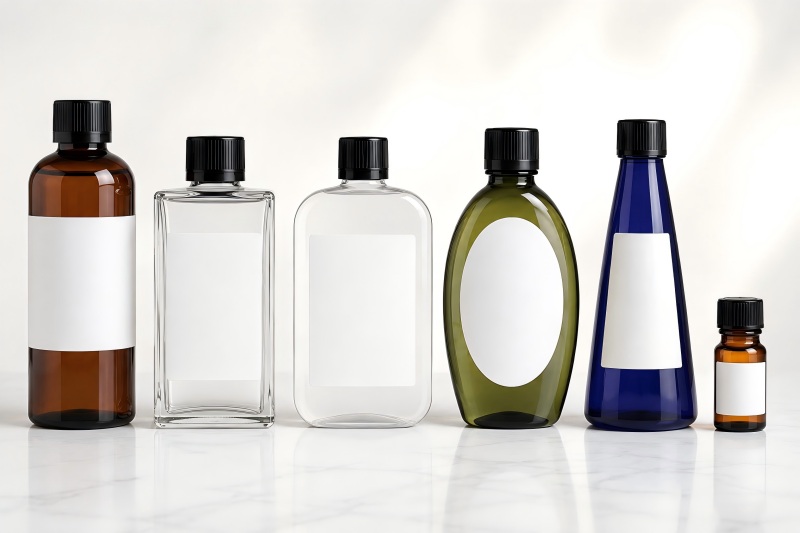
Label Application on Different Bottle Shapes
Different bottle shapes require different labeling methods. A round bottle is usually rotated during labeling, while a square bottle may be labeled on one side, two sides, or multiple sides.
| Bottle Type | Common Labeling Method | Typical Speed Range | Common Applications |
| Round bottle | Wrap-around labeling | 30–300 bottles/min | Water, juice, oil, medicine, shampoo |
| Flat bottle | Single-side or double-side labeling | 30–150 bottles/min | Cosmetics, detergent, sauce bottles |
| Square bottle | Front/back or multi-side labeling | 20–120 bottles/min | Chemical bottles, food jars, care products |
| Tapered bottle | Adjusted angle labeling | 20–100 bottles/min | Cosmetic bottles, special beverage bottles |
| Small vial | High-precision wrap labeling | 60–400 bottles/min | Pharma, laboratory, essential oils |
The actual speed depends on label size, bottle size, machine structure, control system, and operator adjustment. A small round vial can be labeled much faster than a large square bottle with front and back labels.
Pressing, Rolling, and Smoothing the Label
After the label touches the bottle, it must be pressed firmly. It smooths bubbles and strengthens label adhesion to the bottle.
Round bottles are usually pressed by a wrap-around belt or roller. The bottle turns as the label wraps smoothly around it.
Flat bottles may use soft brushes, sponge rollers, or pressing belts. These parts help the label attach smoothly without scratches.
Insufficient pressing pressure can cause label edges to peel up. If the pressure is too high, thin bottles may deform, especially lightweight PET bottles.
For premium products such as cosmetics, wine, and health supplements, label smoothness directly affects the product’s shelf appearance. A small wrinkle may make the packaging look cheaper.
Control System and Machine Coordination
The control system is the brain of the automatic bottle labeling machine. It coordinates sensors, motors, conveyor speed, label feeding, alarm signals, and human-machine interface settings.
Most machines use a PLC and touchscreen. Operators can set labeling speed, label length, delay time, product count, and alarm parameters on the screen.
Some machines store product recipes. This is useful when a factory labels different bottle sizes on the same machine. The operator can save settings for each bottle and quickly switch between products.
In modern production, the labeling machine may also connect with filling machines, capping machines, inkjet printers, visual inspection systems, and carton packing machines. This creates a more complete automatic packaging line.
Labeling Accuracy and Key Data
Labeling accuracy is one of the main indicators of machine quality. For many standard automatic bottle labeling machines, typical labeling accuracy is around ±1 mm, while high-precision machines can reach about ±0.5 mm under suitable conditions.
However, accuracy depends not only on the machine. Bottle tolerance, label quality, conveyor stability, and operator adjustment also affect the result.
| Data Item | Typical Range | What It Means in Production |
| Labeling accuracy | ±0.5 mm to ±1.5 mm | Controls visual consistency |
| Labeling speed | 30–300 bottles/min | Depends on bottle and label type |
| Label roll inner diameter | 76 mm | Common industry roll core size |
| Label roll outer diameter | 250–350 mm | Affects roll change frequency |
| Applicable bottle diameter | 20–120 mm | Varies by machine model |
| Applicable label height | 10–180 mm | Depends on labeling head design |
| Power consumption | 0.5–2.5 kW | Depends on speed and configuration |
For buyers, it is better to provide real bottles and label samples before ordering. Machine suppliers can test bottle stability, label peeling, sensor detection, and final label position before mass production.
How Front and Back Labels Are Applied
Dual-side labeling often requires two labeling heads to apply front and back labels accurately.
The first labeling head applies the front label, and the second labeling head applies the back label. The bottle position must remain stable between the two steps.
For round bottles, front and back labels need accurate orientation. Some machines use bottle positioning devices to find a mark, groove, handle, or cap direction before labeling.
For flat and square bottles, the machine usually applies labels to two opposite sides as the bottle passes between two labeling heads. This method is common for shampoo bottles, sauce bottles, detergent bottles, and chemical containers.
Optional Coding and Inspection Functions
An automatic bottle labeling machine can also work with a date printer, inkjet coder, thermal transfer printer, or laser marking system. These devices print batch numbers, production dates, expiry dates, barcodes, or QR codes.
Some lines also include visual inspection. A camera checks whether the label is missing, tilted, wrinkled, or placed in the wrong position.
If inspection fails, the system alerts operators or rejects the bottle to reduce defective products entering circulation.
For food and pharmaceutical production, this function is especially valuable because label information is related to safety, traceability, and compliance.