A monoblock filling machine is a compact packaging machine that integrates several production processes into one machine frame. Instead of using separate machines for filling, capping, rinsing, plugging, sealing, or labeling, a monoblock system combines these functions into one synchronized unit. This design helps manufacturers save factory space, reduce bottle transfer, improve production stability, and increase automation efficiency.
However, a monoblock filling machine is not always a 3-in-1 filling machine. The number of integrated functions depends on the product type, packaging format, bottle design, cap type, hygiene requirements, and production capacity. Some machines are designed as 2-in-1 monoblock filling machines, while others are built as 3-in-1, 4-in-1, 5-in-1, or fully customized monoblock systems.
For example, bottled water and beverage production often use a 3-in-1 rinsing filling capping machine. Edible oil, detergent, shampoo, lotion, sauce, and chemical liquids may only need a 2-in-1 filling capping monoblock machine. Pharmaceutical liquids, eye drops, oral liquids, perfumes, and cosmetic serums may require more processes, such as washing, filling, plugging, capping, crimping, sealing, or labeling.
Overview of Monoblock Filling Machine Types
| Type | Common Process Combination | Main Application |
| 2-in-1 Monoblock Filling Machine | Filling + Capping | Oil, sauce, detergent, shampoo, chemical liquid |
| 3-in-1 Monoblock Filling Machine | Rinsing + Filling + Capping | Bottled water, juice, tea drinks, beverage |
| 4-in-1 Monoblock Filling Machine | Rinsing + Filling + Capping + Extra Function | Beverage, dairy, pharmaceutical, cosmetics |
| 5-in-1 Monoblock Filling Machine | Washing + Filling + Plugging + Capping + Sealing | Small bottles, oral liquid, eye drops, perfume |
| Customized Monoblock Filling Machine | Flexible process combination | Special bottles, caps, liquids, or production needs |
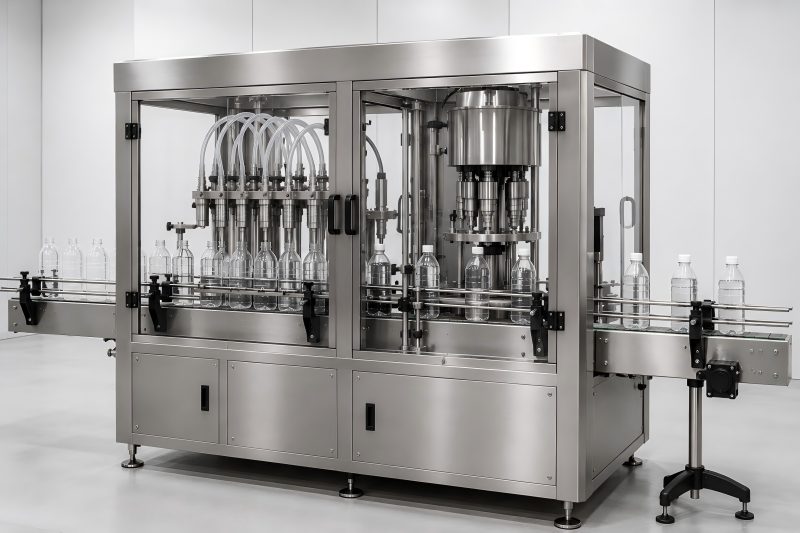
2-in-1 Monoblock Filling Machine
A 2-in-1 monoblock machine integrates filling and capping for products not needing rinsing. This type is commonly used when bottles are already clean, pre-sterilized, or supplied in a controlled packaging environment.
The basic process is simple:
Bottle feeding → Filling → Capping → Bottle output
This type of monoblock machine is widely used for edible oil, lubricating oil, sauce, shampoo, detergent, hand sanitizer, lotion, cosmetic liquid, and some chemical products. Depending on the liquid property, the machine can use different filling systems, such as piston filling, gravity filling, flowmeter filling, pump filling, or servo filling.
High-viscosity products like sauce, cream, lotion, or gel commonly use piston filling. For thin liquids, such as water-like chemicals or detergents, gravity filling or flowmeter filling may be more suitable.
| Pros | Cons |
| Compact structure and easy installation | Does not include bottle rinsing function |
| Lower investment cost than 3-in-1 or 4-in-1 machines | Not suitable for products requiring high bottle cleanliness |
| Suitable for many viscous and non-viscous liquids | May need extra bottle cleaning equipment if hygiene requirement is high |
| Easy to operate and maintain | Function combination is relatively simple |
| Good choice for small and medium production lines | Not ideal for high-speed bottled water or beverage lines |
A 2-in-1 monoblock filling machine is a practical choice if your production process mainly requires accurate filling and reliable capping. Ideal for factories needing automation without a full rinsing-filling-capping system.
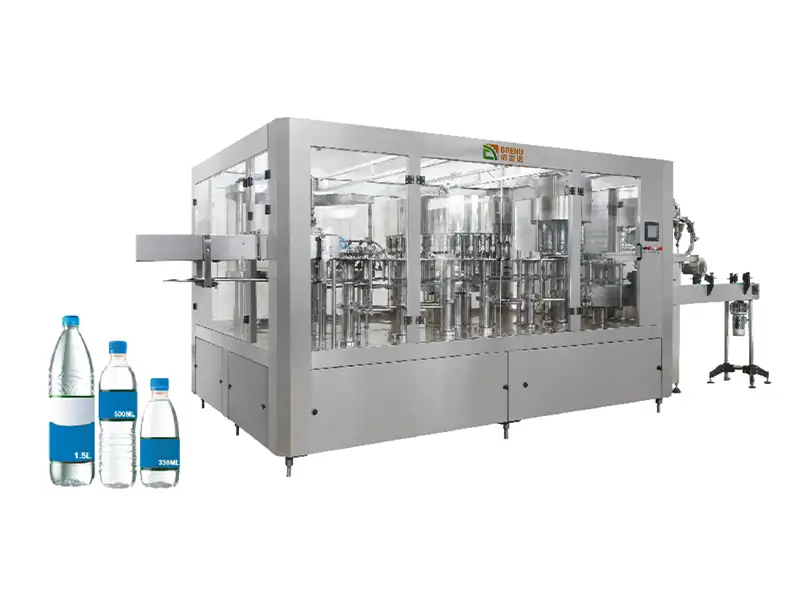
3-in-1 Monoblock Filling Machine
A 3-in-1 monoblock filling machine is one of the most common designs in the beverage and bottled water industry. It usually integrates three functions:
Rinsing + Filling + Capping
The complete process is:
Bottle rinsing → Liquid filling → Cap sealing → Bottle output
This machine is widely used for bottled water, mineral water, purified water, juice, tea drinks, energy drinks, flavored water, and some non-carbonated beverages. In many bottled water production lines, the 3-in-1 monoblock filling machine is the core equipment.
The rinsing section cleans the inside of empty bottles before filling. The filling section injects liquid into bottles with controlled accuracy. The capping section seals the bottle immediately after filling, helping reduce contamination risk and improve production efficiency.
For carbonated drinks, a special pressure filling system may be required. For juice, tea, or dairy beverages, the machine may need sanitary design, hot filling compatibility, or CIP cleaning support.
| Pros | Cons |
| Integrates rinsing, filling, and capping together | Higher cost than 2-in-1 machines |
| Very suitable for bottled water and beverage production | Not necessary for products using pre-cleaned bottles |
| Improves hygiene by rinsing bottles before filling | Requires more space than simple filling-capping machines |
| Reduces bottle transfer between machines | More complex structure and maintenance |
| High production efficiency for standard bottle formats | Less flexible for special bottles or unusual caps |
A 3-in-1 monoblock filling machine is ideal for beverage manufacturers that need stable, hygienic, and continuous production. If you are building a bottled water production line, this type is usually one of the most suitable options.
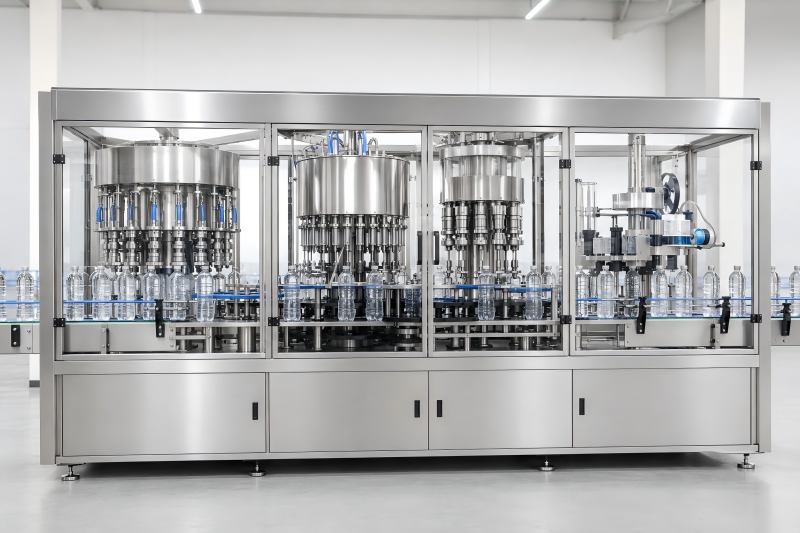
4-in-1 Monoblock Filling Machine
A 4-in-1 monoblock filling machine adds one extra function based on the standard 3-in-1 design. The fourth function depends on the product and packaging requirement.
Common 4-in-1 combinations include:
- Rinsing + Filling + Capping + Labeling
- Rinsing + Filling + Capping + Sterilizing
- Washing + Filling + Plugging + Capping
- Filling + Plugging + Capping + Sealing
- Bottle unscrambling + Filling + Capping + Labeling
This type is often used when manufacturers want a more integrated production system. It reduces standalone equipment and creates a more space-saving production line. For small bottles, pharmaceutical liquid, cosmetic products, and high-hygiene packaging, 4-in-1 monoblock machines are very useful.
For example, an eye drop filling line may need bottle washing, liquid filling, inner plug insertion, and outer cap sealing. A perfume filling line may need filling, pump inserting, crimping, and capping. A cosmetic serum line may require filling, plugging, capping, and labeling.
| Pros | Cons |
| Integrates more processes into one compact machine | Higher investment cost |
| Saves factory space and reduces conveyor length | More difficult to customize and adjust |
| Suitable for high-hygiene and special packaging products | Maintenance requires more technical skill |
| Reduces manual handling between processes | Longer setup time for different bottle formats |
| Can improve automation level and production consistency | Not always necessary for simple products |
A 4-in-1 monoblock filling machine is suitable for manufacturers that need more than basic filling and capping. It is especially valuable when the product requires inner plugs, special caps, sterilizing, sealing, or other additional packaging steps.
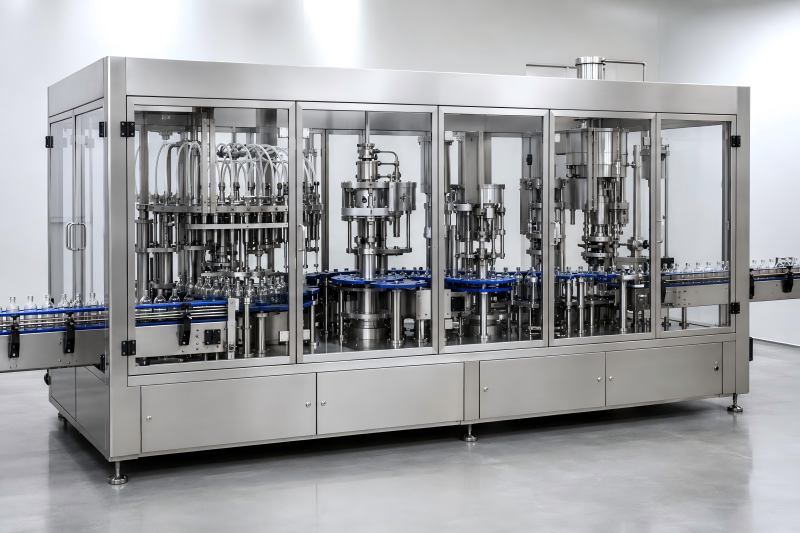
5-in-1 Monoblock Filling Machine
A 5-in-1 monoblock filling machine integrates even more packaging processes into one system. It is often used for small-bottle products, high-value liquids, pharmaceutical products, cosmetic liquids, and products that require multiple sealing steps.
Common process combinations include:
Washing → Filling → Plugging → Capping → Sealing
or:
Bottle feeding → Filling → Inner plug insertion → Outer cap tightening → Labeling
This type of machine is commonly used for oral liquid, essential oil, eye drops, perfume, serum, reagent bottles, small cosmetic bottles, and some pharmaceutical packaging lines. Because these products often use small bottles and precise filling volumes, the machine must provide high filling accuracy and stable bottle handling.
A 5-in-1 monoblock filling machine may include advanced functions such as automatic bottle feeding, no-bottle-no-filling protection, automatic plug feeding, cap sorting, servo capping, torque control, sealing detection, and reject systems.
| Pros | Cons |
| Highly integrated and automated | Highest cost among standard monoblock types |
| Suitable for complex packaging processes | More complex operation and maintenance |
| Reduces manual labor and improves consistency | Requires professional setup and training |
| Good for small bottles and high-value liquids | Less suitable for simple large-bottle products |
| Can support precise filling, plugging, capping, and sealing | Changeover can be slower for multiple bottle sizes |
A 5-in-1 monoblock filling machine is a good choice when your product has strict packaging requirements and multiple process steps. Although the investment is higher, it can reduce labor, improve packaging accuracy, and create a cleaner production process.
Customized Monoblock Filling Machine
Not all monoblock filling machines follow a fixed 2-in-1, 3-in-1, 4-in-1, or 5-in-1 design. Many machines are customized according to the actual product and packaging requirements.
A customized monoblock filling machine may be designed based on:
- Product viscosity
- Bottle shape and size
- Cap type
- Filling volume
- Production capacity
- Hygiene standard
- Automation level
- Industry requirements
- Available factory space
For example, a sauce manufacturer may need a filling and capping monoblock machine with heating, stirring, and anti-drip nozzles. Chemical products may require corrosion-resistant materials and safety-protected electrical components. A perfume manufacturer may need filling, pump placing, crimping, and cap pressing. A pharmaceutical manufacturer may need sterile filling, laminar flow protection, plugging, capping, and inspection systems.
| Pros | Cons |
| Designed according to your exact production needs | Longer design and manufacturing time |
| Suitable for special bottles, caps, and liquids | Higher customization cost |
| Can improve production efficiency and packaging quality | Requires clear technical communication before ordering |
| Flexible function combination | Spare parts may be more specific |
| Good choice for non-standard packaging projects | Future product changes may need machine modification |
A customized monoblock filling machine is suitable when standard equipment cannot fully meet your production requirements. It offers greater flexibility but needs proper planning before ordering.
Monoblock Filling Machine Selection Guide
Choosing the right monoblock filling machine depends on your product, packaging material, production speed, and hygiene requirement. Before selecting a machine, you should clearly understand your production process.
Selection Guide Table
| Product Type | Recommended Monoblock Type | Reason |
| Bottled water | 3-in-1 | Bottle rinsing, filling, and capping are usually required |
| Juice or tea drink | 3-in-1 or 4-in-1 | Better hygiene and stable filling are important |
| Edible oil | 2-in-1 | Filling and capping are usually enough |
| Shampoo or lotion | 2-in-1 or customized | Viscous products need suitable filling systems |
| Sauce or paste | 2-in-1 or customized | Needs anti-drip nozzles and high-viscosity filling |
| Eye drops | 4-in-1 or 5-in-1 | Requires filling, plugging, capping, and clean operation |
| Perfume | 4-in-1 or customized | May need filling, crimping, pump placing, and capping |
| Chemical liquid | 2-in-1 or customized | May need anti-corrosion materials and safety protection |
For bottled water and beverage production, the 3-in-1 monoblock filling machine is the most common choice. For edible oil, sauce, detergent, shampoo, and chemical liquids, a 2-in-1 filling capping monoblock machine may be enough. For cosmetics, pharmaceuticals, perfumes, eye drops, and small-bottle products, 4-in-1, 5-in-1, or customized monoblock machines may be more suitable.