
5 gallon bottling lines handle large reusable 18.9-liter water bottles. Compared with small PET bottle filling, this line handles heavier containers, larger filling volumes, stronger washing requirements, and more demanding logistics.
The complete line usually includes empty bottle inspection, decapping, external brushing, internal washing, filling, capping, cap sleeving, leak checking, labeling, coding, bagging, palletizing, and final storage. For this application, a 3-in-1 filling machine is especially suitable because it combines bottle washing, water filling, and cap pressing in one integrated system.
Why 5 Gallon Bottling Lines Need a Different Design
A 5 gallon bottle is not only larger than normal bottled water packaging. It is also often reused many times, so the production line must focus on cleaning, sanitation, and bottle handling strength.
In FDA terminology, containers intended for more than one use are “multiservice containers.” This matters because reusable 5 gallon bottles need stronger washing, inspection, and contamination control than single-use bottles.
The bottle body is usually made from PC or PET. The common market capacity is 5 US gallons, equal to about 18.9 liters. Because one filled bottle can weigh more than 19 kg including the bottle itself, the line needs strong conveyors, stable grippers, reliable bottle positioning, and smooth transitions between machines.
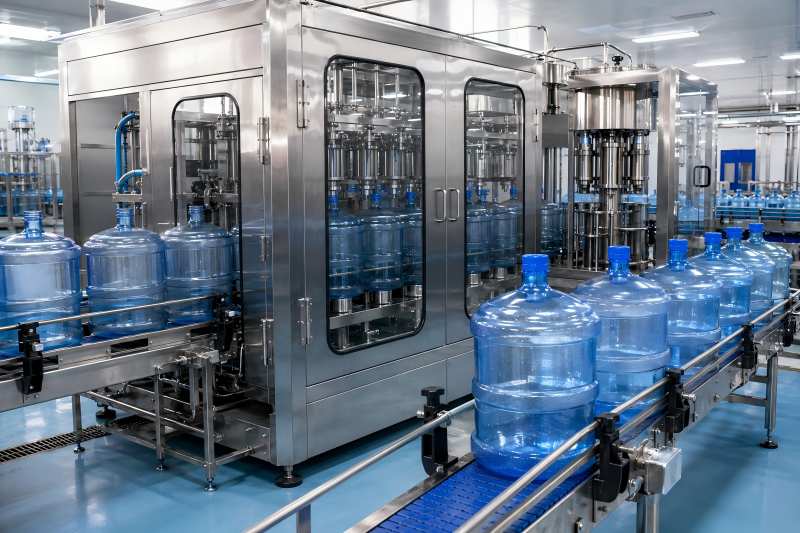
Main Process of a 5 Gallon Water Bottling Line
A standard 5 gallon bottling line can be divided into five major sections: bottle return handling, bottle washing, water treatment, filling and capping, and final packing.
The exact process depends on the water source, bottle condition, local hygiene rules, and target production capacity. However, most complete lines follow a similar route.
| Process Stage | Main Purpose | Key Machines | Control Point |
| Empty bottle receiving | Collect and feed returned bottles | Bottle loader, conveyor | Reject broken, dirty, or aged bottles |
| Decapping | Remove old caps | Automatic decapper | Avoid neck damage |
| External cleaning | Remove dirt from bottle surface | Outer brushing machine | Focus on shoulder, bottom, and handle area |
| Internal washing | Clean and disinfect bottle inside | 3-in-1 washer section or rotary washer | Washing time, chemical concentration, rinse quality |
| Water treatment | Produce safe product water | Sand filter, carbon filter, RO, UV, ozone | Conductivity, microbes, odor, taste |
| Filling | Fill treated water into bottles | 3-in-1 filling machine | Fill volume and splash control |
| Capping | Seal bottle with new cap | Capper or cap pressing unit | Cap tightness and sealing |
| Inspection | Confirm product quality | Leak checker, light inspection | Reject leaking or contaminated bottles |
| Packing | Prepare for delivery | Sleeve shrinking, bagging, palletizing | Clean appearance and stable stacking |
Water Treatment Before Filling
Water treatment is the foundation of the whole 5 gallon water bottling process. Even a high-quality filling machine cannot solve problems caused by unstable source water.
The water treatment system usually starts with raw water storage. Then the water passes through pretreatment, fine filtration, reverse osmosis, sterilization, and final product water storage.
A typical treatment system may include:
- Raw water tank
- Raw water pump
- Quartz sand filter
- Activated carbon filter
- Softener or antiscalant dosing system
- Precision filter
- Reverse osmosis system
- UV sterilizer
- Ozone mixing system
- Finished water tank
- Sterile product water pipeline
The goal is to remove suspended solids, odor, organic matter, hardness, microorganisms, and dissolved impurities. EPA drinking water standards cover microorganisms, disinfectants, disinfection byproducts, inorganic chemicals, organic chemicals, and radionuclides as major contaminant categories for public drinking water systems.
For bottled water plants, microbial safety is especially important. Microbial pollution from faecal sources can make drinking water unsafe and spread diseases such as cholera, typhoid, dysentery, and polio.
Bottle Return, Inspection, and Decapping
Many 5 gallon water businesses use a bottle return model. Customers return empty bottles, and the plant cleans, refills, seals, and redistributes them.
This business model reduces packaging cost, but it increases the need for bottle inspection. Returned bottles may contain dust, algae, odor, oil, foreign objects, old labels, or damaged necks.
Before washing, workers or automatic inspection stations should remove bottles with:
- Cracks or deformation
- Heavy scratches
- Bad odor
- Visible contamination
- Damaged neck finish
- Aged or yellowed body
- Foreign objects inside
- Oil or chemical residue
After inspection, the automatic decapper removes the old cap. The decapping unit should cut or pull the cap cleanly without damaging the bottle mouth. Neck damage can lead to leaking, poor sealing, or higher reject rates after filling.
External Bottle Brushing
A 5 gallon bottle is often touched, transported, stored, and reused many times. The outside surface can become dusty or stained before entering the plant.
The outer brushing machine cleans the bottle body before internal washing. It usually uses rotating brushes, water spray, and sometimes detergent.
Key cleaning areas include:
- Bottle mouth
- Neck area
- Shoulder area
- Handle position
- Bottom ring
- Label residue area
External brushing helps reduce the risk of carrying dirt into the clean filling zone. It also improves the final product appearance, which is important for home delivery, office drinking water, schools, factories, and public institutions.
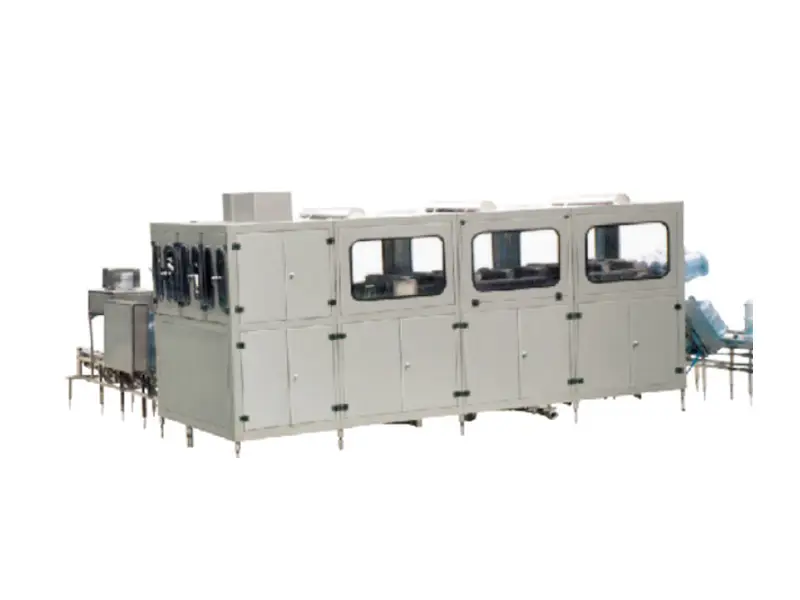
3-in-1 Filling Machine for 5 Gallon Bottles
For 5 gallon bucket water production, a 3-in-1 filling machine is often the best choice. A compact unit handles bottle washing, water filling, and cap pressing together.
This structure is especially suitable for 5 gallon bottles because the container is large, heavy, and difficult to transfer between separate machines. A combined system reduces handling distance, lowers contamination risk, and makes the line easier to operate.
The 3-in-1 machine usually includes:
- Bottle loading and positioning
- Internal washing station
- Sterile water rinsing station
- Draining station
- Filling station
- Cap feeding system
- Cap placing or pressing unit
- Bottle discharge conveyor
Compared with a separated washer, filler, and capper, the 3-in-1 structure saves floor space and improves process continuity. It is also easier to synchronize with the conveyor, cap elevator, sleeve shrinker, and final packing system.
| Machine Type | Suitable Use | Advantages | Limitations |
| Separate washer + filler + capper | Large customized plants with special layout | Flexible configuration | More transfer points and larger footprint |
| Linear 3-in-1 machine | Small and medium 5 gallon water plants | Compact, practical, easy to operate | Capacity is moderate |
| Rotary 3-in-1 machine | Higher-output plants | Faster speed and smoother continuous running | Higher investment |
| Fully automatic complete line | Large commercial bottled water factories | Low labor cost and stable output | Requires larger space and stronger management |
Washing and Sanitizing Requirements
Washing is one of the most critical parts of a 5 gallon line. Returned bottles must be cleaned thoroughly before filling.
FDA rules state that washing and sanitizing containers for bottled drinking water should be performed in an enclosed room, and the operation should be positioned to reduce possible post-sanitizing contamination before containers enter the bottling room.
A common washing process may include:
- Pre-rinse to remove loose dirt
- Detergent or alkaline wash
- Internal high-pressure spray
- Disinfectant wash
- Sterile water rinse
- Final draining
The washing time, spray pressure, nozzle angle, water temperature, and chemical concentration all affect cleaning performance. Poor washing can cause odor, microbial risk, sediment, and customer complaints.
A good 5 gallon bottle washer should have strong internal spray nozzles. The nozzle must reach the bottom and shoulder area because these zones are harder to clean.
Filling Process and Volume Control
Once cleaned, the bottle moves to filling. Treated water is filled into the bottle through a sanitary filling valve.
With 18.9 liters per bottle, precise filling controls cost and protects customer confidence. Underfilling may cause complaints, while overfilling increases product loss.
The filling system should control:
- Filling volume
- Filling speed
- Splashing
- Foam or air disturbance
- Bottle positioning
- Valve hygiene
- Product water flow stability
The finished bottle should look clean, full, and consistent. For high-speed production, the filling valve design must reduce water turbulence and avoid splashing near the bottle mouth.
Capping, Sealing, and Sleeve Shrinking
After filling, the bottle is sealed with a new cap. The cap may be pressed onto the bottle neck or applied through an automatic capping head, depending on the cap design.
Good capping performance depends on cap quality, neck finish, machine pressure, and alignment. A loose cap may cause leaking during delivery. Excessive pressure may deform the neck or make the cap difficult to remove.
Many 5 gallon water lines also use cap sleeve shrinking. The shrink sleeve covers the cap and neck area, giving the product a cleaner appearance and showing that the bottle has not been opened.
A typical sealing section includes:
- Cap elevator
- Cap sterilizer
- Cap sorting system
- Cap pressing unit
- Cap inspection
- Shrink sleeve machine
- Steam or electric shrink tunnel
Production Capacity and Output Data
The required capacity depends on market demand, delivery model, labor cost, and working hours. Small plants may only need a few hundred bottles per hour. Larger water delivery companies may require over 1,000 bottles per hour.
The following table gives practical reference data for planning. Actual performance depends on bottle condition, machine model, operator skill, and line automation level.
| Line Capacity | Bottles Per Hour | Water Output Per Hour | 8-Hour Shift Output | Suitable Business |
| Small line | 100 BPH | About 1,890 L/h | About 800 bottles | Local start-up water station |
| Medium line | 300 BPH | About 5,670 L/h | About 2,400 bottles | City delivery supplier |
| Standard automatic line | 600 BPH | About 11,340 L/h | About 4,800 bottles | Regional bottled water plant |
| High-speed line | 1,200 BPH | About 22,680 L/h | About 9,600 bottles | Large commercial factory |
When calculating capacity, buyers should not only look at the filling machine speed. The real output also depends on bottle loading, inspection speed, washing efficiency, cap supply, packing speed, and warehouse handling.
Recommended Layout for a 5 Gallon Water Plant
A 5 gallon water bottling line should separate dirty bottle handling from clean filling operations. Returned bottles should enter from one side, while finished products should leave from another side.
Bottling rooms should be enclosed and separated to prevent contamination from nearby operations or storage areas. The best layout usually follows a one-way flow:
Empty bottle receiving → inspection → decapping → external brushing → washing → filling → capping → inspection → packing → finished product storage.
This layout reduces cross-contamination and keeps production movement clear.
| Area | Main Function | Layout Advice |
| Empty bottle zone | Store returned bottles | Keep away from filling room |
| Inspection area | Reject damaged bottles | Place before washing |
| Washing room | Clean and sanitize bottles | Use drainage and ventilation |
| Water treatment room | Produce product water | Keep pipelines short and sanitary |
| Filling room | Wash, fill, and cap bottles | Use enclosed clean area |
| Packing area | Sleeve, code, bag, and stack | Connect smoothly to warehouse |
| Finished goods warehouse | Store sealed bottles | Keep dry, clean, and shaded |
Adequate ventilation is also important. FDA regulations mention ventilation to minimize condensation in processing rooms, bottling rooms, and washing and sanitizing areas.
Key Machines in a Complete 5 Gallon Line
A complete 5 gallon bottling line can be semi-automatic or fully automatic. The main difference is the level of bottle feeding, inspection, loading, unloading, and packing automation.
A typical complete system includes:
- Empty bottle conveyor
- Automatic decapper
- Bottle leak tester
- Outer brushing machine
- 3-in-1 washing filling capping machine
- Cap elevator
- Cap sterilizer
- Cap sleeve shrinker
- Light inspection box
- Inkjet or laser coding machine
- Bottle bagging machine
- Palletizer or manual stacking station
- Air compressor
- Water treatment system
- CIP cleaning system
The 3-in-1 washer-filler-capper is the central machine. Other equipment should be selected around its speed and bottle format.
Hygiene Clauses Buyers Should Confirm
Machine cost is only one part of a 5 gallon bottling project. Hygiene design directly affects product safety, brand trust, and regulatory risk.
Important sanitary clauses include:
- Product water contact parts should use food-grade stainless steel or approved sanitary material.
- Washing and sanitizing areas should be separated from finished product areas.
- The bottling room should be enclosed and protected from dust, insects, and dirty airflow.
- Product water pipes should be easy to clean and drain.
- Dead corners inside tanks and pipes should be minimized.
- Bottle washing nozzles should be removable or easy to inspect.
- Caps should be stored, transported, and sterilized properly before sealing.
- Operators should follow handwashing, clothing, and access control rules.
- Finished bottled water should be coded for traceability.
- Cleaning, testing, and corrective actions should be recorded.
Non-public source water should be tested weekly for coliform, with E. coli checks after any positive result. Finished bottled water also requires microbiological testing and corrective actions when needed.
Quality Control Points
Quality control should run through the whole production line. It should not start only after bottles are filled.
Main quality checks include:
- Raw water test
- Treated water test
- Bottle appearance inspection
- Bottle odor check
- Washing effect check
- Final rinse water quality
- Filling volume check
- Cap sealing test
- Leak test
- Finished product microbiological test
- Shelf-life observation
- Batch code and traceability record
FDA bottled water rules cover product standards and GMP controls to ensure safe production, sanitary processing, and properly managed bottled water quality.
For most 5 gallon water projects, the 3-in-1 filling machine is the practical core equipment. It simplifies the line, reduces bottle transfer, supports cleaner production, and helps operators manage washing, filling, and capping in one continuous process.