Because different products behave differently during filling, there is no single filling machine suitable for every application. Some products flow freely like water, while others foam easily, contain particles, or require strict sanitary standards.
Here are 7 common types of industrial filling machines:
- Gravity Filling Machine
- Piston Filling Machine
- Pump Filling Machine
- Overflow Filling Machine
- Vacuum Filling Machine
- Pressure Filling Machine
- Net Weight Filling Machine
- Volumetric Filling Machine
Why Understanding Filling Machine Types Matters
Choosing the correct filling machine is not only about increasing output. It also influences product loss, cleaning efficiency, labor cost, container compatibility, and long-term maintenance.
For example, a gravity filling machine may work very well for still water or thin liquids, but it may not be ideal for thick sauces.
A piston filler can handle viscous materials more effectively, while a pump filling machine offers flexibility across multiple product viscosities.
In high-speed beverage production, rotary monoblock systems are often preferred, while smaller factories may choose inline filling equipment for flexibility.
Main Ways to Classify Industrial Filling Machines
Industrial filling machines can be classified from several different angles, including filling principle, automation level, machine layout, product type, and container format.
Common Classification Methods for Industrial Filling Machines
| Classification Method | Main Categories | Typical Basis |
| By filling principle | Gravity, piston, pump, overflow, vacuum, pressure, net weight, volumetric | How product enters the container |
| By automation level | Manual, semi-automatic, automatic | Level of operator involvement |
| By machine layout | Inline, rotary, monoblock | Equipment structure and line arrangement |
| By product type | Liquid, viscous, powder, granule, corrosive, foamy | Product characteristics |
| By container type | Bottles, jars, cans, pouches, drums | Packaging format |
The most common and practical way to understand filling machine types is by filling principle. Below are the major types used in industry.
Gravity Filling Machine
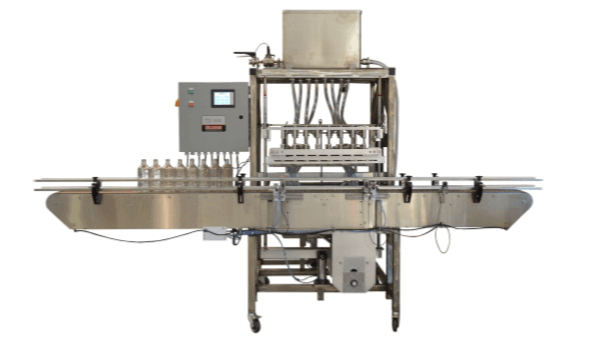
A gravity filling machine uses gravity to fill containers with free-flowing liquids, allowing product to flow naturally from the tank when the valve opens.
Ideal for low-viscosity, non-carbonated liquids like water, juice, detergents, disinfectants, and light chemicals, it offers simple structure, easy maintenance, and lower equipment cost.
| Pros | Cons |
| Simple operating principle | Not suitable for high-viscosity products |
| Lower investment cost | Limited performance with foamy liquids |
| Easy cleaning and maintenance | Not ideal for particle-containing liquids |
| Suitable for thin, free-flowing liquids | Filling accuracy may vary with product consistency |
| Good for small to medium production lines | Tank conditions can affect filling stability |
Piston Filling Machine
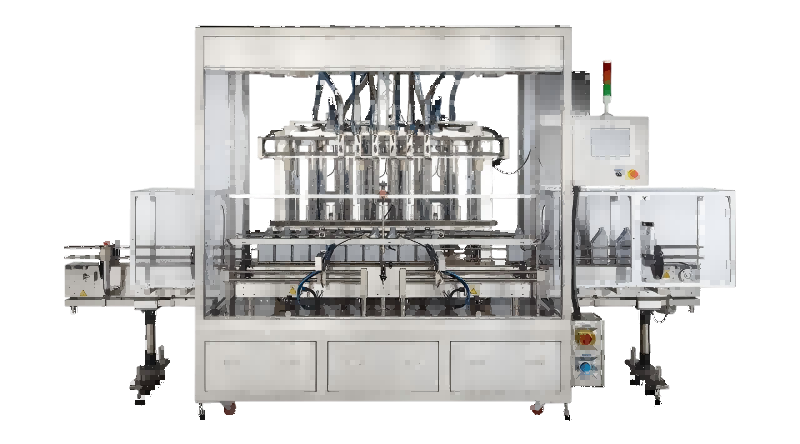
A piston filling machine fills thick or semi-viscous products by drawing a measured volume into a cylinder, then dispensing it into containers with a piston.
This type is especially suitable for products such as ketchup, mayonnaise, cream, shampoo, lotion, peanut butter, paste, honey, jam, and certain chemical materials. Because it delivers a fixed volume in each cycle, it offers good filling accuracy for dense products.
Piston filling machines are available in single-head, multi-head, semi-automatic, and fully automatic versions. Many manufacturers use them where product consistency is too thick for gravity filling.
| Pros | Cons |
| Suitable for thick and viscous materials | More components to clean than simple gravity fillers |
| High filling accuracy | Changeover may take longer for sticky products |
| Can handle products with small particulates | Less ideal for very thin liquids when flexibility is the main goal |
| Widely used in food, cosmetic, and chemical industries |
Pump Filling Machine
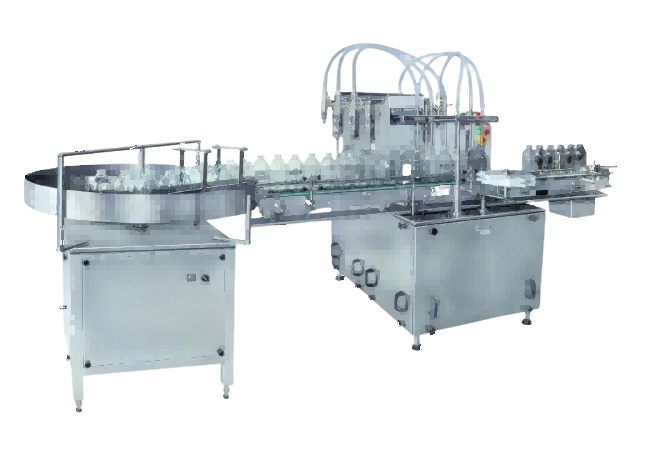
A pump filling machine uses pumps to fill containers, with gear, lobe, diaphragm, peristaltic, or centrifugal types selected according to product characteristics.
Pump filling machines handle thin to moderately thick liquids, widely used for oils, cleaners, cosmetics, syrups, sauces, chemicals, and sanitary food or pharmaceutical applications.
This type is popular because it can adapt to different viscosities and production needs.
| Pros | Cons |
| Flexible for multiple product types | Pump selection must match product characteristics |
| Suitable for thin to medium-viscosity liquids | Some pump systems require more maintenance |
| Can be integrated into automatic lines | Accuracy depends on calibration and product stability |
| Supports gentle product transfer | Filling performance may vary with product behavior |
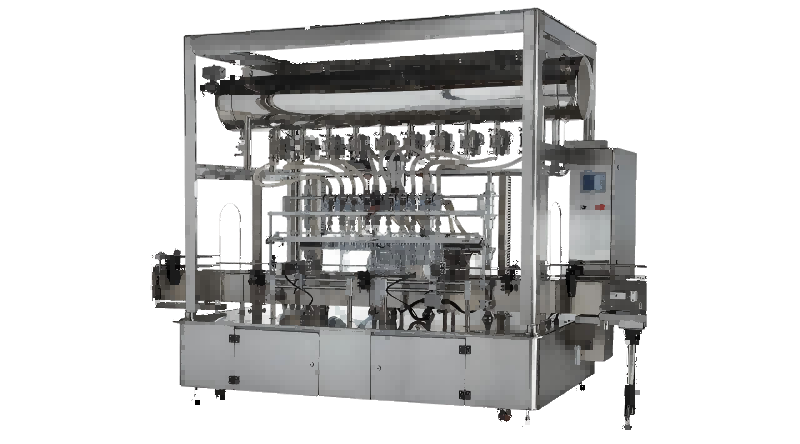
Overflow Filling Machine
An overflow filling machine is designed to fill containers to the same visible level rather than strictly by volume. Excess product flows back to the tank once the set fill level is reached. This makes it ideal for clear bottles where visual consistency is important on store shelves.
Overflow fillers are often used for bottled water, beverages, soaps, shampoos, and household chemicals in transparent containers. Even if bottle volumes vary slightly, the fill level appears uniform.
| Pros | Cons |
| Excellent visual fill consistency | Better for low-foam products |
| Ideal for transparent bottles | Product recirculation may not suit all applications |
| Works well for thin to medium liquids | Not the best choice for highly viscous materials |
| Good for retail-focused packaging appearance |

Vacuum Filling Machine
A vacuum filling machine uses vacuum pressure to fill low-viscosity liquids, especially in glass bottles, while helping improve drip control and maintain cleaner filling.
Vacuum fillers are commonly found in food, beverage, perfume, and chemical packaging applications. They can also be useful when filling containers with narrow openings.
| Pros | Cons |
| Clean filling with reduced dripping | Less suitable for highly viscous products |
| Works well with glass bottles and specialty containers | Best for specific packaging requirements |
| Can improve package appearance | Machine selection depends heavily on product behavior |
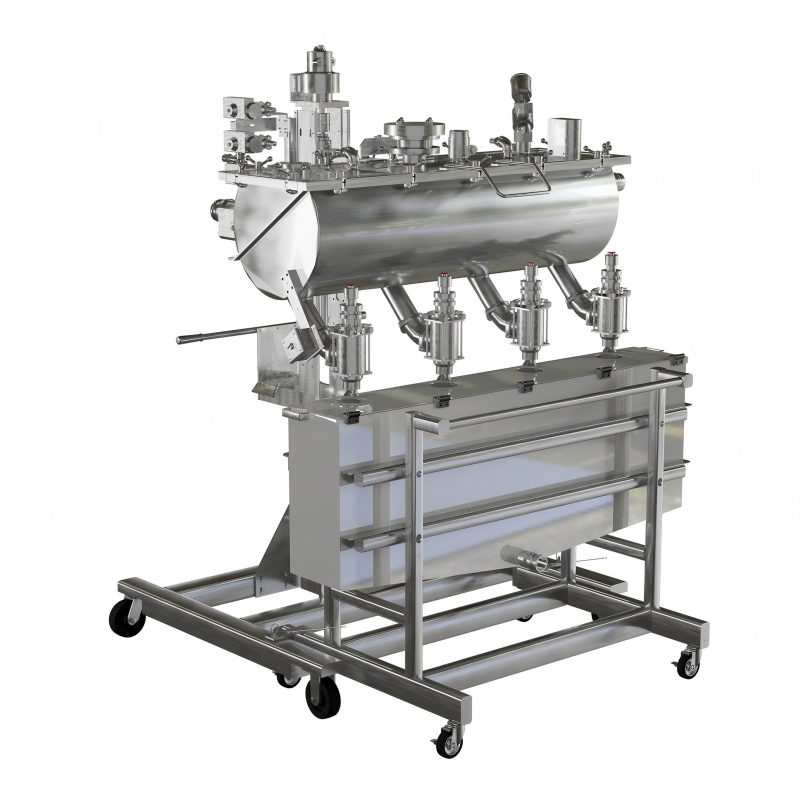
Pressure Filling Machine
Pressure filling machines fill carbonated drinks under controlled pressure, reducing foaming and preserving dissolved gas, product stability, and overall beverage quality.
Systems are common in beverage production lines and are often integrated with rinsing and capping systems in monoblock machines.
| Pros | Cons |
| Suitable for carbonated products | Higher equipment complexity |
| Helps reduce foaming during filling | Requires more precise control systems |
| Maintains carbonation quality | Mainly used for specific beverage applications |
| Supports high-speed beverage production |
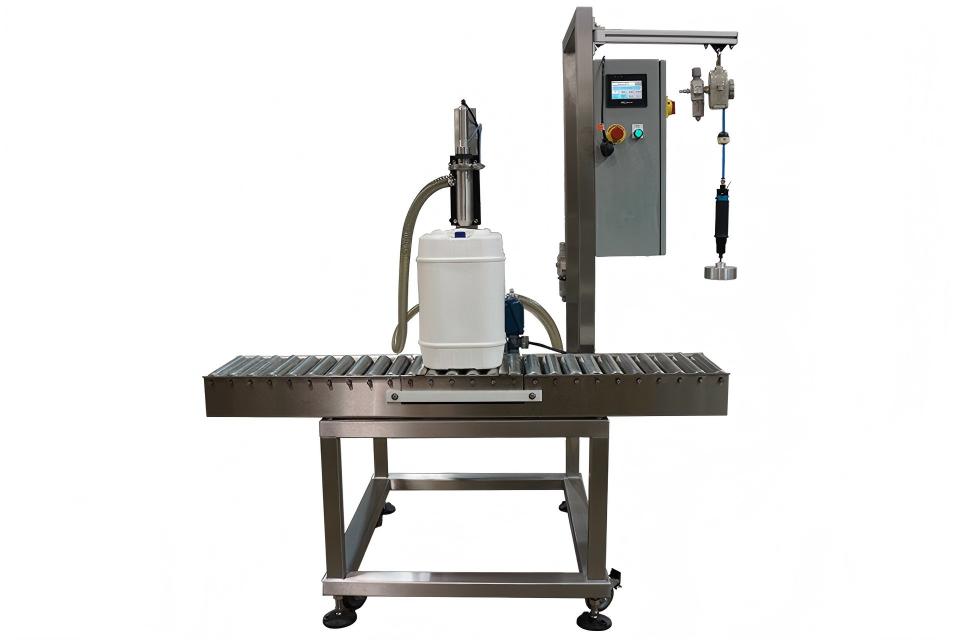
Net Weight Filling Machine
A net weight filling machine fills containers based on target weight rather than target volume. Each container is weighed during or after filling until the desired weight is reached. This type is especially useful for products sold by weight or where density can vary.
Net weight fillers are widely used for edible oil, paint, lubricants, chemicals, agricultural liquids, and large containers such as jerry cans, pails, and drums. They are also valuable when temperature or density changes may affect volumetric filling consistency.
| Pros | Cons |
| High filling accuracy based on product weight | Slower than some high-speed volumetric systems |
| Suitable for products with density variation | Higher equipment cost than basic filling machines |
| Ideal for high-value liquids and bulk packaging | Requires stable weighing and calibration systems |
| Helpful for regulatory and trade compliance |
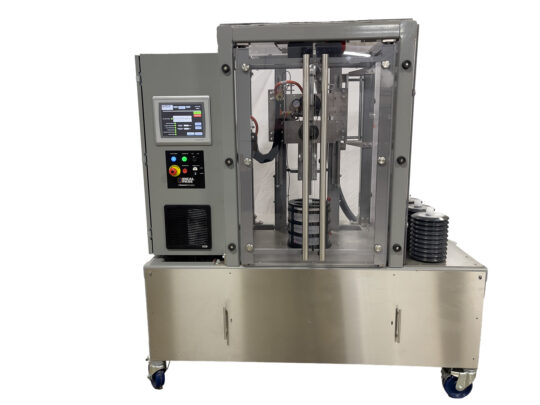
Volumetric Filling Machine
A volumetric filling machine dispenses a fixed amount of product by volume. This category includes piston fillers, flowmeter fillers, and timed flow filling systems. The key idea is that the machine controls a specific measured volume for each container.
Volumetric filling is widely used because it offers efficient and repeatable filling across many industries. It is especially suitable when product density remains stable and production speed is important.
| Pros | Cons |
| Consistent measured output | Density changes can affect actual fill weight |
| Good production efficiency | Product behavior may influence filling performance |
| Suitable for many liquids and semi-liquids | Some models are less suitable for foamy products |
| Easy to integrate with automatic packaging lines | — |
Main Filling Machine Types and Suitable Products
| Filling Machine Type | Suitable Products | Viscosity Range | Typical Industries |
| Gravity filler | Water, juice, detergent | Low | Beverage, chemical, daily care |
| Piston filler | Sauce, cream, paste, honey | Medium to high | Food, cosmetic, chemical |
| Pump filler | Oil, syrup, shampoo, cleaner | Low to medium | Food, cosmetic, chemical |
| Overflow filler | Water, soap, clear liquids | Low to medium | Beverage, personal care |
| Vacuum filler | Perfume, glass bottle liquids | Low | Food, perfume, chemical |
| Pressure filler | Soda, sparkling drinks, beer | Low | Beverage |
| Net weight filler | Edible oil, paint, lubricant | Low to medium | Chemical, food, industrial |
Classification by Automation Level
Besides filling principle, industrial filling machines are also classified by automation level.
Manual Filling Machines
Manual fillers require significant operator input. They are suitable for small-scale production, product trials, or workshops with limited output needs.
Semi-Automatic Filling Machines
Semi-automatic machines need some manual container placement or operator control, but the filling cycle itself is automated. They are popular among growing businesses because they offer better productivity without the cost of a fully automatic line.
Automatic Filling Machines
Automatic filling machines integrate with continuous lines, automatically handling conveying, filling, capping, labeling, coding, and packing for stable, high-speed production in medium to large factories.
Filling Machines by Automation Level
| Automation Level | Features | Suitable Production Scale |
| Manual | Operator-controlled, low cost, simple setup | Small batch |
| Semi-automatic | Partial automation, better efficiency | Small to medium |
| Automatic | Continuous line integration, high speed | Medium to large |
Classification by Machine Layout
Inline Filling Machine
Inline filling machines place filling heads in a straight line, allowing containers to stop beneath them for flexible operation, easier maintenance, and better bottle size adaptability.
Rotary Filling Machine
Rotary filling machines use a rotating carousel design. Containers move continuously through filling stations, making this type ideal for high-speed production.
Monoblock Filling Machine
A monoblock filling machine integrates rinsing, filling, and capping into one system, widely used for bottled water, juice, and carbonated drink production.
Inline vs Rotary vs Monoblock Filling Machines
| Machine Layout | Main Feature | Best For | Limitation |
| Inline | Flexible, simple structure | Multiple bottle types, moderate speed | Lower speed than rotary |
| Rotary | High-speed continuous operation | Large-scale production | Higher investment |
| Monoblock | Integrated rinsing, filling, capping | Beverage bottling lines | Less modular than separate units |
How to Choose the Right Type of Industrial Filling Machine
Choosing the right industrial filling machine requires a practical review of product and production requirements. The following factors are especially important.
Product Viscosity
Thin liquids usually work well with gravity, overflow, or certain pump fillers. Thick products often require piston or positive displacement pump systems.
Product Characteristics
Ask whether the product foams, contains particles, is corrosive, is hot-filled, or requires sanitary handling. These characteristics directly affect machine design.
Container Type
Bottle shape, neck size, material, and volume range all influence machine compatibility. Some machines handle bottles better, while others are built for jars, cans, pouches, or drums.
Required Output
Low-output operations may use semi-automatic or inline equipment, while high-volume factories usually need automatic inline or rotary systems.
Filling Accuracy
Products with higher value or legal weight requirements may benefit from net weight filling or high-precision volumetric systems.
Hygiene and Cleaning
Food, beverage, cosmetic, and pharmaceutical industries often require stainless steel construction, sanitary piping, and easy-clean designs.
Future Expansion
A filling machine should not only meet current production needs but also support future growth, product variation, and automation upgrades.
Common Industry Applications
Different industries often prefer different filling technologies based on product nature and packaging demands.
Recommended Filling Machines by Industry
| Industry | Common Products | Recommended Machine Types |
| Beverage | Water, juice, soda, tea | Gravity, overflow, pressure, monoblock |
| Food | Sauce, jam, honey, edible oil | Piston, pump, net weight |
| Cosmetics | Lotion, cream, shampoo, perfume | Piston, pump, vacuum, overflow |
| Pharmaceutical | Syrup, liquid medicine, powder | Pump, volumetric, powder filler |
| Chemical | Detergent, lubricant, solvent, paint | Pump, net weight, gravity |
| Agriculture | Fertilizer liquid, seeds, additives | Net weight, granule filler, pump |
In practical production, the best filling machine is not simply the most advanced one. It is the one that matches your product properties, container style, hygiene requirements, accuracy target, and production capacity. A well-matched filling system can improve efficiency, reduce waste, stabilize quality, and support long-term factory growth.
For filling machine manufacturers planning a new packaging line or upgrading existing equipment, understanding these filling machine types is the first step toward making a smarter investment.