A monoblock filling machine combines rinsing, filling, and capping into one compact integrated packaging unit. Its ability to streamline operations, improve hygiene, and increase production speed makes it an essential component in today’s automated manufacturing lines.
Unlike traditional production lines where each process is handled by separate machines connected via conveyors, a monoblock machine performs all these operations within one synchronized structure.
Key Concept:
A monoblock system = multiple functions + one machine frame + synchronized operation
Core Functions of a Monoblock Filling Machine
A standard monoblock filling machine typically includes three main functions:
Bottle Rinsing (Cleaning)
- Removes dust, particles, or contaminants inside bottles
- Uses water, sterile air, or chemical rinsing agents
- Ensures hygiene before filling
Liquid Filling
Accurately fills bottles with liquid products
Filling methods vary depending on product type:
- Gravity filling (water, juice)
- Pressure filling (carbonated drinks)
- Piston filling (viscous liquids)
Bottle Capping
- Seals bottles immediately after filling
- Prevents contamination and leakage
- Supports various cap types (screw caps, crown caps, press caps)
Structure and Key Components
A monoblock filling machine is a highly integrated piece of equipment composed of several synchronized systems.
Main Components of a Monoblock Filling Machine
| Component | Function | Key Features |
| Bottle Infeed System | Transfers bottles into the machine | Star wheels or conveyors |
| Rinsing Unit | Cleans bottle interiors | Multi-nozzle system, sterile air/water |
| Filling Valves | Dispense liquid into bottles | High precision, anti-drip design |
| Capping Unit | Applies and tightens caps | Torque control, high-speed operation |
| Rotary Carousel | Moves bottles through stages | Continuous circular motion |
| Control System (PLC + HMI) | Controls machine operation | Automation, real-time monitoring |
| Frame Structure | Supports all components | Stainless steel, hygienic design |
Working Principle
Monoblock filling machines typically operate using a rotary system, where bottles move through different stages on a rotating carousel.
Step-by-Step Process:
- Bottle Feeding
Empty bottles enter the machine via conveyor. - Rinsing Stage
Bottles are inverted and cleaned using water or air jets. - Draining
Excess liquid is removed after rinsing. - Filling Stage
Bottles move under filling valves and are filled precisely. - Capping Stage
Caps are applied and tightened immediately after filling. - Bottle Discharge
Finished bottles exit the machine for labeling or packaging.
Key Feature:
All steps are synchronized and occur continuously, improving efficiency and reducing downtime.
Types of Monoblock Filling Machines
Monoblock filling machines can be classified by filling principle into several main types. Each type is designed for different product characteristics such as viscosity, carbonation, and foaming behavior.
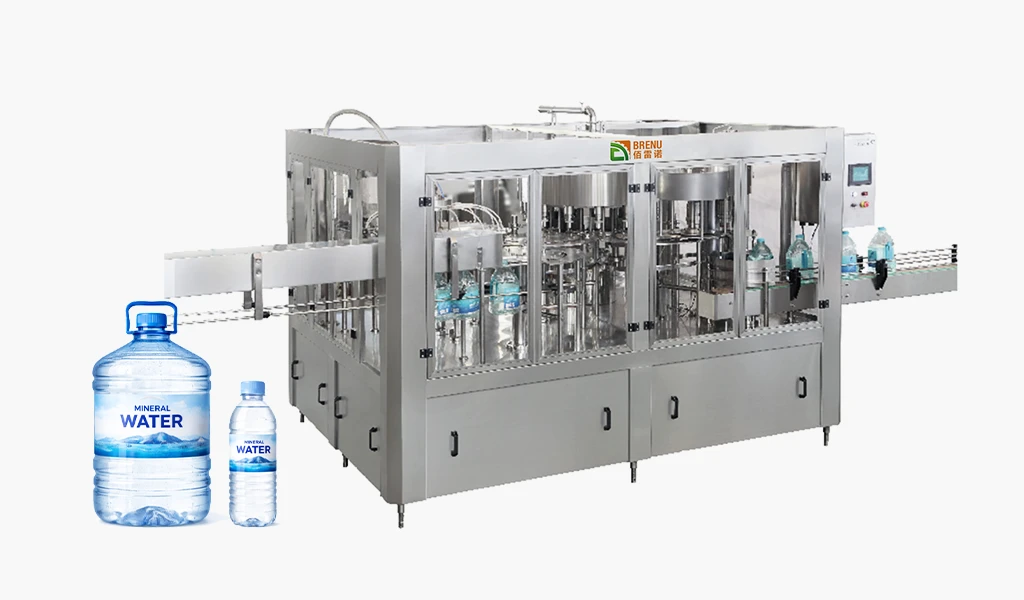
Gravity Filling Monoblock
Working principle:
Liquid flows into the bottle by gravity from the tank.
Key features:
- Simple structure and low cost
- Suitable for low-viscosity liquids
- Easy maintenance
Typical applications:
- Water
- Juice (non-pulp)
- Light liquid products
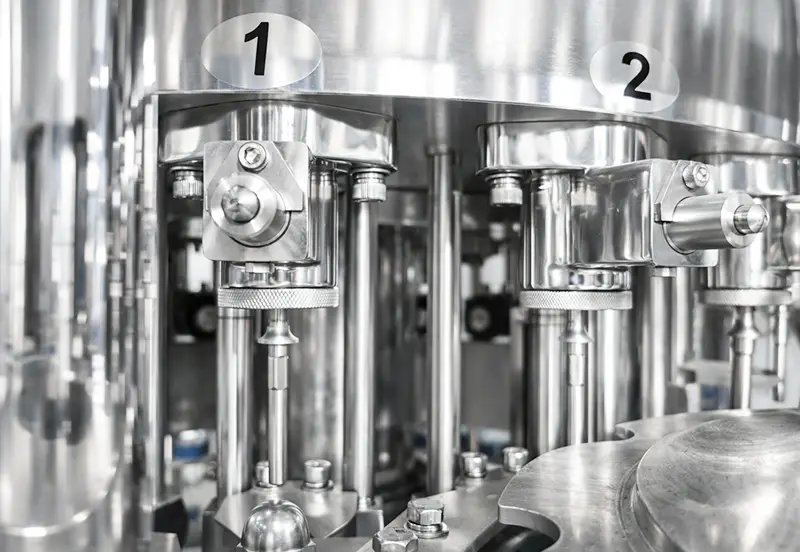
Pressure Filling Monoblock (Isobaric Filling)
Working principle:
Filling is done under equal pressure between tank and bottle.
Key features:
- Prevents foaming and gas loss
- High filling accuracy
- Essential for carbonated products
Typical applications:
- Carbonated soft drinks (CSD)
- Beer
- Sparkling beverages
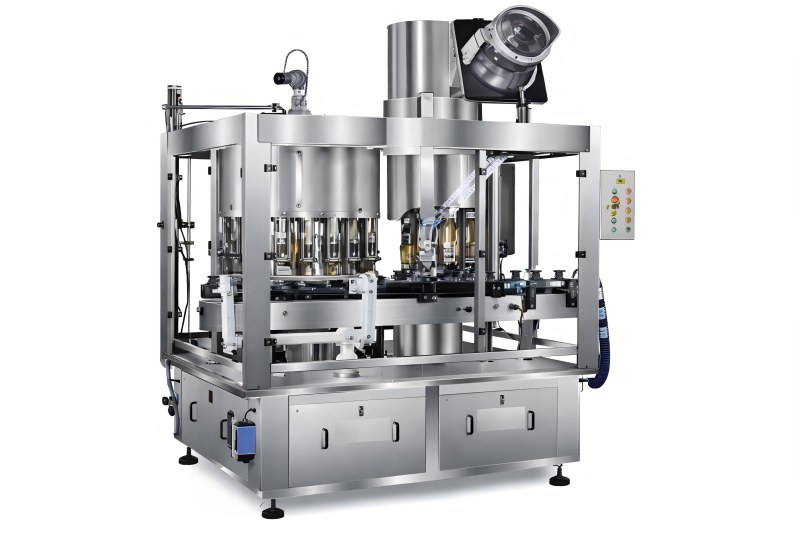
Vacuum Filling Monoblock
Working principle:
Vacuum inside the bottle draws liquid in.
Key features:
- Ensures consistent liquid level
- Reduces oxidation
- Suitable for glass containers
Typical applications:
- Wine
- Sauce
- Oil
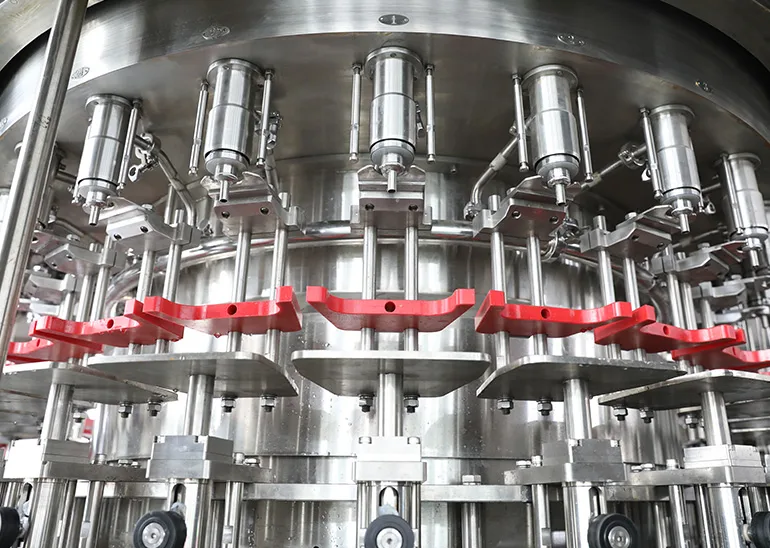
Piston Filling Monoblock
Working principle:
A piston cylinder controls the volume of liquid dispensed.
Key features:
- High precision volumetric filling
- Suitable for high-viscosity products
- Adjustable filling volume
Typical applications:
- Sauce
- Cream
- Honey
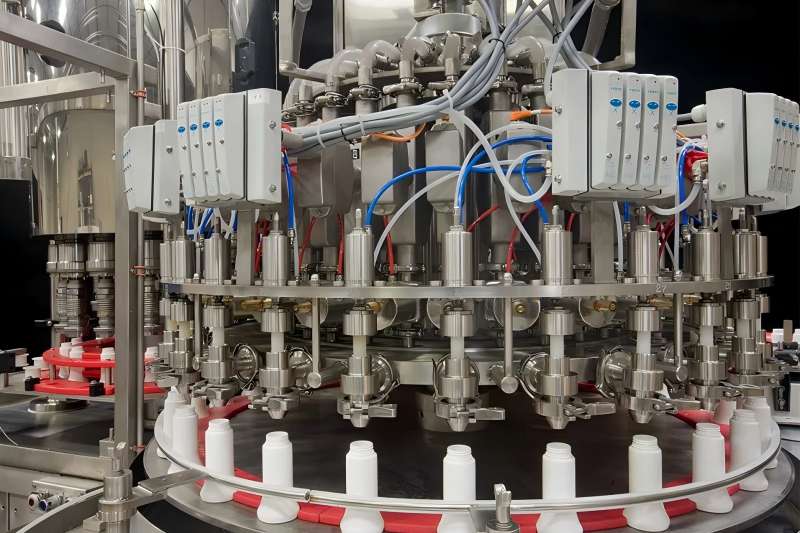
Flow Meter Filling Monoblock
Working principle:
Uses flow meters to measure and control filling volume.
Key features:
- High accuracy and automation
- Ideal for large-volume filling
- Less affected by viscosity changes
Typical applications:
- Edible oil
- Chemical liquids
- Large container filling
Advantages of Monoblock Filling Machines
Monoblock systems offer several advantages compared to traditional multi-machine setups.
Compact Design
- Combines multiple functions into one unit
- Saves valuable factory space
Higher Efficiency
- Continuous rotary operation
- Reduced bottle transfer time
Improved Hygiene
- Fewer transfer points reduce contamination risk
- Enclosed design supports clean environments
Lower Labor Requirements
- Automated operation reduces manual handling
- Easier to manage with fewer operators
Simplified Integration
Easier to integrate with upstream and downstream equipment
Works seamlessly with:
- Bottle blowing machines
- Labeling machines
- Packaging systems
Disadvantages and Limitations
Despite many advantages, monoblock filling machines also have some limitations.
Limitations of Monoblock Systems
| Limitation | Explanation |
| Higher Initial Cost | Integrated design increases upfront investment |
| Less Flexibility | Harder to modify individual modules |
| Maintenance Complexity | Repairs may affect entire system |
| Not Ideal for Small Scale | Overcapacity for low production volumes |
Applications Across Industries
Monoblock filling machines are widely used across industries for efficient, reliable, and streamlined liquid packaging operations.
Beverage Industry
- Bottled water
- Carbonated drinks
- Juice and tea
Food Industry
- Edible oils
- Sauces
- Dairy products
Pharmaceutical Industry
- Liquid medicines
- Syrups
- Sterile solutions
Cosmetic Industry
- Shampoo
- Lotion
- Liquid soap
Integration in a Complete Filling Line
A monoblock filling machine is usually positioned at the core of a production line.
Typical Line Layout:
- Bottle blowing machine (for PET bottles)
- Bottle unscrambler
- Monoblock filling machine
- Labeling machine
- Packing machine (shrink wrapping or cartoning)
This centralized role makes the monoblock machine one of the most critical components in the entire system.
Key Selection Factors
Choosing the right monoblock filling machine depends on several technical and operational factors.
Selection Criteria
| Factor | Consideration |
| Production Capacity | Bottles per hour (BPH) |
| Bottle Type | PET, glass, shape, size |
| Product Type | Viscosity, carbonation, temperature |
| Filling Accuracy | Required precision level |
| Automation Level | Manual, semi-automatic, fully automatic |
| Hygiene Requirements | Food-grade or pharmaceutical standards |
| Budget | Initial investment vs long-term ROI |
Future Trends in Monoblock Filling Technology
As manufacturing evolves, monoblock filling machines are becoming more advanced.
Emerging Trends:
- Smart Control Systems
Integration with IoT and data analytics - AI-Based Optimization
Predictive maintenance and fault detection - Energy Efficiency
Reduced power consumption and sustainable design - Flexible Manufacturing
Faster changeovers and multi-product capability - Higher Speeds
Machines exceeding 30,000 BPH for large-scale production
When Should You Choose a Monoblock Filling Machine?
A monoblock system is ideal if:
- You require high-speed production
- Factory space is limited
- Hygiene and contamination control are critical
- You want fully automated operations
- Your product range is relatively stable
It may not be suitable if:
- You frequently change product types or bottle formats
- You operate at low production volumes
- You need highly modular and flexible systems
For manufacturers aiming to scale production and optimize their operations, adopting a monoblock filling machine is not just an upgrade—it is a strategic move toward smarter and more efficient manufacturing.