Choosing the right filling equipment is one of the most important decisions in beverage, water, juice, oil, and liquid packaging production. The machine you select affects not only output capacity, but also hygiene, labor requirements, factory layout, maintenance workload, and long-term operating cost. Among the most common options in modern packaging plants are the traditional filling machine line and the 3-in-1 monoblock filling machine. Although both can complete the filling process, they differ greatly in structure, workflow, efficiency, and application suitability.
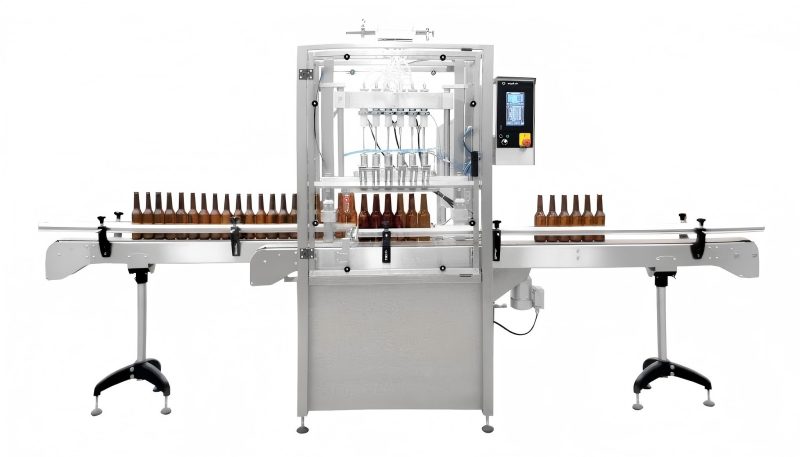
What Is a Traditional Filling Machine?
A traditional filling machine usually refers to a packaging line where each main process is handled by a separate machine.
Typical Line Structure
In a standard bottled liquid packaging line, the core steps are usually divided into independent units:
- Bottle rinsing or washing
- Liquid filling
- Bottle capping
Additional supporting equipment may also be included, such as:
- Bottle unscramblers
- Sterilizers
- Labeling machines
- Coding machines
- Packing machines
How It Works
Bottles move through the line step by step on the conveyor.
A typical process may look like this:
- Empty bottles enter the rinsing or washing machine
- Bottles are transferred to the filling machine
- Filled bottles move to a separate capping machine
- Labeled and packed products continue to downstream equipment
Each machine works independently, even though all units are connected into one production line.
| Pros | Cons |
| Lower upfront cost for many production setups | Requires more floor space |
| Flexible modular configuration | Involves more bottle transfers between machines |
| Individual machines are easier to replace or upgrade | Often needs more labor support |
| Works well for customized or low-speed lines | Higher contamination risk if line control is poor |
| Supports step-by-step factory expansion | Less efficient for high-speed production |
Considerations
Since the process is split across multiple machines, this type of line may also involve:
- Larger installation space
- More bottle transfer points
- Higher labor coordination needs
- Greater contamination risk if layout and hygiene control are poor
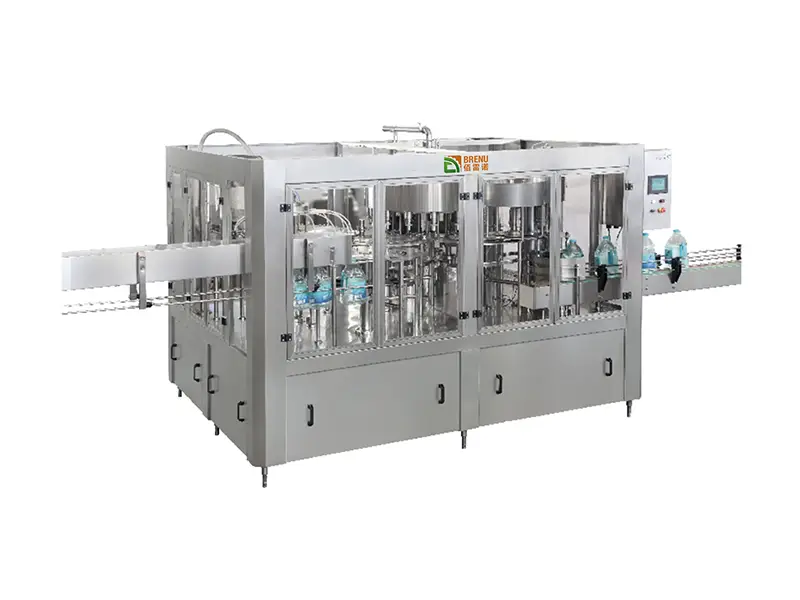
What Is a 3-in-1 Monoblock Filling Machine?
A 3-in-1 monoblock filling machine combines rinsing, filling, and capping into one integrated machine.
Integrated Machine Design
Instead of using three separate machines, this system brings all major bottle packaging functions into a single compact structure:
- Bottle rinsing
- Liquid filling
- Bottle capping
These processes are completed in one continuous rotary machine body.
How It Works
Bottles move through the machine in a connected sequence:
- Bottles enter the rinsing section
- Bottles move directly into the filling section
- Filled bottles transfer immediately to the capping section
- Bottles exit the machine for labeling and packing
Because bottles do not leave the main machine body between these steps, handling becomes smoother and more stable.
Common Applications
3-in-1 monoblock filling machines are widely used in:
- Bottled water production
- Juice filling lines
- Tea beverage production
- Carbonated drink filling
- Other liquid beverage packaging lines
| Pros | Cons |
| Compact design | Higher initial cost |
| Higher efficiency | Less flexible upgrades |
| Better hygiene | More maintenance reliance |
| Less labor needed | Skilled changeover needed |
| Good for automation |
Main Structural Difference
A traditional filling line is based on independent machines, each performing one main function. Bottles are transferred externally through conveyor systems, and synchronization between units is achieved through sensors, control systems, and operator adjustments.
A 3-in-1 monoblock filling machine is based on integrated mechanical and control coordination. Rinsing, filling, and capping are housed together in one unified frame, usually driven by a central transmission and PLC control system. Bottles are transferred internally through neck holding or star wheel systems, which reduces vibration and positioning errors.
This structural difference influences almost every other aspect of production, including speed, cleanliness, space use, labor arrangement, energy efficiency, and maintenance style.
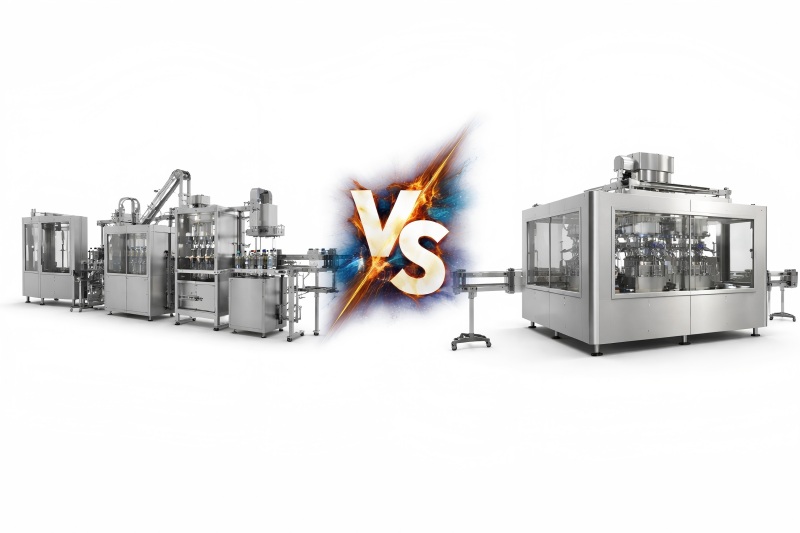
Traditional vs 3-in-1 Monoblock Comparison
| Item | Traditional Filling Machine | 3-in-1 Monoblock Filling Machine |
| Structure | Separate rinse, fill, cap units | Integrated rinse, fill, cap unit |
| Layout | Larger footprint | Compact footprint |
| Bottle Transfer | Conveyor transfer between units | Internal synchronized transfer |
| Hygiene Control | More exposed transfer points | More enclosed process |
| Automation | Medium to high | High |
| Installation | Flexible, more alignment needed | Compact, integrated setup |
| Maintenance | Separate unit maintenance | Centralized maintenance |
| Expansion | Easier section expansion | Less modular |
| Applications | Small to medium plants | Medium to high-speed lines |
| Labor | Higher | Lower |
Production Efficiency and Output Performance
Traditional filling lines can perform well, especially in small or medium-capacity factories. However, because bottles move between separate machines, line efficiency can be affected by conveyor accumulation, synchronization delays, unstable bottle transfer, and inconsistent machine speeds.
A 3-in-1 monoblock filling machine usually delivers smoother production because all core actions are synchronized inside one machine. Bottles travel through fewer transition points, reducing jams, falls, and timing mismatches. This makes monoblock systems especially suitable for continuous, high-volume production environments.
For factories targeting higher bottles per hour, monoblock machines often offer better overall line efficiency. Their rotary structure supports stable high-speed operation, while the integrated design reduces the time lost during bottle handover between separate machines.
That said, not every operation requires maximum speed. Small manufacturers with limited production demands may find a traditional filling line fully adequate and more budget-friendly.
Hygiene and Product Safety
Hygiene is critical in liquid filling industries, especially for drinking water, juice, dairy alternatives, tea beverages, and food-grade liquid products. In traditional filling lines, bottles often travel through more open sections and exposed transfer paths. This means there are more opportunities for airborne contamination, misalignment, or contact with external surfaces if sanitation control is weak.
By comparison, a 3-in-1 monoblock filling machine offers a cleaner process path. Since rinsing, filling, and capping are completed in a unified enclosed system, bottles are exposed to the outside environment for a shorter time. Many monoblock systems also support CIP-friendly design, stainless steel structure, sanitary pipelines, and automatic cap feeding systems, all of which help improve cleanliness.
For manufacturers with strict hygiene requirements, especially in modern beverage filling plants, the monoblock machine usually provides an operational advantage.
Space Utilization and Factory Layout
Traditional filling systems occupy more floor space because the rinsing machine, filling machine, and capping machine are separate units. Additional conveyors, bottle guides, transfer tables, and connection modules further increase the required layout area. In factories with large workshops, this may not be a major issue. But for plants with limited available space, traditional lines can be challenging to install efficiently.
A 3-in-1 monoblock filling machine is far more compact. Its integrated body reduces the length of the production line and simplifies equipment arrangement. This helps manufacturers make better use of factory space and may lower workshop construction or expansion costs.
Compact layout is one of the strongest selling points of monoblock equipment, especially for manufacturers planning highly automated bottling rooms.
Labor Requirements and Operational Convenience
Traditional filling lines typically require more manual supervision because there are more independent machines to monitor. Operators may need to adjust conveyor timing, manage bottle accumulation, inspect transfer points, and coordinate start-stop sequences across multiple units.
A 3-in-1 monoblock filling machine usually requires fewer operators because its control system is centralized. Touchscreen interfaces, automatic alarms, synchronized speed control, and integrated bottle handling help reduce manual intervention. Fewer transfer sections also mean fewer areas where operators need to intervene.
This difference becomes increasingly important as labor costs rise. Companies aiming to reduce dependence on manual operation often favor integrated monoblock solutions.
Operational Difference in Daily Production
| Factor | Traditional Filling Machine | 3 in 1 Monoblock Filling Machine |
| Operator Monitoring Points | More | Fewer |
| Bottle Jam Risk | Higher at transfer sections | Lower due to integrated transfer |
| Cleaning Coordination | Separate cleaning for different units | More centralized cleaning |
| Changeover Time | May be longer across separate machines | Often shorter with integrated adjustment |
| Training Difficulty | Moderate | Moderate to high initially, then easier in operation |
| Production Continuity | Good, but affected by transfer stability | Excellent for continuous production |
Flexibility and Customization
Traditional filling systems have one major advantage: modular flexibility. Since rinsing, filling, and capping units are separate, manufacturers can choose equipment from different suppliers, modify one part without replacing the others, or upgrade only the section that limits capacity.
For example, a company might replace an old capping machine while keeping its existing filler. Or it may add an advanced bottle washer to an already functioning line. This makes traditional systems attractive for factories that expand gradually or need highly customized layouts.
A 3-in-1 monoblock filling machine is less modular because the core processes are integrated. Although many monoblock systems can be designed for different bottle sizes or product types, changing one major function often requires adjustments across the whole machine. This means flexibility is somewhat lower from a structural standpoint.
So, if a manufacturer values staged investment and step-by-step upgrades, a traditional line may be more suitable. If the goal is streamlined efficiency and stable automated production, the monoblock machine is often the better choice.
Maintenance and Troubleshooting
Maintenance style differs significantly between the two systems.
In a traditional filling line, each machine can be maintained independently. If the rinsing machine needs servicing, technicians can focus only on that unit. Spare parts may also be simpler to organize by machine type. However, because there are more conveyors, more motors, and more inter-machine connections, the total number of maintenance points may be higher.
In a monoblock machine, maintenance is centralized, which can be efficient. But because the core functions are interconnected, one fault may affect multiple sections. For instance, if the central drive or synchronized transfer mechanism has a problem, the entire rinsing-filling-capping process may stop. This means preventive maintenance and proper technical support are especially important.
In short, traditional lines offer easier sectional maintenance, while monoblock systems offer more compact but more integrated maintenance demands.
Investment Cost and Long-Term Value
Initial budget is another key factor. In many cases, a traditional filling machine arrangement may appear less expensive at the beginning, especially for low-speed applications or when existing equipment can be reused. Small factories often prefer this route because it allows phased investment.
Over time, traditional lines may generate higher labor costs, require more space, consume more utilities through multiple machines, and experience greater efficiency loss at transfer points.
A 3-in-1 monoblock filling machine may require higher upfront investment, particularly when built with advanced automation, sanitary construction, and high-speed rotary mechanisms. But it can bring long-term savings through reduced labor, improved efficiency, lower contamination risk, and better space utilization.
The best choice depends on whether the manufacturer is focused more on short-term capital savings or long-term operational return.
Cost Comparison
| Cost Factor | Traditional Filling Machine | 3-in-1 Monoblock Filling Machine |
| Initial Equipment Cost | Often lower for simple lines | Often higher |
| Labor Cost | Higher over time | Lower over time |
| Downtime from Transfer Issues | More likely | Less likely |
| Upgrade Cost | Easier to phase | More integrated, may cost more |
| Long-Term Efficiency Value | Moderate | High |
Suitability by Industry and Product Type
Not every liquid product requires the same filling solution. The choice between traditional and monoblock machines also depends on product type, packaging format, hygiene requirement, and production volume.
Traditional filling machines are often suitable for:
- Small and medium-capacity production
- Products with highly customized packaging processes
- Factories with existing separate equipment
- Businesses wanting modular upgrades
- Industries with lower speed requirements
3-in-1 monoblock filling machines are often suitable for:
- Bottled water production
- Juice, tea, and functional beverage filling
- Carbonated soft drink lines with specialized integrated systems
- Medium to high-speed beverage plants
- Operations with strict hygiene and automation requirements
For beverage manufacturers in particular, monoblock technology has become a preferred solution because it aligns well with modern production goals such as speed, cleanliness, reliability, and smart control integration.
Bottle Changeover Compatibility
A well-designed 3-in-1 monoblock filling machine can simplify this process by offering coordinated adjustment points and integrated bottle handling systems. However, because the machine is highly synchronized, bottle format changes still require precision and proper setup. If the machine is designed mainly for one bottle family, flexibility may be narrower than a modular traditional line.
Therefore, factories producing many bottle formats in small batches should carefully evaluate changeover efficiency before deciding.
Automation and Smart Manufacturing Potential
Modern factories increasingly value automation, data monitoring, and traceability. Traditional filling lines can be automated, but because they are made of separate machines, achieving full data integration may require more engineering effort.
A 3-in-1 monoblock filling machine often integrates more easily with PLC control, inverter drive systems, human-machine interfaces, fault alarms, cap management systems, and downstream smart packaging equipment. This makes monoblock machines highly suitable for automated production lines where consistency and traceability are priorities.
In smart manufacturing environments, integrated systems generally provide an advantage because they simplify control logic and reduce coordination complexity between separate machines.
Which Machine Is Better for Different Production Needs?
| Production Need | Better Choice | Reason |
| Small startup with limited budget | Traditional Filling Machine | Lower initial cost and phased expansion |
| High-speed bottled water line | 3 in 1 Monoblock | Better efficiency and compact layout |
| Existing plant upgrading one section only | Traditional Filling Machine | Easier modular replacement |
| Strict hygienic beverage filling | 3 in 1 Monoblock | More enclosed production path |
| Limited workshop space | 3 in 1 Monoblock | Space-saving integrated structure |
| Multi-step custom line configuration | Traditional Filling Machine | More flexible equipment arrangement |
| Labor-saving automation goal | 3 in 1 Monoblock | Fewer operators needed |
How to Choose the Right System
When comparing a traditional filling machine with a 3-in-1 monoblock filling machine, the right answer depends on your actual production needs rather than on theory alone. A manufacturer should evaluate several key questions:
- What is the target production capacity per hour?
- How much factory space is available?
- Is hygiene a top concern for the product category?
- Does the plant need modular upgrades in the future?
- How many bottle sizes will be handled?
- Is reducing labor costs a major priority?
- What is the available investment budget?
If the goal is to build a modern, compact, highly automated beverage line, the 3-in-1 monoblock filling machine is often the stronger choice. If the goal is flexible configuration, staged investment, or integration with existing separate machines, a traditional filling line may be more practical.