
Choose based on each line’s unique advantages and limitations.
- Budget
- Water source availability
- Target market
- Long-term business strategy
Mineral water lines focus on natural value and premium branding, while pure water lines emphasize efficiency, scalability, and affordability.
Understanding Mineral Water and Pure Water
Before comparing bottling lines, it is important to clarify the fundamental differences between mineral water and pure water.
Mineral Water
Mineral water comes from underground sources or springs and naturally contains minerals like calcium, magnesium, potassium, and bicarbonates. These minerals must remain stable and cannot be artificially altered.
Key characteristics:
- Naturally sourced
- Contains essential minerals
- Minimal processing allowed
- Often marketed as premium or health-focused
Pure Water (Purified Water)
Pure water is typically derived from municipal or groundwater sources and undergoes extensive treatment to remove impurities, dissolved solids, and contaminants.
Key characteristics:
- Treated and purified
- Low mineral content (often near zero)
- Consistent quality
- Widely used for mass consumption
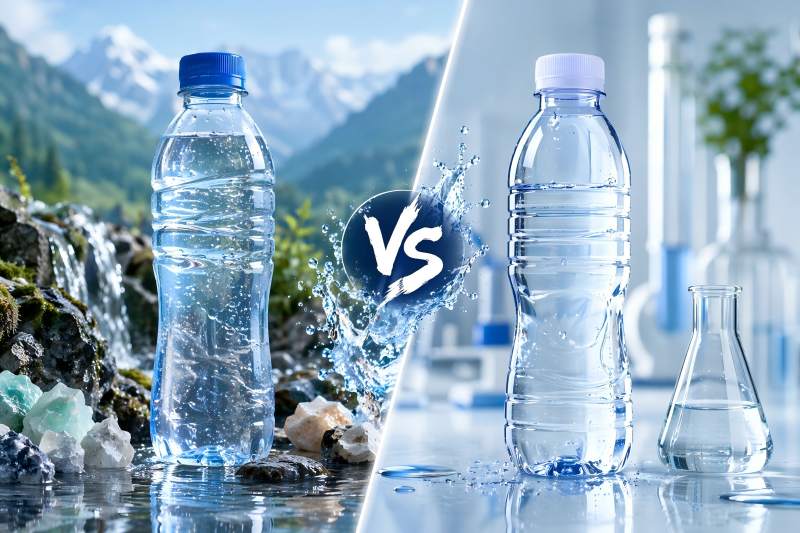
Mineral vs Pure Water: Key Differences Overview
The differences between mineral and pure water significantly impact production line design and operational requirements.
| Aspect | Mineral Water | Pure Water |
| Source | Natural spring or underground reservoir | Municipal or groundwater |
| Mineral Content | Naturally occurring minerals retained | Minerals removed during purification |
| Treatment Level | Minimal (filtration, sterilization) | Extensive (RO, UV, ozone) |
| Taste Profile | Natural, mineral-rich | Neutral and clean |
| Regulatory Control | Strict source protection | Strict purification standards |
| Market Position | Premium | Mass-market |
| Production Complexity | Moderate (source protection critical) | High (advanced treatment required) |
Water Source and Protection Requirements
The water source is the foundation of any bottled water business, and its quality, stability, and legal compliance directly determine the feasibility and long-term success of your project. For both mineral water and pure water bottling lines, water sourcing involves not only technical considerations but also regulatory, environmental, and sustainability factors.
However, the requirements for mineral water and pure water differ significantly, particularly in terms of source protection, treatment flexibility, and legal restrictions.
Importance of Water Source Selection
Selecting the right water source impacts:
- Product quality and taste
- Treatment complexity and cost
- Regulatory approval process
- Brand positioning (premium vs mass-market)
- Long-term sustainability of operations
A poor-quality or unstable water source can lead to:
- Increased treatment costs
- Inconsistent product quality
- Regulatory challenges
- Operational disruptions
Mineral Water Source Requirements
For mineral water, the source is not just important—it is the core of the product itself.
Natural Origin Requirement
Mineral water must originate from:
- Underground aquifers
- Natural springs
It must be:
- Protected from pollution
- Naturally filtered through geological layers
This natural filtration process gives mineral water its unique composition.
Stable Mineral Composition
A defining characteristic of mineral water is its consistent mineral profile.
Key Requirements:
- Mineral content must remain stable over time
- No artificial addition or removal of minerals (in most jurisdictions)
- Regular testing to verify consistency
Common Minerals Found:
- Calcium (bone health)
- Magnesium (muscle function)
- Potassium (electrolyte balance)
- Bicarbonates (pH buffering)
This consistency is often required by law and must be documented.
Regulatory Approval for Mineral Sources
Before production begins, the source must be officially recognized.
Approval Process May Include:
- Geological and hydrogeological studies
- Long-term water quality analysis
- Government certification of the source
Pure Water Source Requirements
Unlike mineral water, pure water production offers greater flexibility in sourcing, since the water will undergo extensive treatment.
Common Source Types
Pure water can be sourced from:
- Municipal (tap) water
- Borewell or groundwater
- Surface water (in some cases, with advanced treatment)
Initial Water Quality Considerations
Although purification systems can remove most contaminants, the initial quality still matters.
Important Parameters:
- TDS (Total Dissolved Solids)
- Turbidity
- Presence of heavy metals
- Microbial contamination
Poor-quality source water leads to:
- Higher treatment costs
- Faster equipment wear (especially RO membranes)
- Increased maintenance frequency
Pre-Treatment Requirements
Before entering the main purification system, source water must undergo pre-treatment.
Typical Steps:
- Sediment filtration
- Activated carbon filtration
- Water softening (if hardness is high)
This protects downstream equipment and ensures stable operation.
Flexibility in Location
Pure water plants are less dependent on natural sources and can be located:
- Near urban centers
- Close to distribution markets
- In industrial zones
This provides advantages in:
- Logistics efficiency
- Lower transportation costs
- Faster market access
Treatment Process Comparison
While both types of water must meet strict safety standards, their treatment philosophies are fundamentally different:
- Mineral water: Preserve natural composition while ensuring safety
- Pure water: Remove all impurities to achieve maximum purity
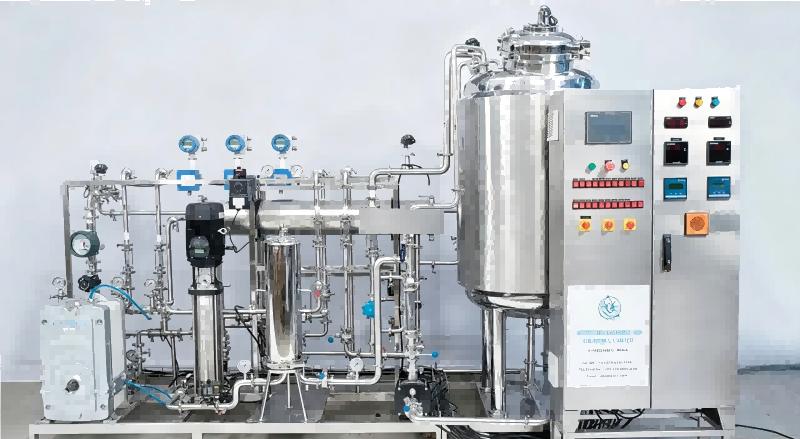
Mineral Water Treatment Process
Mineral water undergoes limited processing to maintain its natural characteristics.
Step 1: Raw Water Intake
- Water is extracted directly from a protected natural source
- Minimal exposure to external contamination
Step 2: Sand Filtration
- Removes suspended solids such as sand, silt, and rust
- Ensures clarity without affecting dissolved minerals
Step 3: Activated Carbon Filtration
- Removes:
- Organic compounds
- Odor and color
- Improves taste while preserving mineral content
Step 4: Microfiltration (Fine Filtration)
- Uses membrane filters (typically 0.2–1 micron)
- Removes:
- Bacteria
- Fine particles
Step 5: Sterilization (UV or Ozone)
- UV Sterilization:Kills microorganisms instantly
- Ozone Treatment:Provides residual disinfection and extends shelf life
Important Restrictions:
- ❌ Reverse Osmosis (RO) is generally not allowed
- ❌ Distillation is prohibited
- ❌ Mineral content must not be altered
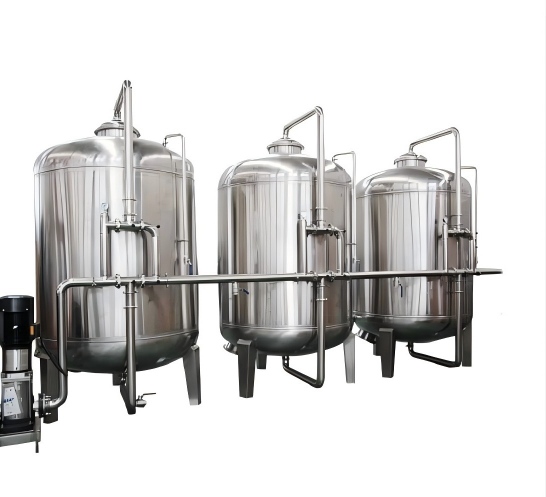
Pure Water Treatment Process
Pure water production involves multi-stage purification to remove all contaminants.
Step 1: Pre-Treatment
Includes several protective steps:
- Sand Filter: Removes large particles
- Activated Carbon Filter: Removes chlorine and organics
- Water Softener: Reduces hardness (calcium, magnesium)
Purpose:
- Protect downstream equipment (especially RO membranes)
Step 2: Reverse Osmosis (RO)
This is the core technology in pure water production.
RO removes:
- Dissolved salts
- Heavy metals
- Bacteria and viruses
- Chemical contaminants
Result:
- Very low TDS water (often <10 ppm)
Step 3: Post-Treatment
After RO, additional treatments may include:
- UV Sterilization:Eliminates remaining microorganisms
- Ozone Injection:Ensures residual disinfection
- Polishing Filters:Final refinement
Step 4: Optional Remineralization
Since RO removes almost all minerals, some producers add back controlled minerals to improve taste.
Process Flow Comparison
| Stage | Mineral Water Line | Pure Water Line |
| Raw Water Intake | Natural protected source | Flexible source (municipal/groundwater) |
| Pre-Treatment | Basic filtration | Multi-stage pre-treatment |
| Core Treatment | Microfiltration | Reverse Osmosis (RO) |
| Sterilization | UV or ozone | UV + ozone |
| Mineral Adjustment | Not allowed | Optional remineralization |
| Final Output | Mineral-rich water | Highly purified water |
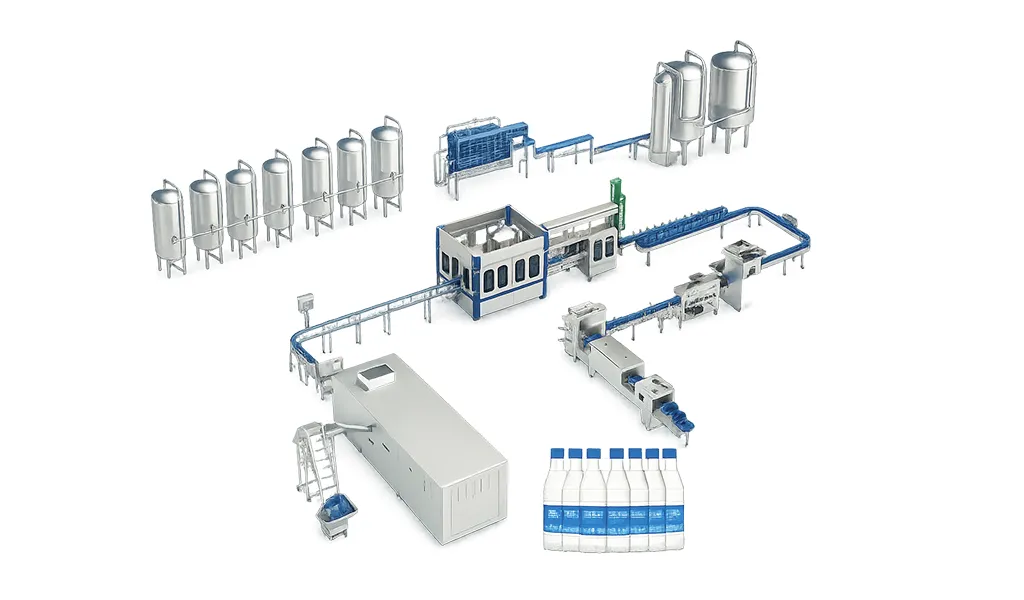
Mineral Water Bottling Line
Source Protection and Handling
The most critical factor in mineral water production is the protection of the natural source.
Key Requirements:
- Protected spring or aquifer
- Controlled extraction methods
- Continuous monitoring of mineral composition
Unlike purified water, the source itself is part of the product’s value.
Treatment Process
Mineral water undergoes minimal processing to maintain its natural characteristics.
Typical Treatment Steps:
- Sand filtration (remove particles)
- Activated carbon filtration (optional)
- Microfiltration
- UV sterilization or ozone treatment
Important Note:
- Reverse Osmosis (RO) is generally not used, as it removes minerals
Filling and Packaging
Mineral water is typically marketed as a premium, so:
- Glass bottles or high-quality PET are commonly used
- High hygiene standards are required
- Filling is often done in controlled environments
Equipment Configuration
- Spring water intake system
- Basic filtration system
- UV/ozone sterilization
- High-precision filling machine
- Premium packaging line
Pure Water Bottling Line
Flexible Water Sources
Pure water plants can use:
- Tap water
- Borewell water
- Surface water
This flexibility makes pure water production more accessible.
Advanced Treatment Process
Pure water requires multi-stage purification.
Typical Process Flow:
Raw Water → Sand Filter → Carbon Filter → Water Softener → RO System → UV → Ozone → Storage
Key Technologies:
- Reverse Osmosis (RO)
- Ultrafiltration (UF)
- UV sterilization
- Ozone disinfection
Filling and Packaging
Pure water is typically produced at large scale.
- PET bottles dominate
- Automated high-speed lines are common
- Focus on cost efficiency
Equipment Configuration
- Complete water treatment system (RO-based)
- Bottle blowing machine
- High-speed monoblock filling machine
- Labeling and packaging system
Which Bottling Line Should You Choose?
Choose Mineral Water Line If:
- You have access to a natural spring
- You want to target premium markets
- You can invest in branding and compliance
Choose Pure Water Line If:
- You want a scalable, flexible business
- You aim for high-volume production
- You prefer lower entry barriers